Author Archives: John Paine

About John Paine

Unknown's avatar
This blog is topical and devotional--we post whatever interests us, whenever. If you want to follow in an orderly fashion, please see our Kaqexeß page.

Dr. Jim Shaw, Saturday 2/15

Lackey Clinic
 

Williamsburg Community Chapel Men’s Breakfast
Saturday, February 15th, 2014
7:30 am
3899 John Tyler Highway
Williamsburg, Virginia 23185
Cost: $8, (bring a friend)

Dr. Jim Shaw has won numerous humanitarian awards for his work in founding and leading the Lackey Free Clinic. He has had a wonderful career as a pulmonary specialist, and has made a real difference in our community and in the lives many people who had nowhere else to turn for medical help.  The Lackey Free Clinic successfully provides skilled, compassionate health care and counselling to the medically disadvantaged in a manner that honors the name of Jesus Christ.

But Jim has not had an easy ride. This will not be a boring success story. I won’t give away the details, but will offer that Jim’s presentation will be a true encouragement to all who attend. Hope you can make it Saturday morning (bring a friend).


Who Wrote the Bible? (Part 1)

Who Wrote The Bible

Who wrote the Bible?

God…right?  While that may be a profound and direct answer, it’s also overly simplistic. The Bible is God’s special revelation to mankind, delivered through the divine inspiration of human authors. So who were the human authors?

There’s a lot riding on the answer. Not so much in terms of their actual identities, but because many attacks against Christianity are targeted at disproving the reliability of human authorship. What kind of defense can those of us who believe that the Bible is the inspired, inerrant, and infallible word of God offer regarding the trustworthiness of the authors of the Bible?

It’s not essential that we know the names of the human authors (otherwise they would have laid out their identities in the text with certainty), but it is essential that we know that the Scripture is trustworthy. So with this post we begin a series to help readers appreciate the Bible as an accurate, historical, and trustworthy document. In a companion series we will explore how we got the “Holy Bible,” but for now we’ll begin with the authors.

Let’s lay out one precept: we’re about discovering the truth, not defending traditional notions. For example, it is widely believed that Moses wrote the first five books of the Bible. But that cannot be completely true. Why not? Because the fifth book (Deuteronomy) contains the accounts of his death and post-mortem reflections on his life—so at the very least someone else put the ending on his five books. Likewise, some people who haven’t really read the Bible have notions that God’s inspiration constituted divine dictation. But it is obvious in many passages that the Bible is not dictation from the Creator of the universe. How do we know that? Because the human authors state so—point blank in many verses (see this post for one clear example).

Back to the authors. Ezra was a priest, who mourned over his people’s disobedience to God after they were delivered from the Babylonian captivity. He was also a painstaking historian whose detailed historical records are downright anal-retentive (who counts plates, really?!). Jeremiah was called the weeping prophet—and why not?  You’d weep too if you went through what he endured (by the way, there have been some stunning archaeological finds involving Jeremiah in recent months). Gad was the bag man for David’s bad news. Obadiah is said to have been a descendant of Eliphaz, the friend of Job. And on and on…you get the point.  There are a lot of fascinating biographical details to appreciate about these authors.  Our aim in writing this post is to make them readily accessible.

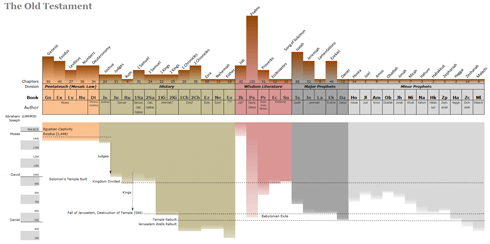
We created the following Bible infographic depicting the grouping of the Old Testament books, the authors, the approximate dates of writing, and how many chapters each book contains. It’s a snapshot of the construction of the Old Testament.

The Old Testament


So…sticking with just the Old Testament for now, here is a new color-coded table keyed to our original infographic with hyperlinks to articles about the inspired authors of the Bible.  As you’ll read in the linked material (click on the author’s name in the right-hand column), some books have considerable contention about authorship.  But the point here is not to resolve that contention—we simply want to expose you to the biographies of the plausible authors.

The Old Testament

Pentateuch (Mosaic Law)

Genesis

Moses

Exodus

Leviticus

Numbers

Deuteronomy

Moses

Joshua

History

Joshua

Joshua

Judges

Samuel

Ruth

1 Samuel

Samuel, Gad, Nathan

2 Samuel

Gad, Nathan

1 Kings

Jeremiah?

2 Kings

1 Chronicles

Ezra?

2 Chronicles

Ezra

Ezra

Nehemiah

Ezra?

Esther

???

Wisdom Literature

Job

Job?

Psalms

David,

Others

Proverbs

Solomon,

Others

Ecclesiastes

Solomon

Song of Solomon

Major Prophets

Isaiah

Isaiah

Jeremiah

Jeremiah

Lamentations

Ezekiel

Ezekiel

Daniel

Daniel

Minor Prophets

Hosea

Hosea

Joel

Joel

Amos

Amos

Obadiah

Obadiah

Jonah

Jonah

Micah

Micah

Nahum

Nahum

Habakkuk

Habakkuk

Zephaniah

Zephaniah

Haggai

Haggai

Zechariah

Zechariah

Malachi

Malachi

In an upcoming post we will give similar treatment to the New Testament  authors, and then review apologetic arguments that defend the trustworthiness of the human authors of the Bible.  Enjoy!

Resources

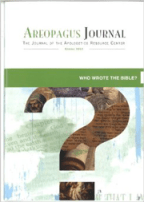
Areopagus-Journal-Spring-20The spring 2012 issue of the Areopagus Journal is an excellent resource for further study, and we will make use of several articles in our upcoming posts.

HT: Yvonne Brendley, Faith Smagalski


End of the Beginning

“You intended to harm me, but God intended it for good to accomplish what is now being done, the saving of many lives.”
Genesis 50:20
Tale Of Two Cities


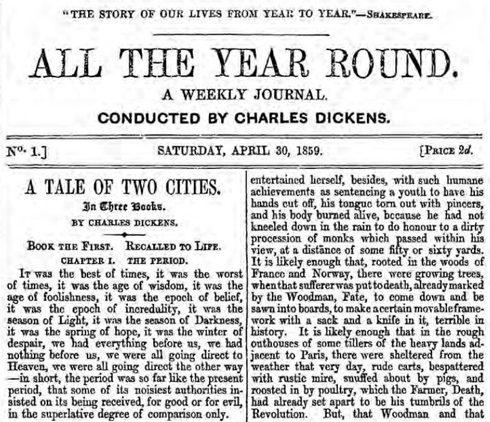
“It was the best of times, it was the worst of times, it was the age of wisdom, it was the age of foolishness….” Charles Dickens’ famous opening line, from the top-selling fictional work of all time, is about dualism.


Have you ever thought about how Joseph (the son of Jacob, the son of Isaac, the son of Abraham) could have just given up and succumbed to his circumstances? Times when he must have felt he was at the end of his rope? Times when everything and everyone seemed to be working against him? Times when his story could have been told and that would have been the end of it?

The beginning of the Bible—the book of Genesis—ends with the biography of Joseph. More than one-third of Genesis is devoted to telling his story (so it’s important), and it’s full of the kind of details a family would prefer to forget. If you don’t remember the story of Joseph, give it a read here, or get this app and listen on your mobile device.

Joseph was sold into slavery by his brothers (who debated whether to kill or sell him). He became the servant over an Egyptian household. He was framed and sent to prison. He became the inmate-overseer of the Egyptian prison. He was left behind in a dungeon and forgotten for two years after correctly interpreting the dreams of Egyptian officials. But eventually Joseph was brought before Pharaoh and put in charge of Egypt—where he was able to save many lives. His descendants (Joshua, Gideon, and Samuel among others) became leaders of the Hebrew people, writing significant portions of the Old Testament.

There’s a tremendous amount of dualism in Joseph’s life. That dualism gives us a clear picture of the providence (and sovereignty) of God. God can and does use bad situations and circumstances to accomplish good.

In case you haven’t noticed, lately on Veracity we’ve been paddling a bit around Calvinism and what goes with it. I’ve had more than a dozen offline (and very interesting) discussions with friends and readers, and received several emails on the topic. But this isn’t a post about Calvinism.

Our home church has been through a tumultuous year.

If it were solely up to me everything would work out well for everybody, all of the time. No controversy, just happy faces in the pews, all singing in perfect harmony. But that’s not how life works. As Jim Davis notes, “Sometimes it’s going to hurt.” God has a plan for our lives, and that plan includes having to deal with trouble—to accomplish God’s purposes (there’s that Calvinism thing again). Ultimately we can trust God or not.

So…as wearisome as discussions about our tumult have become, we clearly have quite a lot to be thankful for. God cares for and about us. God has blessed us richly.

Our church has a mission statement that says, in part, we are “called to make disciples of Jesus Christ by meeting people where they are on their spiritual journey.” We are all on a spiritual journey. Truth be told, we often can’t tell the beginning of the end from the end of the beginning. The biblical pattern is not to dwell in the difficulties, but to overcome them just as Joseph did by trusting that God is in control.

Joseph’s Tomb

Here’s an aside for those who are interested in seeing how the Bible fits on the ground.  We’ve written previously about the Cave of the Patriarchs, the second-most venerated site in Judaism, which has indisputable historical ties to the text of the Bible and to Joseph’s family (drill deep into the hyperlinks contained in that post and you’ll see how Old Testament Scripture about the Hebrew patriarchs and matriarchs fits in Hebron).

Joseph's Tomb in Shechem

Joseph’s Tomb in Shechem (photo credit: Ferrell Jenkins)

The Bible tells us that Joseph was not buried with Abraham, Isaac, and Jacob, but that his bones were buried at Shechem in the tract of land that Jacob bought for a hundred pieces of silver from the sons of Hamor, the father of Shechem.

Shechem has a violent history, and violence continues to plague the site of Joseph’s tomb.  Here’s a 2009 video that documents recent events at the site from a Jewish perspective, and another from 2013 inside the tomb featuring Joel Kramer, a well-known tour guide and videographer (who’s not a Mormon).


Shibboleths

Doctrine that’s right in our wheelhouse! Want to see what systematized theology looks like in person? Here’s an example of the power of the “Fifth Gospel.” HT: Bobby Conway

Dick Woodward's avatar4SpiritualSecrets

“… ‘Then say, ‘Shibboleth’!’ And he would say, ‘Sibboleth,’ for he could not pronounce it right. Then they would take him and kill him at the fords of the Jordan. There fell at that time forty-two thousand Ephraimites.”  (Judges 12:6)

Although we Americans have a common language we all have accents that show our origins to a discerning ear.  The above incident demonstrates how thousands of years ago different regional accents caused the death of 42,000 people.

There had been a civil war among people of the same ethnicity.  As the victors captured survivors, the only way to tell if they were the enemy was to force them to say “Shiboleth.”  When prisoners could not pronounce the “sh” sound because of their regional accents, 42,000 of them were executed.

What does all this have to do with us today?  Metaphorically speaking, when we meet people we often have a…

View original post 155 more words


J.I. Packer: That’s Not Good Enough

Right between the eyes.  From a Calvinist.

HT: Justin Taylor, Crossway