Author Archives: Clarke Morledge

About Clarke Morledge

Unknown's avatar
Clarke Morledge -- Computer Network Engineer, College of William and Mary... I hiked the Mount of the Holy Cross, one of the famous Colorado Fourteeners, with some friends in July, 2012. My buddy, Mike Scott, snapped this photo of me on the summit.

Lame Complementarian and Egalitarian Biblical Arguments

6th post in a series.

This is going to be fun  🙂

If it was up for me to decide, I would favor “women in leadership” in the local church. Sounds good to me. I mean, why not?

Well…. I have a problem….

This is the kind of blog post that will send young children at school screaming home to their parents, cause federal governments to shutdown their services in an attempt to reach a settlement, or mystify people with shouts of, “What is with this guy?”

The problem is that as a Christian, I am obligated to follow Scripture, wherever it leads… and that is a good problem to have.

Scripture is the standard for the Christian. Not personal opinion. If Scripture supports “women in leadership” (whatever that means, and that is part of the problem), then I must submit to that. On the other hand, if Scripture does not support “women in leadership,” then I must submit to that.

In looking at the Bible, both sides have their arguments. I have heard some very thoughtful arguments supporting both positions, from the complementarian side, that typically argues that women should not serve as elders in a church, and from the egalitarian side, that typically argues that women should be eligible to serve as elders in a church.

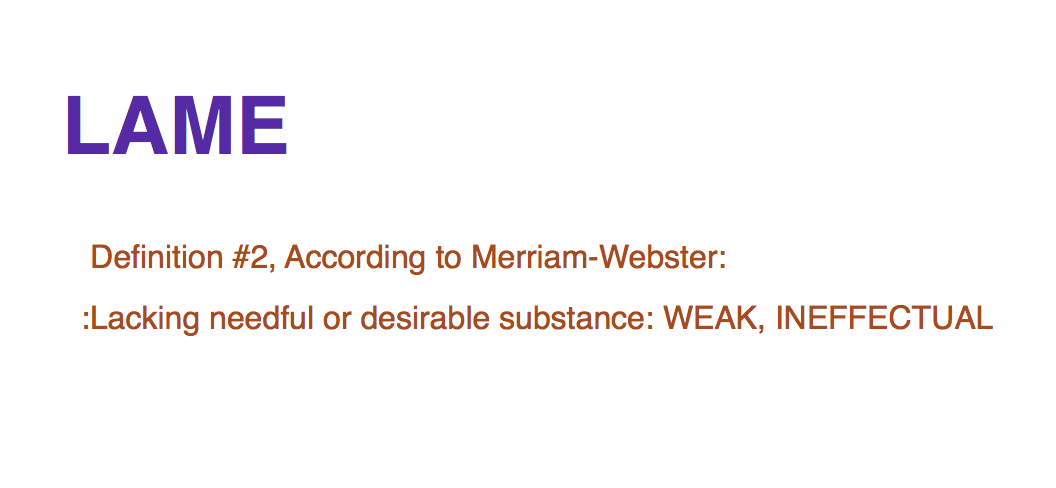
At the same time, I have heard some rather lame arguments, from BOTH SIDES of the debate. So, in this blog post I want to highlight some of the most lame arguments I typically hear, from BOTH SIDES. Some arguments are more lame than others. The worst ones I will call “TOTALLY LAME.” Some arguments actually have some substance behind them, and so I could be wrong on this or that detail of the arguments. Nevertheless, I am not persuaded by them. I will call the arguments I am less sure of as “SEMI-LAME.”

I am going to get into trouble with both sides, as some will take me to task on what I call “LAME.”  But that is okay. I mainly want to get the lame stuff out of the way, before addressing more substantial arguments, in future posts. I am willing to defend, but I am also willing to learn, as I surely do not get everything right. So, if you think I need a mental “adjustment,” just leave your comments below, so that a conversation can be started. I am ready to listen.

Are you ready??

Are you sure??

Are you sitting down?

Good. Let’s do it.

Here we go….

TOTALLY LAME Complementarian Arguments.

(1) When we look at 1 Timothy 2:12-14, we read Paul saying that women should not teach or have authority over a man, because of the situation with Adam and Eve in the Garden. In verse 14, we read “Adam was not deceived, but the woman was deceived and became a transgressor” (ESV). This means that the fall of humanity was not Adam’s fault. Since Eve was deceived, that means that women are weaker emotionally,  and therefore, women are more easily deceived than men.

My response: This explanation is TOTALLY, TOTALLY, TOTALLY LAME. Yes, Eve was deceived in the garden. But what does that mean?

Where do we get the idea, that women in general, are somehow more susceptible to being deceived, than men? There could be a possibility of reading the text this way, but you have to front load such an interpretation with an assumption that is extremely difficult to prove.

Read the passage again. Paul is making an observation: “the woman was deceived.”  As far as we have it, Paul is simply describing the story of the Fall in summary, so the implications that the reader can draw from this about Eve’s character are not necessarily self-evident.

To insist that women, across the board, are somehow emotionally or morally weaker than men is rather lame, as it threatens to denigrate women as being made in the image of God. Nevertheless, this belief persists, since the more and more you hear it, over and over again, the more you are prone to believe it.

Here is some counter evidence, if you not believe me: When Paul was saying:  “But I am afraid that as the serpent deceived Eve by his cunning, your thoughts will be led astray from a sincere and pure devotion to Christ,” (2 Corinthians 11:3 ESV), he was not targeting women alone. “Your thoughts.” Who was the “your?” Paul was including women AND men together, as being vulnerable to being led astray.

Men and women are different, so it might be fair to say that both men and women could be deceived in different ways. Fair enough. But we should be careful not to read in too quickly certain moral or emotional qualities, or dysfunctionalities, to one another, with respect to Eve’s deception, if the text does not adequately support it.

Technically, Eve’s deception was not her sin, though she used that as an excuse, by blaming the serpent (Genesis 3:13). Rather, her sin was in not doing a “fact check” on the serpent’s claims, when she could have consulted Adam and/or God for verification.

Why do I say this? Because this lame argument completely neglects the fact that Adam “was with her” (Genesis 3:6 ESV), namely Eve, in the garden, but he did nothing to intervene when the serpent came along. He just remained silent and let it all happen, as far as we know. Sure, we are told that Adam was not deceived. But that did not make him completely blameless, either.

Here we go, the demonic forces were attacking Eve, and she tried to handle the situation herself, without consulting Adam. But what was Adam doing, while forces of evil were raging?  Reading the newspaper? Fully absorbed in watching a basketball game on TV?

Afterwards, Adam sought to play the “blame game” by putting the responsibility on Eve (Genesis 3:11-12). But notice that God confronted Adam first, and not Eve, upon investigating the “FruitGate” incident (Genesis 3:8-13). In fact, in Romans 5:12-21, Paul puts the blame of sin on Adam, and does not even mention Eve at all!!

In other words, Eve sinned in her ignorance. Adam, on the other hand, sinned with full knowledge of what was going on.

Therefore, it is more reasonable to think that both Adam and Eve sinned. They just sinned in different ways. Why? Because men and women, though equal with one another, and made of the same “stuff,” are in fact, very different. What a profound mystery!


(2) Another interpretation of the same 1 Timothy 2:12-14 passage, suggests that because “the woman was deceived,” women lack the intellectual or spiritual capabilities to discern truth from error. This is the reason why women are not permitted to teach men.

Again, this is TOTALLY LAME. For if women lack the intellectual or spiritual capabilities to be able to teach, why does Paul encourage the older women to “train the young women” to grow in maturity in their faith (Titus 2:3-5 ESV)? If women are not doctrinally trustworthy, then they have no business training or teaching young women either! This interpretation is therefore completely absurd, because it forces the Bible to contradict itself.

Plus, I know of some women who are so clued into the Scriptures, that they can run circles around most of the other people, men and women, they encounter in their churches, who do not know how to find the various books of the Bible!

The point here, given this limited context, seems to be that women are not to teach men, NOT that they are not to teach in general. We will come back to this idea in a later blog post.


TOTALLY LAME Egalitarian Arguments.

(3) Egalitarians do not get off the hook for offering lame arguments. Some have suggested that, for example, if a church has 12 elders, 6 of them should be men, and 6 of them should be women. It is only fair. In other words, gender distribution in church leadership requires a quota system.

Lame. Lame. Lame.

As in, “EL LAME-O!”

Really? Where is that in the Bible? A quota system may work great in corporate America, but it is pretty lame to think that the Bible is trying to teach some type of quota system. We as humans do not get to decide what is “fair.” Plus, history shows that humans do not do a very good job when it comes to infallibly figuring out what is “fair.” True fairness is determined by God and God alone.

What shall we say then? Is there injustice on God’s part? By no means!” (Romans 9:14 ESV). To assume we humans are able to competently judge “fairly,” the Bible counters with a different perspective, “Trust in the Lord with all your heart, and do not lean on your own understanding” (Proverbs 3:5 ESV).


(4) The church is lagging behind secular society in giving equal opportunities for women leadership advancement. The church needs to get with the times.

I hear this reasoning a lot. But like the previous lame argument, this reasoning suffers from the same fault. There is no Scriptural precedent to support the argument. In fact, Scripture argues against this type of argument.

There are a lot of things the church does that are out of the step with the world around the church, but perhaps, that is the point. An illustration is valuable here: When I visit the Atlantic ocean beach near my Virginia home, the northerly moving current is so strong, that it can carry you away from where you started on the beach, without you realizing it. When I jump out into the waves, to try to surf them, I can be out there for 20 minutes before realizing that I have drifted hundreds of feet upstream away from where I first started.

The surrounding culture is like that underlying ocean current that keeps pulling at us, when we are largely unaware of it. Instead, we need to keep our sight fixed on Christ. Granted, the pull of patriarchy patterns of culture have pulled the church in the exact opposite direction, throughout the history of the church. Jesus’ message to women was quite liberating in first century Palestine, but you would be hard pressed to see this message in certain patriarchal, Christian subcultures, where the men routinely deny women the opportunities to obtain a level of higher education, or even in some cases, the opportunity to learn how to drive a car!!

In contrast, Romans 12:2 gives us the Scriptural perspective refuting this lame argument: “Do not be conformed to this world, but be transformed by the renewal of your mind, that by testing you may discern what is the will of God, what is good and acceptable and perfect.”

Following the drum beat of culture is not a good reason for doing anything. That is just lame.
 

SEMI-LAME Complementarian Arguments:

(5) Junia was not a woman, or if she was, she was not an apostle.

This argument comes under the category of semi-lame, because there is a lot of ambiguity here. The ESV renders the disputed verse in Romans 16:7, coming from the Apostle Paul, as follows: “Greet Andronicus and Junia, my kinsmen and my fellow prisoners. They are well known to the apostles, and they were in Christ before me.”

Nearly all modern translations (NIV 2011, ESV, NLT, CSB), and even the venerable KJV, translate the word “Junia,” which is a feminine name. There are older translations, like the NASB, that translate the name as “Junias,” which is masculine. The problem is that the best manuscripts we have available today show that Junia was, in fact, feminine. In other words, what the NASB translators did was in error (However, in defense of the NASB, more recent printings include the feminine, Junia, as a footnote).

Therefore, to continue to insist that “Junia” was really a man, is not only lame, it is most probably, just plain wrong.

The ESV confusingly cheats a bit by referring to Andronicus (male) and Junia (female) as both “kinsmen,” which some would imply to mean that both were male! But the Greek word behind “kinsmen” can refer to both male AND female relatives.

A more ambiguous part is found in the ESV rendering of Andronicus and Junia being “well known to the apostles.”

Compare that to the NASB which has the two persons being “outstanding among the apostles.” This would indicate that Junia was an apostle herself, as opposed to being well known to the apostles, as the ESV has it.

The Greek grammatical construction is difficult to tell with any high degree of certainty. So, technically, both translations are possible.

However, then we get to the difficulty of this term “apostles.” Would that mean that Junia was an apostle, like Paul was?

Once again, the problem here is that the evidence is ambiguous. It could indicate that Junia was “outstanding among the apostles,” within Paul’s circle. But the Greek word behind “apostle” could simply mean “among those who were sent,” kind of like a traveling missionary, a messenger, or even a church planter.

2 Corinthians 8:23 (ESV) is a good example of this more general usage of the term “apostles“: “As for Titus, he is my partner and fellow worker for your benefit. And as for our brothers, they are messengers of the churches, the glory of Christ.” In this verse, the “apostles” are “messengers,” and do not imply they held the apostolic authority that Paul had.

In other words, the idea that Junia was not a woman, and certainly not an “apostle” is not a slam-dunk for the complementarian side of the debate. But I list this as only “semi-lame” because it is not a slam-dunk for the egalitarian side of the debate, either. Romans 16:7 is too ambiguous by itself to decide the matter.1


(6) According to Genesis 3:16, the curse against Eve in the garden is that her “desire would be for her husband;” that is, she would wish to have dominance over him.

As I have written about before, Genesis 3:16 has been a very difficult verse to translate. It relates to the curse with respect to Eve, following Adam and Eve’s fall in the garden.

One long standing argument is the idea, that her “desire would be for her husband,” needs to be understood as that the woman will continue to look to the man for something that ultimately the man can never give to her. In God’s design, the woman should desire God more than anything else. But instead, as a result of the fall, the woman desires the man, wanting the man to meet her needs, and not God, which is a form of idolatry. Her “desire” is a misplaced longing for the man, instead of longing for God. Giving into this idolatry therefore allows the man to rule over her, “he will rule over you,” in a manner contrary to God’s intended purposes.

However, in the 1970s, a new interpretation was proposed, that teaches that the woman would desire to dominate, or rule over, the man. In other words, the problem posed by Eve’s fall is not idolatry, but rather, the battle between the sexes, and the woman’s desire to be in charge. Among many complementarians today, this interpretation has become standard. It is so popular, that many view it today as patently obvious, despite the fact that no one even considered this interpretation prior to the 1970s.

If I had a dime for every time a fellow Christian simply assumed this 1970s reading to be the most obvious interpretation, I would not be writing this blog post, while I am waiting for my other computer to reboot…. I’d be sailing the Bahamas in my nice new sailing yacht.

Now, this might be the correct interpretation (though I am not persuaded, as it adds words to the Bible that are not in the original text). But here is my point:

Complementarians have been very vocal to say that egalitarians keep introducing new interpretations, that no one ever thought of before, to advance their biblical arguments. They keep inventing new ways to “distort” the “clear teaching of Scripture,” even “adding words to Scripture,” in order to try to put women into the pulpit, so the logic goes. If that is case, why then do we have this novel way of reading Genesis 3:16, according to complementarians? So, it just seems disingenuous for complementarians themselves to then turn around and introduce a new interpretation, that was unknown to the church, prior to the 1970s.

That just seems pretty lame.2


SEMI-LAME Egalitarian Arguments:

(7) Lydia held church meetings in her house; therefore, she was the leader in that church.

Here is a case of semi-lame-ness, because the argument is based on an assumption, that while possible, is difficult to prove. In Acts 16:40, we read that Lydia did meet with Paul and Silas, and they most probably met her in her home. It is reasonable then to conclude that the church in Philippi began by meeting in her home.

But just because the church met in her home, it does not necessarily mean that Lydia was the leader of that church, serving as an “elder.” She could have been, but then, maybe not. When egalitarians cite the story of Lydia as proof that women were leading New Testament churches, they are making an assumption that may or may not hold water.

Similar arguments by egalitarians are often produced about other prominent women in the New Testament, like Priscilla (Acts 18). To insist on this type of argument as definitive “proof” is… well… rather lame.


(8) Martha’s sister, Mary, sat at the feet of Jesus to learn from him, just as a rabbi’s student would do in the first century; therefore, Mary was being trained to be a rabbi, or church leader, by Jesus.

Here is another case of making an argument based on an assumption, or set of assumptions, that are difficult to prove. According to Luke 10:38-42, Mary did seat at Jesus’ feet, to learn from him, while Martha was busy “with much serving.” Yes, we do know that rabbis in Jesus’ day did sit at the feet of their teachers, so that they themselves might become rabbis themselves, and then teach others.

Was she learning in a manner that had been traditionally excluded from women?  Why, yes. This was a radical move by Jesus, and profoundly liberating. She was being equipped to help others, to grow in faith, as would be expected of any disciple, male or female, whether they be “rabbi material” or not.

But does this necessarily mean that Mary was a rabbi-teacher in training? Possibly. Maybe. But it is quite a stretch to insist on this particular idea as definitive proof that women were teacher/leaders, with the spiritual authority of elders, in the New Testament church.

Once again, making an assumption, or set of assumptions, that are difficult to prove is not a sound basis for establishing any obligatory form of Christian doctrine. In fact, it is … rather lame.3


Why Consider LAME Biblical Interpretation Arguments Like These?

You may now go to the bus to pick up your crying children, stock up at the store since the government just went into shutdown mode, and call the insane asylum.

I have given you a lot to chew on. I know.

So, what is the point of enumerating these lame Scriptural interpretation arguments? I could be very wrong about any number of the above arguments (I would love to be corrected, if I am). But the point I am trying to make is that neither the complementarian nor the egalitarian side of the debate, at this level, is able to fully knock out the other side. Both sides can come up with some pretty lame arguments, that fail to convince.

Maybe we need to read Scripture a little deeper, and learn to be a little more gracious with one another, even if we end up favoring one side more than the other (as I actually do).

I suggest that both sides have a lot of things important for us to consider.

Stick around for the next few blog posts to find out….


Notes:

1. The discussions about Junia/Junias in Romans 16:7 are quite interesting. From an egalitarian perspective, here is Marg Mowczko. For a complementarian perspective, here is an article from Southwestern Baptist Seminary

2. Here is a link to the original paper, written by Susan Foh, in 1974, where she makes the now popular argument, that suggests that the woman will desire to rule over man, leading the man to rule over her, the “battle of the sexes” interpretation. The interpretation of Genesis 3:16 has become a dividing marker, not just between complementarians and egalitarians, but also between moderate complementarians and more traditional complementarians. Who knew???!!! My 2005 ESV Study Bible renders part of Genesis 3:16 as, “Your desire shall be for your husband, and he shall rule over you.” However, in the 2016, supposedly “permanent” version of the ESV, that particular phrase was changed to read, “Your desire shall be contrary to your husband, but he shall rule over you.” So, what is the difference between desire “for your husband,” versus desire “contrary to your husband?” Actually, quite a lot. The more traditional “for your husband,” as championed by moderate complementarians, is explained here by Wendy Alsup. To summarize, Alsup believes that God never intended Adam to rule over Eve, from Creation’s beginning. Instead, Adam’s rule over Eve is a product of the Fall, due to Eve’s misdirected devotion away from God towards Adam. It is NOT the woman’s desire to rule over the man; i.e. Susan Foh’s “battle of the sexes” interpretation. Wendy Alsup explains here why the “new and improved” ESV translation is not as improved as the more traditional complementarians would teach it to be (DISCLAIMER: I personally find Wendy Alsup’s view to be the most convincing). Claire Smith defends the “new and improved” “traditional” view (now, is that an oxymoron???). Marg Mowczko offers an egalitarian view. Is your head spinning yet?????? 

3. New Testament theologian N. T. Wright, whom I highly respect, makes this observation about the incident involving Martha and Mary, with Mary learning at the feet of Jesus. While this is truly remarkable, and special thanks to Professor Wright for bringing this out, to use this as an argument against the received practice of the church, that of restricting eldership to men only, is quite a leap. Tentative or possible? Yes. But conclusive? No. 


Why the Debate Over “Women in Ministry” is at a Stalemate…. and What to Do About It

Fifth in a multipart series….

As a reminder, I would ask the reader to read the entire blog post series in sequence, starting with the first one hyperlinked here, before making a final judgment on what I am suggesting. You can always skim it over first, and come back to the tough parts later.

I must be honest. I do not relish having a debate over whether or not women should serve in certain positions of church leadership. I would much rather play guitar, eat gooey pizza, or binge-watch The Lord of the Rings movie trilogy, for yet a third time!

The “women in ministry” debate among evangelicals has been around for as long as I have been a Christian, and I do not see any end in sight. Whole denominations and churches split over this issue. Some readers probably already know this, but for those of you who might be somewhat new to the discussion, there are several reasons why this debate continues to persist, without a clear resolution.

First, the most obvious is that the question of gender identity is such a hot button issue within the culture at large. As the cultural momentum continues, to essentially erase gender distinctions (think same-sex marriage, transgenderism, etc.), there is yet a counter-movement that reacts stiffly against it. I will address this in a future blog post in this series, but here, I want to highlight a few other factors that often get overlooked.

So, second, another reason why the “women in leadership” debate continues to persist is that there are just so many wonderful, godly people who line up on different sides in the debate, among our Christian leaders. I respect so many of them, and their devotion to Christ. I have been personally enriched in many ways by all of them. In particular, I am greatly thankful for the contributions of so many exceptional scholars, pastors, and teachers, coming from different perspectives.

On a personal level, I am forever indebted to various men and women, who helped to mentor me, when I was a young Christian as a college student, just as Timothy was indebted to the influence of his grandmother, Lois, and his mother, Eunice (2 Timothy 1:5 ESV).

Perhaps you have heard of some of the following people? Here is a sample of some scholars and/or pastors on the egalitarian side of the debate:

Here on the complementarian side of the debate:

And here is a list of folks who exist somewhere in the middle, leaning mostly complementarian, but with just a bit of egalitarian mixed in, to varying degrees:

  • Andrew Wilson, British teaching pastor and writer.
  • Darrell Bock, Dallas Seminary New Testament scholar, and host of “The Table” podcast.
  • Kathy Keller, wife of pastor Tim Keller.
  • Wendy Alsup, blogger and author.
  • Aimee Byrd, blogger and author.
  • Beth Moore, conference speaker, with that Southern twang.
  • Jen Wilkin, speaker, author, and Bible teacher, at the Village Church, who uses her car key ring as nunchucks, when walking through parking lots at night.

A lot of the above folks are heavy weights, if you read their books. How can I, a mere mortal, contend with such people who know their Bibles backwards and forwards??

Thirdly, the amount of material on this topic is simply overwhelming. The sheer volume of studies representing both egalitarian and complementarian positions on women in leadership is staggering. Who has time to read them all?

Fourthly, this debate continues because the issues can get quite technical.

I mean REALLY TECHNICAL.

…. and it will make your head hurt.

Frankly, diving into the weeds on this requires more than just having a good Bible on hand. It helps to know New Testament Greek, and who in the world, in their right mind, has the time to learn that?!!!!!

Making Your Head Hurt

Here is just one example to blow your mind.

If your eyes start to glaze over, just skim down until the final section of the blog post, in a few paragraphs.

Have you ever heard of the term “textual criticism?” It sounds like a sophisticated term, and off-putting to some. But textual criticism does NOT mean being critical of the Bible, just to clarify that right up front.

For many Christians, the subject of discussing textual criticism, from a conservative evangelical perspective, is as about as exciting as watching paint dry. So what I am about to tell you might wake you up a bit.

New Testament textual criticism has to deal with the study of how we got the Greek New Testament text, that serves as the basis for all of our modern Bible translations. All of the original documents written by the Apostle Paul are completely lost to history. So all we have are copies that have been made over the past 19 centuries. Textual critics study the copies of these New Testament documents that remain in order to estimate, as best as we can, what the original wording was in all of the New Testament books, such as Paul’s first letter to the Corinthians. The good news is that textual critics are very confident that we can faithfully reconstruct the original Greek New Testament, with a high degree of accuracy. Nevertheless, a few nagging problems still remain.

Here is what many textual critics are wrestling with today:

A growing number of textual critics now agree that the “women should keep silent in the churches” verses found in 1 Corinthians 14:34-35 were not a part of the original letter written by Paul. The fact that the passage shows up in different places, in various ancient manuscripts, raises a type of suspicion not found in any other case within the New Testament. Should it be placed after verse 33, as most modern translations do, or after verse 40, as some other manuscripts have it? It might have been added in later by a copyist, in a margin, and unintentionally copied by later copyists.  In full disclosure, other scholars are not as convinced, believing that 1 Corinthians 14:34-35 is indeed authentic, but still recognize that this passage is at least a little weird. Most believe that even if 1 Corinthians 14:34-35 is doubtful, there are enough other passages in the Bible that essentially teach the same thing. Nevertheless, future Bible translations may leave these verses in, only as a footnote, as more research is done on this passage.1

So, women keeping silent at church. Well, what is that all about?

Furthermore, how do you interpret that, when compared to Paul’s statement, in the very same letter, “but every wife who prays or prophesies with her head uncovered dishonors her head, since it is the same as if her head were shaven” (1 Corinthians 11:5 ESV). When those women pray or prophesies, they are hardly keeping silent. So what gives?2

I better stop this for now, as it is making my head hurt.

… and I am not talking about the type of head hurt you get from a bicycle accident! (That’s an inside joke for some you).

Chess

OK, So What Do You Do About This Stalemate?

So, what is the point, in bringing all of this textual critical blah-blah-blah up? Well, it might be tempting to get discouraged by this state of affairs, with various Bible translations and scholars offering different readings and interpretations, that can make our heads hurt.3

But actually, studying these type of passages gives us a broader appreciation at just how deep a lot of the truth of Scripture goes, more than a casual read simply can give us. In other words, Bible study can be hard work, but it is worth it!

At the same time, it is very easy to get so lost in this stuff that we can easily get distracted from the more important things in the Christian life. My own heart is drawn to consider how we can best share the Gospel of Jesus with our friends, neighbors, and family members, who do not yet know him.

This is why, ultimately, I consider the issue of “women in church leadership” to be an “agree to disagree” issue. If we get too bogged down in debates, it can redirect us away from the vital task of making disciples of all of the nations (Matthew 18:16-20 ESV).

But unless you think this is just some clever, conflict-avoidance technique on my part, this does NOT mean that the issue of “women in church leadership” is somehow unimportant. While we are not dealing with heresy here, we are dealing with misguided thinking, at least somewhere, that can take us down the wrong path. If not handled properly, the question of how men and women serve together in the church can impinge upon how we actually go about making disciples of all of the nations, in a negative, destructive way, and that would be bad.

Really bad.

On the one hand, church history has shown how bad theology about women in the church has inflicted great harm, upon the cause of the Gospel. Women have been denied the opportunities of education, property rights, political rights, etc., as well as being subject to abuse, all under the rubric of bad theology at work in the church.

Yet at the same time, the role of gender in contemporary society is unraveling today, and the church is not immune. The church has the opportunity and obligation to demonstrate to an increasingly confused world, what it means to be truly male and female, but we are not always good at doing this. We owe it particularly to our young people in our churches, to protect them from harm, to care for them, so that they might know what it means to be men and women, and grow in maturity. So, it is vitally important that Christians get this right, for the sake of our witness to the truth of the Gospel.

For example, if we go to an extreme complementarian route, whereby we say, “women, your gifts are not welcomed here,” then it really becomes difficult to reach out to exceptionally gifted women in the name of Jesus. Likewise, if we go the extreme egalitarian route, and encourage really super-talented women to take on the roles that men can be serving in, and those men just become passive in response, it is like saying, “Men, you are not needed here. The women can handle it. Go ahead and play your golf game on Sunday mornings. The ladies have this covered.” That is not good when it comes to reaching out to men, in the name of Jesus.

In other words, if handled properly and well, our study of “women in church leadership” in the Bible, and our conversations with others, can actually free us up, to work together, even with other believers, with whom we disagree, for further ministry with those who so desperately need to hear about the love of Jesus.

If you are tempted to despair, please hang in the discussion. Next, we will consider some of the more unhelpful modes of thinking, that can present some barriers when having constructive conversations with others.

However, you will need your seat belt for the next blog post. We will be going for quite a ride. Stay tuned for more to come in this series….

Notes:

1. The vast majority of issues regarding textual criticism in the New Testament are indeed minor. The most significant textual critical issues involve our understand of the ending of the Gospel of Mark, and the story of the woman caught in adultery. Does the original ending to the Gospel of Mark, include the story about the handling of snakes, or was that ending added later (Mark 16:9-20 ESV)? Was the story about Jesus writing on the ground and urging the woman caught in adultery, to go and sin no more, part of the original Gospel story, or was that added in later (John 7:53-8:11 ESV)? The status of 1 Corinthians 14:34-35 ranks far lower in terms of controversy, but it probably holds the number three slot, as being questionable.

2. Due to the odd contrast between Paul affirming women speaking in church, through prayer and prophesy, along with the textual critical issues involved, it seems sensible not to put too weight on 1 Corinthians as being determinative, regarding how to resolve the “women in ministry” conundrum. Nevertheless, responsible biblical exegesis requires that we try our best to understand 1 Corinthians here. A common way of understanding 1 Corinthians 14:34-35 is that Paul’s warning to women to keep silent, is not an absolute command, as this would conflict with the statement just a few chapters earlier, in 1 Corinthians 11:5 , whereby women are encouraged to pray in the worship service, just making sure that they are veiled when doing so. The significance of veiling women is a subject large enough for a blog post of its own. But the point here is that Paul’s warning to keep silent is meant in the context of maintaining order during the worship service, as a large part of 1 Corinthians 14 is about maintaining proper order in worship, in general, as when to speak and when to stay silent, regardless of whether the speaker is a woman or not. …. Back some 20 or 30 years ago, the more popular interpretation was to look at verses 34-35 as kind of a slogan that was going around the Corinthian church, for which Paul seeks to rebuke in verses 36-38, “Or was it from you that the word of God came? Or are you the only ones it has reached? If anyone thinks that he is a prophet, or spiritual, he should acknowledge that the things I am writing to you are a command of the Lord. If anyone does not recognize this, he is not recognized.” The first interpretation discussed is to be preferred (see a future blog post for Cynthia Long Westfall’s approach, that I find most persuasive). 

3. In addition to largely staying away from 1 Corinthians 14, and Ephesians 5, as well, I am not going to address the really tough stuff, like how the relations between male and female reflect the internal relations with the Triune Godhead, between the Father and the Son (see this blog post on the Eternal Subordination of the Son controversy, by Wendy Alsup and Hannah Anderson, for my views). This series will be long enough without having to plumb the depths of the ontological nature of the Trinity. Furthermore, I will not try to tackle William Webb’s “trajectory” argument, that contends that while the New Testament does not explicitly affirm women eldership, it offers the trajectory of where the church should go, as it has gone with the issue of slavery. Perhaps I will address these important topics in other blog posts at a later time.


What are the Qualifications of an Elder? A “Husband of One Wife?”

Fourth in a multipart series….

Should women be elders in a local church? This can be a really explosive question in any evangelical church, that upholds the Bible as the authoritative Word of God. The problem is when it comes to difficult texts, like 1 Timothy 3:1-7, interpreting the specifics of the passage is not always clear cut.

Consider the first couple of verses in this passage:

The saying is trustworthy: If anyone aspires to the office of overseer, he desires a noble task. Therefore an overseer must be above reproach, the husband of one wife, sober-minded, self-controlled, respectable, hospitable, able to teach,… (1 Timothy 3:1-2 ESV)

For the sake of this discussion, let us set aside the debate over what an “overseer” is, and assume that this means “elder,” among other things, and just focus on one particular phrase, that generates so much controversy within the church today.1 The English Standard Version (ESV) translation of the Bible carries forward the old phrase from the venerable King James Version (KJV), “the husband of one wife.”

For a number of Christians, they may not even know where 1 Timothy is, in their Bibles, so this passage could be very new to them. Yet for many other Christians, the implications of this phrase are obvious. Only men can be elders. Just “read the Bible” and the answer is as plain as day. We should get back to work, and stop reading these silly little Internet blogs.

But what exactly does “the husband of one wife” mean?

As with all matters related to biblical interpretation, context is king. But determining the precise context can be complex at times. Several factors come into play when discerning the context for a particular portion of Scripture:

  • How relevant is the available evidence in determining the particular context?
  • How important is that evidence? How much weight should it be given?
  • How much evidence are we dealing with? Have we considered all of the available evidence?

This one little phrase, “the husband of one wife,” is impacted by all of the above contextual factors.

Any number of possible interpretations of this phrase have been offered, suggesting that (1) unmarried, (2) widowed, (3) polygamist, (4) divorced, and/or (5) remarried men, as well as (6) women in general, are thereby prohibited from the church office of elder. But consider the first disqualification, namely that of being unmarried. Does this even make sense?

The available evidence indicates that neither the Apostle Paul, the traditionally understood author of the letter, nor Timothy, the recipient of this letter, were married. In other words, if “the husband of one wife” requires one to be married, this would exclude both Paul and Timothy from being elders in Timothy’s community.

That is like Paul telling Timothy, “You need elders in your church, that you are leading, Timothy. But all of your elders must be married. So, you need to go and find another job.”

This is absurd. On this basis, and this basis alone, the contextual evidence shows that this purely literalistic reading of “the husband of one wife” is not very convincing.

What then, does “the husband of one wife” really mean? It would appear to reflect more of an idiomatic expression, and indeed, a more strictly literal rendering of the original Greek gives us the word-for-word phrase “one woman man.”

Well, what does being a “one woman man” mean?

Ah, welcome to the interesting world of biblical interpretation!

The problem is that the letter to Timothy does not give us any further specific details into what constitutes a “one woman man.” However, evangelical Bible scholars offer us a range of interpretive solutions. The most common solution suggests that a “one woman man” is more about the character of the person; namely, one who would be faithful to their spouse, whether married or not. At the very least, only those who have a good, reputable character are eligible for the office of elder. Paul is concerned about a person’s character, and not their marital status.

But does a “one woman man” imply more than that? Specifically, does it imply gender; namely, to be male?

The disagreement among evangelical Bible scholars is significant on this point. The situation is further complicated by the fact that there are no male-specific pronouns in this passage, that would add clarity. In fact, there are no pronouns at all in the passage, in the original New Testament Greek. Gasp!!!

Many of our most popular English Bible translations do not necessarily help us.

For example, the ESV translation (above) assumes that the one who “desires a noble task” as an “overseer” is a “he.” But no “he” is found in the original Greek. The male pronoun is assumed on the basis that a “one woman man” is, in fact, specifically a male. 

A more ambiguous translation, that reflects a non-gender-specific understanding, is found in the following Contemporary English Version (CEV) translation:

It is true that anyone who desires to be a church official wants to be something worthwhile. That’s why officials must have a good reputation and be faithful in marriage. They must be self-controlled, sensible, well-behaved, friendly to strangers, and able to teach. (1 Timothy 3:1-2 CEV)

Notice that there is no pronoun here, not even an implied one. A “one woman man” has the genderless meaning of one “faithful in marriage.” For readers of the CEV, both men and women might qualify as “church officials,” which would include “elders.”2

So, considering the contextual issues present in these verses, how relevant is the fact that there is no gender-specific pronoun found in the original Greek text? How significant is this point of evidence? How much more evidence does one need to consider before making a well-informed judgment on the matter of gender here? (HINT: the evidence addressed here merely scratches the surface, and I am trying to keep this blog post short).

Traditionally, a “one woman man” has been assumed to be male, having the full weight of nearly 2,000 years of Christian history behind it, but does the contextual evidence cited thus far bear the weight to overthrow the traditional reading? The difficulty in answering these questions reveals just how hard it is to determine context with absolute certainty. In other words, the supposed plain interpretation of Scripture is not completely obvious, based on what I have presented here.

Those who favor a more traditional interpretation of “one woman man,” as being specifically male, are generally understood to be complementarian; that is, those who, in the context of church governance, believe that only males can be elders. In general, those who reject the traditional view, of maleness being implied by a “one woman man,” are understood to be egalitarian. Egalitarians would then believe that the office of elder should be open to both men and women. There are a number of other nuanced variations that could be considered, but this distinction between complementarian and egalitarian readings of 1 Timothy 3:1-2 holds for the most part.

The Tribal Divide in the Evangelical Church

As you should be able to tell so far, this complementarian vs. egalitarian issue is not some question to be discussed only by seminary graduates, far removed from the concerns of your everyday plumbers, carpenters, nurses, elementary school teachers, exhausted mothers of young children with part time or full time jobs, dads unable to figure out how to make enough money, to feed their family, etc.

This impacts anyone who goes out to buy a Bible at your local Barnes and Noble bookstore.

If you pick up a copy of the ESV translation, for your daily Bible reading, you might be more swayed to consider the complementarian view. If you pick up a copy of the CEV translation, you might be more swayed to consider the egalitarian view. In other words, our English Bible translations have become quite tribal in character, and that does not bode well for the health of the church.

Given the complexities of interpretation and Bible translation, how do we as Christians go about adjudicating between these conflicting views? The first step to take is to have a measure of humility, with respect to Scripture, and among those with whom we disagree.

Yet it also bears taking a closer look at why the complementarian vs. egalitarian division exists, even among our leading Bible scholars, in seminaries and leading churches. Stay tuned, and look forward to the next blog post!3

Notes:

1. Some traditions treat “overseer” and “elder” differently. In the oldest traditions, an “elder” has been understood to be the priest or pastor in a local church. An “overseer” would be a bishop, someone who looks over the affairs of several churches, led by those local elders. However, most Protestants today tend towards treating “overseer” and “elder” as one in the same. For the sake of the discussion, I will follow this interpretation. 

2. Most translations follow the ESV here, but there are other popular translations that differ. The 2011 Common English Bible (CEB) does the same thing as the CEV, in 1 Timothy 3:1-2, rejecting the male personal pronouns found in the ESV and substituting non-gender specific language in their place. When translations like the CEB do this type of thing, I find it useful for doing comparative study, but it is also quite distressing, as it just shows how tribal Bible translation has become. Sad.

3. Note that the NRSV (New Revised Standard Version) renders the controversial phrase in 1 Timothy 3:2 as “married only once.” That is pretty well out of step with other Bible translations. The issues involved in understanding the meaning of “husband of one wife,” or “one woman man,” are exceedingly complex. For a helpful blog discussion from a complementarian point of view, consider this essay by Randy Alcorn (Alcorn concludes that “husband of one wife” is a man who is not a polygamist). For a helpful blog discussion from an egalitarian point of view, consider the work of Australian Margaret Mowczko. In my reading, by far, the most common understanding of a “one woman man,” as held by egalitarians, is that Paul was mostly concerned about marital infidelity among the men of Ephesus, as opposed to the women of Ephesus, who were generally not prone to polyamorous activity. Decisive in my mind is the comparison with what we read in 1 Timothy 5:9, which describes a “widow,” most definitely a woman, as one who is the “wife of one husband,” or in the more plain sense of being “a one man woman.”  If you compare this with Paul’s reference in 1 Timothy 3:2, a “husband of one wife,” then the weight of the evidence is in favor of the complementarian view, that Paul has a male overseer in view, in 1 Timothy 3 (see comment section below, for references). 


An Easy Question? Should Women Serve as Deacons?

Third in a multipart series.

Should women serve as deacons in a church? I wish this was an easy question to handle, but apparently not.

Let us set aside the question about elders and pastors, in this blog post.

Not all Christians agree about deacons.

The word deacon is a transliteration into English of the Greek word diakonos, which simply means “servant.” In a sense, all Christians are called to be “servants.” But there is also a sense in the New Testament whereby a “servant,” or deacon, constitutes a particular office of the church. And this is where the controversy exists.

Some believe women can be deacons. Many other Christians do not.

I will lay out the case for the former, and try to address the concerns of the latter, as I respectfully disagree with it.

If you look at the ESV translation of 1 Timothy 3:8-12, you get a sense of where the conflicting interpretations are:

(8) Deacons likewise must be dignified, not double-tongued, not addicted to much wine, not greedy for dishonest gain. (9) They must hold the mystery of the faith with a clear conscience. (10) And let them also be tested first; then let them serve as deacons if they prove themselves blameless. (11) Their wives likewise must be dignified, not slanderers, but sober-minded, faithful in all things. (12) Let deacons each be the husband of one wife, managing their children and their own households well.

This is one of the two passages in the Bible that directly address the issue of deacons. In general, the word “deacons,” in our English translations is assumed to be male. But then we get to verse 11, that speaks of “their wives.”

The ESV translators have inserted the word “their,” which is not in the original Greek text, in order to make the sentence flow better. But if you have an ESV translation with footnotes, you will find an alternative translation of “women.” If this latter translation is correct, then this would indicate that Paul has in mind the idea that deacons can be either male or female.

As evidence for the latter view, the word “likewise,” when followed by the alternative “women,” as in “women likewise must be dignified….”  indicates that Paul is continuing to list the types of people who could serve as deacons, before returning back to the qualifications of male deacons in verse 12. But the choice of “their wives,” in the main body of the ESV translation, is actually a particular interpretation of the data, that is not favored by other translations, like the NIV, which by default, indicates women deacons (wives is in the NIV footnote).

In the same way, the women are to be worthy of respect, not malicious talkers but temperate and trustworthy in everything ( 1 Timothy 3:11 NIV).

Elsewhere in 1 Timothy, Paul gives us the qualifications of male elders, but he never addresses the issue of elder’s wives. That being the case, it is unlikely that Paul has deacons’ wives in mind in 1 Timothy 3:11. Rather, this more likely indicates that these were women deacons (some speak of “deaconesses,” but that is just a made-up English word referring to women deacons. “Deacon” in English is actually gender neutral).

Those two pieces of evidence alone are not necessarily sufficient to convince everyone. But there is more.

The other passage that directly addresses the issue is Romans 16:1-2:

I commend to you our sister Phoebe, a servant of the church at Cenchreae, that you may welcome her in the Lord in a way worthy of the saints, and help her in whatever she may need from you, for she has been a patron of many and of myself as well. (ESV).

Here is where we get the English direct translation of the Greek word diakonos, which would be “servant.” Contrast this with the NIV, that has deacon, instead. Both “servant” and “deacon” mean the same thing. The question here is, what kind of deacon or servant are we talking about?

We get our clue with the word “commend” that Paul uses to address Phoebe, who is a woman. For Paul to “commend” is simply more than just, “Hey, Phoebe is a swell gal.”  As the context of the passage indicates, Paul is urging the church in Rome to give Phoebe a place of honor, singling her out for special treatment. This would suggest that Phoebe occupies some official position, with respect to Paul, which is consistent with the office of “deacon.”

Perhaps that still does not persuade the student of Scripture. Some believe that Phoebe still was not a deacon in any “official” sense. In other words, Paul is indeed commending Phoebe to the Romans, but doing so in a non-commendable manner? I suppose?

However, we also have evidence from church history to consider. Near the end of the first century or early second century, we have a letter in Latin addressed to the emperor in Rome, describing Christian women who were “ministers” in Bithynia, which is a good Latin, plural equivalent of the Greek word “diakonos.” This would indicate that the early church, within about 50-70 years after these New Testament letters were written, had women serving as deacons in the churches.

Imagine that.

This would mean that the early church considered having women as deacons, as consistent with the teaching of the New Testament.

Now, critics of this view would suggest that only men can serve as deacons, because they carry the same type of spiritual authority as elders, or overseers, do. While this is hypothetically possible, you have to come up with a lot of explaining to do, in order for this particular interpretation to work.

Consider the heavy lifting involved:

First, it assumes that deacons do carry an elder-like type of spiritual authority. But this would suggest that deacons are kind of like “junior-elders,” or something like that, for which we have no substantial evidence for support. This effectively renders the distinction between elder and deacon as fairly meaningless.

You would also have to explain why Paul mentions the qualifications of deacons’ wives, and then totally neglect the description of elders’ wives (see 1 Timothy 3:1-12). Did Paul just forget? Or run out of papyrus? Probably not, but let us keep going with that.

Then you would have to suppose that Paul was somehow not being clear when he describes Phoebe as being a deacon. On top that, you would have to suggest that 50-70 years after these New Testament documents were written, the early church had by then completely misunderstood what Paul was talking about, when it came to the office of deacon.

If you can make all of these various assumptions hold together, with super-glue, then sure, you can go ahead and have a male-only deaconship in your church. If that sounds convincing to you, then well…. okay.

But it all seems pretty sketchy to me.

Nevertheless, I know of several churches that believe that only men can be deacons. I surely understand why such churches would go this route, as it can be defended from Scripture, in a sense. OK, I might sound a little snarky, so apologies go out to my “male-only deacon” friends, but this is my point: If you are going to resort to these type of arguments to restrict the office of deacon to men, you probably should not be surprised if egalitarians, who argue FOR women as elders, use the same type of complex, multi-assumption arguments, to make their case.

Such male-only diaconate churches are simply using the title of “deacon,” but in reality, the “deacons” are functioning in the role of “elder.” So, churches that have both “elders” and “deacons” exercising spiritual authority essentially have a two-tiered system of “elders,” the primary elders and the junior-elders, the latter whom are called “deacons.”

Calling someone a deacon does not make that person a deacon (read my post linked here, if something I am saying in the current post is confusing).

Likewise, there are often things that elders do that should properly be in the domain of the deacons. This follows the example set in Acts 6, whereby the apostles sought to delegate certain functions to servants; that is, deacons, that would otherwise distract the elders from their primary task, that of spiritually shepherding the community of faith, through the propagation of sound doctrine and the application of church discipline. The elders need not be micro-managing the details of the welcome team ministry, hovering over the operations of the floral guild, or managing the logistics for the short-term mission trips.

The service ministry performed by deacons is just as important as the functions performed by elders. But we should be careful not to saddle the elders with tasks that can easily be handled by the deacons.

Egalitarians will shrug their shoulders, as to much of what I am saying here, but some complementarians need to think long and hard about how they view deacons.

Some might be drawn to conclude that a firm stance against women as deacons must be held in order to dissuade Christians from accepting women as elders. But the difficulties concerning the teaching about deacons are NOT the same as the teaching about elders.

For example, we have no examples of women serving as elders in the New Testament, unlike Phoebe was for deacon. Furthermore, we have no clear, substantial evidence in the early church, just following the New Testament era, that women served as elders there, unlike the positive evidence we have for women deacons in the early church.

Confusing the office of “elder” and “deacon” does not help in this discussion. Granted, those who believe in a male-only diaconate do not necessarily marginalize women. Women can serve in other ways. There is a consistent, biblical interpretation supporting a male-only diaconate, so I do not intend to be disrespectful at all. But it sure makes the situation more confusing than it really needs to be. At the risk of stepping on someone’s toes, I must state that the male-only view of deacons is simply not convincing.

If a church wants to “hold the line” against encroaching feminism in the church, restricting the office of deacon to men only is an unstable line to hold, and unnecessarily restrictive. It is much better to allow the weight of the biblical and historical evidence to stand, and to encourage both men and women to serve as deacons in a local church.

For a scholarly argument for women as deacons, read Tom Schreiner’s essay. For a scholarly argument against women as deacons, read Guy Waters’ essay.


Can Women Serve as Elders, Deacons or Pastors?

Second in a multipart blog series.

In the first post in this multipart blog series, I raise the question: “Should women serve as elders, deacons, or pastors” in a church?

But notice what I did NOT ask. I did NOT ask: “Can women serve as elders, deacons, or pastors?”

Do women have the capabilities, talents, stamina, etc. to exercise leadership? So, can women serve as elders, deacons, or pastors?

Of course they can.

At least, it should be apparent by now that women are just as talented, if not more so, than men, at many, many things. Granted, this must be examined at the individual level. Some are more capable than others, whether they be men or women.

Various Christian groups have been electing women to serve as ordained, or otherwise, as spiritual leaders for a long time. Various Pentecostal and Holiness groups have been ordaining women since the late 19th century, and many of these women have done a spectacular job at what they have done. The Quakers have been encouraging women leadership in the church since the 17th century. Plus, there are different kinds of leadership and ministry skills needed in the church, where the needs far exceed the willingness of Christians to heed the call. It would be fair to say that God has used these women preachers and leaders to build His Kingdom.

An old traditional, patriarchal view suggested that women were somehow inferior, or that they lacked something to be able to perform as well as men. Many Christians over the years have been guilty of perpetuating the idea. Some still do so today. But Galatians 3:28 should be evidence enough that such misogyny has no place in the thought of the believer:

There is neither Jew nor Greek, there is neither slave nor free, there is no male and female, for you are all one in Christ Jesus (ESV).

Old habits die hard. But die they must.

Nevertheless, the question of can women do these things is NOT the same as should they do them. For some who overreact to the old patriarchal ways, the fact that I distinguish between the two questions might come as a shock, and may even sound abrasive. I just encourage both sides in the discussion to keep reading.1

Broadly speaking, at the risk of grievously oversimplifying, there are two camps within evangelicalism that try to address this question of “should.”

Complementarians believe that men and women are to complement one another in ministry. However, women should not exercise positions of spiritual authority or headship, over men, in the church.

Egalitarians believe that men and women are equal with one another in ministry.  As a result, both men AND women should be eligible to serve together in all positions of spiritual authority in the church.

The issues between complementarians and egalitarians are complex. Complementarians are concerned that egalitarians are minimizing the differences between men and women, to the detriment of both women and men, and introducing complex assumptions into our reading of Scripture, that are hard to sustain, in good conscience. Egalitarians are concerned that complementarians are trying to smuggle misogynist, woman-hating thinking back into the church, while they ignore valuable cultural factors present, in how Scripture is read.

A lot of Christians, perhaps the majority, are somewhere in between. In fact, it is probably more realistic to think of the complementarian/egalitarian debate as something that exists on a continuum. A number of Christians, like me, might lean one way, more than the other, but we want to try to figure out how to make peace with one another, so that we can move on towards other, more important things.

The following blog posts are an attempt to address just some of the issues, mostly related to how the Bible is to be interpreted, in a way that the average student of Scripture can comprehend. Hopefully, I have done my homework correctly, and put such weighty matters down on the bottom shelf, as much as possible, so that as many as possible can reach for them, and think them through.

You probably will not be able to tell where I will “land the plane,” based on the majority of these blog posts, near the beginning. Both sides deserve a fair hearing. Just hang in there, as you will eventually discover where this is going. But you will quickly figure out that there are hyper-complementarian and hyper-egalitarian readings of the Bible that ought to be rejected. Some of these hyper-complementarian and hyper-egalitarian views are amazingly popular, in different corners of the evangelical church.

Before continuing on, I would urge the reader to consider looking at some of the other blog posts I have written on this topic before, to fill in some of the gaps. In particular, one of the most troublesome issues is in the very terminology we use, such as terms like “elder,” “deacon,” and “pastor.” You might want to start there before moving on much further. If you get lost, go back to the first blog post, where I am keeping track of the series.

Until next time…..

Notes:

1. Well, surely questions like should women serve as X, Y, or Z, as well as can women serve as X, Y, or Z, are good questions. But perhaps a more profound, and more meaningful question is, who are the elders, deacons, and pastors in a church? This is quite a different question, as it touches upon very deep topics regarding the structure of the church (ecclesiology) and a theology of gender (part of a theological anthropology), which is too much to go into here, at the present time.