Clarke Morledge -- Computer Network Engineer, College of William and Mary...
I hiked the Mount of the Holy Cross, one of the famous Colorado Fourteeners, with some friends in July, 2012. My buddy, Mike Scott, snapped this photo of me on the summit.
When my wife and I visited Rome in 2018, we had the opportunity to visit the famed Colosseum. In my mind I beheld images of Christians cowering in the corner, as the lions were being released, while Rome’s pagan citizenry cheered on Emperor Nero’s animals to destroy those who confessed the name of Jesus. Though a gruesome thought, it is still a sobering and inspiring demonstration of the resiliency of Christian faith.
I guess I really did not know my history as well as I thought I did….
The Colosseum of Rome. In our trip to Rome in 2018, my wife and I learned that contrary to popular belief, Christians were not “fed to the lions” simply because of their faith here. Instead, the story is more complicated.
Here is our passage which has perplexed many Bible readers over the centuries, from the English Standard Version (1 Corinthians 11:2-16):
2 Now I commend you because you remember me in everything and maintain the traditions even as I delivered them to you. 3 But I want you to understand that the head of every man is Christ, the head of a wife is her husband, and the head of Christ is God. 4 Every man who prays or prophesies with his head covered dishonors his head, 5 but every wife who prays or prophesies with her head uncovered dishonors her head, since it is the same as if her head were shaven. 6 For if a wife will not cover her head, then she should cut her hair short. But since it is disgraceful for a wife to cut off her hair or shave her head, let her cover her head. 7 For a man ought not to cover his head, since he is the image and glory of God, but woman is the glory of man. 8 For man was not made from woman, but woman from man. 9 Neither was man created for woman, but woman for man. 10 That is why a wife ought to have a symbol of authority on her head, because of the angels. 11 Nevertheless, in the Lord woman is not independent of man nor man of woman; 12 for as woman was made from man, so man is now born of woman. And all things are from God. 13 Judge for yourselves: is it proper for a wife to pray to God with her head uncovered? 14 Does not nature itself teach you that if a man wears long hair it is a disgrace for him, 15 but if a woman has long hair, it is her glory? For her hair is given to her for a covering. 16 If anyone is inclined to be contentious, we have no such practice, nor do the churches of God.
We have surveyed seven views held by scholars who have studied this (frankly) weird passage, which I have hyperlinked below to the previous blogs posts in this series:
As we conclude this blog post series on head coverings, it is worth coming back one more time to examine more closely the question of how all of this applies to the believer today. Is Paul instructing women to wear head coverings as a universal practice, applicable to all times and places, or is this applicable only in certain cultural settings?
Everything about head coverings in 1 Corinthians 11 (well, maybe not “everything,” but we try to hit the highlights here at Veracity)
As we end off the summer of 2023, I wanted to first write something more personal. It was a great summer. The highlight for me was a trip to Colorado, where my longtime friend, Mike Scott, and I hiked South Arapaho Peak, a near 13,400 foot mountain about an hour west of Boulder, right on top of the Continental Divide. God’s Creation is pretty awesome. Standing at near 13,400 feet and looking across the Rockies is amazing!
I had not done a hike like this in seven years, yet we had a total blast! As I am getting older, I am not sure if I have any more “14’ners” left in me, but I sure hope I still do! Behind us is North Arapaho Peak:
…………..
Cambridge House at the College of William and Mary
This Labor Day weekend inaugurates the THIRD year for the Cambridge House at the College of William and Mary, a ministry that I am fully excited about, which continues to grow. As a staff member at the College, it is great to have a place where followers of Jesus, from a wide cross-section of Christian traditions, can come together as students, faculty, staff, and friends in the community, to share in stimulating conversation about the beauty of historical orthodox Christian faith.
Cambridge House has brought on a full-time intern to help staff the study center this year, and has a “Fellows” program, where about a dozen students participate in growing deeper both spiritually and intellectually in their journey with Christ. This is our director, Jon Thompson’s, second year and I could not be more thrilled to see how God is moving on the campus. Small beginnings, for sure, but very encouraging for me to be a part of this on a secular college campus.
The Cambridge House, at the Crossroads, at 930 Jamestown Road, in Williamsburg, Virginia. With close proximity to the campus of the College of William and Mary, the Cambridge House is one of the newest Christian study centers.
…………………
Some Fun History…..
I also have something fun in mind that has to do with history. After all, my interests here on the Veracity blog are mainly Christian apologetics, and Christian history. But this little bit of history is broader in scope, as it has to do with Colonial Williamsburg.
Years ago, I worked as an usher for showing The Story of a Patriot, the famous Colonial Williamsburg 1957 Paramount film production recalling the events of Williamsburg’s roll in the American Revolution of 1776. Here is the film, starring a young Jack Lord, of the old TV series, Hawaii Five-O. Then after that is a “Quest Capsule” video comparing the filming locations of the movie in 2023, a “Then & Now” trip through history:
….
The Death of Pat Robertson
One of the events this summer that has had an impact on the Christian world was the death of television evangelist, Pat Robertson.
Pat Roberston was definitely a controversial figure in evangelical Christianity, and the culture at large. In the New York Times story remembering his life, I got a strong whiff of negative comments about him. Here is just a sample:
“I will not mourn his passing. He was a mean-spirited man whose objective was the fouling of democracy. He is one of many high-profile preachers who give Christianity a bad name.”
“Pat Robertson was truly one of the most destructive and divisive religious leaders this country has ever known and there have been many. When one passes another crops up with the same message of personal intolerance packaged for sale as the word of God. Like most pestilence, there is no getting rid of them.”
“Robertson was on the leading edge of the Christian alt-right political machine which has wreaked so much damage on the nation over the last thirty years.”
Yikes! Pat Robertson’s reputation did not fair very well in the national media. Robertson’s campaign for President amplified the vitriol levied against him. These attitudes towards him should give Christians pause whenever we try to mix the Gospel with an overtly political message. As Christians, we are called to pray for our political leaders, act as good citizens, and participate in the political process for the common good of our neighbors. But if our involvement in political matters overshadows our efforts to share the Gospel with a lost and hurting world, we might end up alienating the very people around us who so desperately need to hear a word of hope and comfort that the Good News of Jesus Christ came to bring.
As an aside…. I have known of misguided fans of Pat Robertson who would do well to heed this warning: There is a lot of talk about “Christian Nationalism” these days, placing the importance of certain political alignments ahead of Jesus’ call to evangelize and make disciples of all of the nations.
As YouTuber Inspiring Philosophy argues, many of the most active adherents to so-called “Christian Nationalism” are people who profess a form of Christian belief, but who are ironically little involved in the life of healthy Christian communities. Such advocates of “Christian Nationalism” are pursuing something other than a genuine devotion to Christ, a growing knowledge of Scripture, and a sense of accountability within a local church…. assuming that such people even participate in a local Christian church at all!
You might be thinking that I am targeting certain people on the political “right,” and to a certain extent, that would be true. But there is just about as much mischief, if not more-so, on the political “left.” For everyone I know who is enamored by Q-Anon-type conspiracies on the right, there are plenty of supposedly Christian people who repeat worn-out tropes of the “woke” movement, and supposed champions of “social justice,” which is just as bad, and just as self-righteous, in my view.
I am looking forward to the 2024 political season just as much as I am looking forward to having a tooth-ache….
Now, back to Pat Robertson….. I do recall a news story back in 1985 when Hurricane Gloria was approaching Virginia Beach, and Pat Robertson publicly prayed that God would steer that hurricane away from Virginia. When that hurricane did veer off from Virginia, to slam into New England instead, many Americans were annoyed by that kind of prayer. Furthermore, Pat Robertson’s association with extreme elements of the Charismatic Movement, some radical political figures in other parts of the world, and certain other shady television evangelists did him no favors among more mainstream evangelical Christians.
However, there was another side to Pat Robertson that has been overlooked by all of that negative publicity. Robertson grew up in Lexington, Virginia and went to college at Washington and Lee University, where I obtained my undergraduate degree decades later. As the son of a well-known Democratic United States congressman and senator, Absalom Willis Robertson, and coming from a family of Baptist preachers, young Pat was known to be a renegade and a “black sheep” within his family.
There is a well-worn anecdote about Pat Robertson in college. Who knows how much truth there is to the story, but it sure fits. One night, his fraternity at Washington and Lee University was getting ready to have a big party, and bring in a lot of girls from the surrounding women’s colleges. Suddenly, a fire broke out in the fraternity house. Several of Robertson’s fellow frat brothers escaped the burning building, including Roger Mudd, who later on became a well-respected television journalist, and John Warner, who later became a multi-term Virginia senator and husband to the famed movie star, Elizabeth Taylor.
But after the fire was put out by the local fire squad, and thankfully sparing much of the building, Pat Robertson was nowhere to be found!! Had he perished inside the frat house during the fire?
Frantic fraternity brothers looked for him high and low. There was no sign of him. A sense of despair rippled through the despondent party goers.
Then just a few minutes later, a fancy convertible with its top down drove up in front of the house. Pat Robertson hopped out of the car safe and sound. He had gone off to get another beer keg for the party and missed the fire altogether!!
That story chimes in well with what we know of Robertson after college. Though he had joined the Marines, he avoided combat in the Korean War, rumored to have been because of the influence of his senator father. He married his wife in 1954, but years later, when Robertson ran for President, it was discovered that the birth certificate for his first son was dated just 10 weeks after the wedding.
It was after those early years of being a young father and married that Pat Robertson’s life changed dramatically, when depression settled in and he considered suicide. He met a Christian evangelist and soon gave his life to Christ.
By 1960, Pat Robertson sensed a calling to start a Christian television station, which became the Christian Broadcasting Network, in Virginia Beach, Virginia. I remember watching Channel 27 on the television every now and then, mostly out of curiosity, as Robertson made an effort in the 1960s and 1970s to make something out of television evangelism. Most famously known as the host of the “700 Club,” Pat Robertson became not only a talented religious broadcaster, he developed into becoming a very capable businessman.
Despite a lot of the negative controversies surrounding Pat Robertson, I actually grew to appreciate a lot of the good things he had done over the years. I even took several classes at Regent University in order to obtain my seminary degree, so I can say I am a direct recipient of the notable vision that Pat Robertson had within the Christian church.
Other Notable Deaths
There have been other notable deaths from the summer of 2023. Daniel Fuller, son of radio evangelist Charles E. Fuller, died at the age of 97. Daniel Fuller taught biblical interpretation at Fuller Theological Seminary, for forty years: 1953-1993. This was where I did graduate work, but unfortunately I never had a class with him. Daniel Fuller was the most influential intellectual figure in the life of evangelical preacher John Piper.
I recently picked up a Kindle copy on sale of Thiselton’s Puzzling Passages in Paul, Forty Conundrums Calmly Considered. I thought about writing a separate blog review, but I have to confess that while the book is illuminating, it is also terribly infuriating. Thiselton goes to great lengths explaining the controversies surrounding various passages from the Apostle Paul, but he tends to be gun-shy about making conclusive judgments of his own. Unless you are a hopeless Bible geek, you would be better off with a good study Bible.
Then there was the death of popular singer/songwriter Sinéad O’Connor….. you know, the musician who ripped up a photo of pope on live television on Saturday Night Live, in 1992. Sinéad O’Connor was protesting sexual abuse within the Roman Catholic Church, but she did not articulate why she was protesting Pope John Paul II in her Saturday Night Live appearance. Therefore, many viewers simply took her unexpected action to be an anti-Catholic, if not, anti-Christian expression of speech. It is hard to believe that some 30 years later, Sinéad O’Connor’s expression of speech would pale in comparison to what people often view almost everyday on social media.
This story just fell under the wire of much of the international news media this year, but I am hoping that there might be greater attention drawn to it in the coming years.
I believe in the non-binary God whose pronouns are plural.
I believe in Jesus Christ, their child, who wore a fabulous tunic and had two dads and saw everyone as a sibling-child of God.
I believe in the rainbow Spirit, who shatters our image of one white light and refracts it into a rainbow of gorgeous diversity.
I believe in the church of everyday saints as numerous, creative, and resilient as patches on the AIDS quilt, whose feet are grounded in mud and whose eyes gaze at the stars in wonder.
I believe in the call to each of us that love is love is love, so beloved, let us love.
I believe, glorious God. Help my unbelief. Amen.
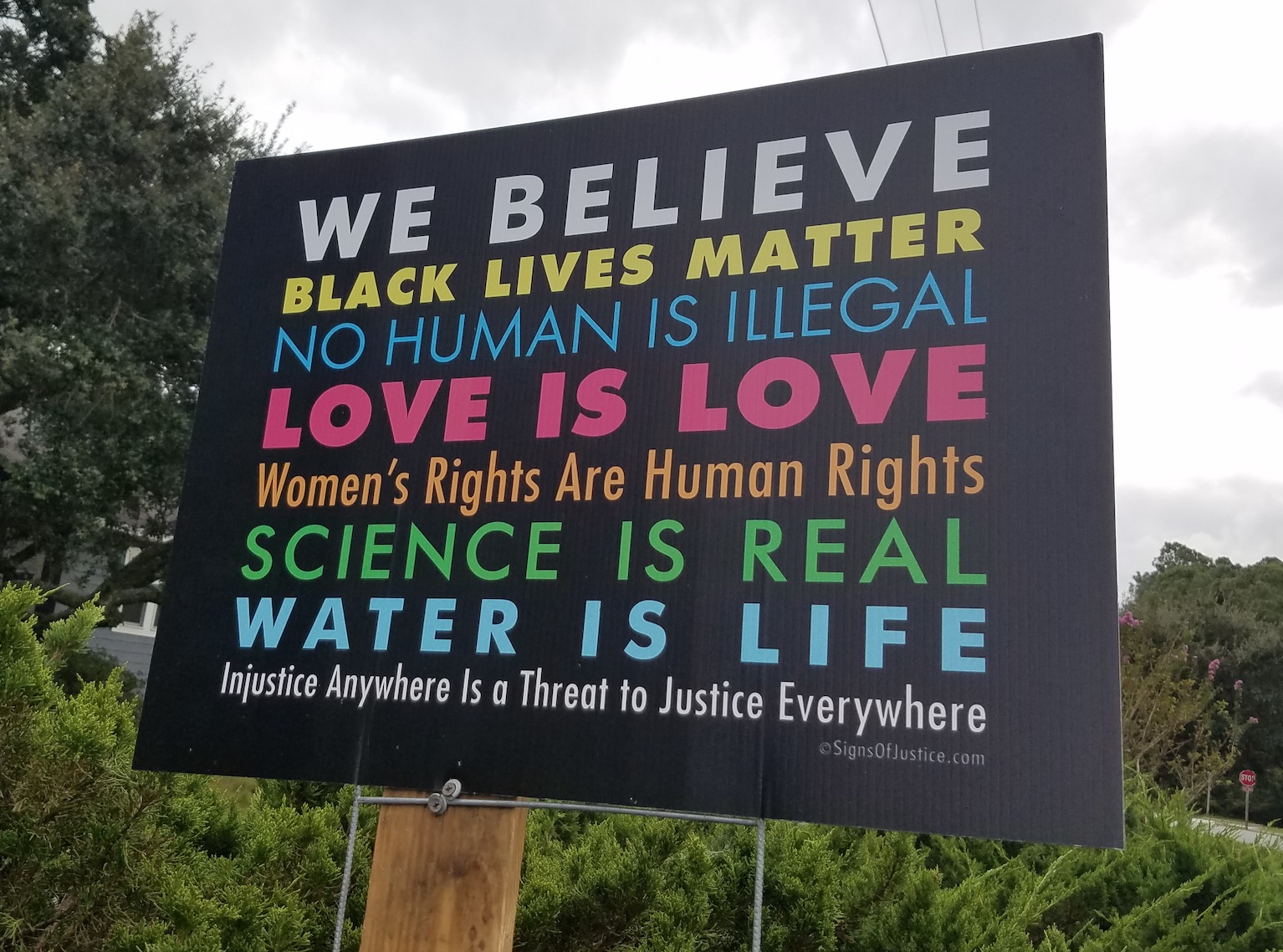
There have been numerous critiques of the “Sparkle Creed,” coming from evangelical Protestants, Eastern Orthodox, and Roman Catholic alike. I have no desire to “pile on” with additional criticism, as it should be plainly evident that this progressive Christian creed departs radically from any historically orthodox Christian creed, across the widest diversity of Christendom.
A secular creed, from sign displayed on a suburban front yard in Kill Devil Hills, North Carolina, October 3, 2020. …. But now we have the Sparkle Creed.
However, the “Sparkle Creed” does present a challenge for historically orthodox-minded Christians: We need to do a better job of articulating an imaginative, beautiful vision of God’s intention and purposes for human gender and sexuality, which is both winsome and Scripturally grounded. We need to extend compassion towards others, particularly young people, who wrestle with complex questions regarding gender and sexual identity. It is a lot easier to poke fun at something like the “Sparkle Creed,” and ridiculing those who support it, than it is think through how our churches can more effectively reach out to those with genuine questions and confusions, building relational bridges instead of blowing up those bridges and needlessly alienating those who desperately need to hear Good News.
If you are looking for a very practical way to implement a kind of positive ministry focus in your church, I would suggest checking out The Center for Faith, Sexuality, & Gender. They sponsor webinars, online courses, and events, grounded in supporting a traditional sexual ethic, that helps people work through questions about gender and sexual identity, as well as parents and other friends looking for resources to help them better love their LGBTQ family members and friends. With endorsements by various Christians leaders, like Francis Chan, Matt Chandler, and Karen Swallow Prior, The Center for Faith, Sexuality, & Gender can offer a lifeline for folks who find themselves wrapped up in confusion and doubt regarding such sensitive, personal issues.
Veracity in the Fall of 2023
I read several books over the summer that I am excited to review here on Veracity, that I hope will be helpful to readers. I am almost finished reading another Bart Ehrman book, and I am planning on offering an extended critique over a series of blog posts over the fall. Bart Ehrman is one of the most prolific writers and influential New Testament scholars, who rejected Christianity several decades ago, but who continues to draw in a lot of media attention…… In the meantime, there is one more blog post in the 1 Corinthians head covering series left, to come out in September. Look for it in a few weeks.
We finally get to what is probably the most unusual and yet most powerfully explanatory approach to 1 Corinthians 11:2-16: the “Supernatural Sexual Modesty” view.
However, in order to do this, a disclaimer needs to be made first: This should also be called the PG-13 view, because it is not suitable to share this perspective with young children. In other words, parents should not teach this view to their children until AFTER they have “the birds and the bees” conversation. It is that weird. But once you unravel the whole idea, you will be amazed by how much sense it makes of a passage that is already super-weird to begin with.
That being said, this Supernatural Sexual Modesty view of 1 Corinthians 11:2-16 does not convince everyone. For example, apologist Mike Winger, from the video in the first blog post in this blog series calls this view “annoying” and “problematic.” He even mistakenly calls this view “new,” which is a demonstrably false statement, but with this argument and a host of others he just pounces on this viewpoint in his video.1
Now, I LOVE Mike Winger. Mike has some incredibly helpful videos, including the one highlighted in the first blog post in this series. But I do not think Mike Winger understands the Supernatural Sexual Modesty view very well. A lot of egalitarian scholars, on the other side of the never-ending “women-in-ministry” debate from Mike Winger, do ridicule the Supernatural Sexual Modesty view, too. In fact, it took me a few times through it myself to get a feel for what is going on, so I will not be surprised if the majority of readers are not impressed, at least at first.
The truth is, the view I am going to summarize here is ….uh…. frankly…. well, yes…. WEIRD. At first, it will sound like something out of the X-Files…. or the Twilight Zone …. or perhaps in today’s world, Stranger Things. However, the explanatory power of this view is so strong that I would encourage folks to hang in there while I try to explain it.
Are you ready? Are the kids already in bed? Have the neighbors stopped watching what you are up to? Good. Now let us begin.
Everything about head coverings in 1 Corinthians 11 (well, maybe not “everything,” but we try to hit the highlights here at Veracity)
Announcing the seventh in this Veracity summer blog post series….
Should 1 Corinthians 11:2-16 even be in our Bible? Are these verses in some sense completely foreign to the mind of Paul? This idea may sound really strange, but this proposition has actually been entertained by some competent scholars.
This hypothesis, the “Interpolation” view, is fairly straightforward, even though the evidence for it is widely disputed. An “interpolation” is a fancy academic word to say that something was added into the text that really did not belong there in the first place. Most people, if they have ever heard of the concept of “interpolation,” recognize it as a mathematical term, but few know that there is a literary concept of “interpolation” as well. Essentially, the idea is that you have an original letter or document, where additional material was added either intentionally or unintentionally by a later copyist of that letter or document.
There are a couple of famous examples of interpolation that at least a few Christians know about, but I will mention only one here. In just about any modern Bible translation today, there will be a marginal note after Mark 16:8. The English Standard Version (ESV) inserts the following:
[Some of the earliest manuscripts do not include 16:9–20.]
What in the world is THAT all about?
Everything about head coverings in 1 Corinthians 11 (well, maybe not “everything,” but we try to hit the highlights here at Veracity)







 Veracity