Author Archives: Clarke Morledge

About Clarke Morledge

Unknown's avatar
Clarke Morledge -- Computer Network Engineer, College of William and Mary... I hiked the Mount of the Holy Cross, one of the famous Colorado Fourteeners, with some friends in July, 2012. My buddy, Mike Scott, snapped this photo of me on the summit.

The First Thousand Years, by Robert Louis Wilken: A Look at the First Half of Christian History (from Europe… and Beyond!)

From the Christianity Along the Rhine blog series…

How did Christianity grow during the first thousand years, since the time of Christ?

During a recent trip to Europe featuring a river cruise down the Rhine River, my wife and I got to explore a lot a history. From cities like Basel, Strasbourg, Mainz, to Trier (up on the Moselle River), you can essentially travel back in time through the centuries, imagining what it was like to witness the destruction of World War 2, to walk along the cobblestone streets of the medieval period, and even to envision how the Romans built their fortifications some 2,000 years ago.  One archaeological site I saw in Mainz from the Roman period has been dated to within a few decades of Christ’s birth, an event which we will celebrate within a few days at Christmas. So I decided to read a book which covered a good chunk of this history, much of it focused on events which took place in the Holy Roman Empire, where the Rhine River was a major thoroughfare.

Historian Robert Louis Wilken is a professor emeritus of Christian history at the University of Virginia. Back in 2013, Wilken wrote The First Thousand Years: A Global History of Christianity, a fine survey into the first half of the Christian movement’s history. Wilken has a general audience in mind (no footnotes!!), and is great to listen to as an audiobook.

Two factors standout for The First Thousand Years, as compared to other similar histories. First, while my main interest was in the European part, Wilken’s book is very much a “global” history of the Christian movement, a story which often ignores the contribution of the Christian East, in other history retellings. Secondly, Wilken includes several chapters regarding the growth of Islam and its impact on Christianity, going into detail more than other texts generally do. The closest book that I know of which covers a lot of the same type of material is Philip Jenkins’ The Lost History of Christianity: The Thousand-Year Golden Age of the Church in the Middle East, Africa, and Asia–and How It Died, another book that I can highly recommend which I read more than a decade ago, before I started blogging.

Wilken’s work is chock full of scholarly insights into significant moments of church history, without getting too technical. Here is one section of the story that I liked a lot: I had been reading Wilken throughout 2025, the 1700th anniversary of the Council of Nicaea giving us the Nicene Creed. Wilken fills out a lot of details that are often missing in popular presentations about the Nicene Creed.

For example, in the early 4th century, when Constantine became one of the emperors of Rome, he built an assembly hall in today’s Trier, Germany, which eventually became a Christian church. My wife and I had the privilege to visit this Basilica of Constantine when we visited Trier. The Basilica lost its roof during the bombing of Trier in World War 2, but since then it has been beautifully restored.

It was through the influence of Constantine when Christianity essentially began to take over the whole of the Roman Empire, within a few hundred years. I was amazed to think that part of this Christian influence spread as far north in Europe as Trier, Germany, at such an early time in European history.

Inside the Basilica of Constantine, which Constantine established in Trier, Germany, in the early 4th century. Part of the brick work in the church has survived since that early Roman period. I could imagine that the Nicene Creed was recited here within a couple hundred years of the Council of Nicaea. My photo from October, 2025.


Robert Louis Wilken on the Story of the Nicene Creed

But all was not without controversy in the Christian movement in those days. This is where the story of the Nicene Creed which Wilken describes in The First Thousand Years comes into play.

When emperor Constantine finally vanquished his last competitor to the claim of emperor, Licinius, in 324, he had learned of an uproar in Alexandria, Egypt. Over the past few years, a controversy was brewing between the local bishop there, Alexander, and a nearby presbyter, Arius. Arius was teaching that while the Son of God was indeed divine, the Son was actually a creature created by the Father.

Alexander believed this to be heresy. The rumors of heresy were spreading across Christian communities in the Roman empire, and it had the emperor worried that the political fallout of such a theological controversy would make it difficult for him to govern effectively. Constantine, on the other hand, considered the whole matter to be “small and trivial” and the dispute an “idle question.” Constantine called the great Council of Nicaea, involving a little over 200 bishops from all over the Roman empire, to settle the matter and restore peace in the Christianity community of the imperial realm (Wilken, p. 90-91).

Constantine thought the controversy had ended once the meeting at Nicaea was over. But for the next several decades, Christians debated one another about the content of the creed, as the matter was far from settled, contrary to Constantine’s expectations. The Arian controversy and the Nicene proposal dominated imperial politics for several decades, involving several Roman emperors.

When Theodosius, who was friendly to the pro-Nicene party, became emperor in 379, he deposed an Arian bishop, Demophilus, from his office as bishop in Constantinople. Apparently, in many Roman cities at this time, you could find both an Arian (or Semi-Arian) and a Nicene bishop, a situation which brought great confusion to ordinary Christians (Wilken, p. 95).

Advocates of the Nicene Creed saw the ascension of Theodosius as an opportunity to reassert the orthodoxy of the Nicene formulation. Theodosius then called yet another council in 379-381, to be held this time in Constantinople, to reaffirm the creed from 325, and bring some resolution to issues that had caused contention over the creed, during the intervening years. Though the Council at Constantinople is considered to be an ecumenical council, all of the bishops who attended were from the Christian East, as opposed to the Council of Nicaea, which drew bishops from both the East and West (Wilken, p. 96).

Interestingly, the final text of the Nicene Creed formulated at Constantinople has not survived from that meeting. What we know of as the Nicene Creed today was actually recorded at the Council of Chalcedon, some seventy years later, as preserved in the minutes from that council in 450.

Wilkens is careful to note at Constantinople, the language of the Son being “begotten of the Father” (John 1:14, 1:18, 3:16, 3:18; Hebrews 1:5; 1 John 4:9) and the Spirit who “proceeds” from the Father (John 15:26) helped to establish the difference between the Son and the Holy Spirit. The original creed at Nicaea, in 325, merely mentioned the Holy Spirit, but gave no details as to how a Christian was to think about the Spirit, as the Spirit related to the Father and the Son. However, the controversial phrase regarding the Son as being of the “same substance” (homoousion) as the Father, used at Nicaea, was not used to speak of the Holy Spirit at Constantinople. Wilkens reports that 36 bishops at Constantinople argued that the Spirit should not be worshipped as God in the same way Christ is worshipped, though both were considered to be divine. The final creed is explicit in saying that the Spirit is to be worshipped and glorified “with the Father and the Son.” This gives us the doctrine of the Trinity as we know it today (Wilken, p. 97).

Porta Nigra is one the best preserved Roman gate to the city of Trier, Germany. The gate dates back to 170 CE, before Christianity had thoroughly spread across the Roman Empire. My photo from October, 2025.  The link here is a then-and-now shot comparing the World War 2 look with today.


Other Nuggets of Church History Gold from the First Thousand Years

Loads of other anecdotes fill out the narrative of the growth of global Christianity during this period. I will just highlight a few more which stuck out for me.

Wilken explains why the Quartodeciman controversy, concerning how to determine the exact date for the yearly celebration of Christ’s resurrection, was so difficult to resolve (Wilken, p. 38…. I will have a future blog post which will dive into the Quartodeciman episode in a more detail).

Wilken has a whole chapter dedicated to Origen of Alexandria, perhaps one of the greatest Christian intellectuals of the early church era, who often gets dismissed by Christians today because of his universalistic doctrine, whereby he argues from 1 Corinthians 15:28 that all of humanity will ultimately be reconciled to God, thus emptying hell (Wiken, p. 61). Origen dropped the ball with his teaching on universalism, but in other respects, Origen was one of the first great towering intellectuals of the early church.

Origen was a master of multiple languages, one of the few early church fathers after the first century who made a concerted effort to understand the Hebrew language, the original language of the Old Testament. The Hebrew version of Genesis 2:4 reads: “These are the generations of the heavens and the earth when they were created,” whereas the Septuagint, the Greek translation of the Hebrew Bible, reads: “This is the book of the generation of heaven and earth when they were made,” adding the work “book,” which is missing in the Hebrew. Origen supposed that the Jewish Greek translator added the word “book” since the same phrase “the book of the generations” appears in Genesis 5:1. This inspired Origen to make a learned study of the Hebrew language. The church remains indebted to Origen’s scholarship, despite having been censured for his views of universalism, a few centuries after his death (Wilken, p. 59).

Little did I know that Constantine’s famous “Edict of Milan” was actually a misnomer. The “Edict of Milan” was not an “edict” but rather a “letter” posted by the rival of Constantine, Licinius, who wrote the letter from his residence as emperor in Nicomedia, in modern day Turkey, but that the contents of the letter reflected the thought of Constantine as well (Wilken, p. 85).

Wilken is far from painting the early church as faultless. He acknowledges that the highly esteemed Bishop Ambrose of Milan was one of the greatest doctors of the church. In 388, a group of Christians set fire to a Jewish synagogue, at the border military town of Callinicum, on the Euphrates River. Emperor Theodosius ordered the local bishop of Callinicum to rebuild the synagogue out of the bishop’s own funds. Yet Ambrose intervened against the emperor, urging that the synagogue not be rebuilt, citing that the synagogue was “an abode of unbelief, a house of impiety, a shelter of madness under the damnation of God Himself.”  Ambrose argued that it would be wrong for Christians to rebuild a Jewish synagogue. Theodosius relented. Scholars have debated the morality of this controversial act, on the part of Ambrose (Wilken, p. 134). Yet in my mind, it casts a shadow over the great bishop’s otherwise remarkable legacy. For if the arsonists were let off the hook for their actions, then it would not be just.

Wilken dedicates whole chapters focusing on architecture and art (with some helpful photos in the book), music and worship, and a history of how the bishopric of Rome became “pope.” Through this I learned that the Christian calendar actually arose much later than I originally thought. A late 5th/ early 6th century monk in Rome, Dionysius the Short, took the traditional Julian calendar, which was linked to the reigns of Roman emperors, and anchored the Christian calendar (or at least attempted to do so) to the birth of Jesus, anno Domini, “in the year of our Lord.” The Synod of Whitby in England in 664 formally approved of the new calendar, but it still took a few more centuries for it to be adopted across the Christian world (Wilken, p. 180).

Wilken clearly favors the influence of Saint Augustine of Hippo, describing him by saying “that during his lifetime [Augustine] was the most intelligent man in the Mediterranean world” (Wilken, p. 183). Augustine is known in the West for his conflict with Pelagius. But what I did not know is that charges of heresy against Pelagius were dropped by a council of Eastern bishops in Palestine in 415. Augustine was not satisfied by that judgment, and finally persuaded the Roman emperor Honorius to issue a condemnation of the Pelagians in 418 (Wilken, p. 192). Apparently, Augustine was not afraid of mixing church affairs with the affairs of the state, a mistake in my view, but one that became very common during the medieval era.

Whereas the early church largely grew organically, from neighbor to neighbor, worker to worker, family member to family member, the latter half of the first millennium was marked by a more top-down approach to church growth. Without the support of the king of a region, Christianity made little to no headway in expanding. Wilken relates the story of how Christianity spread to various places, particularly in the east, among the Ethiopians, the Slavs, and as far away as China. In each case, the regional king played a pivotal role in the global development of Christianity.

The First Thousand Years: A Global History of Christianity, by Robert Louis Wilken, tells the story of the first half of the history of the Christian movement, much of it which took place in Europe, but not only in Europe. Much of the forgotten story about the first thousand years of the church happened elsewhere around the world.


A Global History

Yet it was a risky endeavor, as sometimes Christianity took off and remained vibrant, whereas in other cases the church stagnated and even declined, as in the case of China. Christianity managed to reach China in the 7th century, growing quickly, before fizzling out within a few more centuries. The whims of the ruler often proved decisive.

Wilken dedicates a lot of attention to the emergence of Islam. The author shows how Christianity in some cases survived and even thrived under Muslim rule, as with the Copts of Egypt, and where it declined, as in the case of Asia Minor, known now as modern day Turkey.

The story overall of the first thousand years of Christianity is one of remarkable growth followed by decline, particularly in the Christian East. Only once the growth of Islam was challenged did Christianity grow again, and the future of that growth was in the Christian West. But that is the story of the next thousand years of Christian history.

Robert Louis Wilken’s historical survey of the first thousand years of church history is a “must-read” for those interested in learning about the history of the first half of Christianity’s existence.


Ancient Israel’s Women of Faith, by Claude Mariottini. A Review

Looking for a thoughtful, challenging book to read over the Christmas holidays? Here’s a suggestion.

Much of what we read in the Old Testament is about the contributions of men to the life of ancient Israel. We typically think of the big names, like Abraham, Moses, David, Isaiah, and Jeremiah. But what about the women?

Often the stories of women in the Old Testament are sidelined in favor of male figures. In some stories, women are even cast as villains. However, more recent scholarship suggests women stand out better in at least some of those cases, more so than previously thought.

A Cheating Wife? Or an Abusive Husband? What is the Real Story?

One often neglected story is about the Levite and his concubine of Judges 19:1-30. No matter what way you look at it, the story is tragically shocking, one of the more graphic episodes in the entire Bible.

Typically, a concubine served as a second wife for a man, in this case an Israelite Levite. The more traditional reading suggests that the Levite’s concubine was unfaithful to him, assuming that the concubine became a prostitute. In becoming a prostitute, the concubine had committed adultery, a capital offense. The concubine had fled the house of the Levite, and went back to her parents’ home. But eventually the Levite went out to pursue his concubine and bring her back to his home.

After several nights staying with the concubine’s family, he was able to retrieve his concubine from her parents’ home. On the way home, the Levite and his concubine managed to spend the night with an old man in the town of Gibeah. But during the night, men from the city came to threaten the Levite. The Levite saved himself by giving his concubine over to the men of Gibeah, who in turn sexually violated the Levite’s concubine to near the point of death. When the Levite finally returned home with the lifeless body of his concubine, he cut up her body into twelve pieces, and sent the remains throughout the land of Israel.

It is a pretty awful story. But the traditional reading has some serious problems. The traditional reading hinges on an ambiguous verse, Judges 19:2, at the outset of the story.  The ESV translation reads:

And his concubine was unfaithful to him, and she went away from him to her father’s house at Bethlehem in Judah, and was there some four months.

The KJV is even more direct, implicating the adultery of the concubine:

And his concubine played the whore against him, and went away from him unto her father’s house to Bethlehemjudah, and was there four whole months.

However, some other translations read differently. Consider the NASB, revised in 2020 (as compared to the earlier 1995 revision, which was more like the KJV):

But his concubine found him repugnant, and she left him and went to her father’s house in Bethlehem in Judah, and remained there for a period of four months.

Or the NRSVUE:

But his concubine became angry with him, and she went away from him to her father’s house at Bethlehem in Judah and was there some four months.

It turns out that the Hebrew word, zana, can be translated in different ways. The traditional reading has the word meaning to be “unfaithful” (as with the ESV) or to “commit adultery.” However, the Septuagint, the ancient Greek translation of the Hebrew text, has zana to mean to be “angry” with (as with the NRSVUE). The second meaning does not imply any sexual infidelity on the part of the concubine. Instead, it suggests that the woman had some reason to be angry with the Levite, angry enough to leave him and return home to her parents, without any hint of prostitution or other infidelity, as the KJV states.

Dr. Claude F. Mariottini, Professor Emeritus at Northern Baptist Seminary, suggests that translations like the NASB and NRSVUE get it right. The text does not tell us why the concubine found her Levite husband to be “repugnant.” While the reason for the concubine’s “anger” is never stated, it easily implies that her husband was abusive, and that she sought to return to her parents to get away from an abusive man. In an age when spousal abuse is getting a lot of attention, as with the #metoo movement, this should spark our interest more in the 21st century. There are some good reasons to accept this alternative reading.

The following verse may contain some clues, as there is ambiguity in Judges 19:3 as well. The ESV follows the traditional reading:

Then her husband arose and went after her, to speak kindly to her and bring her back. He had with him his servant and a couple of donkeys. And she brought him into her father’s house. And when the girl’s father saw him, he came with joy to meet him.

You get the impression that the Levite wants to try to persuade his concubine to return back to him. Was the Levite offering his love and forgiveness towards her? Here it is the woman who took her husband, the Levite, into her father’s house. Why did she do this? It is possible that she felt obligated to do so, for if she was unfaithful to her husband, she may have felt it was her responsibility to seek reconciliation. But there is more to the story. The NLT translation reads differently:

…. her husband set out for Bethlehem to speak personally to her and persuade her to come back. He took with him a servant and a pair of donkeys. When he arrived at her father’s house, her father saw him and welcomed him.

In this translation, there is no mention of the woman bringing her Levite husband into her father’s house. Only the father-in-law receives the Levite.  Furthermore, the NLT suggests that the Levite husband was on a mission to try to talk her back into coming home to his house, which is behavior consistent with an abusive husband. Curiously, the concubine and the Levite’s father-in-law tried some stall tactics for several nights which prevented the Levite from leaving with his concubine wife to take her back to his home. Were the concubine and her father hoping that the Levite would eventually just give up and go back home without her?

The incident in Gibeah raises other problems for the traditional view which casts the concubine as an adulterer. When the men of Gibeah threatened the Levite in Judges 19:25 , the ESV says that the Levite “seized” his concubine and sent her out to be sexually abused by the men of Gibeah. If the Levite truly loved his concubine, would he really “seize” her to be handed over to these violent men? The text purposely uses this word to convey a meaning which is certainly not a gentle way to treat a wife.

To make matters worse for the Levite, Judges 19:22, in a manner much like the story of the men in Sodom with Lot, these men of Gibeah declared their intentions to “know” the Levite, a euphemism for having sexual relations. But when the Levite relates his version of the story in Judges 20:5-6, the Levite says that the men were intent on killing him, which was not the case.

The story gets even worse. If the Levite really loved his concubine, and wanted her back, it seems really creepy and unloving for the Levite to chop her dead body up and send her body parts all across Israel. All of these pieces of evidence suggests that the standard portrayal of the concubine as a wayward woman hides the real story, namely that she was an innocent victim of a Levite husband who abused her, and in the process, she ultimately lost her life.  What a tragic story!!

Mariottini’s interpretation of this difficult passage is compelling. It demonstrates that the Bible is quite aware of the problem of “toxic masculinity,” whereby men can abuse their power and destroy the women in their lives. The story of the Levite and his concubine serves as both a warning and a rebuke against such morally perverse behavior.

Claude Mariottini’s newest book, Ancient Israel’s Women of Faith: A Survey of the Heroines of the Old Testament, is collection of stories about many of the amazing women of the Old Testament, offering insights that will be helpful to many men and women today.


Women of Faith in Ancient Israel

Claude Mariottini has written a vitally helpful book: Ancient Israel’s Women of Faith: A Survey of the Heroines of the Old Testament, to highlight the often forgotten contributions of women in the story of the Old Testament, with a single chapter focused on the story of the Levite and his concubine. Thankfully, Professor Mariottini’s book has more positive stories to offer to highlight the valuable contributions made by women to the story of ancient Israel. Professor Mariottini has for years written a blog which focuses on the best of Old Testament scholarship, making the story of the Old Testament more accessible to lay persons and scholars alike. While a good deal of the material found in the book can be discovered on his blog, his new 250 page book brings the wealth of that material to one place in one text.

As Mariottini says, the influence of women in the Old Testament is often obscured by how our sources came to us, filtered through male perspectives and priorities. Make no doubt about it, ancient Israel was a patriarchal society, where women were subordinated at home, with limited autonomy, and even treated as property. Nevertheless, as the Old Testament narrative unfolds we read how women were given a greater voice and were at times vindicated in the face of injustice, which can serve as an inspiration to women today.

Mariottini does not sugar-coat the story. The men typically take center stage in Israel’s narrative.

But then certain women come at critical points in the Old Testament, to make a difference. There are fairly well-known women, like Sarah, Abraham’s wife; Deborah; a prophetess and a judge; and Rahab, who hid and rescued the Hebrew spies at Jericho.  Then there are lesser known women, like Sheerah, who was a builder of cities (1 Chronicles 7:22-24). Jehosheba, the daughter of King Jehoram of Judah, protected the young Joash, the Davidic heir to become king, from being killed (2 Kings 11:20). Huldah, a prophetess, was consulted by King Josiah, who had rediscovered a book of the law found in the Temple, bringing it to Huldah to verify that the book was indeed authentic (2 Kings 22:15-20).

Professor Mariottini follows standard insights into the Old Testament held among nearly all evangelical scholars today, insights which are not always well understood by the average church-going Christian. He acknowledges the concept of Yahweh’s “Divine Council,” whereby the uncreated and supreme Yahweh presides over a fellowship of other created divine beings, often described as “gods” or “sons of god” in the Old Testament, a concept in the academic world popularized most recently by the late Dr. Michael Heiser (Mariottini, p. 25). Mariottini acknowledges that the Pentateuch, the first five books of the Bible, was written in stages, such that a text like Deuteronomy acts as an inspired revision to earlier material. Identifying Moses as the originator of the Pentatuech tradition need not rule out the activity of divinely inspired editors in later centuries,  or even just Moses himself later in his life, working to keep the Mosaic law tradition up to date, in light of new challenges to the people of Israel over time.

Mariottini offers several examples, by showing how Deuteronomy provides more protections for women as compared to earlier texts in the Pentateuch. In the days of King Josiah, in the seventh century before Christ, Deuteronomy was cited to prescribe these protections.

In Exodus 20:17, the tenth commandment reads:

“You shall not covet your neighbor’s house; you shall not covet your neighbor’s wife, or his male servant, or his female servant, or his ox, or his donkey, or anything that is your neighbor’s.”

However, in Deuteronomy 5:21, the same commandment reads:

And you shall not covet your neighbor’s wife. And you shall not desire your neighbor’s house, his field, or his male servant, or his female servant, his ox, or his donkey, or anything that is your neighbor’s.”

Even though the Exodus version does not relegate the position of the wife to that of a slave, it nevertheless is ambiguous enough to indicate that the wife belongs to the husband, as though the wife is the possession of her husband (Mariottini, p. 39).

Yet the Deuteronomy version rearranges the original Exodus version, splitting the command not-to-covet into two separate commands, first that of not coveting a neighbor’s wife, and the second, that of not to covet (or desire) anything which is a possession of the husband, like a house, a field, a servant, a domestic animal, or any other possession. This gives greater clarity and explicit force to suggest that a wife is not to be treated in this same way as a man’s piece of property  (Mariottini, p. 42-43). Deuteronomy gives more explicit recognition of women having their own voice in the life of the Israelite community.

A similar pattern is observed when considering the Pentateuch’s code regarding the release of a Hebrew slave. In Exodus 21:2-6, a male Hebrew slave was to be released after six years of labor. But if that male slave enters the slave relationship as a single man, and the master gives him a wife, that woman will remain with the master even after the male slave is allowed to go free. However, in the Deuteronomy 15:12-18 version of the same rule, the woman is allowed to go free with the freed Hebrew slave, and remain the wife of that Hebrew slave (Mariottini, p. 44-47).

Perhaps the most important contribution Mariottini makes is in his highlighting of the Book of Deuteronomy, as giving us a clearer expression of addressing injustice against women in ancient Israel.

Some Critique of Mariottini

Ancient Israel’s Women of Faith is a great book, but a few criticisms are in order. There is at least one minor error whereby the NRSV’s translation of 1 Chronicles 25:5-6 is said to read: “God gave Heman fourteen sons and three daughters. All these men were under the supervision of their father for the music of the temple of the LORD.” Actually, this translation is what the NIV 2011 has for this passage. The NSRV actually substitutes the phrase “all these men” with “they were all,” a more gender accurate translation of the verse, acknowledging the inclusion of both Heman’s sons and daughters in helping to lead the worship music in the temple (Mariottini, p. 56-57).

A more serious problem arises when Mariottini expands his treatment on this passage later in the book. Here he corrects the earlier misquote of the NSRV translation of the passage, which suggests that both men and women participated in leading worship music in the temple (Mariottini, p. 83).

Mariottini describes this as the “egalitarian” reading, thus indicating that “although sin created a distortion of [this] mutuality [resulting from men and women being created equal], the gospel of Jesus Christ has abolished this distortion and that now both men and women are equally called to serve God” (Mariottini, p. 84) He contrasts that with the CSB (Christian Standard Bible) and NIV 1984 (despite the fact that the NIV 2011 keeps the same translation regarding gender), which reads “all these men.” This latter reading Mariottini says is exemplar for the “complementarian” position, that “God has set apart men to hold political and religious leadership in Israel.” This explains why the CSB and NIV suggest that the daughters of Heman were “not part of the music ministry of the temple” (Mariottini, p. 83).

However, this analysis is misleading as the complementarian position is not as monolithic as Mariottini assumes. While some complementarian churches do restrict women from leading music in a worship service, not all complementarians hold to such a broad restriction.

These other complementarians allow women to serve in such leadership roles, though these same churches nevertheless still hold that the office of elder specifically be held only by qualified men, according to what is found in 1 Timothy 2 & 3, and Titus 1. Other leadership functions in the church, like that of deacon, worship leader, etc. are open to both men and women. This reality is reflected in the fact that the ESV translation echoes in similarity the NRSV reading: “God had given Heman fourteen sons and three daughters. They were all under the direction of their father in the music in the house of the Lord with cymbals, harps, and lyres for the service of the house of God.”  In other words, men and women participate in the leading of worship music.

The ESV (English Standard Version) is rarely described as an “egalitarian” Bible translation, and is instead popularly known as the most influential complementarian-leaning Bible translation today in the English speaking world. Nevertheless, Mariottini is right to conclude, along with the ESV and NRSV, that women were allowed to participate in the music ministry of the temple, and that should anticipate later Christian worship practice.

The question of whether or not women can serve as elders, much less other leadership positions in the church, is a contentious issue today in evangelical churches. As a moderate complementarian myself, the idea of having only qualified males to serve as elders is not a slight against women, as women clearly can exercise leadership in other ways in Christian ministry. Rather, the gender “restriction” regarding elders is more about encouraging men to act as spiritual leaders in the church, modeling what should be done in the home. Even in our supposedly morally-advanced 21st century culture in the West, typically men much more than women tend to abdicate in taking spiritual leadership in their families, relegating such a task to their wives, who are often already overburdened with other responsibilities. When husbands and fathers take more responsibility in a positive, supportive way to spiritually lead in the home, everyone in the family is enabled to benefit.  (As a side note, I spent about four years writing on the complementarian/egalitarian controversy which is dividing evangelical churches today. You can read my research referenced here. Just this past year, yet another church in my town of Williamsburg, Virginia divided over this same issue. In my estimation, there are extremes on both sides of this issue which has tragically led to such church divisions).

It is curious how Mariottini cites some scholarship which challenges the traditional translation of Genesis 3:16 (Mariottini, p. 33).  The ESV has controversially rendered this verse as:  “Your desire shall be for your husband, and he shall rule over you.”  In fairness, the ESV also includes a footnote which suggests an alternative translation: “Your desire shall be to (or toward, or even against) your husband, and he shall rule over you.” But Mariottini cites Allen H. Godbey’s translation: “Thy longing shall be toward thy husband; and he shall be likewise toward thee.”  Godbey’s translation is completely new to me, and I am not familiar with other scholars commenting on Godbey’s view.

Some of the chapters in Ancient Israel’s Women of Faith tend to be repetitive at certain points. This is because a number of the stories highlighted by Mariottini tend to overlap, which indicates that the book is more of a reference book, where the chapters can be read in any order, whereby the reader can select what stories might interest them, while coming back to other stories later. This is probably fine for most readers, who want to read a short chapter that interests them, and then read some other short chapter elsewhere in the book. But for someone who wants to read the book from start to finish, the repetition might be bothersome.

Aside from a handful of problems like these, Claude Mariottini has given us a book which assists Christians to discover how many of the forgotten women of the Old Testament expressed their voices and have made significant contributions to the story of ancient Israel. Ancient Israel’s Women of Faith will be a helpful read for those who tend to think that the Old Testament has a purely negative view of women. May these stories continue to inspire us regarding the faith of these amazing women of the Old Testament.

One more thing: As I have read Claude Mariottini before, I am a bit partial to his work. However, there is another book out now which covers the same theme of women in the Old Testament, along with a brief look at women in the New Testament. Ingrid Faro’s Redeeming Eden: How Women in the Bible Advance the Story of Salvation has received some good reviews, too, so that might also be worth checking out.


Did Kirk Cameron Just Deny the Doctrine of Hell?

Kirk Cameron, the Christian actor, who first made his name in Hollywood as a teen actor in the Growing Pains television series, has recently gotten into some hot water, so to speak, with some of his fans. Cameron revealed on his podcast that he no longer accepts the traditional doctrine of hell as eternal conscious torment. Instead, he now holds to the doctrine of conditional immortality instead, at least tentatively.

A number of commentators have responded, such as Southern Baptist Seminary President Al Mohler, in an essay for the WORLD News Group. Dr. Mohler believes that Kirk Cameron’s move towards the doctrine of conditional immortality is a slippery slope towards other areas of compromise in Christian doctrine, whereby Cameron has allowed emotional concerns to overwhelm a commitment to historic Christian orthodoxy.

Cameron is in many ways a popular evangelical Christian influencer, an evangelist and a spokesperson on conservative political issues as well. He admittedly acknowledges that he is not a scholar, and some of his amateur misunderstandings of things have come out in at least one filmed “prayer meeting” a few years ago, and on an historical documentary he produced on American history, which I have critiqued.

Kirk Cameron made a historical documentary film Monumental back in 2012, among his many other projects. Cameron has become a trustworthy and influential popular spokesperson among many evangelical Christians.  But some now are concerned that Kirk has gone off the deep end…. or has he?


Is Kirk Cameron Now a “Heretic,” or Is He Simply Thinking Through Some Really Important Questions, and Wants to Talk About It?

Alas, Kirk Cameron means well, and to many in his audience, he seems trustworthy. So it really shocked some people, myself included, when he announced that he has shifted towards upholding a doctrine of conditional immortality.

The doctrine of conditional immortality differs from the traditional doctrine of eternal conscious torment. In the latter view, those who are eternally separated from God will undergo a never-ending experience of divine punishment resulting from their sin. However, the doctrine of conditional immortality, otherwise known as annihilationism, argues that those eternally separated from God will be punished, but that the punishment will have a terminus. To use a common expression, the punishment (of God) will fit the crime (of the sinner). Once the punishment, as rightly determined by God’s judgment, is rightly finished, the person will be annihilated. That person, separated from God, will no longer exist, eternally.

So, to answer the question posed by the title of this post: No, Kirk Cameron is not denying the doctrine of hell. But he is framing the way to think about hell in a category that might be unfamiliar and unsettling to others.

The debate of the exact nature of hell has been going on since the days of the early church. There are three main views on the topic: (1) the doctrine of eternal conscious torment, (2) the doctrine of conditional immortality, and (3) the doctrine of universalism. Universalism, which in its most popular form in Christians circles, as suggested by those like theologian David Bentley Hart, or William Paul Young, the author of The Shack, teaches that hell is really a kind of purgatory, whereby God will purge sin from the non-believer and eventually win that person to salvation, eventually, in the next life. In other words, hell is primarily restorative and redemptive, as opposed to being punitive.

While Christian universalism has had its proponents, even in the early church era, the doctrine was rejected as veering away from historic Christian orthodoxy. Names like Origen, and possibly Gregory of Nyssa, on up to more recent times, as with C.S. Lewis’ intellectual hero, the 19th century author George MacDonald, have espoused some form of universalism. But the orthodoxy of universalism has been rightly questioned.

However, the story is different from the doctrine of conditional immortality. There are no ancient, historic creeds or confessions which have rejected conditional immortality, unlike universalism. Prominent church fathers, and champions of orthodoxy, such as Ignatius of Antioch and Irenaeus of Lyons, were aligned with the advocates of conditional immortality.

It was really Saint Augustine of Hippo, an avid proponent of the doctrine of conscious eternal torment in the 5th century, who effectively put the nail in the coffin on general acceptance of conditional immortality…. at least for many Christians. Augustine’s massive influence pretty much made conscious eternal torment the traditional view of hell for centuries. But every now and then, conditional immortality makes a comeback, at least among a few Christians, in nearly every age of the church. So, Kirk Cameron’s musings on the doctrine of hell are far from new.

I take an agnostic view on the debate between these two perspectives at the present time. Dr. Mohler cites Matthew 25:46 as the main “go-to” verse to favor the doctrine of eternal conscious torment:  “And these will go away into eternal punishment, but the righteous into eternal life.”  But then there is Paul’s statement in 1 Thessalonians 2:9: “They will suffer the punishment of eternal destruction, away from the presence of the Lord and from the glory of his might.”

Eternal destruction sounds a lot like annihilation, at least to me. But I get Dr. Mohler’s point about Matthew 25:46. I am concerned about slippery slope tendencies on controversial topics, like Mohler, but these can be complex issues where different people will come to varying conclusions based on different ways of thinking. What matters more to me is how people arrive at their conclusion, as opposed to not just the exact conclusion they land on.

Interestingly, the world’s most famous New Testament scholar/skeptic, Bart Ehrman, believes that Jesus actually held to a kind of belief in conditional immortality, as opposed to eternal conscious torment. But Ehrman recognizes the difficulty put forward by Matthew 25:46. Ehrman’s solution, as a skeptic, is to say that Mathew 25:46 was a later invention by the early church, to make Jesus into being a teacher of eternal conscious torment (when he really was not).

This is one of those doctrinal disputes which I have wanted to study, but I have not done a thorough enough job to make any firm, informed conclusion. About thirteen years ago, I read Robert A. Peterson’s Hell on Trial: The Case For Eternal Punishment, a 272 page articulate text which I highly recommend. Peterson makes a strong argument for eternal conscious torment, while acknowledging that some verses in the New Testament do lean towards conditional immortality. I have not yet read thoroughly any counter-perspective from the conditional immortality side of the discussion. I simply have not yet had the mental bandwidth to take on such a project, and I doubt I will get to it anytime soon (though I have wanted to).


An Appeal to Have More Charitable Dialogue on Controversial Topics Among Christians

But what concerns me the most about the controversy concerning Kirk Cameron are some of the outlandish comments, which have called into question Cameron’s spiritual integrity. Some have claimed that Kirk Cameron is embracing “heresy” now with his views on hell. That simply is not true. Kirk Cameron might indeed be wrong about conditional immortality, but that does not make him a “heretic.”

Apologist Wesley Huff, who defends the traditional doctrine of eternal conscious torment, calls for more charitable conversation on this topic, from a post he made on X:

“With @KirkCameron announcing his position on conditionalism I’m seeing a lot of people attempting to critique it. I hold to ECT, but I do understand the topic of conditional immortality and I have yet to see anyone actually give a rebuttal that shows me they’ve interacted with the arguments and biblical reasoning from the other side. To condemn conditionalism/annihilationism as heresy is to say that John Stott, Edward Fudge, F. F. Bruce, potentially even Athanasius of Alexandria, are all heretics. This is, with all due respect, ridiculous. While the position might be unorthodox it is not heresy. If you actually want to interact with someone who knows the topic reach out to my friends @datechris and/or @DanPaterson7. Both are solid, fair minded, well educated and articulate holders of conditionalism.”

Gavin Ortlund, another theologian who holds to the traditional doctrine of conscious eternal torment, has a video which echoes Wesley Huff’s call for more charitable discussion. In Gavin’s four-layered model for how to go about “theological triage,” when Christians disagree with one another, from his book Finding the Right Hills To Die On, Gavin does not place this debate about the nature of hell as a “Tier 1,” top-level issue. It is an important issue to consider, a “Tier 3” issue, but Christians of good faith may come to different conclusions regarding the nature of hell. This is a good reminder that we should all strive for more charity in having discussions with one another on controversial topics.

I mean, if Kirk Cameron is no longer “safe,” then is anybody really “safe” anymore?

I have a couple more blogposts to put out before the end of the year, but this topic was too important not to pass up!


Was Winston Churchill a Warmonger?? (And Other Lunacy in the “New Media”)

From the Christianity Along the Rhine blog series…

Lunatic conspiracy-like theories tend to run amuck at the most confusing times in the oddest places. You can spot these typically in the hands of self-promoting journalists and other thought leaders in the age of the “new media,” who have a misguided or otherwise inadequate grasp on human history.

Take for example statements made by popular conservative news commentator Candace Owens about the early Christian movement:

And those Jews became Christians. Full stop. There is no hyphenated faith. You are either a Christian or you are a Jew. Christ fulfilled the law.”

Candace Owen apparently believes that the earliest Christ followers left their Judaism behind to follow Jesus. Such statements have given rise to a kind of “replacement theology,” which has infected Christian thinking in various quarters for centuries. Now, “replacement theology” can mean different things to different people, which does get confusing. But in this context, it suggests that God has somehow forgotten the Jews, and “replaced” the Jews with Christianity.

Has Ms. Owens never met a “messianic Jew?” A “messianic Jew” is a Jewish person who has become a Christian, believing that having faith in Jesus fulfills what Judaism is all about. The growth of messianic Judaism, particularly in the last generation or so, where thousands of Jews have come to know Jesus as their true Messiah, is one of the most remarkable stories of Christian missions in our day. In other words, contrary to what Ms. Owens thinks, you can be both a Jew and a Christian, and the trend is growing.

So, where do people get such bizarre ideas? Apparently, Ms. Owens has never learned that nearly all of Jesus’ earliest disciples were Jewish, and they never forsook their Jewish heritage. Even after the Apostle Paul became a Christian, he still acknowledged that he was both “a Hebrew of Hebrews (Philippians 3:4-5) and “I am a Jewish man” (Acts 21:39). If you read the text carefully, you will notice that Paul is speaking in the present tense, and not the past tense. Do we need a reminder that Jesus himself was Jewish?

Back in September, 2024, another popular conservative news commentator took a step in a similar direction. Tucker Carlson has been a television journalist, who after leaving the Fox television network, became perhaps the first Western journalist to score an in-person interview with Russian President Vladmir Putin, after the Ukraine-Russian war began in February, 2022. Since then, Mr. Carlson has been on an interesting journey, essentially re-discovering Christianity, as evidenced by several interviews he has given, which is very encouraging. Carlson’s interview with campus evangelist Cliff Knectle stands out as a positive example of engaging journalism, allowing a Christian evangelist to discuss the Gospel at length without being misconstrued.

That being said, Mr. Carlson crossed a line when he interviewed an American historian, Darryl Cooper, a man who Carlson describes as “may be the best and most honest popular historian in the United States.” In that interview, Cooper makes the claim that during World War 2 era, British Prime Minister Winston Churchill was a “warmonger” who was itching for a fight with Adolph Hitler, suggesting that Churchill became the “chief villain” of World War 2, making the war into something more than just the invasion of Poland. Sadly, Carlson did very little to challenge Cooper’s claims.

NOTE: This was all a year before THAT interview Tucker Carlson had with Nick Fuentes in October, 2025….. (And I need not go down the road of more recent conspiracy theories propagated by Ms. Owens, well documented by others …. which gets more and more bizarre by the day, wild claims which possess no evidence)…. But Tucker Carlson’s promotion of revisionist history by Darryl Cooper is the most troubling to me, partly because of the popular reach Tucker Carlson has, particularly among evangelical Christians.

It is troubling as Christians are often blamed for a good amount of antisemitism, needless antipathy towards ethnic Jews, which I have argued stems from a failure to interpret Scripture responsibly. So, when public figures who consider themselves as Christians, play into certain anti-Judaic falsehoods, whether intentionally or not, it nevertheless harms Christian witness.

Where do people get such nonsense?

Why do such voices get so many clicks on social media platforms?

Well, I decided to find out for myself.

One of the most highly respected biographies of Winston Churchill is by British historian Andrew Roberts, who responded to the Darryl Cooper interview by Tucker Carlson. Roberts’ articulate and evidence-based response from 2024 has been so stinging (and a follow-up piece just a year later, criticizing even the Heritage Foundation), that I knew I had to get a copy of Churchill: Walking With Destiny.  On Audible, the audiobook is a whopping 50 hours long. But in my estimation, it was worth it!

Churchill: Walking With Destiny, by the highly respected British historian, Andrew Roberts, dispels the false narratives being propagated in some supposedly Christian circles in our day. Read Roberts’ book to get the real truth about Winston Churchill.


Winston Churchill: Villain or Hero of the Second World War?

This past fall, in October, 2025, my wife and I were in Europe. After taking a cruise down the Rhine River, we visited the Luxembourg American Cemetery, where about 5,000 American war dead are buried, many of them who died in the Battle of the Bulge, in the ferociously cold winter of 1944-1945.  As I walked around the cemetery, and spotted the grave of General George Patton, the U.S. Army leader who relieved the tired and surrounded troops of Bastogne, during that terrible battle, I wondered why so many young American men lost their lives in an effort to defeat Nazi Germany.

According to Darryl Cooper, Tucker Carlson’s most highly revered historian, much of the American involvement in the war was prompted by the “warmonger” rhetoric of Winston Churchill.  This “warmonger” description of Churchill suggests that perhaps Adolph Hitler was not quite as bad as commonly believed, and that Churchill had become rather unhinged in his opposition to the Nazis. Is this claim really true? For if Darryl Cooper is correct about Winston Churchill, then it casts a lot of doubt regarding the moral reasoning which led to the deaths of so many Americans buried in Luxembourg.

Winston Churchill was a most complex and interesting figure, the son of another famous British politician. Winston Churchill idolized his father, though his parents often placed their own ambitions above spending time with their son. When his father, Randolph, died an early death, Winston Churchill knew that he was filled with ambition to exceed the political aspirations of his father. He even expected that he would become prime minister of the United Kingdom, some time in the future.

Churchill believed that his path of national leadership would be through a combination of military service and journalism. In some cases, he was able to serve in the military without pay, while receiving pay as a journalist. He served as a war correspondent in Cuba. He also served in the army in one of the last British cavalry clashes in Sudan. In South Africa, he was captured and imprisoned, but somehow managed to escape confinement. His imprisonment and escape from prison made Churchill a war hero.

Churchill’s military and journalism career took him far across the global British empire. While in the British army in India, Churchill began to read widely, influenced greatly by the writings of Edward Gibbon and Charles Darwin. Particularly due to Gibbon’s skeptical influence, Churchill, who had been raised a nominal Anglican, expressed doubts about the truth claims of Christianity. But as Roberts portrays him, Churchill was an agnostic, who embraced a kind of “cultural Christianity,” acknowledging the virtues of Christianity’s influence in British culture without believing the metaphysical truth-claims associated with the faith.

He finally made his way into Parliament in 1901, and eventually became First Lord of the Admiralty in 1911, overseeing the British Navy. It was during the “Great War” that Winston Churchill’s reputation suffered the most, when he was blamed for much of the failure of the Gallipoli campaign, an attempt by allied forces to try to knock the Ottoman Empire out of the war. Churchill sought to revive his reputation after that by saying that the campaign was mismanaged by other military leaders, when he advocated for a Naval attack on the Dardanelles, with insufficient Army support to back up Churchill’s efforts, thus leading to the quagmire, and ultimate failure of the campaign.

Churchill continued on in the military, and served in the trenches on the continent during the Great War, after Gallipoli, avoiding death on several occasions. Even after the war, Churchill continued to serve in public office, but was eventually forced out of office in 1929. Many historians called this period, where Churchill was in many ways a government outsider, his “wilderness years.” In the run up to World War 2, Churchill became a voice sounding the alarm about Hitler, but now largely as a journalist and popular historian.

Sir Winston Churchill. Fiery debater. He had a reputation for respecting his opponent. Yet he never gave up on his belief that Nazi Germany was bent on perpetuating evil. In the end, history proved Churchill to be right. Is it possible for the evangelical apologist to have Churchill’s fortitude AND respectfulness when it comes to defending the Christian faith?


The Churchill “Warmonger” Thesis Challenged

As with any conspiracy or conspiracy-like theory, there is a grain of truth about Darryl Cooper’s fantastic claim that Churchill was a “warmonger.” The British Isles had suffered greatly during the “Great War,” and afterwards the economy was extremely sluggish. There was not much stomach for military conflict at the time, but Churchill did advocate for an accelerated development of the Royal Air Force, predicting that Hitler would eventually become a menace to Europe. Historian Andrew Roberts notes that many during the 1930’s considered Churchill to be a “warmonger,” stirring up trouble where none existed. Simply put, very few people considered Hitler to be the type of evil person, who in our day and age is now considered to be the very personification of evil.

Churchill opposed the appeasement policy of Prime Minister Neville Chamberlain, who proclaimed “peace in our time.’ When Chamberlain helped to broker a peace deal with Hilter with the 1938 Munich Agreement, allowing Hilter to occupy the Sudetenland, part of Czechoslovakia, with no consultation with the Czechs, Churchill was appalled. For Hilter merely broke the agreement and occupied the rest of Czechoslovakia in less than a year later.

It is true that Hilter called Churchill a “warmonger,” in view of Churchill’s reaction to Nazi German aggression. But it is completely false to claim that Churchill was somehow itching for a fight with Hitler, as though Churchill was the instigator, a point which Andrew Roberts makes clear in his biography of Churchill. 

As war grew closer, so did Churchill’s popularity increase. Churchill’s predictions about Hitler’s aggression proved true over and over again. Churchill’s urging for beefing up the military was in reaction to Hitler’s provocations, not the other way around. As Hitler’s army invaded Belgium and made its way towards France, Churchill was selected to be Prime Minister, believing that the whole of his life thus far was preparation for this dire moment in Britain’s history.

Many still distrusted Churchill, recalling the failure of the Gallipoli campaign during the “Great War” a few decades earlier. As war with Germany became inevitable, before Churchill became prime minister, he made some major mistakes in trying to coordinate efforts to stop the Nazi takeover of Norway. But as Andrew Roberts describes the next few years, Churchill learned from his mistakes. Churchill’s skill as a an orator helped to unite the British people to resist the Nazi movement, as the island of Great Britain eventually became subject to withering attack by Hitler’s Luftwaffe.

As Andrew Roberts reveals in an interview, Cooper’s thesis that Churchill was the “chief villain” of World War 2 is simply “reheated, old David Irving stuff from twenty years ago.” David Irving has been known as a holocaust denier voice in the U.K., publicly claiming that the gas chambers at Auschwitz never existed. This need not imply Cooper as being a holocaust denier himself, but it does not better his case. Cooper’s thesis that Churchill was the “chief villain” falls flat when one realizes that Hilter’s blitzkrieg against the West happened before Churchill was selected as prime minister of Great Britain. Do journalists like Tucker Carlson need to be platforming such views as merely offering a different perspective having equal footing with many others?

Though admittedly not an historic orthodox Christian, Winston Churchill was nevertheless a lonely voice who saw the anti-Christian motivations behind Hitler, and who called out the evil nature of the Nazi regime. Churchill had his quirks, and like many of his day, uttered some frankly racist statements. He opposed national sovereignty for India, which has left him with many critics still today in India. He was slow to support the effort giving women the right to vote, only being persuaded to accept the cause after marrying Clementine, who fully supported female suffrage. Churchill made many mistakes, even somewhat silly ones, at one point suggesting that a curtain supported by balloons might be launched above the border of England, carrying explosives, as a deterrent against Hitler’s luftwaffe.

Churchill: Walking With Destiny is not hagiographic. Roberts does not shy away from telling about Churchill’s shortcomings. In many ways, Churchill had a lot of the same negative qualities that people despise so much about the U.S. President Donald Trump. Yet Churchill was also a great communicator, very witty, and brilliant, with an ability to connect with the British people during a time of great national and world crisis, which ultimately helped to stem the tide against Hitler’s aggressions.

One of my favorite lines from Churchill is this: “Stop interrupting me while I’m interrupting you.”

Churchill was a British patriot, who at times was blinded by his own nationalism, xenophobia, and other faults. Nevertheless, he spoke out against Hitler for years, when relatively few in Britain in the early and mid-1930s would do so. Churchill’s study of history convinced him that Adolph Hitler was up to no good and could not be trusted. Years before the Nazi implementation of “The Final Solution,” Churchill knew that Hitler’s antisemitism was a serious problem. Thankfully, people began to eventually listen to Churchill, and Hitler was finally challenged and his Nazi regime was stopped. As the British prime minister, Churchill took an active role in countering the anti-Jewish objectives of the Nazis. Churchill was perhaps the most influential person on the planet to persuade the Americans take the fight against Hitler. Winston Churchill was the right man for the right job at the right time.

One standout irony of Churchill’s life was in how self-prophetic it was.  At age 16 or 17, Winston Churchill came to believe that one day, “I shall save London and England from disaster.”  Many decades later, that prophecy would come true.

Unlike so many voices from the “new media” of YouTube and TikTok, studied and reputable historians, like Andrew Roberts, can help to dispel the nonsense. Grab a copy of Churchill: Walking With Destiny, and learn for yourself, just like I did.

We live in an age when credible authorities for discerning the truth are being distrusted by social media algorithms. As a Christian, we should be wary of these unfortunate trends, and look instead towards God’s standard for truth: beginning with the Holy Scriptures, under the Lordship of Jesus Christ.

Walking along the many rows in the Luxembourg American Cemetery was an incredibly sobering experience, realizing just how many American soldiers died for the cause of freedom and the defeat of the Nazi regime. My photo taken in October, 2025.


George S. Patton’s grave at the Luxembourg American Cemetery. My photo taken in October, 2025.


Be Careful What You Click!

I go back to the lunatic storylines promoted by figures like Candace Owens and Tucker Carlson. With the demise of the monopolies of traditional news organizations has come the “new media” of podcasts, which claim to get at the “real truth” being obscured or hidden by “mainstream media.” Much of this democratization of the newer media driven by advances in information technology has been fruitful. The stranglehold which legacy news organizations have had over the flow of information has been broken by the “new media.” Yet while trying to hold “mainstream media” accountable, these new forms of news media have their own accountability problems.

As Konstantin Kisin, co-host of the Trigonometry podcast, says in the following video, “what you reward with your clicks is what you create more of in the world. That is not a responsibility to be taken lightly.” Our consumption of media does not simply try to tell us the truth about our world, it also reveals a lot about ourselves. This is a good measure of wisdom to think through before you flip on the television or turn on your favorite YouTube channel:

As a double-bonus, the folks at the Trigonometry podcast have a two-hour interview with Andrew Roberts, about the book Churchill: Walking With Destiny . Following that, the historian dynamic duo of Tom Holland and Dominic Sandbrook on The Rest is History Podcast tackle the kind of rubbish revisionism being pedaled in certain corners of the “new media,” with another installment of their history of Nazism series, this time focused on Britain’s and France’s entry into the war against Germany, following Hitter’s invasion of Poland. Both are well worth the time. Enjoy!!


Zwingli in Zurich: Part Two (A Parallel to Charlie Kirk??)

From the Christianity Along the Rhine blog series…

Zwingli was in a tight spot. With radical Anabaptists on the one side and Roman Catholic papist defenders on the other, Zwingli saw himself as a defender of true reformation. He rejected what he perceived to be the excesses of Rome, while pushing back against the dangerous foolishness perpetrated by the Anabaptists, like his former friends, Konrad Grebel and Felix Manz. In his mind, his way was a moderate path between two extremes. It was with this posture that Zwingli hoped to form an alliance with his contemporary Reformer from Germany, the former Augustinian monk, Martin Luther. But such a dream was not to be realized.

Following the first part of a two-part “travel blog” series, we now look a bit more at the story of Huldrych Zwingli of Zurich, and what led towards his tragic end.

Zwingli’s statue in Zurich, with the Grossmünster Church where he preached, in the background, towering above on the right. My photo from October, 2025.


Clashing Visions of Reform: The Swiss Huldrych Zwingli and German Martin Luther

The Swiss Zwingli and the German Luther operated independently, while both were originally drawn into reformed thinking through the work of Desiderius Erasmus. Erasmus had published a new authoritative Greek New Testament. Both Zwingli and Luther devoured Erasmus’ writings, springing them into action, hoping to reform the Roman church. Both men reasoned that an appeal to Scripture, and Scripture alone, would guarantee the right path to genuine reform. But it soon became apparent that the two preachers would not be able to agree. There was no “we agree to disagree” sentiment at this stage of Protestantism, particularly on serious matters like the Lord’s Supper.

Yet some of the disagreements were relatively minor. According to Bruce Gordon, author of Zwingli: God’s Armed Prophet, there was to be no singing in Zurich’s churches, unlike what was taking place in Luther’s Wittenberg. Zwingli’s singing-free worship was based on his appeal to Amos 5:23:

Take away from me the noise of your songs; to the melody of your harps I will not listen.”  ‘What would the rustic Amos say in our day,’ asked Zwingli, ‘if he saw and heard the horrors that were being performed and the mass priests mumbling at the altar…Indeed, he would cry out so that the whole world could not bear his words.” (Cited by Gordon, p. 140).

Even more moderate Reformed churches sympathetic to Zurich, with contemporary colleagues like Martin Bucer in Strasbourg and Johannes Oecolampadius in Basel, would not go as far as Zwingli and ban all singing. Yet contrary to common opinion, Zwingli did not hate the arts. He was a fine musician himself, and he  “had a deep conviction that music had a power over the soul like no other force” (Gordon, p. 140). Zwingli’s own music was composed for house gatherings, not congregational worship settings (Gordon, p. 141). Luther, on the hand, composed music for corporate worship, hymns which have endured to this day.

Luther’s engagement with Erasmus eventually turned sour, just as Zwingli’s relationship with Erasmus did, but over a different issue. Luther disputed Erasmus over the doctrine of election, articulated in Luther’s Bondage of the Will, leading Luther to have a strong view of predestination. Like Luther, Zwingli believed that “according to God’s pleasure and will, hidden from all humans, the election of some and not others was decreed before the moment of creation. Predestination therefore preceded faith, as only those whom God chose would come to believe” (Gordon, p. 158). However, Zwingli was not as strident as Luther, and from what can be gathered from his writings did not clash with Erasmus on election. Instead, Zwingli put an emphasis on divine providence.

[Zwingli] was repeatedly optimistic: God is good and benevolent, inviting humanity into his revelation. Men and women can have absolute assurance in divine providence, which orders all things for the good and without doubt. God is absolutely provident or is not God” (Gordon, p. 180).

So, Zwingli and Luther had their differences. But could those differences be worked out?

Zwingli rarely left Zurich, mostly out of concern for his safety, as he was a wanted man in traditional Roman Catholic circles. But Zwingli wanted to find out if he and Luther could find common ground, in order to further the advance of genuine reform against what both saw as a corrupt papacy. Zwingli was hopeful that he and Luther would be able to get along well. Both parties agreed to travel at the invitation of Philip of Hesse in Marburg, in order to have a dialogue. However, both men were already aware of what the other thought about the Lord’s Supper, and the two differed substantially.

The story goes that Zwingli removed the organ from the Grossmünster Church, taking music out of the church, only to eventually return the organ years later. Ironically, Zwingli was a rather accomplished musician himself, writing songs for private use, but who believed that medieval church practices had warped the use of singing in worship.


Zwingli and Luther at the Marburg Colloquy

When the two arrived at Marburg, along with other reformed thinkers, it soon became apparent that things were not going to go well. Zwingli had been cautiously optimistic that both he and Luther were saying pretty much the same thing, and that some kind of agreement could be worked out. Luther, on the other hand, had prejudged Zwingli to be a fanatic, showing no real desire for anything which suggested compromise, primarily on the Lord’s Supper.

Both Zwingli and Luther rejected the medieval doctrine of transubstantiation, but little common ground was found with respect to anything else regarding the Lord’s Supper. For Luther, Jesus’ own words “this is my body,” as in Luke 22:19, as Paul’s same language in 1 Corinthians 11:23–25, was to be taken at face value. This was no mere symbolism for Luther. “Christ had meant what he said” (Gordon, p. 175). Christ was and is indeed physically present in the sacred meal.

Zwingli appealed to John 6:63, “The flesh profits nothing,” to make the more symbolic argument:

At heart was an unshakeable conviction that Christ could not be physically present in the bread and wine of the meal….after his resurrection the Son ascended to the right hand of the Father, as the creeds of the Church declared….The meal, Zwingli believed, was a memorial to Christ’s passion and resurrection, to the salvation of the faithful….For centuries, Christian theologians had rejected the Passover as having no place in the Church. For Zwingli, it was the key to understanding Christ’s meal” (Gordon, p. 170-171).

Luther dismissed Zwingli’s response as depending on a form of human reason that could not demonstrate any article of faith. To say that Christ could not be in the world, because he sat at the right hand of the Father was utterly false (Gordon, p,. 175). Luther’s rejection of Zwingli was harsh, describing the Swiss preacher as “perverted” and “lost to Christ“:

“I testify on my part that I regard Zwingli as un-Christian, with all his teachings, for he holds and teaches no part of the Christian faith rightly. He is seven times worse than when he was a papist” (Cited by Gordon, p. 176).

An impasse was reached. While other theological matters were largely agreed upon, the controversy over the Lord’s Supper could not be resolved. A statement was drafted that both Zwingli and Luther could agree that Christ is present at the Lord’s Supper, but that was only a tenuous matter that could not be held together for long.  Full reconciliation was lost. Zwingli broke down in tears, wishing that both men could still find some common bond of friendship. Luther, on the other hand, could not see Zwingli as a fellow brother in Christ. Zwingli had willfully denied the teaching of Scripture, crossing a line for Luther in the mind of the preacher from Wittenberg (Gordon, p. 179-180).

The gap between Zwingli and Luther only widened after the Colloquy of Marburg.  Zwingli had a more humanist background than Luther, believing that in some cases even pagans could be saved. In an effort to win over the King of France to the Zurich cause, Zwingli had listed the King of France, as well as pious pagans of history like Socrates and Cato, as being among God’s elect.  Luther was scandalized by Zwingli’s willingness to believe that such “idolaters” were among the saved (Gordon, p. 238-239). Like his one-time mentor, Erasmus, Zwingli was enamored by the classical world, believing that the greatest thinkers of the Greco-Roman past, prior to the emergence of New Testament Christianity, were essentially in alignment with Christian values and mindset.

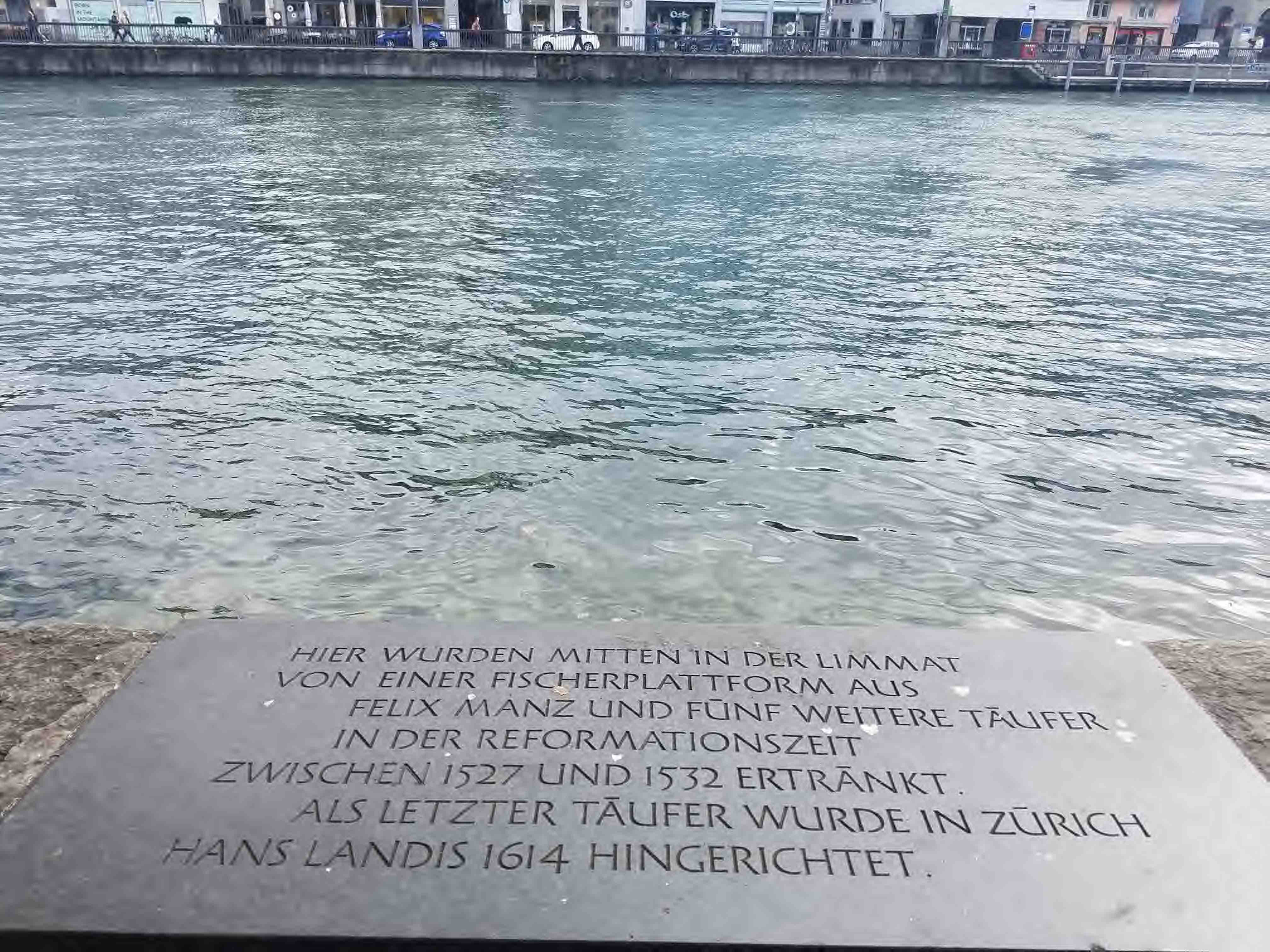
With hopes for reconciliation with Luther dashed at Marburg in 1528, Zwingli continued out on his own in his opposition to the papacy. Yet Zwingli had grown more strident in his resolve against his Protestant critics. In particular, his patience with the Anabaptists had run out. Just two years earlier in 1527, his former friend, Felix Manz, was publicly drowned in Zurich by city officials after being re-baptized. Zwingli made no effort to intercede on behalf of his old friend.

Shortly before his death, Manz wrote a letter with a stinging critique of Zwingli:

“Unfortunately, we find many people these days who exult in the gospel and teach, speak and preach much about it, yet are full of hatred and envy. They do not have the love of God in them, and their deceptions are known to everyone. For as we have experienced in these last days, there are those who have come to us in sheep’s clothing, yet are ravaging wolves who hate the pious ones of this world and thwart their way of life and the true fold. This is what the false prophets and hypocrites of this world do” (Cited in Gordon, p. 191-192).

To the Anabaptists, Zwingli embodied the worst form of self-righteous bigotry one could imagine. Zwingli’s concern was just the opposite.


A female abbey was founded in Zurich in 853. But in the early 16th century, preaching from Zwingli ended up encouraging the abbess to dissolve the abbey, and the property became the Fraumünster Church.


Zwingli Against the Anabaptists

Zwingli’s response was just as caustic, casting the Anabaptists as having the spirit of antichrist, by citing 1 John 2:19: “They went out from us, but they were not of us” (Gordon, p. 192, wrongly cites this as being from the Gospel of John). Behind all of Zwingli’s polemic against the Anabaptist desire for a pure church was Zwingli’s maturing view of the church visible and invisible, somewhat like what we find in various forms of Christian Nationalism today.

Zwingli viewed Anabaptism as a cancer which was hindering the true reformation movement, a cancer which must be eradicated. The spread of the Gospel was paramount, but it required the existence of a state sponsored church where non-believers and believers freely existed. There was no room for Roman Catholics and Anabaptists to practice their understandings of Christianity in Zwingli’s Zurich. Monasteries and nunneries were shut down in Zurich, whose inhabitants were encouraged to get married or otherwise leave the city. Catholics lost their seats on the city council.

Yet his Anabaptist critics faired no much better. Civil authorities in Zurich persecuted Anabaptists wherever they were found, with Zwingli’s blessing. The concept of religious freedom, so central to modern democratic visions of state/church relations, was completely foreign to Zwingli’s thinking.

In the year following the colloquy of Marburg, 1529, the emperor Charles V held a meeting with the Protestants in Augsburg, in hopes of trying to heal the breaches ruptured by the Protestant movement. Charles was terribly concerned that a breakdown in Europe would weaken the defence against the Turks who were on the doorstep of Vienna.  Charles was hoping for a united Christendom to face the menace of the Turks, but instead the German Protestants gave him the Augsburg Confession. Charles rejected the Augsburg Confession, which became the defining confession of Lutheranism. But then there was Zwingli.

Zwingli submitted his own “Account of the Faith” for the Diet of Augsburg, where he took on all opponents, not just the Roman Catholics. For those who held to purgatory, they had no Christ. His views regarding the sacraments remained unchanged. Yet even friends of Zwingli, like Martin Bucer, were appalled by the intransigence of the tone in which Zwingli wrote. The Lutherans there realized that Zwingli had simply dug in his heels against them. Whatever agreement had been reached at Marburg, however fragile it was, had been broken by Zwingli. The Anabaptists were treated even far worse. Zwingli along with his Zurich city-state had become increasingly isolated (Gordon, p. 226-231).

Zwingli’s theology of how the state and church relate to one another was not entirely unique.  During the medieval era in Western Europe, it was practically assumed that to be a European was to be Christian and to be a Christian was to be European, even with the presence of groups like the Jews which upset such a neat formula. Yet what made a number of Zwingli’s friends increasingly wary of the Zurich Reformer was Zwingli’s willingness to use force in order to defend his understanding of the church visible and invisible.

Even in the summer prior to Zwingli’s meeting with Luther in Marburg in 1529, hostilities between various Swiss city-states had broken out between Protestant and Catholic alliances, the First Kappel War. A peace was reached at the end of the conflict, but Zwingli believed the terms of the conflict to be an impediment to the spread of the Gospel.

Zwingli’s house: The marker above the door in English reads: “From this house he left on October 11, 1531 with the Zurich army to Kappel, where he died for his faith.”


The Death of Zwingli

Zwingli’s translation of the entire Bible into German began to be printed in 1529, even though the Swiss dialect could not compete with the influence of Luther’s Bible which came out a few years later (Gordon, p. 243). Zwingli fully believed that the cause of the Gospel was at stake, but it would take a military alliance among the Protestants to push back against Catholic resistance to Zwingli’s proposed reforms. But such an alliance seemed remote, as other Swiss Protestants hoped instead for peace and stability.

Failure of the Swiss Protestants to effectively unite emboldened the Swiss Catholic city-states to strike against Zwingli’s Zurich. By October, 1531, war had become inevitable. What began as a theological crisis with high hopes for reform some fifteen years or so earlier devolved into open military warfare. The city of Zurich sent troops out to meet the Catholic war party, and Zwingli donned armor as well and joined the Zurich military effort. When the defeated Zurichers returned later from the battle of the Second Kappel War, Zwingli’s wife Anna learned that she had lost son, her brother, her brother-in-law, and ultimately her husband, Huldrych Zwingli.

Zurich was ordered to pay reparations to the Catholic war effort, and while Zwingli’s reforms were not completely rolled back, Zwingli himself was blamed for the calamity inflicted upon Zurich. The people in the rural areas under Zurich’s influence were particularly incensed. They drafted a resolution forbidding any clergyman from meddling in civic and secular affairs, a clear rebuke against Zwingli’s memory (Gordon, p. 251-252).

Zwingli’s friends, like Martin Bucer in Strasbourg, lamented Zwingli’s death. Nevertheless, even Bucer in a letter to another reformer wrote about his disappointment with Zwingli’s proclivity towards war:

“I feared for Zwingli. The gospel triumphs through the cross. One deceives oneself when one expects the salvation of Israel through external means with impetuosity, and triumph through weapons . . . It greatly unsettles me that our Zwingli not only recommended the war but did so incorrectly, as it appears to have been the case, and if we are rightly informed” (Cited by Gordon, p. 258).

Luther’s response in Wittenberg to Zwingli’s death was not at all conciliatory. He was convinced that Zwingli died in sin and great blasphemy, as he wrote in his Table Talk:

“I wish from my heart Zwingli could be saved, but I fear the contrary; for Christ has said that those who deny him shall be damned. God’s judgment is sure and certain, and we may safely pronounce it against all the ungodly, unless God reserve unto himself a peculiar privilege and dispensation. Even so, David from his heart wished that his son Absalom might be saved, when he said: ‘Absalom my son, Absalom my son’; yet he certainly believed that he was damned, and bewailed him, not only that he died corporally, but was also lost everlastingly; for he knew that he had died in rebellion, in incest, and that he had hunted his father out of the kingdom” (Cited by Gordon, p. 259).

Luther would not have been able to succeed in the reformation of the church without the assistance of the power of the state, that much is true. However, Luther was much more cautious in linking together the church and the state than was Zwingli. Unlike Zwingli, Luther championed a theory of two powers, a spiritual kingdom associated with the church, being exercised through faith and the Gospel, and a temporal kingdom governed by the state, being exercised through efforts to maintain order and restrain sin. For Luther, the church should not exercise secular power and the state should not interfere with matters of conscience, a type of distinction which Zwingli would not recognize.

Zwingli’s capable successor in Zurich, Heinrich Bullinger, was a friend of Zwingli, but wisely chose not to respond to Luther. Even when John Calvin eventually came along to Geneva, Calvin barely mentioned the name of Zwingli in his writings. Calvin sought to find common ground among Protestants without appealing to Zwingli’s controversial legacy.


Zwingli: God’s Armed Prophet, by Bruce Gordon. I highly recommend this biography of the Swiss reformer of Zurich


Reflections on Zwingli, Particularly with Respect to Baptism and Church/State Relations

Bruce Gordon ends his book, Zwingli: God’s Armed Prophet, with a look at how biographers have remembered Zwingli over the centuries, and he even offers a review of a fairly recent movie about Zwingli’s life, one that I can highly recommend (in German, but you can find a version with English subtitles).

For me, Zwingli is in many ways a hero, a champion for preaching the Gospel, and an ardent supporter of verse-by-verse exposition of the Bible. He shocked his hearers when he set aside the standard medieval lectionary for preaching from certain texts of Scripture, and instead started with Matthew, chapter one, and worked his way verse-by-verse through the New Testament during his weekly Sunday sermons.

Zwingli did the right thing here. He did not skip over parts of the Bible that were uncomfortable. If the text mentioned something in his verse-by-verse analysis, he would address it straight from the pulpit. Today, many pastors stay away from verse-by-verse expository preaching, and stick to purely topical approaches to Scripture. Technically, there is nothing wrong with topic-oriented preaching, and topic-oriented preaching can offer a good change of pace. But the problem is that topic-oriented preaching often forces the preacher to skip over things in the text of Scripture that do not nicely fit in with the topic being focused upon. Zwingli, on the other hand, faced what was presented to him in his Bible head-on, with no skipping the hard stuff. Preaching from the text verse-by-verse leaves you with no other alternative. That, in and of itself, helped to spark the Reformation in his church in Zurich, creating the Protestant movement among the Swiss.

Yet Zwingli was a complex hero, with some serious rough edges. Zwingli remains a controversial and contradictory figure. I still puzzle over his views of the Lord’s Supper, preferring John Calvin’s third-way approach through the impasse between Zwingli and Luther. Luther overreached in his criticisms of Zwingli, but Zwingli could be just as stubborn.

Defenders of Zwingli say that the Zurich preacher was not a mere memorialist when it comes to the Lord’s Supper, and was willing to at least acknowledge the spiritual presence of Christ in the sacrament. Perhaps he was. But it is difficult to reconcile this with the tendency in certain Protestant circles, following Zwingli, to downplay the role of the Lord’s Supper in Christian worship, contrary to the historic emphasis on weekly celebration of the eucharist which has united the church for many, many centuries.

In my view, Erasmus was correct to be wary of Zwingli’s insistence on his own understanding of the perspicuity of Scripture.  Scripture is indeed clear on the central articles of Christian faith. But Zwingli was naive to think that every Bible-believing person should simply be able to draw the exact same conclusions regarding the teaching of Scripture, which were in perfect alignment with Zwingli’s own interpretations of Scripture.

There is certainly a genuine interpretation of each and every passage of Scripture, based on the original intentions of the author, but every interpreter of the Bible must acknowledge their own fallibility when it comes to handling the text of the Bible. The Scriptures are indeed without error, but our human interpretations of the text are still prone to error, so each of us should approach the Bible with a sense of exegetical humility.  If Zwingli had himself this kind of exegetical humility, it might have led him to live a much longer life and avoid the stain of controversy which still tarnishes his otherwise influential legacy to this very day.

Zwingli’s contradictions make him a fascinating figure to study. In many ways, I concur with much (though not all) of Zwingli’s understanding of baptism. Infant baptism does not save, but it does act as a New Testament parallel to the Old Testament understanding of circumcision.

Defenders of “credobaptism;” that is, “believer’s baptism,” who are critics of “paedobaptism;” that is, infant baptism, will often cite Colossians 2:12 in support of their view:

“….having been buried with him in baptism, in which you were also raised with him through faith in the powerful working of God, who raised him from the dead” (ESV).

As the argument goes, “baptism” is linked to the concept of having “faith,” therefore, baptism assumes that a candidate for baptism has exercised some form of believing faith, something which infants can not do.  While there is substantial weight to this argument, it often ignores the verse prior to it which adds some important context, directly leading into verse 12:

“In him also you were circumcised with a circumcision made without hands, by putting off the body of the flesh, by the circumcision of Christ,….” (Colossians 2:11 ESV).

Paul is clearly linking the Jewish practice of circumcision with baptism in this passage. The Old Testament quite clearly shows that Jewish male infants were circumcised, so any opponent to paedobaptism must somehow wrestle with this, in how Paul is associating circumcision with baptism. But advocates of credobaptism have a good point to make in saying that we have no clear, undisputed New Testament example of infants being baptized.

I have good friends of mine who are pastors, who in good conscience, simply could not perform an infant baptism. I totally get that. In other words, different Christians standing in good faith hold to different positions regarding baptism.

Given the difficulty of resolving the debate over infant baptism, Zwingli’s unrelenting opposition to “believer’s baptism” comes off as most extreme. Zwingli’s efforts to stamp out the Anabaptists, standing aside as the state sought to violently punish these Anabaptists, was going way too far. Linking the power of the state with the enforcement of a contentious Christian doctrine clearly reveals the dangers of a Christian Nationalism, a lesson that Christians should be reminded of today.

Baptism is not a hill I am going to die on, and it should not have been for Zwingli either. Zwingli probably had the best of intentions. Perhaps Zwingli viewed the Anabaptists as a promoting a kind of “slippery slope” to spiritual anarchy, of some sort. Yet sadly, Zwingli weaponized baptism as a violent tool of the state, ultimately and utterly missing its Scriptural purpose.

The very nature of politics assumes that it is appropriate to use force to impose laws on people. Yet if people are not persuaded in their hearts and minds that a particular law is just, they will rise up in opposition to it. This is the very problem which Zwingli ran into, and which has since tarnished his otherwise remarkable legacy.

Far from squashing the belief in “believer’s baptism,” the opposite took place. The original Anabaptist impulse, which Zwingli tried to use the heavy-hand of the state to squelch, ended up unleashing a movement whereby “believer’s baptism” has become a very dominant feature of evangelical thought and practice in the 21st century.

—————————————————-


Charlie Kirk, outspoken Christian and political activist, in his last moments before being shot by an assassin.  In my view, both Kirk and Zwingli had a lot in common.


Addendum: Is Zwingli A 16th Century Parallel to Charlie Kirk??

Zwingli’s fervent preaching of the Gospel, combined with his willingness to cozy up closely to the powers of the state, and even take up arms, should provide for us a cautionary tale. Within a month or so before our trip to Europe, walking the streets where Zwingli walked in Zurich, the Christian evangelist and conservative political activist, Charlie Kirk, was killed by an assassin. Videos of the shooting circulated for weeks on social media. The memorial service for Kirk held in Arizona featured speeches by both the American president and vice-president, with some 90,000 in attendance, while millions online viewed the service.  The event was partly a Christian revival meeting, but also had the unmistakable tone of a political rally.

After my time in Zurich, upon reflection I think that Zwingli would have been right at home with Charlie Kirk’s blend of Christian revival and political conservatism. Zwingli, as a preacher, refused to stay in his lane, and combined his evangelical calling with political activism. Defenders of Zwingli celebrated his preaching of the Gospel. Zwingli’s message stirred up revival in a Switzerland living under centuries of medieval distortions of Christian faith.  But his opposition to other sincere Christians who differed with him bred resentment from others.

A one-for-one correspondence between Zwingli and Charlie Kirk would be a misleading claim, as the circumstances of their respective deaths differ dramatically, and they lived in different cultural contexts. Nevertheless, the parallels between the two are striking. Both Zwingli and Kirk died as relatively young men. Both were evangelists. Both were strident in their beliefs, outspoken with their views, and were excellent communicators, organizers, and debaters. Both were known for their courage. Both lived with death threats issued against them. Both had close friends in high places. Both were fervent patriots. Both were misunderstood by many of their contemporaries.

Yet Zwingli’s wedding together of church and state proved to be an embarrassment for the great Reformer. Most people who think about the Reformation of the 16th century today immediately consider the names of John Calvin and Martin Luther. But Zwingli, who was just as influential, if not more so, has been a more controversial figure to grasp. Some 500 years later, Zwingli still remains relatively unknown.

Though separated by the centuries, the deaths of both Zwingli in the 16th century and Charlie Kirk in the 21st century have been tragic, even senseless losses.

The death of Charlie Kirk in September, 2025 ripped a hole in the American psyche. In many ways, the death of Huldrych Zwingli did the same thing for 16th century Europeans. It is extremely concerning when supposed Christians in response to Charlie Kirk’s death are acting out in ways that express violent rhetoric, as Christian apologist Jon McCray reported shortly after Kirk’s death:

I do wonder how many champions of Charlie Kirk today think about the complicated memory of Huldrych Zwingli, and what can be learned from the Protestant reformer of Zurich.

Some might think that my comments reflect a kind of wishy-washy, fake “third wayism,” which in some quarters gets a lot of harsh criticism today. If you want a helpful clarification as to what I am getting at, then take a few extra minutes and watch the following video by Christian apologist Gavin Ortlund, who makes a defense of the late Tim Keller, whose legacy has come under fire recently in the wake of Charlie Kirk’s death. Even if you come to the conclusion that a “third way” approach offered by a Tim Keller or Gavin Ortlund is inherently bad, at least make the step of acting in good faith and not misrepresent what a Tim Keller or Gavin Ortlund is saying:

Which is better: To be winsome and persuasive, or confrontational and combative?  I favor the former over the latter.

Christians should be involved in the political process. But when Christians tend to elevate political concerns in such a way that the clear proclamation of the Gospel tends to get overshadowed and crowded out, great harm can be done. We can learn from church history, to avoid some of the terrible mistakes made in the past, a lesson we should not ignore. The story of Zwingli serves as a sobering example for us today.