
From the Christianity Along the Rhine Blog Series…
The courage and conviction of a Swiss radical reformer, Felix Manz, has inspired Christians who have since come after him for almost 500 years. But who was Felix Manz?
In October, 2025, my wife and I took a trip to Europe, visiting a few sites linked to the history of the Protestant Reformation. One of those sites was the city of Zurich, Switzerland, the home of Huldrych Zwingli, one of the leading lights of the Protestant Reformation, alongside more well-known figures like Germany’s Martin Luther and Geneva’s John Calvin. Check out the two-part blog series about Zwingli recently covered a few months ago on Veracity, which gives some background regarding Felix Manz.
Felix Manz was at one time a follower of Zwingli, the great Protestant reformer of Zurich. Desiderius Erasmus, one of the most widely read authors of the day and a theologian from the Netherlands, had shocked the medieval world with his new, authoritative Greek New Testament. Since the fall of Constantinople to the Turks in 1453, scholars from the Christian East had brought their copies of the Greek New Testament to the Christian West. In examining these copies of the New Testament, which was originally written in Greek, it became apparent that some traditional interpretations of the New Testament popularly received in the West were not accurate. In going back to the original sources, “ad fontes,” as humanists like Erasmus called it, a new effort was made to refresh medieval ideas about the New Testament. Feliz Manz had become familiar with Erasmus’ work, and it changed his life.
Zwingli and Manz were part of this effort in Zurich, Switzerland. Like Zwingli, Manz had been educated in the biblical languages of Hebrew and Greek. Zwingli was the fiery preacher who advocated for the reforms of Erasmus, but Zwingli went beyond Erasmus in challenging papal authority itself. At first, Felix Manz applauded Zwingli’s efforts for reform. However, later on, Manz did not believe that Zwingli went far enough.
Zwingli was convinced that the traditional Christian view affirming the practice of infant baptism was thoroughly biblical. But Manz was not convinced. Manz and his friends were persuaded that only the practice of “believer’s baptism,” whereby adults (or perhaps older children) who made a profession of Christian faith should be baptized.

Felix Manz, who had been baptized as an infant, was baptized as an adult near this spot in Zurich, Switzerland, an act defiance and conviction, which cost him his life. Manz’ “believer’s baptism” happened just over 500 years ago, in January, 1525. Manz was executed two years later, 1527. My photo, October, 2025.
The Anabaptist Movement: Felix Manz, the First Anabaptist
A debate was held in the mid 1520’s, some five hundred years ago, presided by the Zurich city council, to determine who was right, Zwingli or Manz. In the end, the Zurich government authorities sided with Zwingli. Manz and his friends took the radical step of having themselves baptized by one another.
Imagine the shock to the medieval mind this type of thinking created. Felix Manz had already been baptized once as a baby. But now, as a believing adult, he became re-baptized, or baptized for a second time, having become convinced that his baptism as a baby was not grounded in Scriptural teaching. Ephesians 4:5 called for “one Lord, one faith, one baptism,” so Manz’ second baptism threw a wrench into the older, traditional theology. It was for this reason that Manz and his friends became founders of the Anabaptist movement, whereby the term meant to be “baptized again.”
Yet the authority of the church and the state were tightly intertwined at this time. The Zurich government decided that Manz should be punished, to set an example for others who dared to challenge the state’s authority to weigh in on religious matters.
What was Manz’ punishment? To be baptized yet a third time, but this time, it would be death by drowning in the Limmat River, which passes through the city of Zurich.
His former friend, Zwingli, did nothing to intervene. As the citizens of Zurich looked on, Felix Manz was tied up and bound, and then tossed into the freezing Limmat River in early January, 1527.
Felix Manz became the first martyr for the Anabaptist cause, inspiring groups today like the Mennonites and the Amish, who follow in that same theological tradition established in the early 16th century. The Anabaptists tended to pick up other radical teachings, associated with their readings of the New Testament, such as the rejection of military service and communal living with no private property, ideas which led to further persecution from both Roman Catholics and more mainline Protestant movements.
A little over a century later, Felix Manz’ specific teaching regarding believer’s baptism was embraced by another reform movement within the larger Protestant movement, which we now know as the Baptist faith. Those early Baptists were very much like their “Reformed” cousins in their theology, except for where they stood on infant baptism. In other words, while Felix Manz did not survive his “third” baptism, his teachings did survive and flourishes in both Anabaptist and Baptist circles all over the world today.
Thankfully, Christians today generally try not to use the force of the state to regulate theological opinions. Local churches will have their differences on whether or not infant baptism is permitted for their congregations. But it is quite common for infant baptism affirming churches to maintain some form of fellowship with infant baptism non-affirming churches, and vice-versa, despite differences in such practices. This is not wholly unlike how local churches may differ regarding whether or not women may serve as elders; part of the so-called complementarian-egalitarian controversy, or with differences regarding whether or not certain supernatural gifts of the Spirit; such as speaking in tongues and prophecy, are thought to be normative today.
For centuries, most Christians in the West from the era of the early church developed the habit of having their children baptized within a few weeks, if not days, after birth. Felix Manz broke the mold which had anchored Western Christianity, and he paid for that with his life.
Many evangelical churches today, of the so-called “interdenominational” or “non-denominational” variety, have replaced infant baptism with something called “baby dedications.” This practice is kind of a half-way approach to resolving the baptism controversy. A “baby dedication” looks like infant baptism (sort of), but it is not baptism. But at least it conveys to parents a means by which their infant children can have some type of meaningful connection to their local church.
The only problem with a “baby dedication” is that it only has vague support for it in the Bible, if any. But so-called “interdenominational” or “non-denominational” churches often go that route as it is an imperfect yet practical means of maintaining some type of peace in such churches.
Before Felix Manz, Christians never practiced “baby dedications,” for the first 1500 years of the Christian movement’s history, and scholars debate as to when the practice finally caught on. Some say that the Anabaptists themselves adopted the practice in the 16th century, looking to examples in the Bible like Hannah dedicating her child to the Lord (1 Samuel 1:11) and Mary and Joseph presenting their baby to the Lord in the Temple (Luke 2:22). But it has only really been in the modern era, with “interdenominational” or “non-denominational” churches, that “baby dedications” have become normative in at least certain parts of the Protestant evangelical world.
Basically, either you have infant baptism in a local church, or you do not. It is a binary choice. But “baby dedications” offer such local churches a means of adhering to the common ground held by all Christians affirming the validity of “believer’s baptism” for adults or older children, and not introducing a potentially divisive issue like infant baptism.
It has become standard practice in such churches to have their children, whether dedicated or not, wait until they have made a profession of faith, as they get older, before stepping forward to be baptized.
You can pretty much thank Felix Manz for setting that precedent.
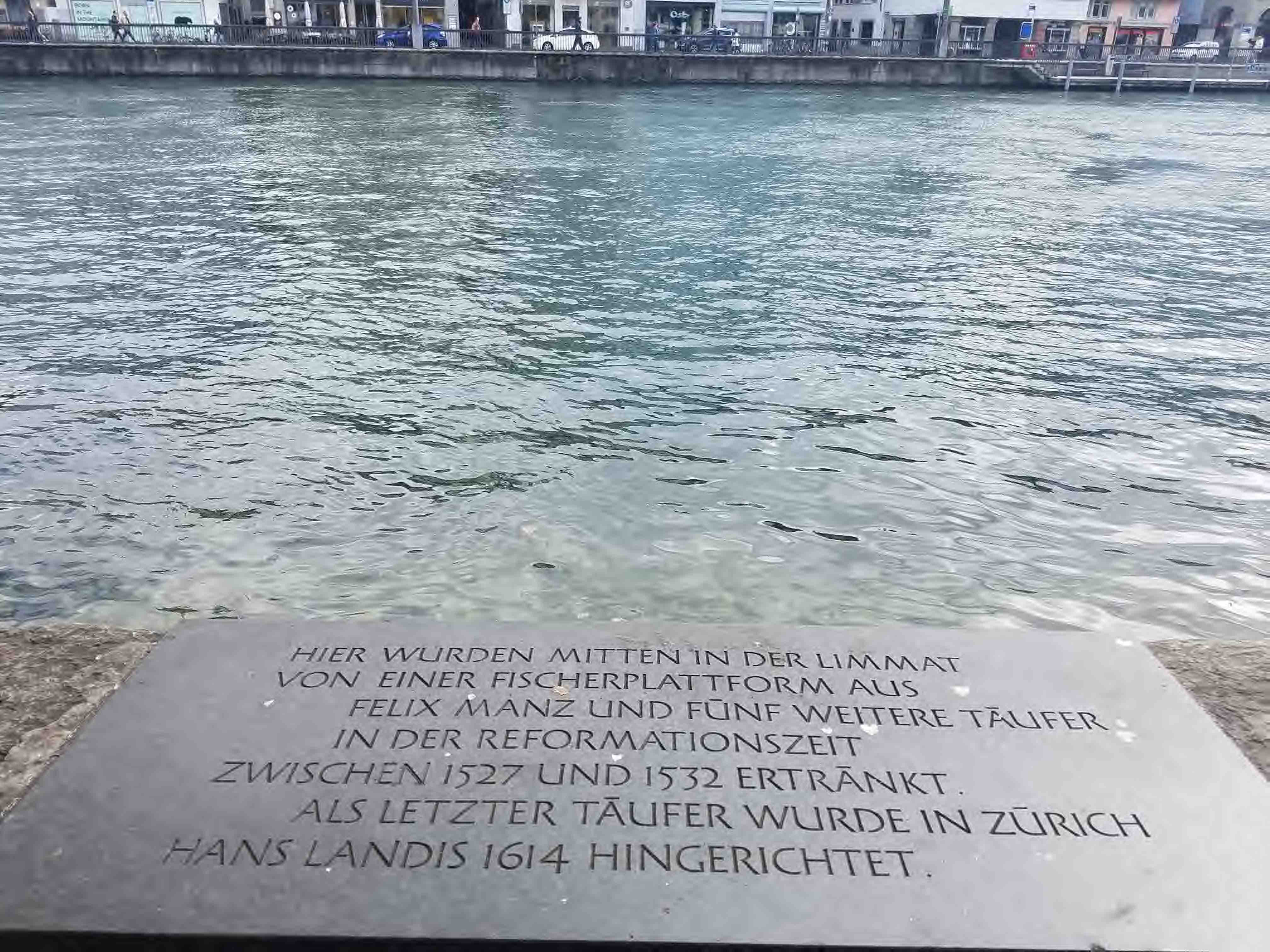
In English, this marker on the Limmat River reads: “Here, Felix Manz and five other Anabaptists were drowned off a fishing platform in the middle of the River Limmat during the 1527-1532 Reformation. Hans Landis was the final Anabaptist executed (1614).” Memorial Plaque, Schipfe Quater, Zürich, CH. My photo, October 2025.




 Veracity
What do you think?