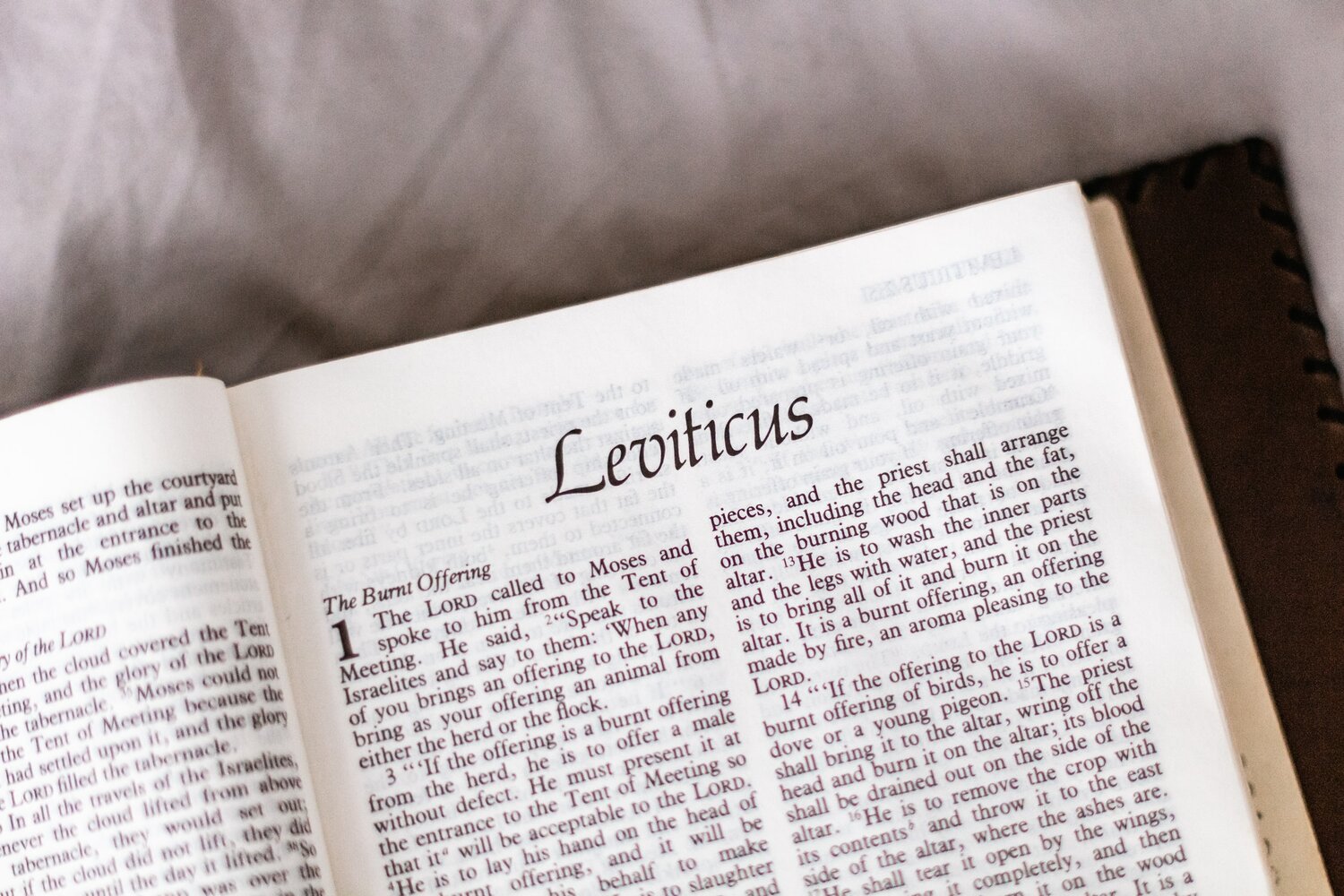
Which parts of the Law of Moses found in the Book of Leviticus are still binding on the Christian today? Christians from diverse traditions debate this most controversial topic. Jonathan Edwards, perhaps America’s greatest theological mind, had this to say:
“There is perhaps no part of divinity attended with so much intricacy, and wherein orthodox divines do so much differ, as stating of the precise agreement and differences between the two dispensations of Moses and Christ.”1
Leviticus is essentially a law book, detailing the specifics of the Old Covenant, which defined the standards for the ancient Israelite community. But what exactly are the elements from that Old Covenant that have been brought forward into New Covenant? And even if particulars of certain Old Covenant regulations from Leviticus are not binding on New Covenant believers, might there still be lessons in Christian obedience to be learned from them today?
Protestant evangelicals are divided on such issues: Is tithing carried forward under the New Covenant? Does the Bible allow Christians to get tattoos? What about Saturday Sabbath observance? Hebrew Roots Movement enthusiasts bring forward as much from the Old Covenant as they can, even without a standing temple in Jerusalem. Progressive Christians do just the opposite, and jettison as much of the Old Covenant as they can, when certain moral prescriptions are deemed out-of-date. The diversity of such practical applications in interpreting Leviticus can be bewildering.
I came across the teaching of the late Dr. Michael Heiser several years ago, through his Naked Bible Podcast. An expert in Semitic languages and the Old Testament, he did an audio series on the Book of Leviticus, which were transcribed to form the book Notes on Leviticus: From the Naked Bible Podcast. As the author of The Unseen Realm, one of the most groundbreaking books I have read in recent memory, having influence across multiple denominations and Christian traditions, Heiser walks the student of Leviticus through the text in ways that opened up the book for me, with a lens that helps to better understand so many other parts of the Bible. As I have noted at several points, I am not always convinced by Dr. Heiser’s thinking, but he is way far more right than wrong in what he says, and he challenges me to think more deeply on crucial issues concerning the Bible. The tens of thousands of thoughtful Christians who follow Heiser’s YouTube channel surely agree with me.
Heiser’s premise is that Christian readers have often read Leviticus through presuppositions they bring in from their understanding of the New Testament, often confusing things in the process. Alternatively, Heiser proposes that we should learn to read Leviticus from the perspective of an ancient Israelite. What did Leviticus mean to a follower of Yahweh centuries before Jesus came on the scene?
One of the major themes in Leviticus is the concept of atonement. I am publishing this post on Good Friday, which in the Christian calendar commemorates what Jesus accomplished on the cross for us. Many theologians link Good Friday to the concept of atonement, the focus of this final post in this series. But the exact meaning of atonement has stimulated a significant debate among scholars: What does it mean to say that Jesus died for our sins?
On the late Michael Heiser’s Naked Bible Podcast, this Old Testament scholar brings out important highlights, accessible to everyday Christians, who want to have a better grasp on Leviticus, one of the least studied, least understood, and least read books in the Old Testament.
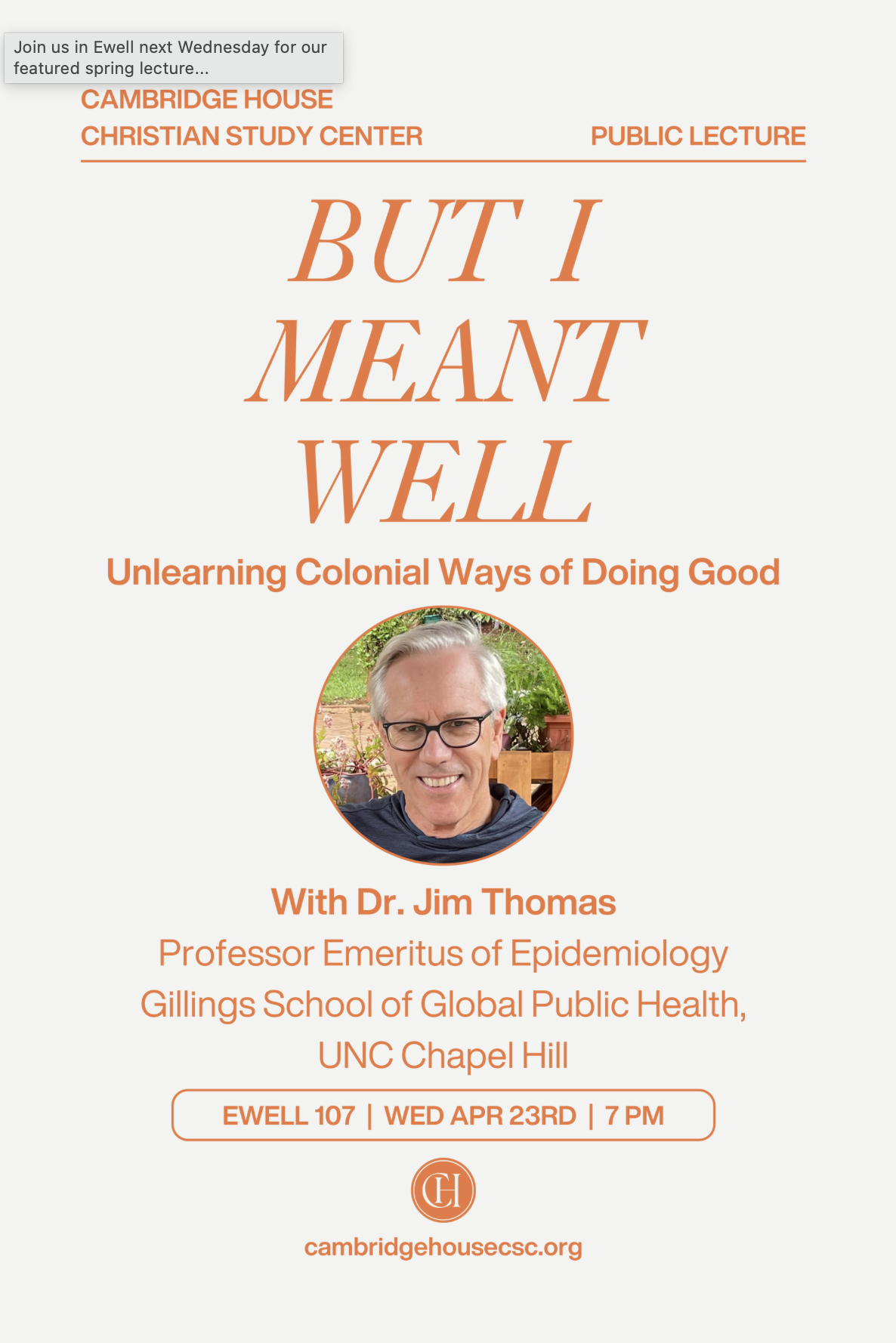
Come on out next week for the annual spring lecture sponsored by the Cambridge House, the Christian study center near the campus of the College of William & Mary. Cambridge House is about fostering dialogue about the historically orthodox Christian faith within the campus academic community, offering hospitality to students, faculty, staff, and friends of the study center in the Williamsburg area.
But I Meant Well: Unlearning Colonial Ways of Doing Good Wednesday, April 23rd | 7 PM | Ewell Hall, Room 107 Our spring lecture, “But I Meant Well: Unlearning Colonial Ways of Doing Good,” will be presented by Dr. Jim Thomas at Ewell Hall.
Jim has worked as an epidemiologist and ethicist in more than 40 countries. As a social epidemiologist, he studied how social forces, such as mass incarceration, shape the distribution of health outcomes in a community. As an ethicist, he was the principle author of the first American public health code of ethics and now advises other countries as they write their codes. While in Ghana to coordinate with the World Health Organization on data collection following an Ebola epidemic, he visited Elmina Fort. Elmina is where Africans were enslaved and held to be put on ships to the Americas. Seeing a church in Elmina was a shock to Jim’s Christian faith. On Wednesday, April 23rd, he will talk about how he processed that shock over the following years and how it affects his international work now.
Jim is an Emeritus Professor of Epidemiology in the Gillings School of Global Public Health at the University of North Carolina, Chapel Hill. Additionally, he serves as an Adjunct Professor at the French École des Hautes Études en Santé Publique.
If you can come, take a minute and RSVP, so that we can have a semi-accurate head count! See you next Wednesday!
A popular online video makes the rounds every now and then with a clip from The West Wing, a political drama television series broadcast from 1999 to 2006. It features a scene where the President of the United States, played by the actor Martin Sheen, has an interaction with either a Jewish or Christian call-in show host, with a PhD, where they have some back and forth regarding the interpretation of the Book of Leviticus, and a few other passages describing particulars of Old Testament Law.
The scene dramatizes a heightened conflict, concerning the instruction in Leviticus 18:22 prohibiting same-sex relations. The President challenges the doctor by quoting select verses, such as Exodus 35:2, which prescribes the death penalty for those who violate the Sabbath. Then there is Leviticus 11:7-8, which forbids an Israelite from touching the dead skin of a pig. Would someone playing football be required to wear gloves to avoid becoming unclean? What about Leviticus 19:19, which forbids planting two different kinds of crops within the same field, and wearing different kinds of fabric in their clothing?
The message of The West Wing video connects with many in our culture today, appealing to both non-believers and progressive Christians alike, who find the regulations described in the Book of Leviticus to be baffling, to say the least, if not overly harsh and rigid. At least on an emotional level, it is difficult to parse out why a prohibition against same-sex relations would be mixed in with odd requirements about not wearing two types of clothing (Leviticus 19:19). If historically-orthodox Christians seem so adamant about defending a definition of marriage restricted to one man and one woman for one lifetime, why is it that they seem so casual about wearing clothing made up of both cotton and polyester, when Leviticus addresses both subjects with disapproval?
Such a posture comes across to many critics today as needlessly judgmental, hypocritical, and not very loving. As a result, many progressive Christians (though not all) would rather lump the Levitical prohibition against same-sex acts in with instructions about not planting two different kinds of crops within the same field: Dismiss both of them!
The non-believer would go further and dismiss the whole Bible as a muddle of contradictions, an outdated moral system stuck in the Late Bronze age. Either way, the conclusion drawn by such critics and skeptics is the same: the regulations in Leviticus as a whole are a bunch of nonsense and no longer apply in today’s world. Get your morality from somewhere else other than Leviticus.
On the late Michael Heiser’s Naked Bible Podcast, this Old Testament scholar brings out important highlights, accessible to everyday Christians, who want to have a better grasp on Leviticus, one of the least studied, least understood, and least read books in the Old Testament.
Leviticus: An Outdated Relic from the Late Bronze Age?
Frankly, there are many conservative Christians, who while not being persuaded by such an impactful rhetorical argument, simply would not know how to respond to this kind of message. Disagreements between such progressive Christians and non-believers on the one side, and conservative and even moderate Christians on the other, are indeed very difficult to resolve. Is there any way to make sense of Leviticus? What would it have meant to an ancient Israelite many hundreds of years ago? Is there any kind of sensible application to make today for Christians? Or to put it bluntly: Are historically orthodox Christians really hopeless bigots?
I took the time to listen to Dr. Michael Heiser‘s Naked Bible Podcast series, covering the Book of Leviticus. I was surprised to learn that there are indeed ways in which scholars have been able to parse through such difficult texts, and make sense of them. Heiser’s teaching, where the transcripts of these podcasts have been put into book form, Notes on Leviticus: from the Naked Bible Podcast, while not a full-blown verse-by-verse analysis of every sentence in Leviticus, it nevertheless is an in-depth treatment of the Levitical system, exploring the logic of what is what in Leviticus, and what continues to be applicable today (and how) in a New Testament context, and what does not. While not every question I had in mind was answered, I gained a much better perspective as to how the Bible can be read within its historical, cultural context.
The Difference Between Ritual Impurity and Moral Impurity, in the Old Testament Jewish Mindset
In the previous post in this series, I reflected on Heiser’s teaching regarding “sacred space,” and the distinction between ritual impurity and moral impurity, despite the fact that both concepts of impurity often share the same language of “clean versus unclean.” Ritual impurities are simply things that happen in the normal course of life, and therefore, are not sinful, whereas moral impurities do qualify as sin, in the New Testament sense. The tabernacle/temple idea in Old Testament Judaism is about defining an area of “sacred space,” where God dwells. For someone to enter this “sacred space,” one needs to be fit to enter it, cleansed from both ritual and moral impurity.
One may easily see that the prohibition against same-sex relations is an example of a moral purity regulation as it is associated with the language of “abomination” (Leviticus 18:22). But it is difficult to understand how this relates to commands about mixtures in Leviticus 19:19, just one chapter later:
“You shall keep my statutes. You shall not let your cattle breed with a different kind. You shall not sow your field with two kinds of seed, nor shall you wear a garment of cloth made of two kinds of material.”
A similar passage is found in Deuteronomy 22:9-11. The New Testament is silent about the Leviticus regulations on mixtures. Some scholars argue that since the prohibition against same-sex relations is repeated in the New Testament (1 Cor 6:9-10, Romans 1:26-27), and that the commands against mixtures are not repeated in the New Testament, that the prohibition against same-sex relations is applicable for Christians today but that the commands against mixtures are not. While there is strength to this argument, it does not help us much in understanding why these commands are different from one another. If the commands against mixtures are not related to moral impurity, what about them makes them related to ritual impurity? What is the logic behind both of these regulations: the one concerning homosexual practice and the commands against mixtures?
With respect to homosexuality, it can be easily established that male same-sex relations can imply a role and power imbalance, where one sexual partner dominates and penetrates the other. Outside of ancient Israel, same-sex relations were allowed, with caveats. Heiser notes that same-sex relations were still looked down, but in general, they were not severely punished, in comparison with what is described in the Old Testament. Outside of Israel, homosexual rape was condemned in certain cultures. However, pederasty, where Greek adult men would have sexual relations with younger men, was used as a method of training in the art of war. In this context, homosexual activity was not condemned. Israel was the exception in that all same-sex relations were condemned (Heiser, p. 231ff).
In citing the Jewish Old Testament scholar, Jacob Milgrom, Heiser concludes that homosexual practice goes against the creation order, in that it removes the possibility for procreation. While procreation is not the sole purpose of sex, as texts like the Song of Solomon celebrate human sexuality without reference to procreation, homosexual practice takes the procreative act out of sexual expression. Since the God of Israel is a God of life, to deny procreation from an Old Testament standpoint runs against God’s purposes for human sexuality.
The omission of any reference to lesbianism in the Old Testament is curious. Nevertheless, Paul’s inclusion of a prohibition against lesbian sexual expression in Romans 1:26-27 shows a parallel to male-male sexual relations. As Heiser summarizes:
“These passages are not written so that space is devoted to being mean. They’re written to reinforce a worldview that elevated the production of and care for human life” (Heiser, p. 237).1
The commands which restrict mixtures in Leviticus,about wearing different types of clothing, planting different types of seed in a field, etc., are even more perplexing. Centuries later, in the time of David, the Bible mentions mules, which are bred with a mixture of horse and donkey (1 Kings 1:45-47). But the Bible never has anything negative to say about mules. So, how does a student of Scripture make sense of all of this? Thankfully, recent scholarship, particularly from the eminent Jewish scholar, Jacob Milgrom, which Michael Heiser relates to the reader/listener, can help to sort things out.




 Veracity