
Life transitions are hard. Particularly when it comes to the death of someone special to you.
When my two parents died within nearly a year from one another, I felt like the world shifted underneath my feet. I thankfully had some good friends over the years, along with numerous cousins, and I had been married for about fifteen years. However, these relationships only encompassed certain portions of my life. My parents on the other hand were there over the entirety of my life up to that point.
Though I was closer emotionally to my mom, losing my dad after my mom turned out to be harder. My mom remained pretty sharp until her cancer incapacitated her in her last two months. Yet my dad’s advancing dementia spanned well over a year. Seeing him slip over that period eventually led to my despair the day he died, when I finally realized that the only person left who knew me during my whole life was gone. What was going to happen next?
One of the last persons to visit with my dad before he died was pastor Travis Simone, just three days before I got the phone call that my dad was dead. As I recall, a few days later Travis came by my house and brought me a Tim Keller book on suffering. I appreciated that Travis was there to help me through my life transition at a critical time.
I think about that transition time as I have read Travis’ D.Min doctoral paper, Moses is Dead: Strategies for Pastoral Transition. Just as the death of Moses eventually allowed the “baton to be passed” to Joshua, Travis had experienced his own transition, just a few years prior to my parents’ death.
Our church had suddenly lost our then lead pastor for several decades, due to an uncomfortable and unresolved controversy. Though not a physical death, the loss of the lead pastor was still a kind of death, an experience that was both shocking and unsettling. Many congregants who had made the church their Christian home for years were traumatized.
As a less senior member of the pastoral staff, Travis was suddenly asked to step forward as the interim pastor of a rather large congregation. If there was such a thing as a “megachurch” in Williamsburg, Virginia, hardly a large city, it was our church: the Williamsburg Community Chapel. Travis had to help our church navigate that difficult period, and he eventually was selected by the church membership to be the next lead pastor of this independent church, which had no denominational backing or predetermined succession plan. The church had been a part of a loose network of churches, a “consortium”, made up of other “community chapels” in the greater Hampton Roads Virginia area. But for the most part, that relationship at that particular moment was rather quite loose, so our church was pretty much on its own. It was a tough task to take on.
Life transitions are hard. Sudden church leadership transitions included.
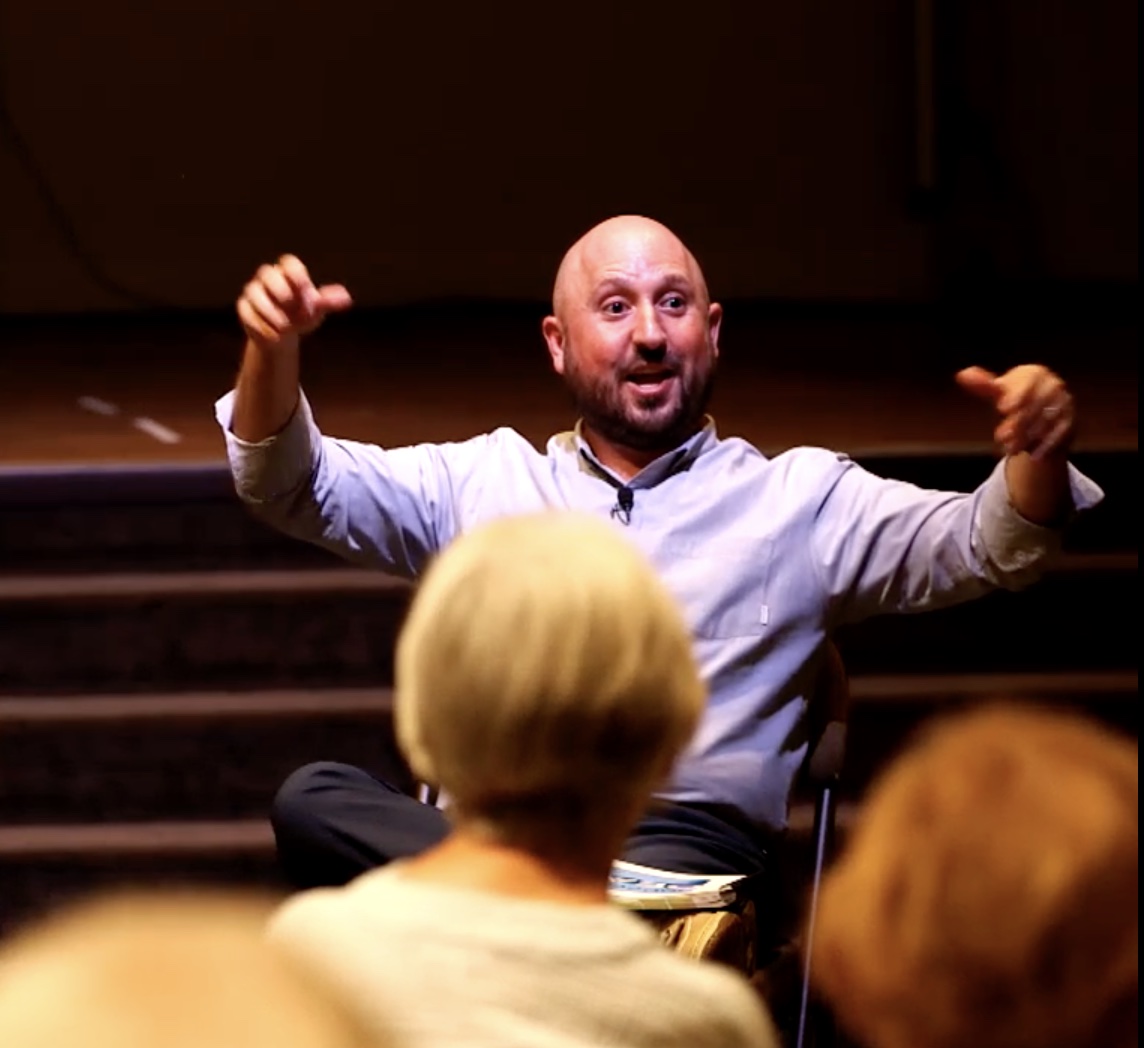
Pastor Travis Simone, leading a book club discussion for his recent D.Min. dissertation entitled Moses Is Dead: Strategies for Pastoral Transition in the summer of 2024, at the Williamsburg Community Chapel.
Moses Is Dead
Travis’ paper entitled Moses is Dead recalls the episode from the Old Testament in Deuteronomy 31-34 where the people of Israel were on the east side of the Jordan River, getting ready to settle towards the Promised Land, which existed primarily on the west side of the Jordan. Moses dies, and Joshua is then thrust into the role of leading the people of Israel. Travis uses this episode as the lens in which he reviews his own journey as a “Joshua” figure at an independent church in transition,.
This congregation had done relatively well in making a transition nearly 25 years earlier from a very accomplished, winsome, and popular preacher to his successor. The “Moses” figure at that point was suffering a debilitating spinal cord condition, which eventually left him as a quadrapelegic. It was evident back then that a transition to a new “Joshua” leader was necessary. Thankfully, the transition process was fairly smooth as the two leaders overlapped one another over a significant period of time of several years. As I was personally there to see it, it was clear that the former leader had given his blessing for the new leader to take over the lead pastoral duties, and that the new leader expressed gratitude for what the previous leader had given to the congregation.
However, in Travis’ situation roughly over 10 years ago, the transition was abrupt and jarring, with the sudden departure of Travis’ predecessor. Moses is Dead describes the lessons Travis learned in this process.
Lessons Learned For How to Successfully Navigate a Leadership Transition
Travis notes that a successful church leadership transition requires the congregation to look for a “one-eyed” pastor. The 4th century early church father Gregory of Nyssa thought that a pastor should have “a single eye to the things of God.” Instead of asking “what should our pastor do?,” Travis argues that a better question would be “what should our pastor be?” Or to put it differently, Jesus is the only true pastor of any church, and that any church leader needs to uphold such a perspective as an expression of one’s character.
The next lesson is that any successful church transition requires the deployment of a king, prophet, and priest. The work of the king is to build institutions. The work of the prophet is to imaginatively ask questions like, “Where should we be regarding mission and organization?” The work of the priest is to ask, “Where are we relationally and what is required to maintain healthy congregational relationships?” No one person can adequately step into all three roles. Instead, it requires a team effort within a church in order to realize a successful leadership transition.
The follow up lesson to the above is to learn how to speak with candor towards every constituency within the local church body. This requires good communication skills, and most importantly, the gift of listening well. With every church leadership transition, whether expected or suddenly unexpected, giving voice to lamentations among the congregants is a vitally important part of the process.
Travis also suggests that it is important to allow the baton to be dropped in the process of making a successful transition, a point to be addressed later in this review. Furthermore, a successful transition requires independent churches to cultivate a sense of interdependence with other like-minded churches, as was eventually the case with the “Hampton Roads Consortium,” in which our church had been a member.
Reflections on “Moses Is Dead”
All of the lessons which Travis describes are invaluable. As a congregant who participated in the life of this independent church as it was making its way through the transition involving Travis, several immediate responses come to mind.
First, when it comes to the need for candor, I am convinced from Travis’ paper that our church had failed on this point. The elders of the church had decided to sign a non-disclosure agreement regarding the effective dismissal of Travis’ predecessor. Originally, I thought this might be a good idea, as it put the burden of responsibility upon Travis’ predecessor to make amends regarding the reason for the unexpected departure. Sadly, such closure was not adequately realized, at least in the minds of many in our church, which left a lot of people having distrust with the elders concerning what had actually transpired. Looking back now, the idea of having such a non-disclosure agreement was a mistake. It effectively bound the elders to a type of silence in which candor was sacrificed, leading to further distrust and disillusion.
Secondly, it was startling to learn that this independent church had no transition plan in place ahead of time, in case something like what might happen actually happened. In his paper, Travis includes two appendices, one with a copy of the “Hampton Roads Consortium Covenant,” dated May 2004. Having been associated with the church for many years, I confess as to having been completely ignorant that such a covenant even existed, outlining the visions, values, and commitments of this group of independent churches.
The second appendix is an updated version of the same covenant, dated November, 2016, with additional verbiage discussing the “Consortium Involvement in Pastoral Censure,” which gives guidance for helping churches with difficult leadership transitions. One item regarding the “Need” is worth quoting:
“Independent evangelical churches are susceptible to church splits for many reasons. One reason can be the valid dismissal of a senior pastor for moral failure, changes in philosophy of ministry (for instance the dropping of interest in world missions) or doctrinal reasons. Alister McGrath in Evangelicalism and the Future of Christianity (IVP, 1995) comments on this under “The Curse of the Evangelical Personality Cult” (p. 148f). His advice is that we need to encourage the Reformational idea of the priesthood of all believers” (Simone, p. 166-167).
The inclusion of this appendix is worth the paper’s worth in gold. What if the measures proposed in this appendix were well understood by the elders of the local church prior to the crisis in our church, instead of after the fact?
The lack of having an advance plan for handling unexpected leadership transitions, among other concerns, in my view, was an oversight on part of the elders (ironically). Scripturally speaking, one of the primary purposes of having local church elders is to provide some continuity with the past. In Acts 20, the Apostle Paul met with the church elders of Ephesus in the city of Miletus, after Paul made it clear that he would not be returning to Ephesus to shepherd the church there.
We have no evidence as to when Paul instituted the office of elders in Ephesus, though most scholars acknowledge that Paul had served the church in Ephesus for around three years (Acts 20:31). There would have been no need to have an office of elders out at the outset of the founding of the church in Ephesus until after it had gained at least some maturity and stability. But once some stability was reached and Paul decided to move on for various other reasons, the institution of those elders became important in providing continuity for the mission, shepherding the flock and protecting against false teaching which might undermine the work which Paul himself had established.
Moses Died in a Board Room
As Travis tells his story, “For me, Moses died in a boardroom” (Simone, p. 22). This was the moment when Travis’ predecessor had just departed the church, when the elders met to discuss what to do next.
‘… the board struggled to find their footing. Eventually a board member voiced what everyone was feeling, asking “What does this board even do?” An honest reply came from another board member: “I don’t know, we always just did what the pastor told us to do” (Simone, p. 23).
My heart sank when I read that paragraph.
I had to put Travis’ paper down for a few days to think about what I just read.
A number of years have since passed since Travis’ evening in that board room. It is evident now in my mind that a cohesive, across-the-board understanding of what biblical eldership is to be about was not completely present at the Williamsburg Community Chapel both during and after the crisis which led to the transition involving Travis. I say this with some hesitancy, mixed with fear and trembling, as a number of those elders I still consider to be dear friends, siblings in Christ. Alas, looking back on this in hindsight is all water under the bridge.
Moreover, as a lesson that I believe to be valuable, it should be a part of the educational program for new church members, to require at least some acquaintance with how an elder is defined by that local church body, and what type of plan is in place to deal with leadership transitions, particularly at the highest level.
Among Travis’ other lessons learned is the importance of sabbath. In Moses is Dead, Travis gives an outline of the sabbatical leave policy for the Williamsburg Community Chapel. Full-time pastoral team members are required to comply with the terms set in the policy. Broadly put, after six years, such pastors must take a three-month sabbatical leave, which is mandatory. This is a good policy to have in place, as such a policy might have prevented the crisis from at least 10 years ago from happening in the first place.
The Promise and Pitfalls of an Independent Church
A review like this would not be honest if it did not include some critical pushback. While independent churches have some definite advantages to them; such as the ability to be more nimble and flexible than a large bureaucratic structure associated with a denomination, independent churches have certain downsides to them as well. Travis was able to recognize several of these downsides in his paper, suggesting that the best solution for independent churches would be for “seeking interdependence,” particularly among other like-minded congregations. Travis explores this for sure, but perhaps not enough.
I wish every church leader would take the time to listen to Christianity Today’s podcast on “The Rise and Fall of Mars Hill,” the story of the largest megachurch in the Seattle, Washington area, when a conflict between the elders and the then lead pastor, Mark Driscoll, led to almost a complete meltdown of this large, multi-site independent church. I confess that several years before Driscoll’s departure at Mars Hill Church, I really liked the guy. If I was living in Seattle, I probably would have at least visited his church, if not becoming a regular worshipper there. I even posted some of his videos here on the Veracity blog, which have since been removed from the Internet by Mars Hill following the scandal at Mars Hill. Watching Mars Hill implode from across the Internet was unsettling.
One particular episode of the podcast featured an interview with the late Tim Keller, whereby Keller spoke of the advantages of being part of a denomination, like the Presbyterian Church of America. In particular, Keller noted that a denominational structure offers a built-in system of accountability that an independent church often lacks. Travis acknowledges the value of the insights that someone like the late Tim Keller brings to the discussion, which is very good. That being said, in my view, Travis did not highlight these elements enough in his paper.
Any independent church which hopes to successfully survive a pastoral leadership change, whether it be a planned succession over time or a sudden response to a crisis, needs to have a theological framework to undergird it. For example, in Matthew 16:13-20, Jesus takes his band of followers to Caesarea Philippi, where Simon Peter makes his famous first confession of faith that Jesus is indeed the Messiah. Jesus responds in verse 18: “And I tell you, you are Peter, and on this rock I will build my church, and the gates of hell shall not prevail against it.”
The English word for “church” here is derived from the Greek “ekklesia,” which in its original context simply means “assembly.” However, too often, independent churches will apply this sense of “church” to their own local congregation, thereby missing the larger universal context of what Jesus is teaching. Some think that when Jesus is speaking of “my church” that he means “my local church congregation.” That might be a valid application in certain situations, but it is not good exegesis of the text.
What begins with Peter and the rest of Jesus’ early followers is not simply one unique local expression of a community. Rather, this is a reference to the church universal, a movement that has reshaped the world for the past 2,000 years, with well over 2 billion claiming adherents to the faith, and countless local churches included. Simply having the word “interdenominational” or “nondenominational” within the motto of an independent church is insufficient for establishing a robust theological understanding of how such a church should go about seeking interdependence within the larger Body of Christ universal. It would have been helpful if Travis had explored that theological dimension more in his paper.
Part of the problem stems back to some basic critiques of the evangelical Protestant movement itself, which is largely responsible for the increasing rise of independent churches in America. In his chapter on “Evangelicalism” in Rock and Sand, Eastern Orthodox priest and author Josiah Trenham articulates what he sees as the Achilles Heel of evangelical Protestantism:
“Many modern Protestants do not even recognize themselves as the heirs of the Protestant Reformation. The most vibrant and demographically explosive forms of Protestantism are so ahistorical, so radically detached from the historic Christian ethos that an organic association even with their own Protestant lineage is too much of a chronological and dogmatic commitment. For many of these Protestant Christians the only relevant history of Christianity began with the history of their own particular congregation or even the history of their particular preacher and no tangible connection to the Christian past is considered essential. What matters to them is that their spiritual experience is real, not that their spiritual experience is in harmony with that of their forebears.”
Evangelical Protestants typically fall into one of two categories when thinking about a tradition like Josiah Trenham’s Eastern Orthodoxy. Either they are completely unfamiliar with Eastern Orthodoxy, not knowing what to think about it, or they treat Eastern Orthodox Christians as heretics (at worst) or just plain weird (at best).
However, this stinging rebuke above by Father Trenham exposes two cumbersome problems often associated with independent evangelical Protestant churches, particularly when it comes to leadership transitions. First, there is often a disturbing lack of knowledge about church history, both the long view towards the 2,000 year story of the church more broadly as well as the history of the independent church congregation in particular.
Today’s independent churches, particularly within the United States, are a uniquely Protestant phenomenon having grown considerably within the past few decades. As the Protestant mainline tradition of the 20th century has declined in the 21st century, more independent, conservative evangelical churches have arisen in place of the old mainline. But this recent phenomenon particularly within American 21st century culture is an outlier in the history of Christianity. As I am reminded by both Roman Catholic and Eastern Orthodox friends, the Protestant project itself is only 500 years old, thereby covering only one quarter of the history of the 2,000 year old Christian movement.
Even within independent churches, the urgent focus on the pragmatic tasks of “getting the job done” often supersedes or overshadows carefully tending the memory of what has gone on before, even to the point of obscuring salient markers as to why and how such an independent church was founded in the first place. A good set of questions to ask regarding how well an independent church values its own history and church history more broadly can begin with these:
- (a) How well do the elders and other church leaders understand the story of how an independent church was founded, and how the mission of the church grew and changed over the years?
- (b) How well do the elders and other church leaders know about the interdependence connections a local church has with other like-minded congregations?
- (c) How important is an understanding of a local church’s history a part of the education process for new members?
- (d) Are church history classes, and other opportunities, covering the 2,000 year span of the Christian movement included as a priority within the adult educational curriculum for the church?
Secondly, this ahistorical nature of independent churches highlights the temptation of such a church to define herself in terms of how congregants relate to their lead pastor. As more and more churches move away from a denominational model, which emphasizes structure and traditions, towards more non-denominational or so-called “interdenominational” models, problems associated with developing a personality cult around the lead pastor become more acute.
Celebrity Pastors: The Dangers of the Cult of Personality in Independent Churches
It is no surprise that we see more failures of “celebrity pastors” as churches move towards more independent models of local church structure. From Mark Driscoll to Tony Evans to Carl Lentz to Bill Hybels to Bruxy Cavey, celebrity pastors cultivate the atmosphere of independent churches, for good or for ill. No pastor wants to end up in the “for ill” category, but it just seems like an unavoidable hazard that independent congregations sadly might face. Hardly a month goes by in the age of social media before another announcement of a lead pastor stepping down from their duties at an independent church due to some scandal or other conflict. In contrast, for more denominational-oriented churches, the church experience is defined more by consistent liturgical practices, specific doctrinal commitments, and/or missional strategies.
For example, if someone attends a Roman Catholic mass or a Presbyterian service, you pretty much know what you are going to get, if you are familiar with that denominational tradition, no matter what local expression of that denomination you find. On the other hand, in a non-denominational or interdenominational independent church setting, the “feel” of that church is largely defined by the personality of that lead pastor. Therefore, when a leadership change becomes a reality, whether expected or due to a crisis, such transitions can be more painful and difficult than in more denominational settings. In many ways, the promises and pitfalls of “celebrity pastors” comes with the territory of independent churches.
Obviously, these types of problems are not unique to independent churches. Even more denominationally-oriented churches have them as well. Entire Protestant denominations have drifted dramatically from their moorings over the past few decades, due to leadership transitions. But independent churches are more prone and vulnerable to experiencing such problems.
In his paper, Travis writes a bit about actually “dropping the baton” as part of the necessary process in making a successful leadership transition. For example, “While Moses delivered the commands, Joshua’s task was to apply them in the complex process of settling the Promised Land and establishing a nation. To do so, some aspects of Moses’s leadership had to be adapted to the new setting. Joshua too had to drop the baton” (Simone, p. 138). True, Joshua was not always successful in applying God’s standards of righteousness and justice revealed to Moses in the new situation of going into the Promised Land.
But perhaps “dropping the baton” is not quite the right imagery. True, one may drop the baton within the passing zone and still win the race. But even according to NCAA rules, dropping the baton outside of the passing zone disqualifies someone from the race. Dropping the baton outside of the passing zone suggests it would have been very different if several of the tribes of Israel failed to become settled within the Promised Land. Joshua 21:45 suggests that whatever baton drop failures Joshua made he did so within the passing zone, as every promise regarding the settlement of the land came true under Joshua’s leadership.
It is often a judgment call to determine when and if a baton drop falls within the passing zone or outside of it. If congregants in a church sense that a baton was dropped outside of the passing zone, a loss of confidence in the church leadership will result, at least for a certain number of congregants. To a certain extent, some baton dropping is unavoidable, and whether real or merely perceived, some congregants will leave a church in response. But if an independent church has a good grasp of its history, the nature and character of its founding, and a clear understanding of the mission and doctrinal integrity of the local church, then such losses might be avoided. Otherwise, the cult of personality will tend to overshadow the transitional process, leading to a loss of confidence in the leadership when expectations are not met.
The Role of Elders to Tone Down the Cult of Personality
Many of the issues regarding church leadership transitions in independent churches can be mitigated when a healthy, responsive group of elders are able to take the long view and have the above insights in mind, along with the contributions that Travis Simone brings out in his paper. More pragmatic concerns regarding policy settings, budget concerns, etc., clearly should not be neglected, but often such urgent matters push out sufficient reflection to consider the long view.
How many churches think through theologically what is meant by the term “elder?” While most scholars view the terminology of “elder” (Greek: presbyter ) as being synonymous with the word for “overseer” (Greek: episcopus ), also used in certain traditions as “bishop,” many independent churches think of the “elders” of the local church as a kind of “board of directors,” a concept borrowed from secular leadership manuals. While this more secular-type leadership component is crucial to running any organization, such as a local church, we often miss the New Testament context from which “elder” is derived.
The related word “pastor” is often used almost interchangeably with “elder,” but this is more of a function of how the word “pastor” has morphed and changed from its original New Testament context, particularly in Protestant settings. The word “pastor” has its root in being a shepherd of sheep, but it has become commonplace today to use it analogously to refer to pastor of a community. The noun form of “pastor” is used almost exclusively to refer to Jesus as the shepherd of the sheep (Hebrews 13:20). But it is used as a noun only once to refer to someone other than Jesus, in Ephesians 4:11, and it speaks of being a “pastor” as a gift and not an office.
When the word “elder” is used in Titus 1:5-6, it is used within the context of describing the qualifications of an elder, which assumes that the gift of being a “pastor” is among the qualifications. Unfortunately, in popular usage today, the primary ultimate leader of a local church is often described as a “pastor,” as opposed to the more biblically accurate term of being an “elder.”
This confusion of terminology is just one of the problems independent churches face today. Aside from the passage in Titus, and the related passage in 1 Timothy 3:1-7, the only other main passage that speaks of the responsibilities of “elders” is found in Acts 20:17-38, as Paul while in Miletus meets with the “elders” from the church in Ephesus, explaining to them that Paul will no longer be with them. Paul charges the “elders” in Acts 20:28-30 (ESV):
Pay careful attention to yourselves and to all the flock, in which the Holy Spirit has made you overseers, to care for the church of God, which he obtained with his own blood. I know that after my departure fierce wolves will come in among you, not sparing the flock; and from among your own selves will arise men speaking twisted things, to draw away the disciples after them.
Paul entrusted the “elders” to carry on the work which Paul had started, clinging to Paul’s teachings, and protecting the sheep from being attacked by those who would undermine Paul’s labors over the years in Ephesus.
Today, debates within evangelicalism as to whom Paul believed should be suitably qualified to serve as elders, as taught in 1 Timothy 2-3 and Titus 1, continue to animate many discussions within independent churches, particularly when it comes to whether that particular office is limited to qualified men (and not women). This is an issue which requires every church to do theological triage in some way to try to resolve (See reflections on Gavin Ortlund’s excellent Finding the Right Hills to Die On: The Case for Theological Triage, with a review at Veracity).
Nevertheless, what should be clear is this: the first and most important task of the elders, from the perspective of the Apostle Paul who instituted the office, is to uphold the teaching tradition Paul put into place. In Paul’s day, the emphasis was less on Paul’s personality and more on Paul’s teaching. However, it should be important to note that it would be improper to say that the elders of the church were the only ones doing any ministry in the church at Ephesus. The “priesthood of all believers” suggests that everyone, men and women, were involved in every aspect of church ministry, exercising leadership and using their gifts to accomplish the mission laid out by the Apostle Paul.
My own view is that the concept of “eldership” has a sacramental quality to it, which is very different from a more secularized “board of directors” philosophy employed by many independent churches. Such a theologically sacramental view of eldership follows from a robust theology which undergirds the practices of baptism and the Lord’s Supper.
A Modest Proposal for Elders
There is no one singular proposal for how a local independent church should apply this teaching today, but here is one modest proposal: Perhaps a local church should consider setting aside some among their number to act as “elders” in the sense of paying attention to the long view of the church’s mission, including her teachings objectives, with a sense of accountability to that mission, thereby leaving the more urgent tasks of budgets, shorter-term strategies, policy-making, etc. to a separate “church board.” In the case of the Williamsburg Community Chapel, such a dual model of board/elders was ironically enshrined in the founding documents of the church written in the 1970s, but it has since been modified in a way that largely reflects the current organizational structure of a singular “elder board.” This is a deficiency, which in my view, could be remedied by a more studied discussion as to what the founders of the church originally had in mind.
How well a church weathers a leadership transition can often be measured by how well a church retains elders both during and after the transition. If a church loses too many elders, either through resignations or even leaving the church, then this can generally indicate that the elders of the church were not sufficiently prepared to think through many of the things Travis discusses in his paper. Unfortunately, while Travis pays some attention to this, he pays not enough attention to the role of elders in his paper, neither in terms of articulating a theology of eldership, nor in how local church elders and/or board members specifically can assist in making planned transitions or transitions due to a crisis easier for a church in the long run.
Concluding Thoughts
One minor matter: Travis gave some statistics regarding “Average Sunday Attendance” of the churches he surveys in the Hampton Roads Consortium. It is not clear as to the method Travis used to determine average Sunday attendance, and when these arrived upon figures were measured.
These criticisms aside, Moses Is Dead has much, much positive to offer, and I am thankful that Travis put such hard effort into putting his thoughts into words, expressing his own vulnerabilities with tenderness. Travis Simone’s approach is not merely academic, as it also offers a very personal, emotionally sensitive set of reflections in his Moses Is Dead paper. It made me think a lot about what I had to deal with personally several years ago when my parents died. I also congratulate Travis for all of the hard work he put in towards his D. Min. program, and how well he has served the church. Travis’ paper also offers some very important lessons that any independent church can learn from in knowing how to successfully manage leadership transitions in a church, either planned or due to a crisis.






 Veracity
August 17th, 2024 at 4:02 pm
Clarke,
Fascinating treatment of Travis’ paper. I was on the Pastoral Selection Committee at WCC during the transition of ministers which in itself was fascinating. Our guidance from the elders who were involved then stressed to our committee the importance of maintaining the “DNA” of the Chapel when making our recommendation. I wonder if that was counter to what is stressed here.
Jerry Dearmon
LikeLike
August 17th, 2024 at 6:50 pm
Thanks, Jerry, for commenting. I am sure that you are correct that the WCC elders stressed the importance of maintaining the “DNA” of the Chapel to the Pastoral Selection Committee. The challenge is that in an independent church not everyone has the same opinion of what that “DNA” actually is. I have heard conflicting definitions over the years, through multiple conversations. I think that just comes with the territory.
Alas, my reading of Travis’ paper indicates that the trauma of that particular jolting experience tended to exacerbate that difficulty in discerning that “DNA.”
This is not something unique to the Chapel. On page 3 of his paper, Travis includes an excellent example of what happened when John Piper stepped down from serving Bethlehem Baptist in Minnesota for many decades. The hand-picked successor resigned within a year! What is astounding about Travis’ example is that in Piper’s transition, the change was not sudden. It took years of planning to make it work, and it ultimately failed for that particular successor.
I am sure that Bethlehem Baptist had many long discussions about what the “DNA” of that church was, too. What is interesting about that church is they even had denominational guardrails in place, and that still did not make the transition any easier. What was clearly unique about Bethlehem Baptist, for a denominational church, was that John Piper has been such a dominant personality, which is characteristic of so many independent churches.
It is just hard to avoid the challenges of personality cult issues in an independent church. Thankfully, God was indeed faithful, in the case of WCC, and the church weathered the storm rather well, considering the challenges. There is much to be grateful for. People continue to hear the Gospel, and many continue to come to know the Lord or otherwise grow deeper in their spiritual journey. Nevertheless, there have still been unfortunate casualties along the way.
Blessings to you, and thank you, Jerry, for stirring me to consider things more deeply!!
LikeLike
August 17th, 2024 at 8:40 pm
Thanks Clarke. We moved to Richmond and are now attending Third which is an Evangelical Presbyterian Church and see the benefits of a structured administrati
LikeLike
August 17th, 2024 at 9:28 pm
Jerry: I did not know that you had moved up to Richmond. Third Presbyterian is a great church there in Richmond. A friend of mine from college, Nelson Ould, was a pastor there at Third for a number of years, when it was still in the PCUSA. But now Nelson is at a church plant started by Third called “Community West Church.” Both Third and Community West are part of the ECO Presbyterian spin-off from the PCUSA, as I recall. You should ask about Nelson, as I am sure there are some old-timers at Third who remember Nelson. Great guy…. I don’t know if you remember Milt Hines, formerly at the Chapel (he sadly died a few months ago), but I think his daughter and her husband are at Third…. Great to hear from YOU!!
LikeLike
August 18th, 2024 at 8:22 am
Clarke,I don’t know Nels
LikeLike
August 26th, 2024 at 8:27 am
This recent PBS story seemed apropos to this blog post:
LikeLike