
When my wife and I visited Rome in 2018, we had the opportunity to visit the famed Colosseum. In my mind I beheld images of Christians cowering in the corner, as the lions were being released, while Rome’s pagan citizenry cheered on Emperor Nero’s animals to destroy those who confessed the name of Jesus. Though a gruesome thought, it is still a sobering and inspiring demonstration of the resiliency of Christian faith.
It was quite a shock then to hear our docent tell us that we have no evidence of Christians being ripped apart by lions at the Colosseum under the reign of Nero. Nero died in the year 68 A.D., and construction of the Colosseum did not begin until 70 A.D. when Vespasian became emperor. The structure was not completed until 80 A.D.
I guess I really did not know my history as well as I thought I did….

The Colosseum of Rome. In our trip to Rome in 2018, my wife and I learned that contrary to popular belief, Christians were not “fed to the lions” simply because of their faith here. Instead, the story is more complicated.
Getting the Facts Straight About Christian Persecution in the Early Centuries of the Church
As it turns out, Christians probably were devoured by animals at the Colosseum at a later time, but not because these believers fervently professed their belief in the Resurrection of Christ. Instead, Rome’s emperors would round up various social outcasts to be killed through such blood sports at the Colosseum, but Rome generally did not care what the beliefs were of such victims.
The more likely scenario is that Nero did persecute Christians at a different spot in Rome, the Circus of Nero, near the current location of St. Peter’s Basilica, in Vatican City. If you visit Rome today, an Egyptian obelisk in Vatican City is all that remains which marks that spot where a Roman emperor first persecuted Christians. The Roman historian Tacitus tells us that certain Christians under Nero were “covered with the skins of beasts, they were torn by dogs and perished.” Other Christians were bound, covered with pitch and tar, and lit up to be used as torches throughout the city. Nero had found a convenient scapegoat among the Christians to blame for the great fire of Rome, targeting the oddity of Christian beliefs as the reason for his cruelty.
Stories of Christians being “thrown to the lions” first were reported in the reign of Marcus Aurelius, 161-180 A.D., but nothing explicitly connects these incidents to the famed Colosseum. Though still not clearly happening at the Colosseum itself, the only known exception we know about “lions” is through the story of the early 2nd century Christian martyr, Ignatius of Antioch, who had to “fight with beasts” prior to his death, according to the historian Wolfram Kinzig. This was well after Nero, and even after emperor Domitian ruled over the Roman Empire, which was near the end of the 1st century.
It would appear that what I initially assumed prior to visiting Rome was really a conflation of different historical reports all smashed together into a narrative that obscures more than it clarifies :
- Nero did persecute Christians.
- He covered Christians with tar and pitch, and lit them as torches.
- Christians were eventually fed to the lions.
- Christians died for their faith.
- Christians probably died in the Roman Colosseum after Nero’s death.
Combining all of these different historical events into one coherent story has a lot of appeal in Christian sermons. However, it does not work very well, without distorting the actual data.
Discovering this in our trip to Rome reminded me how the story of Mary Magdalene as a “prostitute” eventually grabbed hold of the imagination of the medieval church, despite a complete absence of data to substantiate that claim. Though not an essential doctrine in Roman Catholicism, I know of a lot of Roman Catholics, and more than a few Protestants who persist in thinking that Mary Magdalene was a “lady of the night,” as some might say. If you have ever seen the movie The Passion of the Christ, director Mel Gibson portrayed Mary Magadalene as one in the same as the “woman caught in adultery,” much to the chagrin of bible scholars. I wrote about that “Christian Urban Legend” a few years ago at Veracity.
As with Mary Magdalene, have Christians been misinformed about the history of Christian persecution in the first few centuries after Christ’s Resurrection? While Christians were indeed persecuted during the early era of the church, is it possible that we have a lot of the details wrong?
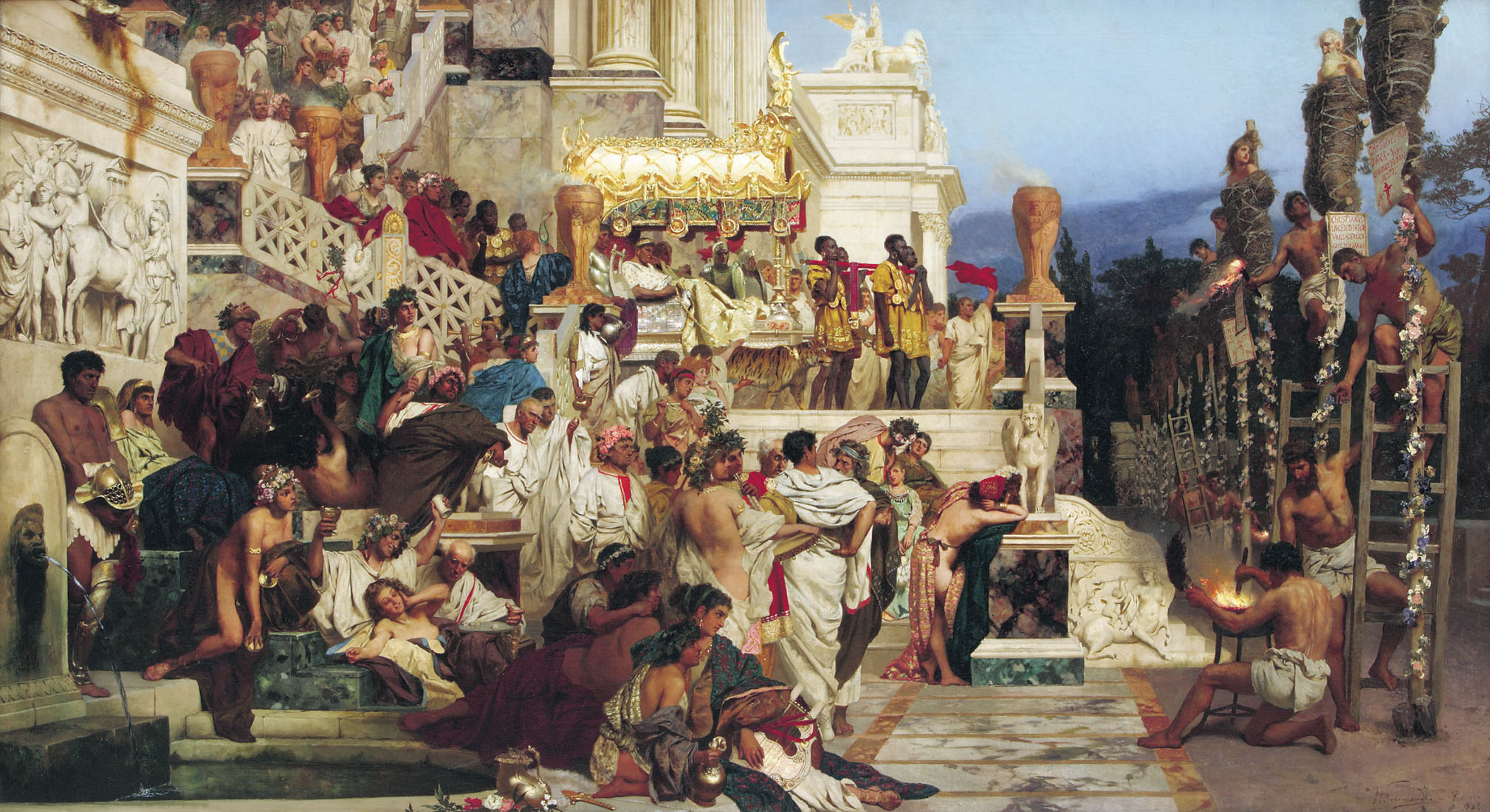
Nero’s Torches , 1876, by
Henryk Siemiradzki (1843–1902). Nero used Christians as torches in Rome, in the last days of Paul.
Do American Christians Have a “Persecution Complex,” Based on a Faulty Historical Narrative?
Former Notre Dame scholar of early Christianity Candida Moss startled many in 2013 with her The Myth of Persecution: How Early Christians Invented a Story of Martyrdom. Dr. Moss sought to correct a number of misunderstandings about early church history, but her critics note that she also made a number of overstatements in the process.
To her credit, Dr. Moss dispelled the popular idea that the entire history of the early church was littered with constant persecution against the new Christian faith by Roman authorities until the time of Emperor Constantine. To the contrary, direct persecution of Christians was mostly local in nature as the church grew, with certain periods of intense persecution limited to relatively short periods under certain emperors. With such notable exceptions in mind, the available evidence shows that the Christian church mostly grew under relatively favorable conditions throughout the early centuries of the late Roman empire.
However, as Baptist historian Michael Haykin offered in his review of her book, Dr. Moss tends to be overly dismissive of various accounts of Christian martyrdom in those early centuries. The culprit behind the confusion in Dr. Moss’ mind? Eusebius of Caesarea, a fourth-century Christian bishop, whom Dr. Moss believes largely invented the historical orthodox narrative of Christian persecution inherited for centuries within both the Christian East and West. For example, for Dr. Moss, the famous martyrdom of Polycarp, who is often thought to have been a disciple of one of Jesus’ original disciples, John, is a narrative hopelessly filled with exaggerations and appears so late in the historical record, that its authenticity should be questioned.
Dr. Moss also shows a great amount of skepticism for the first great persecution of Christians under the Emperor Nero, in the seventh decade of the first century. Why? Dr. Moss dates the Book of Acts as being written rather late, long after Nero’s death, where Acts describes the first time that the followers of Christ were called “Christians,” making it implausible to really believe that Nero persecuted “Christians” (Acts 11:26; 26:28). Apparently, Dr. Moss does not think it possible for a word to be used orally years before it makes it into print.
A number of book reviewers, like Haykins, and Paul L. Maier, have sought to challenge Dr. Moss’ counter-narrative, but what has been needed is an updated, book-long treatment of the entire history of pre-Constantinian Christianity, which focuses on the subject of persecution in particular. In other words, despite certain fanciful details thrown into the stories here and there, there are still good reasons to believe that Polycarp’s martyrdom and the localized persecutions in the city of Rome under Nero were not “fake news.” But where can you read a definitive text to find the best summary of the evidence, that normal humans can digest?

Wolfram Kinzig’s Christian Persecution in Antiquity sets the record straight on the story about Christian persecution in the Roman Empire
A More Authoritative Account of Christian Persecution in the Early Church
German church historian Wolfram Kinzig, who has taught at the University of Bonn, stepped up to the task and has written Christian Persecution in Antiquity to fill the gap. Thanks to the translation work of Markus Bockmuehl, Kinzig’s work is now accessible to an English-reading audience. Though not overly academic in tone, it is both a short and rewarding read.
It would appear that Dr. Kinzig is not a conservative evangelical in his view of Scripture, or at least he is borderline at best. For example, Dr. Kinzig follows the dominant mode of critical scholarship which suggests that the Apostle Paul did not write 2 Timothy (p. 39). Dr. Kinzig considers the idea that identifying the author of John’s Gospel with the author of the Book of Revelation “is today considered impossible” (p. 44). This is still a highly contentious issue in New Testament scholarship, though it is possible that another John within the apostolic circle might have been the author. Even some conservative evangelical scholars argue that a different John, one called “John the Elder” living on the island of Patmos, was the actual author, along with 2 John and 3 John, and not to be confused with the author of John’s Gospel. However, this should not distract the reader from appreciating the wide range of source material the author brings to bear in setting the record straight regarding the persecution of Christians in antiquity.
During our trip to Rome, my wife and I also visited the Church of St. Paul Outside the Walls (San Paolo fuori le Mura) to see the traditional site of where Paul was buried. Dr. Kinzig offers a modest treatment of Paul’s martyrdom, citing the evidence that in that tomb there are fragments of bones that can be dated to the first or second century. However, this does not definitively prove that these bones belong to the great apostle. We simply lack the archaeological data to say so one way or the other. Nevertheless, Kinzig concludes that “in consideration of all the evidence, however, we may nevertheless stand by the conclusion that Peter and Paul were respectively executed under Nero by the cross and the sword” (p. 41). Whether or not St. Paul Outside the Walls really possesses the remains of Paul, our visit reminded me of the historical nature of our faith, that Paul died for his beliefs in the Risen Jesus.
The next wave of Christian persecution under an emperor’s edict is often associated with Domitian, in the last two decades of the first century C.E. A number of commentators link the persecution narrative of the Book of Revelation with the persecution of believers under Domitian. However, Dr. Kinzig follows a more recent scholarly view that suggests that the popular notion of a large-scale persecution of believers is not adequately supported by the available evidence. Eusebius of Caesaria, along with a few others, are often cited as the main sources for saying that Domitian was just as cruel as Nero in persecuting Christians.
However, the only specific detail we get is that a few Christians were sent into various forms of exile by Domitian. We have no record of Domitian using tar-covered Christians as torches, as we found with Nero. We have no other record from pagan contemporaries of Domitian that the emperor persecuted Christians, in any way similar to what Nero did. Plus, there is no mention of Domitian throwing Christians into a public arena, like the Coliseum, to be attacked by lions.
Furthermore, Tertullian tells us that while there was some persecution by Domitian against the Christians, that persecution was short-lived, and Domitian soon terminated the persecutions himself, even recalling those whom he had banished. In other words, while it can be suggested that there was some persecution of believers during Domitian’s reign, traditional explanations of more extensive persecutions tend to be overblown. Along with a growing number of historians, Kinzing concludes:
All in all, then, we cannot speak of a comprehensive persecution of Christians during the reign of Domitian. (p. 43).
If this newer research is correct, and Kinzig’s controversial analysis overcomes the naysayers, then this casts some serious doubt as to the traditional date when the Book of Revelation was actually written. For centuries, many scholars have suggested that the Book of Revelation was written during the era of Domitian persecution of the church. But if the story of Domitian persecution is deemed to be colored by misleading data, then it would make more sense to date the writing of Revelation during the reign of Nero, where the available data actually fits better. Indeed, Revelation 11:1-2 describes how John was instructed to “measure the temple of God,” which would have been very difficult to do after the year 70, when the Jerusalem Temple was completely demolished by the Romans during the Jewish War, all well before Domitian’s reign as emperor.

A visit to Saint Paul’s Church Outside the Walls allows visitors to see grave where Paul was buried, and the reported chains that he wore at his death. I had to wait about 10 minutes before I was able to get close enough to view the chains myself.
Christian Persecution Begins to Heat up During the Second Century
Sporadic persecutions of Christians across portions of the Roman empire find their way more often into the historical record during the second century. Kinzig documents these persecutions in his chapter entitled, “Christians as Victims of Local Police Actions (111-249).” Roman emperors like Hadrian were annoyed by Christians, and Marcus Aurelius stepped up the Roman government’s antagonism towards the growing Christian movement. Kinzig writes, “Christianity as such was prohibited in principle but, rather like Judaism, tolerated in practice. The authorities only intervened where public order was at risk— although they might then unleash against Christians the full savage might of a military state” (p. 45).
However, the first empire-wide persecution of Christians took place under Emperor Decius, from 249 to 251 A.D. While Christians were not singled out, Decius’ edict required all subjects of Rome to offer cultic veneration to the gods. Jews were also under suspicion for their religious irregularities.
Some Christians did comply with the edict. Some recanted their faith after experiencing torture. Others figured out ways to convince officials to turn the other way, particularly through bribes. Others went into hiding. Yet many other Christians resisted, with various punishments placed on them, including prison, and in other well reported cases, through martyrdom (p. 79ff).
After Decius died, another round of empire-wide persecutions were inflicted by Emperor Valerian. The spark that lit Valerian’s fury was his practice of murdering infants as part of a magic ritual. When various Christians within his imperial court tried to resist these murders, Valerian decided that the Christians must be punished for their insolence, mainly through targeting Christians leaders and bishops. The persecution only ended with Valerian’s death in 260 (p. 85ff).
Peace returned to the Christian communities, but only for about 40 years. The most severe period of persecution came in the early 4th century, under Emperor Diocletian. At first, these persecutions were like those of Decius, focused on all religious believers who were not polytheists, which now included not only Christians and Jews, but Manicheans as well. The exclusive claims of monotheism did not mesh in very well with the officially sanctioned paganism that Diocletian believed necessary to cement his empire together.
After certain Christian members of the military renounced their vow to serve the army, Diocletian became determined to put the clamp down specifically on Christianity in 303 A.D. At first, Diocletian tried everything but imposing the death penalty to keep the Christians in-line. But as Christians continued to resist, more draconian measures were introduced. Christian churches were ordered to be destroyed, and the Scriptures held by Christians were ordered to be turned over to the officials to be burned. Diocletian had hoped that the execution of some Christian leaders would convince other Christians to back down, in an attempt to try to keep the number of martyred deaths to a minimum. But the strategy failed as more and more Christians stepped forward to accept martyrdom (p. 95ff).

St. Peter’s Square, Vatican City. Behind me stands the obelisk, marking the spot formerly of the Circus of Nero, the first known location of persecution against Christians by a Roman emperor, Nero, in the 60’s C.E.
Third and Early Fourth Century: The Climax of Roman Persecutions Against Christians
Even after Diocletian abdicated in 305, persecutions continued for several more years. Some church leaders opted to perform the pagan sacrifices, though this is not clear, perhaps in exchange for protections of the members of the flock from being killed or otherwise punished. However, such acts to appease the government were viewed as acts of cowardice, particularly among the Donatists, which later threatened the unity of the Christian movement once the persecutions had finally started to die out when Emperor Galerius relaxed the restrictions against the Christians in 311. Finally, Emperor Constantine’s Edict of Milan in 313 ended the persecution of Christians. By 380 A.D., under Emperor Theodosius, Christianity became the official faith of the Roman Empire.
History is often used as an appeal to justify current attitudes and actions. A “persecution complex” which over-emphasizes current opposition to historic orthodox Christianity will at times misuse the story of martyrdom to reinforce a wrong approach to cultural conflict. Yet at the same time, an overly skeptical approach to the story of persecution in the early church introduces its own distortion into contemporary discourse, thus threatening to minimize the reality of persecution, not only for Christians, but for others as well.
The title of Kinzig’s book lacks the sensational appeal of Candida Moss’ The Myth of Persecution: How Early Christians Invented a Story of Martyrdom, which means that Christian Persecution in Antiquity probably will not sell as many books as Moss’ work. Moss’ work should not be ignored; however, the level of scholarship in Kinzig’s book meets if not greatly exceeds Moss’ work, without the attention getting gymnastics employed by Moss. With far more measured sobriety, Kinzig’s recounting of this history includes a number of stories of martyrdom, including the stirring story of Polycarp, without embellishing the record. For those interested in the history of Christian persecution, Christian Persecution in Antiquity offers a relatively brief yet accurate look into the early centuries of the Christian movement. Highly recommended reading to set the record straight.




 Veracity
November 2nd, 2023 at 11:40 am
Bart Ehrman claims in this YouTube short that very little persecution of Christians happened during the reign of Domitian in the 90s, which casts some doubts on claims by the author of Revelation that many Christians were being martyred during that period. While still disputed, Ehrman’s argument actually has some substance to it. However, if the Book of Revelation was written towards the end of the reign of Emperor Nero in the 60s (about three decades earlier), or shortly thereafter prior to the destruction of the Temple in Jerusalem, then this changes the situation dramatically, as we do have sufficient evidence to demonstrate systematic persecution of Christians during the reign of Nero in Rome:
LikeLike
May 16th, 2024 at 9:12 am
Gavin Ortlund on Christian Persecution:
LikeLike
May 19th, 2025 at 10:55 am
Excellent discussion defending the Neronian persecution of Christians:
LikeLike