Monthly Archives: October 2012

Who Is Jesus?

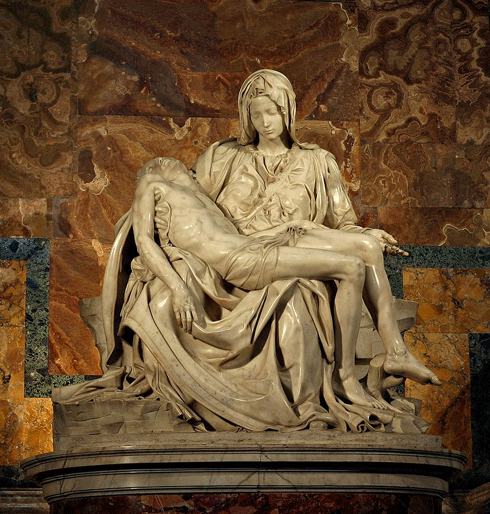
Michelangelo's Pietà

Pietà by Michelangelo, 1499

Who is Jesus?  Wow, talk about a profoundly important question!

There are a lot more people who “believe in Jesus” than there are those who know what Jesus actually claimed about himself.  Many think he was a great moral teacher, a prophet, or a wise Rabbi.  Some think a legend, a myth, or a contrivance.  Still others that he was one of many gods, or one of many roads to God.  That Jesus straightforwardly and clearly attacked these notions is of little consequence to those who will not invest the time to read the Gospels and weigh the evidence for his claims.

Jesus had to fulfill hundreds of Old Testament prophecies written centuries before he appeared on earth, and live within the Mosaic law of the Torah.  He had to submit to the cruelest punishment mankind could dish out, and to top it all off he had to rise from the dead.  No small feat.  When you think about it, he had to color between some extremely tight lines.  Lee Strobel calls this framework the “unmistakable fingerprint of the Christ.”  Only Jesus was man enough for the job—that was the whole point. Continue reading

Unreasonable Doubt

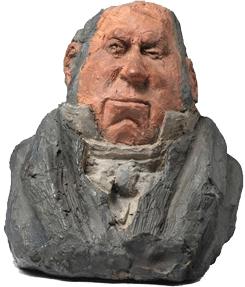
Felix Barthe (1796-1863), Minister of Justice and Deputy by Honore Daumier, 1833

Some people will not allow themselves to be convinced by evidence. I touched upon this topic recently in a post entitled Judge for Yourself, that illustrates the need to explore the standard of proof we each demand, the need to check our biases, and our ability to weigh evidence.

Lee Strobel took the approach that he was willing to follow the evidence for a Creator whether it led him to an uncomfortable conclusion or not.  Unfortunately, many atheists lack this kind of integrity.

Ironically, there are scientists who investigate the facts behind the Big Bang, the DNA molecule, the fine tuning of the universe, cellular machines, and many other physical phenomena and draw the conclusion that the data clearly indicates intelligent design. Yet some of them can’t call the designer ‘God’.  Really?

However…before we throw any rocks at scientists for not having the integrity to counter their professional biases, shouldn’t we revisit our own biases—professional and otherwise?

As Ken Petzinger points out, how we approach theism determines a lot about our lives, and how we interact with the world. Here’s a thought-provoking, on-topic article entitled Unreasonable Doubt, that Mary Petzinger wanted to share. The article (by Jim Spiegel writing in  Christianity Today, January 2011) calls intractable skepticism into the light of day.  The byline reads “The reasons for unbelief are more complex than many atheists let on.” To read the article, click here.

Enjoy!

HT: Mary Petzinger
