Henry M. Morris (1918-2006). Along with Grace Theological Seminary’s John C. Whitcomb, this engineer was one of the pioneers of the contemporary Young Earth Creationist movement and a leading figure in the inerrancy crisis of the 1970s and early 1980s.
The pen lay undisturbed on the table. The document needed one more signature. Others had scribed their name in ink. But Dr. Henry Morris had left the room. The hope for having a unified front in defense of the inerrancy of the Bible were dashed at that moment.
The International Council on Biblical Inerrancy (ICBI) had accomplished so much. In 1977, this group of Bible scholars and teachers had drafted a document affirming a set of principles that sought to expound on the meaning of Biblical inspiration and authority. Christian leaders from across the widest denominational spectrum had agreed to put aside their relative doctrinal differences to stand on what Francis Schaeffer had understood to be the “watershed of the evangelical world“. Against the tide of a creeping liberalism in the churches that would compromise God’s Truth, these leaders had pinned their hopes on the banner of inerrancy to unite the evangelical church.
But it was now 1982, and despite how well things had gone, the unique opportunity for a consensus was gone. How did we get here, and what went wrong? Continue reading
Some of this Veracity blogger’s distance relatives, or just a really bad TV show from the 1960s? (It’s About Time).
One of the most persistent challenges in trying to reconcile Biblical truth with the findings of modern science is this: What do you do with the cavemen?
The mainstream scientistic consensus today is that there have been human-like creatures discovered in the ancient fossil record that predate humans like you and me. Names such as Cro-Magnon man, homo erectus, and the neanderthal fill our imaginations with images of semi-ape, semi-human creatures hobbling or running around with crude tools, making grunting noises, many of them living in… well… caves. My wife thinks I must be related at times to these creatures, particularly when I get out of bed in the morning, bumping into things when I am barely awake!!
But seriously, could it be that these brute creatures are related to us, we homo-sapiens, or is such a concept alien to the teaching of the Bible? Does the existence of these creatures insult or even undermine the Christian concept of the special status of humanity’s uniqueness?
News within recent years suggests that there is some evidence of actual interbreeding between modern humans and neanderthals thousands of years ago, as in this story from the British Natural History museum:
So what does the Bible have to say regarding creatures like the neanderthal? Continue reading
For Bill Nye, “creationism” means believing in a Young Earth that is only 6,000 to 10,000 years old. Other forms of “creationism,” including Old-Earth Creationism as articulated at Reasons to Believe and Evolutionary Creationism as articulated at BioLogos simply do not count as “creationism.”
For Bill Nye, the science of evolution does not allow a reasonable person to see any divine “plan” in nature… at least for him.
If you accept the black-and-white categories laid out by both Bill Nye and Ken Ham, it leaves very little room for talking about harmonizing the God of the Bible’s Creative activity with contemporary science without compromising either the Biblical authority on the one hand or modern Science on the other. I was not very thrilled with the debate as it just seemed as though the participants kept talking past one another, something that comes out in the Answers In Genesis video linked below.
What Michael Behe and Hugh Ross said was refreshingly encouraging. While both disagreed with the view of Darwinism held by the folks at BioLogos, and both nevertheless continue to try to persuade others to their point of view, both men still count a number of their critics at BioLogos as being friends.
Wow. What a novel concept: Embracing fellow believers in Christ as friends, even when you strongly disagree with them on a particular non-salvation issue.
Perhaps if others in the creation/age-of-the-earth/evolution debate within the Body of Christ had that type of attitude with one another, then when you have debates with folks like Bill Nye, it would not seem like you were always talking past the other person.
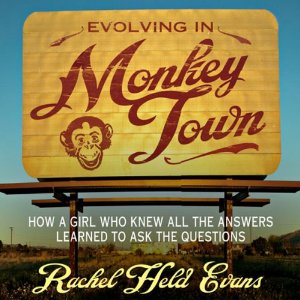
Rachel Held Evans first book. She’s young, church-going…. and not very sure about her faith. Does she represent the future of “evangelical Christianity”?
How do you handle doubt? Some want to shove it under the rug. Some, frankly, never really go through serious periods of doubt. Others wallow in their confusion. Some simply rebel as an escape mechanism. Others are driven to God’s Word, study, prayer, and fellowship to find answers. Where do you go when you begin to second guess everything, if you ever do?
Part of what we are trying to do with Veracity is to provide tools to help folks to get into God’s Word so that God’s Word can get into us. What resources are available that can equip us to better understand our faith so that we can better serve the Lord in our worship and witness? However, there are times where doubt can plague us in our spiritual journey and threaten to derail us spiritually. Perhaps an explanation about the Bible we once heard no longer makes sense anymore. Or is there some assumption that we have made about the Christian life that no longer appears to be working? Perhaps we expected God to do something and things did not turn out the way we think it should.
Doubt is an enormous topic to tackle in a single blog posting. So I will be content for now to give you a partial case study. Continue reading
My wife and I were still out making our monthly run to CostCo while last night’s debate between Ken Ham and Bill Nye was going on. It was not like the SuperBowl or anything, but somewhere between a half a million to a million people watched the YouTube version online.
I only caught the closing statements near the end and rewinded to the beginning to catch their opening statements. I actually thought the exchange went better than I thought it would, and it did turn out a little different than I expected and predicted here on Veracity.
Instead of focusing on the harm evolution education he reports is causing in our schools, Ken Ham focused more on the distinction he was making between historical science and observational science. His main argument was that he and Bill Nye actually share the same perspective on observational science that gives us things like modern technology today. The disagreement is over historical science. For Bill Nye, historical science gives us genuine knowledge about the past. For Ken Ham, science can not give us reliable knowledge about the past. We must look to the Bible for that.
Likewise, Bill Nye surprised me, too. Though he clearly has an agnostic orientation towards the Christian faith, he made some approving mention that not all Christians share Ken Ham’s Young Earth Creationist views.






 Veracity