Tag Archives: veracity

C.S. Lewis and the Butterfly Effect

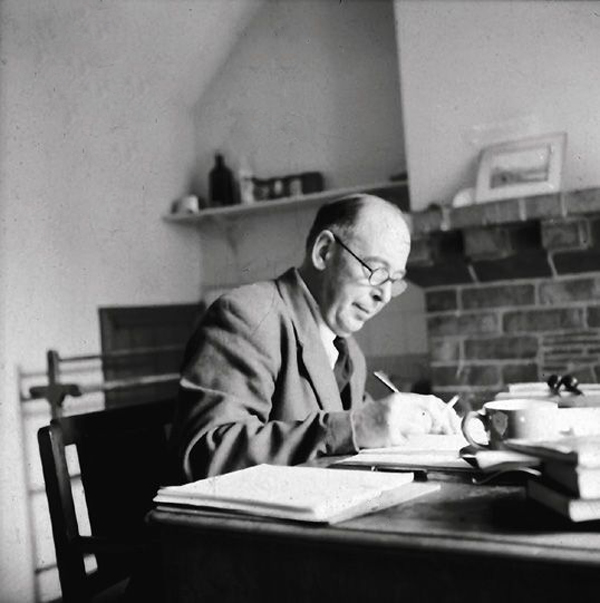
C.S. Lewis

Why would C.S. Lewis take the time to correspond with a young American girl he did not know? Would his four letters, including the one he wrote to her just 11 days before his death, have any consequence?

In our culture we are taught to swing for the fences. Blast the game-winning home run high over the center field wall. Instant gratification and recognition. Great work if you can get it.

But a life lived in obedience to God is seldom like that. It’s much more like the butterfly effect—where one small change can make a big difference in the way things turn out. Consider the chain of events in the following story.

  1. In the 1960s, a somewhat under-appreciated (at the time) Cambridge don, deep thinker, and writer of children’s literature gets a fan letter from a 12-year-old American girl. Despite all he has going on, he takes the time to write back to her.
  2. The young girl begins to read some of his other work, including his Christian writings. She writes more letters, he writes back.
  3. When he dies, only a small number of friends attend his funeral.
  4. Through subsequent publishing he becomes one of the most influential Christian thinkers of the 20th century.
  5. Because he took the time to write to the little girl, his corpus has a profound effect on her faith and her ability and desire to defend her Christian worldview.
  6. The little girl grows up, marries a small town preacher, and has a profound effect on him.
  7. The small town preacher becomes one of the most influential Christian writers and thinkers of the 21st century.

For the whole story, read this article.

We really don’t take enough time to correspond with people. Taking the time to write someone can have significant and lasting consequences—much more so than hitting a dramatic home run.

HT: Marion Paine, David the Older


Dr. Jim Shaw and the Butterfly Effect

Dr. Jim O. ShawThe essence of the butterfly effect is that one small change can make a big difference in the way things turn out.

Dr. Jim Shaw died last Wednesday, and while reading the online media tributes, I can’t stop thinking about the butterfly effect.

For those unfamiliar with Jim’s story, he is best known as the founder of Lackey Free Clinic, which provides “skilled, compassionate health care and counseling to the medically disadvantaged in a manner that honors the name of Jesus Christ.” He was also a husband, father, grandfather and respected pulmonary specialist. For their compassion and humanitarian efforts, Jim and his wife, Cooka, received the Daily Press Citizen of the Year award in 2007. Lackey Free Clinic just celebrated its 20th anniversary, racking up quite an impressive list of awards and accolades along the way.

I served with Jim as an elder in our church. He commanded respect. He was smart, humble, and determined to make a difference in this world. He was steadfast in his faith—not just in the hearing of the Word, but in the doing. Jim modeled what he read in the Bible.

If a brother or sister is poorly clothed and lacks daily food, and one of you says to them, “Go in peace, keep warm and eat well,” but you do not give them what the body needs, what good is it? So also faith, if it does not have works, is dead being by itself. But someone will say, “You have faith and I have works.” Show me your faith without works and I will show you faith by my works.
(James 2:15-18 NET)

Jim had a very long battle with cancer, chronicled in the links above. He fought the disease bravely, intelligently, and with conviction. He found a way to take all the pain and suffering and turn it into good in the name of Christ. Not unlike Dick Woodward.

The butterfly effect? My most profound memory of Jim is one in which, truthfully, I was a little peeved at him. It was a couple of decades ago when a group of volunteers would meet every Saturday morning to cut the grass at the Church. We saw all the comings and goings of people from the business end of our lawnmowers. Jim was one of those who kept coming. He had a lot of questions about Christianity, and he would show up Saturday mornings, Bible in hand, to meet with our senior pastor. I remember thinking, “Bill doesn’t have time to meet with this guy every Saturday. He’s got sermons to prepare and a church to pastor.”

Shows how much I know.

Chi Rho, Jim. Our community is far better off on your account, and you completely succeeded in honoring the name of Jesus Christ. We will miss you.

HT: Bill Warrick, Tuck Knupp, Lackey Clinic, Daily Press (Photo)


Thoughts on ‘Literality’

Editor’s Note: We received the following comment from David the Older, as part of a running dialog following Clarke’s recent post Terry Mortenson on the Problem of Millions of Years. Due to its length and substance, I decided to publish it as a post in the hope that it will promote thoughtful and charitable dialog on this topic.

_____________

(From David The Older)

A thought on Lyn’s response with regard to “literality.”

Your response to Brother Clarke was very helpful to me in attempting to sort out some things concerning the reading and understanding of Holy Scripture.

First, I want to say that I have no interest in the age of the earth.  To put it another way, I have no interest in the “age of rocks;” I do have an intense interest in the “Rock of Ages.”  And I have an intense interest in truth.

The words “literal” or “literally” occurred six times in your response to Clarke.  None of these six occurrences were within Bible verses.  The word “truth” occurred twice in your post, both times embodied within Bible verses.  That got me to thinking about the word literal (and derivatives thereof) and the word truth (and derivatives thereof) and their place in my personal Bible reading/study as a layfolk (that is, a person without professional or specialized knowledge in a particular subject).

It came to me that I don’t open my Bible and say to myself that I am going to read it literally.  I don’t think to myself now this text must be read, digested, and processed literally.  The literality of Scripture is simply not at the fore of my mind when I read my Bible.  What then is on my mind, if anything?  What then do I say to myself, if anything?  I say to myself something like this, and what is on my mind is something like this, “David, in your old age, read God’s Word, Scripture, for truth, that is, read the Word truthally (a made-up word).”  Truth is the focus of our Sacred Texts as is stated in many biblical passages. For example:

John 17:17 Sanctify them in the truth; your word is truth.

Ephesians 1:13-14 In him you also, when you heard the word of truth, the gospel of your salvation, and believed in him, were sealed with the promised Holy Spirit…

John 1:17 For the law was given through Moses; grace and truth came through Jesus Christ.

Indeed, E. J. Young (Professor of Old Testament at Westminster Theological Seminary for 36 years and an Evangelical luminary) entitled his book, which is a “classic … exposition of the biblical doctrine of inspiration,” Thy Word is Truth not Thy Word is Literality.  Allan Harman writes of Young that he “held unswervingly to a high view of Scripture …”  The word literal does not occur in the Bible to my knowledge.  So, I read the Bible firstly and primarily “truthally.”  I want to know what the truth of Scripture is that I might apply that truth in my life to “be conformed to the image of the His Son [Jesus]” as Paul commands in Romans 8:29.

Here is an example of what came to my mind after reading your response to Clarke’s post on Mortenson.  Max Lucado has written many books that Christians find helpful, so I am told.  Actually, I haven’t read any of Lucado’s books for adults.  However, I have devoured his children’s books, some of which are superb.  My favorite Lucado children’s book is You Are Special (https://www.youtube.com/watch?v=15QuHygLwFU) featuring mythological people including Punchinello, Lucia, Eli, etc.—Lucado’s story is myth.  What do I mean by myth? This.

“Myth is the language of imaginative insight into ultimate reality, which reveals [uncovers]… truth under the form of symbol  …  To know myth, therefore, in the proper sense, is to be initiated into a unique experience of reality [that is, a unique experience of the real/literal].” (Alan Griffiths)

Lucado’s characters are wooden people, call Wemmicks, who were made by Eli the master wood carver.  They live in Wemmicksville.  It is a powerful story/myth/allegory/metaphor/parable (it is not fantasy) about finding our true and abiding identity in a vertical relationship with the Creator God rather than in a horizontal relationship with peers.  Lucado’s narrative is described well by Goodreads:

Max [Lucado] was interested in helping children understand their value – not from the world’s perspective, but from God’s. Wemmicksville is a land created by Eli, the “God” figure of the story. He creates each Wemmick in Wemmicksville uniquely, each with its own look and personality. Each story and video is a new adventure with the citizens of Wemmicksville. Punchinello is the central character, along with his friends Lucia, Splint, and Chip. When Punchinello strays from Eli, he begins to have problems. Only when Punchinello stays close to Eli does he clearly see how to walk through his life in Wemmicksville.

In this heartwarming tale [myth/story], Eli helps Punchinello understand how special he is—no matter what other Wemmicks may think. Children [and adults] will learn a vital lesson—regardless of how the world sees them, God loves each of them just as they are.

Thus, truth can be conveyed to me, to any reader, in either a literal textual genre or in a genre of story/myth/allegory/metaphor/parable, or, further, the text may be both literal and story/myth/allegory/metaphor/parable at one and the same time.  Consider the account of the man who had two prodigal sons in Luke 15.  Luke’s text does not say, that is, does not say, that this is a parable!  The text begins with only this: “And he [Jesus] said, “There was a man who had two sons …”  Nowhere in the narrative does Jesus call this account a parable.  So, should we read this narrative literally or parabolically/metaphorically/mythically/etc?  We really don’t know with certainty whether this narrative is literal or parabolic.  But—Does it make any difference here to the truth value of Jesus’s teaching?  I propose that the truth value in this case, and perhaps in other cases in Scripture, is independent of literary genre.  Now, Alan Griffiths’s definition of myth must be recalled: “Myth [maps] into ultimate reality [that is, a literalness] … To know myth … is to be initiated into a unique experience of reality [that is, a literalness].”  So there is a necessary and essential reciprocal mapping between myth and reality.  This is different than fantasy; I am speaking of myth, not fantasy.

So, distinctions/differences among the ideas of literality, history, story, allegory, metaphor, myth, parable, and language itself may not be quite as simple as I once thought, particularly as we are in pursuit of God’s truth.  The vehicles for conveying truth are varied. And truth may encompass more than one dimension of reality—for example, John 3:6: “That which is born of the flesh is flesh, and that which is born of the Spirit is spirit.” I remember the words of Paul in II Corinthians 4:18:

“… we look not to the things that are seen [e.g., the material, rocks, flesh] but to the things that are unseen [spirit]. For the things that are seen are temporal/transient, but the things that are unseen are eternal.”

For the Christ-follower, there is an abiding reality that is beyond visible, tangible, material phenomena, beyond the “literal.”  I see such a reality in Paul when he says in II Corinthians 12:

I know a man in Christ who fourteen years ago was caught up to the third heaven—whether in the body or out of the body I do not know, God knows. And I know that this man was caught up into paradise—whether in the body or out of the body I do not know, God knows— and he heard things that cannot be told, which man may not utter [Why can they not be uttered?—Perhaps, I suggest, to the limitations of language].”

And then there are those lines in the hymn Break Thou the Bread of Life:

“Beyond the sacred page, I seek thee Lord …”

Thanks for challenging me to think carefully concerning the truth value that is embodied in text of our Scriptures, which is inspired (God-breathed) and the final authority in matters of belief and behavior. Evangelicalism (i.e., Christian, biblical orthodoxy) is defined by this commitment to inspiration and authority and a commitment to the historic creeds such as the Apostles’ Creed and the Nicene Creed (as well as perhaps the Statement of Faith of the National Association of Evangelicals)—within these boundaries there is interpretative (hermeneutical) elasticity as evidenced by the multiplicity of conservative, orthodox denominations/traditions and even different views within denominational frameworks.

Postscript from the world of physics related to Paul in II Corinthians 4:18:

HydrogenGasHere is an example from physics bearing on myth and literality and truth value. I will now argue (briefly) that myth in literature is similar to theory in physics. As myth communicates truth in a literary form, so theory communicates truth in physics.  Consider this illustration. If you pass an electrical current through hydrogen gas, a brilliant reddish glow is observed, as shown at the side.  This is the literal appearance of electrically energized hydrogen atoms.  Erwin Schrodinger (Nobel Prize for Physics 1933) asked the proverbial question, “Is there more here than meets the eye?”  That is, is there an unseen reality behind the visible experience (the seen red glow) of energized hydrogen atoms? Schrodinger’s answer to these questions is embodied in his mathematical creation for a hydrogen atom shown below.

SchrodingerEquation

It is an abstract/symbolic “narrative”—that is, it is mythical in that it is a non-material reality generated in the mind that God gave to all men within the bounds of common grace in the creation. Upon solving Schrodinger’s equation one quantitatively generates all the unseen electronic energy states of the hydrogen atom and thus understands that the visible reddish glow is the composite of four electron transitions that release energy in the region of the color spectrum that we can see with our eyes. This is analogous to St. Paul speaking of seen and unseen realities in II Corinthians 4, of which the unseen (non-sensate) reality is the abiding, essential, eternal reality. Furthermore, the complete set of solutions to Schrodinger’s equation provides an elegant explanation for the periodic table of the elements which is foundational to all of chemistry. Physicists are interested in the truth concerning God’s material creation—they want to know the “mind of God” as many have put it. From my perspective God allows human beings created in His image to learn and know the truth of the physical world by both literal and symbolic/mythical/metaphorical pathways. Both pathways are crucial. If there is no literal hydrogen atom, there is no Schrodinger equation. If there is no Schrodinger equation, there is no understanding of the essential, abiding, eternal nature of the hydrogen atom. It may be a serious over-simplification to say that we read our sacred Scriptures literally and leave it at that, just as it is a serious over-simplification to say that we know all about a hydrogen atom by simply observing its sensate, material appearances. There is a reality that is behind the literal both in spiritual world and in the material world, both of these worlds being created by God. For more in this vein it is instructive to read C. S. Lewis’s essay Myth Became Fact in God in the Dock. It is available on the web–katrinageiger.weebly.com/…/myth_became_fact-god_in_the_dock.doc.


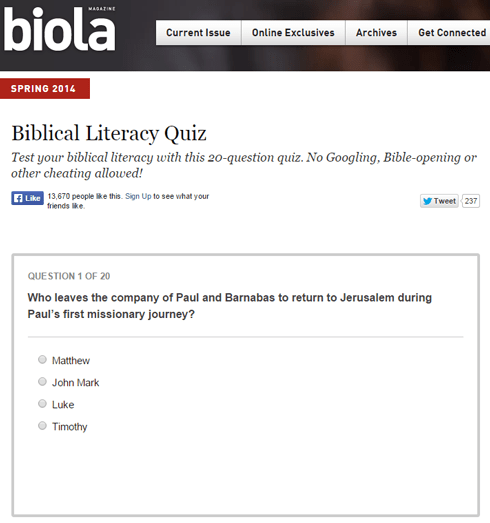
Biblical Literacy Quiz

Up for a challenge? Here’s a fast-paced, 20-question online quiz you can take to test your biblical literacy. Click on the image below, then just fill in the dots to get your score at the end. The links at the Biola Magazine site are pretty revealing about biblical illiteracy—spend some time browsing. There is much work to be done. (We’re certain that Veracity readers will be way above average, but give it a shot anyway.)

Biblical Literacy Quiz


Spiritual Diagnosis

Sphygmograph

Transmission Sphygmograph, c. 1900

Do you ever think about your spiritual health? Spiritually speaking, how are you doing? How about those around you? How about your church? Are you making a difference? Are you trying hard enough? How good is good enough?

I do. I think about spiritual effort a lot.

Dick Woodward used to call this kind of thinking “a checkup from the neck up.” (Dick had a way with words.) Spiritual diagnosis was a prerequisite for the Sermon on the Mount—it’s all about attitudes. And Jesus Christ had a lot to say about attitudes and spiritual effort.

“I know your deeds, that you are neither cold nor hot. I wish you were either one or the other! So, because you are lukewarm—neither hot nor cold—I am about to spit you out of my mouth.”
Revelation 3:15-16, NIV84

That sounds frightfully harsh…but wait a minute. No need to worry, we have Sola Gratia. What about Ephesians 2:4-5 and Romans 3:23? It’s all about grace, right? We don’t have to be good enough. Gimme a break, we all fall short. I’ve got a job that wears me out, responsibilities…I don’t have the time or energy to do more. Besides, salvation doesn’t depend on our works.

The problem with that kind of attitude about spiritual effort is that it constitutes what Dietrich Bonhoeffer called “cheap grace.”

“Cheap grace is the grace we bestow on ourselves. Cheap grace is the preaching of forgiveness without requiring repentance, baptism without church discipline. Communion without confession. Cheap grace is grace without discipleship, grace without the cross, grace without Jesus Christ, living and incarnate.”
Dietrich Bonhoeffer, The Cost of Discipleship

Grace without Discipleship? How can we diagnose grace without discipleship? Well, it could look like serving your church or ministry in a leadership position and feeling a little too complacent. How is your personal discipleship coming along? Is there urgency in your service? Are you working effectively to promote discipleship—or are you part of an organization that’s largely going through the motions? Isn’t it best if everyone just gets along and serves in harmony? It’s best not to rock the boat. Maybe. But if we heed Christ’s words to His churches in Revelation, this is indeed serious business. So how hard should we row? There’s that checkup from the neck up again.

An Ethic for Ministry

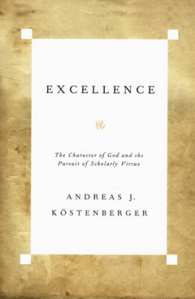
Excellence: The Character of God and the Pursuit of Scholarly VirtueMarion and I recently had dinner with Drs. Andreas and Marny Köstenberger. Not surprisingly, we got around to talking about personal discipleship and the Veracity blog. When I mentioned the spiritual basis for the blog in Philippians 2:12, Andreas told us about a book he had written that expands upon these ideas.

Excellence: The Character of God and the Pursuit of Scholarly Virtue is an exhortation written to scholars, but with broad application to anyone involved in ministry. The burden of the book is to “urge all of us who sense God’s call to scholarly labor to pursue earnestly, and with God’s help, the scholarly virtues discussed in this book.”

We don’t really talk about virtues anymore. It’s as if the word went out with parasols and medicine shows. But the pursuit of biblical virtues constitutes an appropriate cornerstone for personal discipleship.

The biblical basis for Excellence is the apostle Peter’s exhortation for believers to “grow in the rich knowledge of God and of Jesus our Lord” (2 Peter 1:2).

“For this very reason, make every effort to add to your faith excellence, to excellence, knowledge; to knowledge, self-control; to self-control, perseverance; to perseverance, godliness; to godliness, brotherly affection; to brotherly affection, unselfish love. For if these things are really yours and are continually increasing, they will keep you from becoming ineffective and unproductive in your pursuit of knowing our Lord Jesus Christ more intimately. … Therefore, brothers and sisters, make every effort to be sure of your calling and election.”
2 Peter 1:5-8,10a (NET Bible)

Just as Paul instructed believers to work out our own salvation with fear and trembling (Philippians 2:12), Peter directs us to work on our faith. And he sets the bar very high—the first virtue is the pursuit of excellence in increasing measure. With this scripture in focus, we have the answer to “how hard should we row?” and we have an ethic for ministry. Complacency has no place in the church, so go ahead, rock the boat if need be, but appreciate that Christianity is serious business.

One of the things I appreciate most about Excellence is the passionate humility with which Dr. Köstenberger paints the text. A book exhorting readers to steadfastly pursue excellence and Christian virtues could easily have swayed between dogmatic cheerleading and impersonal instructions for self-help. But it doesn’t. Without pulling any punches, he makes the point that mediocrity is not pleasing to God but does so with a gentle and genuinely humble voice. The book is extremely well written and thought out.

Dr. Köstenberger also offers practical suggestions for keeping the work of the ministry from becoming stale and getting off track. I particularly appreciated what he had to say about the importance of balancing purposeful rest with hard work. In fact, the book is full of well-formed balancing points. For lots of reasons, I read the text at just the right time.

The following quotes from Excellence: The Character of God and the Pursuit of Scholarly Virtue should give some indication of how helpful this text can be in thinking about spiritual diagnosis and spiritual effort.

Being set apart unto God as a scholar also entails a rejection of the false modernist dichotomy between faith and scholarship, a wholehearted pursuit of truth, complete dependence on the guidance and empowerment of the Holy Spirit, a balanced life that does not turn our scholarship into an idol, an awareness that the primary orientation of our work is to be missional, and an engagement in spiritual warfare through faithful witness to the truth.

Without the Spirit’s empowerment, our pursuit of holiness and excellence through growth in godly virtues will devolve into mere human self-effort that invariably results in pride and failure.

The primary spiritual disciplines advocated by Scripture are prayer and the obedient study of God’s Word.

We need to cultivate the discipline of rest, of regular time set aside for reflection, planning, and relaxation. In the long run, this will ensure that we will be at our most productive. I often find that after a week or two away from the office, I return invigorated, sharper, and more focused and alert.

The principle, then, is this: rest in God’s grace, look to him for guidance, and then do the work (in that order!). Don’t put self-effort and striving ahead of listening to God. And balance hard work with regular rest and relaxation (which means don’t forget to take a vacation once in a while, or take a day off on your son’s or daughter’s birthday or on your anniversary).

Mediocrity, sloppy workmanship, and a half-hearted effort do not bring glory to God or advance his kingdom.

The message here is not simply to try harder, to put in more effort, and to make things happen through sheer force of will. Salvation is entirely by God’s grace (Eph. 2:8–9), and sanctification is by grace as well (Eph. 2:10). This means that the pursuit of scholarly excellence must be undergirded by a keen sense of God’s continual grace in the personal and professional spheres of our lives and that we should pursue scholarly excellence in an environment of grace, not in a spirit of self-effort or unhealthy competition.

As evangelicals, we have too often, in Franky Schaeffer’s words, been “addicted to mediocrity,” and this mediocrity has in many cases become a curse—a curse that has kept us from reaching our personal, creative, and academic potential given to us by God, and has prevented us from impacting other believers as well as unbelievers for the glory of God and for his kingdom.

To your wisdom, add grace. Everything a Christian does should be characterized by grace. Grace should permeate our thoughts, words, and actions, and make a noticeable impression on those with whom we come in contact, both believers and unbelievers.

What are you and I going to do? Will our scholarship be characterized by a mean-spirited, confrontational, and harsh attitude? The writings of some evangelicals show little love for their scholarly opponents; in fact, one might almost conclude that they despise them. Unfortunately, these brothers in Christ do not seem to realize that the scholars on the other side of a given issue are, ultimately speaking, not the enemy. Satan is our common enemy.

Graciousness in response to criticism requires that we take ourselves out of scholarship to some degree and leave the results in God’s hands.

This balance, of course, is hard to achieve. It is much easier to spend long hours in one’s study and to ratchet up an impressive record of scholarly publications while neglecting one’s family. Conversely, someone may be a great father and husband but only a mediocre scholar (though, if a choice has to be made, the latter is, of course, to be preferred over the former).

While dangers are doubtless lurking ahead, commit yourself to excellence. The God you serve is himself characterized by excellence, and that same God has called you to the pursuit of excellence for his glory and for the good of others. If you pursue excellence and progress in it, you and others will be blessed, and God will be glorified.

HT: Dr. Andreas Köstenberger, Museum of Historical Medical Artifacts (transmission sphygmograph photo)