
How did the earliest apostles of the church understand the content of their faith and live it out?
Much of contemporary scholarship focuses on the idea of an evolutionary model for the development of Christian doctrine. Some critical scholars suggest that Christianity in the first century was a cacophony of conflicting voices, whereby what might be considered “historic orthodox Christianity” was but one voice among many, that eventually conquered and vanquished other contenders. As this story goes, what eventually became “historic orthodox Christianity” did so through a series of doctrinal developments, including a move from a pure Jewish unitarian monotheism to the Nicene Trinitarian concept of God articulated in the 4th century, incorporating bits and pieces of Greco-Roman thought along the way. This “evolutionary” model of doctrinal development presumes that the doctrinal features of Nicene orthodoxy had no precedent in Judaism.
Even in some conservative Christian circles, this “evolutionary” model is often uncritically assumed. For example, Mark is often considered to be our earliest gospel, and having a rather “low christology;” that is, a rather primitive view of Christ’s divine nature, if any at all. But by the time you get to the Gospel of John, our latest gospel, we see a “high christology,” having a full-blown doctrine of Christ’s divinity
Stephen De Young, in his The Religion of the Apostles: Orthodox Christianity in the First Century, aims to demolish this “evolutionary” model of Christian doctrinal development. Instead, De Young proposes that the earliest instantiation of Christianity draws from theological ideas and practices found in Second Temple Judaism. In other words, what we know as “historic orthodox” Christianity, most fully articulated by the great Council of Nicea in the 4th century, has its fundamental roots stretching back into the world of Judaism during the time of Jesus, before the Second Temple of Jerusalem was destroyed in the year 70 C.E. The Religion of the Apostles is a comprehensive look at what the early church believed and sought to practice. On paper, the book is still sizable at 320 pages, but it is jam packed with material, making it seem even bigger, a theological treat of treasures. As a result, I am breaking up the content over multiple posts (four total), in hopes of making this book review more easily digestible.
- This post will consider how the early church drew upon the Old Testament to develop the doctrine of the Trinity, as a contrast to the typical “evolutionary” view of Christian doctrinal development.
- The second blog post will look at how the early church thought about the “divine council,” a key idea found in the Old Testament, an idea often ignored by many conservative Christians, which then gets unfortunately (and wrongly) weaponized by some critical scholars to discredit historically orthodox Christianity.
- The third blog post explores the doctrine of the atonement, in how the early church thought about what it meant for Jesus to die for our sins, and contrasts how a certain popular view grounded in historical critical scholarship conflicts with what the early church actually believed and taught.
- The fourth blog post surveys some concluding topics; such as how the Ten Lost Tribes are connected to the Gentiles, how the Law of Moses pertains to the Christian life, and how the ordination of presbyters was drawn from the Old Testament, with some extended discussion as to why the early church only selected qualified men to serve as elders/overseers of the local churches, and not women. I offer some critical evaluation of the book in this final blog post, too.
This series is a deep-dive into how the early church appropriated Scripture in defining the beliefs and practices of a movement, which eventually shapes much of the world we live in today, even in the modern West.
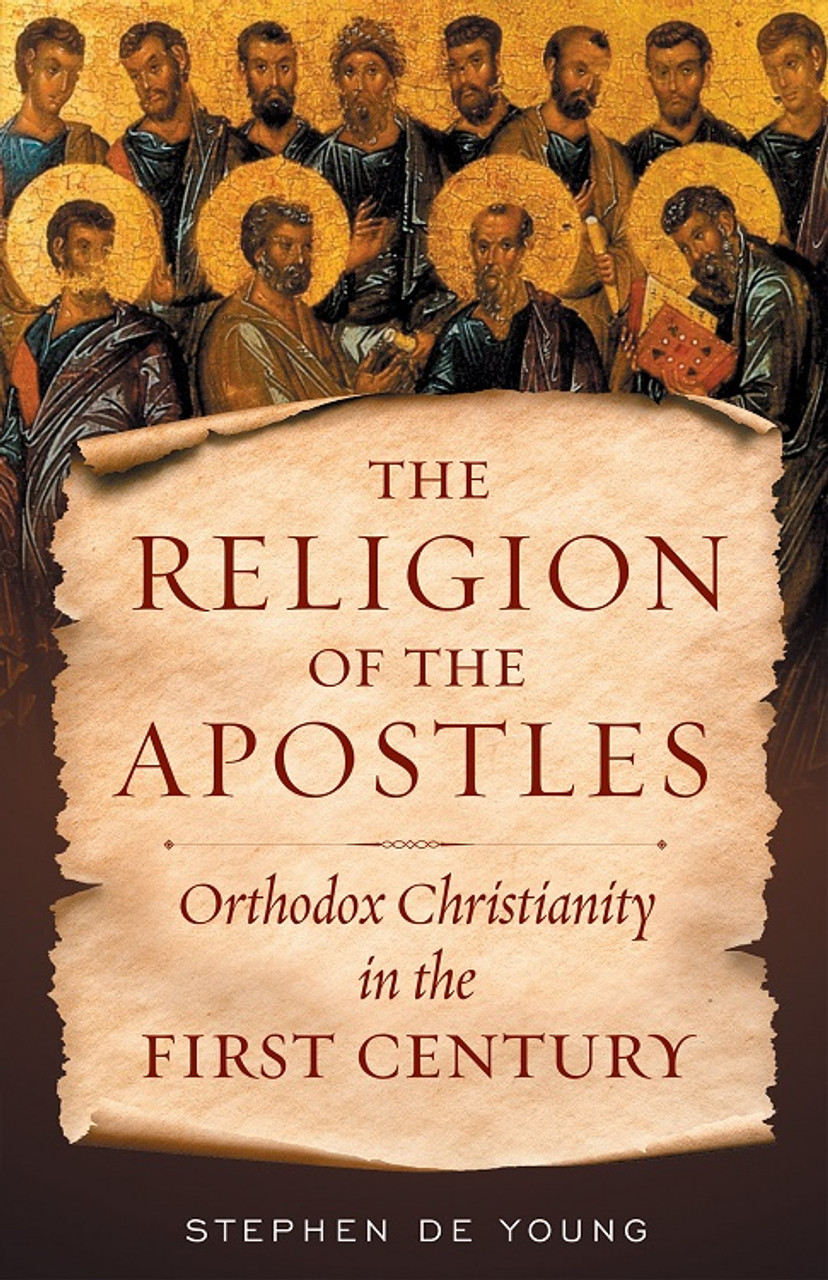
The Religion of the Apostles, by Stephen De Young, shows how the beliefs and practices of the early church connect with the world of Second Temple Judaism, the historical context for Jesus of Nazareth and the New Testament.



 Veracity