Tag Archives: saint augustine

Botticelli and the Search for the Divine

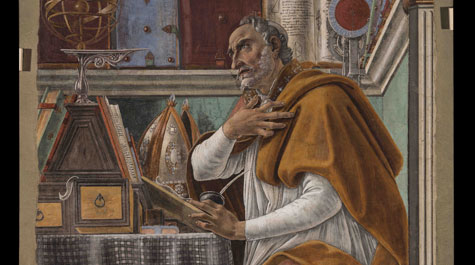
Sandro Botticelli, Sant’ Agostino nello studio (Saint Augustine in the studio), Fresco, Chiesa di San Salvatore in Ognissanti, Florence.

It is worth your time, if you are in the Williamsburg, Virginia area, to consider viewing the Sandro Botticelli exhibit at the Muscarelle Museum and the College of William and Mary, on tour in the United States, but only at the Muscarelle until April 5.

As an Italian renaissance painter, who counted Michangelo and Leonardo Da Vinci as contemporaries, my favorite painting is that of Saint Augustine, in his study. Augustine is in the process of writing to St. Jerome, who had recently died, though Augustine was not aware of this, when he began his letter. As the story goes, the scene anticipates Augustine’s reaction to a vision of hearing St. Jerome’s voice, rebuking him for trying to understand the mysteries of Heaven, with Augustine’s earthbound reason.

Many of Botticelli’s works were lost when an exuberant 15th century Dominican priest, Girolamo Savonarola, sought to rid Florence, Italy of objects that might tempt one to sin, on the Mardi Gras festival. Thankfully, not all of Botticelli’s works were destroyed during the Bonfire of the Vanities, so be sure to catch a glimpse of them at this, the first traveling exhibit of Botticelli’s work, to the United States.

Enjoy.


Saint Augustine on the Literal Interpretation of Genesis

Saint Augustine.  Champion of the biblical doctrine of Grace..... but troublesome to many regarding the damnation of unbaptized infants.

Saint Augustine. Bishop of Hippo. (354-430)

In recent years, some have argued that anything other than a “literal” reading of the first few chapters of Genesis would be a compromise against the authority of the Bible. Any other approach is a capitulation to the spirit of the modern age that would undermine the faith of the believer, smuggling in a materialist, evolutionary worldview that is inconsistent with and hostile to Holy Scripture.

The modern concern is genuine, and it should not be taken lightly. The idea of injecting philosophies that are at odds with Christian faith should indeed be rejected by those who care for the absolutely supremacy of God’s Word. Nevertheless, such an argument with respect to materialist evolution would have been completely incomprehensible to the early church scholar and Bible teacher, Saint Augustine.

For the great African Christian intellectual of the early 5th century, Augustine had other concerns. An atheistic, “Darwinian evolution” could not be anachronistically inserted into his thought or vocabulary. In his classic work, De Genesi ad litteram, known in various ways in English as “On the Literal Interpretation of Genesis,” Augustine wrestled with the most appropriate way to interpret God’s Word faithfully. For Augustine, to interpret something “literally” means to interpret “in the sense intended by the author.”

Studying the history of the church is a neglected task in today’s evangelical Christianity, which is obsessed with the supposed virtues of “newness,” continually reinforced by rapid changes in technology (would you have read this blog on your phone ten years ago??). But church history can tell us a lot about ourselves today. Do we have the courage and discipline to learn from our forebears?

In the early church, Christians held different views on the interpretation of Genesis, just as we find today. On one side, there were those like Basil the Great, who saw the days of Genesis as being 24-hour creation days, thus rejecting the allegorizing approach advocated by Origen of Alexandria. Augustine was well aware of these debates, and he sought a different way to work through the issues. Augustine’s theory that God created everything instantaneously, based on his understanding of Psalm 33:6-9, is surely out of step with most Christian views of earth’s origins today, but nevertheless he still offers some advice that might help believers who wrestle with these challenging biblical texts.

Does Augustine help you? Read on, and let me know what you think.

Continue reading
