Tag Archives: reformation

How Would You Dress for a Halloween Party?

Recently, I was invited to go to a Halloween party this coming weekend. I need your help. What do I dress up as for this party?

Now, I know that a lot of Christians are deeply suspicious of Halloween: Is it not connected, at least remotely, to some kind of Satanic practice?

Well, the question has a point to make. After all, the timing of Halloween goes back to an ancient pagan festival, some say that was originated in Ireland, marking the beginning of winter. Samhain, pronounced “SAW-in,” from what I have learned, also celebrated the end of the harvest season. Since Samhain is at the same time of year as the traditional date for Halloween, the overlap gives the impression that Halloween has a pagan connection…. And since anything that distracts the believer from whole hearted worship of Jesus Christ could be considered “Satanic,” it only makes sense to raise such suspicion.

All Saints Day was celebrated by early medieval Christians to remember those Christian martyrs and other exemplary Christians who had gone on before them. All Saints Day, though originally in May, was moved to November 1st, under Pope Gregory (731-741 A.D.). All Souls Day, a related Christian festival to remember the faithful departed, particularly deceased relatives, was set on November 2nd. During the Reformation, the All Souls Day fell out of favor. But All Saints Day was held on by the English Anglican Church. All Saints Day is otherwise known as “All Hallows Day,” (Hallows=Holy, or Saint), which is how we get “All Hallows Eve,” or “Halloween,” for the night before on October 31st.

All Saints Day still continues in liturgical traditions that still hold to ancient Christian calendars. Its success explains why, even for today’s pagans, it is difficult to even know for sure what Samhain was like before All Saints/Souls Days came into the mix.

Halloween today is basically secularized, as are most holidays now, but as the 21st century merges into what appears to be a “post-Christian” era in the West, the revival of pagan practices associated with the ancient Samhain festival have started to reappear, such as among contemporary Wiccans. But even most honest observers admit that neo-pagan spirituality is in a continued state of flux, morphing and changing quite a bit.

We can have endless debates about how “Satanic” all of this is. Or we can take a tip from this 3-minute video at John Piper’s desiringgod.org ministries. Do you see Halloween as something to be avoided, or do you see it as an opportunity to be a witness for the Gospel?

Here is my spin on that this year: If Christians really want to “take back Halloween,” then we might want to take a few lessons from church history. I suggested to my wife that instead of a ghost, or something like that, she can dress up as a Christian saint at the party, such as Saint Thecla. Early accounts are sketchy, with various elaborations, but Thecla was surely one of the Apostle Paul’s most well-known converts to the faith, first meeting Paul in what is now modern day Turkey. According to this Eastern Orthodox source, Thecla was forbidden by her mother to go out into the street to hear Paul preach. But she was able to listen outside of her bedroom window, where she heard the Gospel. So, if someone asks my wife, “Who are you supposed to be?,” well, then, she has an opportunity to talk about Thecla’s story as she heard the Gospel of Jesus Christ, and had her life set free from the fear of darkness and death.

As for me, I am still encouraged by what I wrote about last year, that identifies All Saints Day as the same day that a young, German theology professor named Martin Luther, first nailed his Ninety-Five Theses to the Wittenberg church door.  Maybe, I should try to dress up as Martin Luther?  I would probably have to gain some weight though, in order to be convincing.

The point is this: perhaps one of the best ways to celebrate “All Hallows Eve” is to remember the examples of remarkable Christians who have died and gone before us. If you receive an invitation to a Halloween party, perhaps you can read up a bit on church history, dress up as some Christian figure from the past, and then use the opportunity to share the story of that person you came dressed as, with others at the party. Sure, it sounds a bit geeky, but it is a whole lot more interesting than dressing up as some “Superhero.”

For more on the origins of Halloween, New Testament scholar Ben Witherington has some perceptive comments to share in 3 minutes. In the meantime, I need to figure who I should be…  and find a costume!

UPDATE: November 3, 2015

I need to make correction to an earlier statement, which suggested that the original All Saints Day spring celebration was moved to November 1st, partly to counteract the Samhain fall festival.  A recent post at the Anxious Bench blog, references a work by historian Nicholas Rogers, arguing that while the Irish world, where Samhain came from, originally celebrated a feast for saints in April, the Germanic world, that did not recognize the Irish Samhain, had a feast for saints in November. This undermines the idea that All Saints Day was placed in November in order to try to supplant the Samhain festival. I am glad to be corrected, and so I modified the rest of the blog post. The study of history reveals some interesting surprises and busts a lot of pious fiction.


Why N.T. Wright Can Be Both Fascinating and Frustrating

Nicholas Thomas Wright. British New Testament scholar, retired Anglican bishop, ... and agitator among more than a few conservative, evangelical Protestants.

Nicholas Thomas Wright. British New Testament scholar, retired Anglican bishop, … and agitator among more than a few conservative, evangelical Protestants.

This fall, our church has been conducting a Bible study on the first eight chapters of the Book of Romans. We have been using a study guide written by an Anglican New Testament Scholar teaching at the University of St. Andrews in Scotland, N.T. Wright, Romans (N.T. Wright for Everyone Bible Study Guides).

I need not give you a biography of N.T. Wright, other than to say that Wright is perhaps one of the most influential evangelical scholars of our day. In the 1990s, Wright wrote about and impressively critiqued the rather infamous Jesus Seminar, that sought to determine the “truly” authentic sayings of Jesus in the Gospels simply on the basis of majority vote among the Jesus Seminar scholars. Wright also wrote perhaps the best contemporary defense of the bodily resurrection of Jesus Christ, The Resurrection of the Son of God (the only other book that comes anywhere close to exceeding Wright’s work is Michael Licona’s The Resurrection of Jesus: A New Historiographical Approach). He has been a bishop, and he regularly speaks all over the world, appealing to conservative and liberal-minded Christians alike, along with interested skeptics and seekers. N.T. Wright writes faster than most humans can read… and he is overall an excellent and engaging writer, writing for both academia and also for the popular audience, as with his C.S. Lewis-like introductory book to the Christian faith, Simply Christian: Why Christianity Makes Sense. For the intellectually inclined, Wright is very much like a C.S. Lewis for our times… and he even has a great English accent to listen to!

But Wright also disturbs many of his fellow Christians, particularly those from a Reformed theological background. Now, the study of Romans is incredibly rich and rewarding in and of itself, but if you are not familiar with N.T. Wright, you might find yourself perplexed by some of the things N.T. Wright argues for in his study book. Consider a note on Romans 1:17 that Wright gives us on pages 13-14 of the Romans study guide:

Here Paul introduces a word and theme that will be critical throughout the letter. The Greek word and its variants are often translated as “righteous,” “righteousness,” “just” or “justice.” The problem is that Paul (though writing in Greek) has Hebrew words and meanings in mind, which English translations often overlook…..the phrase “the righteousness of God” [refers] to God ‘s own faithfulness to his promises to Israel, to his covenant…He keeps his word and thereby shows his trustworthiness, justice and righteousness…. What does this mean for what Paul is saying in Romans? [God] does not impart or impute or transfer his righteousness, his just character [to the believer]….”

and here is this remark on page 26:

The phrase often translated “righteousness of God” … is not, as some have argued, a righteous quality that God gives or imparts to humans. It is God’s own righteousness, his being true to the covenant. This covenant faithfulness carries with it more of the overtones that Paul is trying to highlight, referring back to God’s covenant promises to Abraham to undo the problem caused by the sin of Adam. But Israel failed to both keep the law and bring the message of God to the nations.

For evangelical Christians who read this, those who have grown up hearing sermons about the “imputation” of Christ’s righteousness to the believer, primarily through Christ’s “active obedience” to the Mosaic Law, thus enabling God to see us clothed in Christ’s righteousness, instead of our sin, sentences like those above from N.T. Wright are frankly startling. It can even be downright maddening! So then, what is N.T. Wright up to here? (CAUTION: you might need to put your thinking cap on!)
Continue reading


Oliver Cromwell’s Crisis

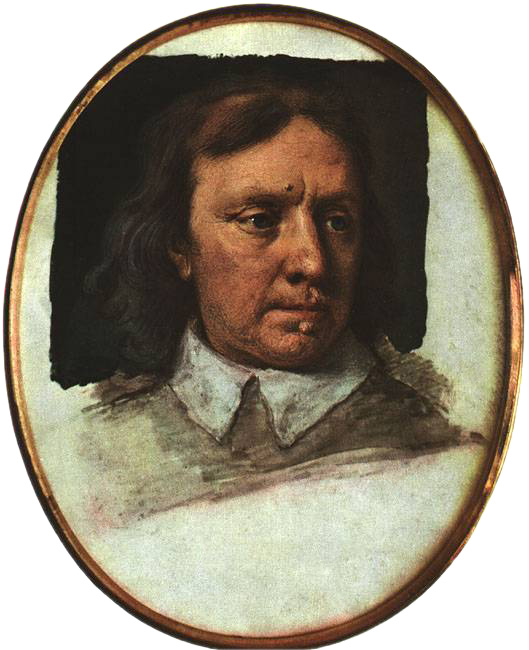
Oliver Cromwell (1599-1658), Lord Protector of England, and Christian reformer of church and civil governance. A hero of liberty to some. A fanatical tyrant to others.  From an unfinished portrait by Samuel Cooper (credit: Wikipedia)

Oliver Cromwell (1599-1658), Lord Protector of England, and Christian reformer of church and civil governance. A godly hero of liberty to some. A fanatical tyrant to others. From an unfinished portrait by Samuel Cooper (credit: Wikipedia)

By the early 17th century, the only type of governance that the English people had known for hundreds of years was the monarchy.  Along with the office of the king in the political realm, for Christians there was a corresponding office of bishop. The term bishop was derived from the Greek word episkopos, as found in Titus 1:7, typically translated today as “overseer.” Just as the king oversaw the worldly affairs of state, the bishop oversaw the spiritual affairs of the church.  King James I of England, who sponsored the famous English Bible translation that bears his name, was famously quoted as saying, “No bishop, no king.”

For James, a king can only rule a people properly with the assistance of bishops who could administer the spiritual life of Christian communities in accordance with the standard set by such a benevolent and divinely appointed king. King James, along with his bishops, saw this governing arrangement as quite efficient. But what happens when the people begin to lose confidence with their leaders? What happens when you can trust neither your bishop nor your king?
Continue reading