Does the Bible teach that women should serve as elders in a local church?
This is a question which has become one of the most divisive issues in evangelical churches today. It is also a question filled with assumptions which begs for other questions. What is an “elder” in a local church? What is the “local church?” Then there is the question which has plagued American society culturally for at least the last ten years: What is a “woman”?
Preston Sprinkle on the Complementarian/Egalitarian Debate
Preston Sprinkle taught New Testament at Eternity Bible College, at an extension campus in Boise, Idaho, before it downsized in 2016. As a New Testament scholar, with a PhD from the University of Aberdeen (Scotland), Preston Sprinkle has written about and spoken on a number of issues relevant to the study of the New Testament. Eternity Bible College was founded by popular Christian author and speaker, Francis Chan. Francis and Preston even wrote a book together, Erasing Hell, a response to the universalism-leanings of Rob Bell, a controversial former evangelical pastor, back in 2011. After leaving Eternity Bible, Preston founded the Center for Faith, Sexuality, and Gender, providing resources for churches, parents, and other individuals, in order to more effectively care for people who struggle with questions about sexuality and gender, while upholding a traditional view of human sexuality and marriage; that is, a one-man to one-woman covenantal relationship intended for life.
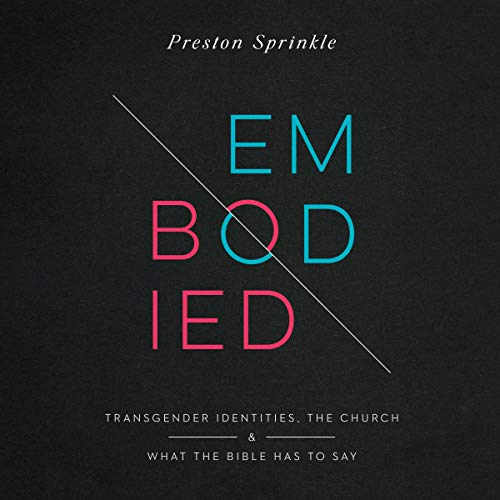
As one might expect, entering any conversation regarding sexuality and gender will probably generate controversy, and Preston is no stranger to it. Preston’s previous books on these topics, such as People To Be Loved: Why Homosexuality is Not Just an Issue (reviewed here on Veracity), and Embodied: Transgender Identities, the Church, and What the Bible Has to Say (reviewed here on Veracity), have sparked very lively discussion and criticism from all sides. I have not always agreed with every element Preston puts forward in his writings, but I appreciate his willingness to tackle tough questions, doing so with a commitment to follow the Scriptural text, wherever it leads, to find answers.
What other controversy could Preston address?? Well, Preston had put off doing a deep dive into the question of “women in Christian leadership” for years, knowing that he had other scholar friends whom he highly respected, who landed on different conclusions to the question. But Preston finally took the time to read a stack of books for several years in order to write his book, as a way of bridging the gap between ordinary Christians, without seminary training, and those in the academy.
Preston’s newest book was one of my best reads of 2025 (and early 2026), having received an advanced copy of the book. Though I do feel compelled to write this rather long, critical review, as I will explain below.
I am taking a break from my two-part book review of Bart Ehrman’sArmageddon to address some significant news in the evangelical world. It involves biblical scholar Richard B. Hays on one side, and popular author Rosaria Butterfield on the other. This is probably the one blog post I have made this year, which I really did not want to write. But sadly I find it necessary.
As I wrote about late in the spring of this year, it was announced that a new book by a prominent New Testament scholar would come out this fall that would shake up a lot of people, particular evangelical thought leaders and teachers: “Most Christians probably have no clue who Richard B. Hays is. But when it comes to the Bible, Hays is big news. Think the Tim Tebow of the National League Football, or the Caitlin Clark of women’s basketball, or the Taylor Swift of pop-music, ….. or the John Piper of evangelical pastors. Richard B. Hays is THAT big when it comes to New Testament studies. He is a rock star.” I would urge you to go back and read that post for further context for this blog post.
Richard B. Hays is the rough American equivalent to the British New Testament scholar, N.T. Wright. His son, Christopher, teaches Old Testament at my alma mater, Fuller Theological Seminary. Yesterday, the elder Hays and the younger Hays released The Widening of God’s Mercy: Sexuality Within the Biblical Story. What is remarkable about this book is that it marks a reversal in Richard B. Hays’ position in the 1990s, where he then concluded (at least tentatively) that the New Testament does not allow for any concept of affirming same-sex marriage as a legitimate option for the Christian. The elder Hay’s book, The Moral Vision of the New Testament: A Contemporary Introduction to New Testament Ethics, was the touchstone for many in what is often described as a “Side B” approach to same-sex attraction.
A definition at this point is vitally important.
At the risk of being too brief, a “Side B” approach to same-sex attraction is that it acknowledges that some people experience a kind of sexual attraction to members of the same-sex, in which at least some (if not many) who experience this same-sex attraction find it difficult to completely shake off. Though quite debatable in “Side B” circles, some, if not many, or perhaps even most in this category, live with this condition their entire lives. Understood this way, “same-sex attraction” is not an identity, as though “same-sex attraction” competes with one’s identity as a Christian. Neither is it equivalent to sexual lust, though it could lead to same-sex lust, which is described as sin in the Bible. Rather, “same-sex attraction” as an “identity” is simply an acknowledgment of one’s experience in contrast with heterosexuals who never experience same-sex attraction. It does not automatically imply that someone is actively involved in some kind of sexual activity with a member of the same sex.
Richard B. Hays. One of the top New Testament scholars on the planet. Has he changed his mind on what the Bible teaches about human sexuality?? A new book suggests he has, but his argument is complicated.
Richard B. Hays (Father) and Christopher Hays (Son) on Christian Sexual Ethics
Reviews are starting to come out taking a hard look at the new book, The Widening of God’s Mercy: Sexuality Within the Biblical Story. As many reviewers have indicated, Richard B. Hays has changed his mind regarding the legitimate, biblical boundaries for sexual behavior, a viewpoint which his son, Christopher, also supports. A couple of reviews favorable to the conclusions made by the Hays can be found here:
Rebecca McLaughlin, for The Gospel Coalition. McLaughlin acknowledges she experiences same-sex attraction, but that she is committed to upholding an historic Christian sexual ethic, which honors marriage as being between one man and one woman.
All five reviews are worth reading, particularly as preparation for someone who wishes to read the new Hays and Hays book. However, the most detailed and engaging review is the last one by Preston Sprinkle. The conclusion Sprinkle makes is worth quoting in full:
I have to admit, the scholarly side of me was excited when this book was first announced. Some Christians immediately trashed the book on social media—something no thoughtful Christian should ever do with books they haven’t read—but I was genuinely excited to read it. Richard is a brilliant scholar (I wasn’t familiar with Christopher’s work), and his article on Romans 1 in particular was one of the most thorough and exegetically responsible treatments of this tough passage. I was deeply curious how he was going to refute his previous argument. I also wondered if The Widening of God’s Mercy would tease out a fresh argument for same-sex marriage that hadn’t yet been made.
To my surprise, the book did neither. Instead, it simply repackaged an old trajectory argument to make a questionable logical leap: since God welcomes foreigners, eunuchs, tax collectors, and sinners, therefore sex difference is no longer part of what marriage is.
At the risk of oversimplifying, all of these reviews suggest that the exegetical work Richard B. Hays did in the 1980s and 1990s, which demonstrates that the New Testament does not affirm same-sex marriage, is interestingly still intact. In a nutshell, the New Testament affirms marriage as being between one man and one woman, thereby indicating that a marriage between two men, or between two women, can not qualify as within the boundaries of what constitutes a biblical marriage.
However, the message of the new book suggests that God can, and indeed, has changed his mind. While same-sex marriage has been rightly condemned as outside of accepted historic, orthodox Christian understanding for almost 2,000 years, God has in the 21st century moved through the action of the Holy Spirit to now affirm a broader perspective on marriage. This is equivalent to what is often known as a “Side A” approach to same-sex attraction and marriage.
The idea that God can and has changed his mind is provocative. It is also an argument that can act like a wild tiger which can not be tamed, or like the proverbial bull in a china shop.
How Do You Know When God Changes His Mind… After the New Testament Has Been Completed?
But the argument can easily go in directions which will surprise Christians and non-Christians alike. The rise of the Enlightenment in the late 18th century suggested that we can essentially dispense with the concept of the supernatural. Why? Because perhaps God has changed his mind.
Follow this thought experiment: Back in the New Testament era, people were naive enough to believe in things like miracles, so God used the belief in the resurrection as a way of convincing premodern people to accept the Christian message. However, now we live in the modern (even post-modern) era, where science tends to reign supreme. We can give up on the whole concept of the supernatural as essential because God has basically changed his mind. No one needs to make any decisions based on supernatural beliefs anymore because the secularization process of society has made those supernatural beliefs irrelevant.
This is effectively what the Hays father and son team have done. There is nothing new here.
One might then argue that both secularization and new understandings of marriage in the civil sphere are inevitable results of the trajectory of contemporary Western culture, and could have potential advantages. Perhaps there is some good after all if the ethical framework of Christendom takes a backseat culturally. But theologically, these new supposed “movements of the Holy Spirit” are a disaster for the church. Where can the justification that God has revealed a change of mind be found? In the writings of a pair of United Methodist biblical scholars?
Richard B. Hays has in the past, and even now, ultimately told us the truth about the what Bible says about same-sex attraction and marriage, but in this new book with his son Christopher it would appear that what the Bible says really does not matter. Because God has changed his mind.
The father and son Hays team would probably push back against this. They might say that the Christian ethic of love supersedes the ethical teachings of the New Testament written in the first century. They might say in the sovereignty of God, God has every right to change directions ethically in the 21st century, even at the expense of what we read in Scripture. But as an evangelical Protestant who looks at the Bible as the final authority for faith and practice, it is really difficult to square the contention made by the father and son Hays team that the Bible condemns all same-sex erotic relations as going against Scripture, while simultaneously saying that 2,000 years later this no longer applies, simply because God has since changed his mind.
On the one hand, I appreciate the efforts by Richard B. Hays and Christopher Hays to look for a compassionate way to accept LGBTQ people as people who are genuinely loved by God, thereby rejecting the ways that the church has condemned such persons in the past, simply because they experience some form of same-sex attraction, whether they act on it or not.
But the main problem is not simply their conclusion, but rather, it is the method by which they arrive at their conclusion. In the end, for the Hays, it is not Scripture which remains ultimately authoritative for determining Christian ethics. Instead, it is human experience which trumps Scripture. But in making this argument, Hays and Hays are adopting a kind of progressive Christianity that goes beyond simply affirming same-sex marriage. They are undermining the basis for determining what faithful Christian discipleship and theology has looked like for 2,000 years.
For if the Bible teaches that same-sex marriage is permissible, then that would be one thing. Instead, they argue that Paul and the rest of the New Testament writers got the doctrine of marriage wrong. In their argument, we need new revelation today to fix what Paul and the other apostles messed up.
I do not doubt the Christian commitment of either the senior or younger Hays. Yet as far as I am concerned, it just seems like it would be a whole lot more honest to say that Christianity got some stuff so fundamentally and horribly wrong, that it would be wiser to reject Christianity as purely wishful thinking and leave it at that. To think that the Christian church for nearly 20 centuries got the fundamental doctrine of marriage wrong is a really big “OOPSIE!!!”
Perhaps we could just preserve the supposedly good parts of what the Bible teaches, and safely discard the rest. Perhaps a kind of “cultural Christianity” is all we can really hope for. Perhaps we could set up a committee to try to negotiate through acceptable versus unacceptable moral claims in the Bible. But who gets the authority to carve those things out and make such decisions?
Is this really about telling the truth about same-sex attraction, marriage, and one another?
It would be better to be an atheist, an agnostic, or generic theist instead of trying to stuff the square peg of Richard B. and Christopher Hays version of Christianity into the round hole of 2,000 years of historic orthodox Christianity. But as I believe that the central core claim of Christianity, that Jesus rose from the dead, is indeed true, I am driven to conclude that there must be a better way to describe what Christianity looks like than what the father and son Hays team would have us believe. Even if the Bible teaches something I do not fully understand, I still need to learn to trust that God knows what he is doing, and not try to pretend that twenty centuries after the Incarnation, that I suddenly know better.
I hope to at some point read The Wideness of God’s Mercy, to make sure I have not misrepresented the authors, but for now I would suggest reading some of the reviews that have come out, to whet your appetite for wrestling with the arguments of the book. If you are not much of a reader, you should consider watching or listening to a YouTube video by Preston Sprinkle, where he goes into some detail into what he agrees with about the book and ultimately disagrees with about the book. In a world where the traditional Christian doctrine of marriage has come under relentless attack from the culture, it is refreshing when you have someone telling the truth about what Scripture is saying, and doing so in a respectful way that honors the best of intentions that others possess.
——————————————
An Addendum…. About Rosaria Butterfield’s Fives Lies of Our Anti-Christian Age….And A Plea for Speaking the Truth
This final part of the blog post addresses the other side of the conversation taking place in evangelical spaces in the church today.
I highlight Preston Sprinkle’s video because near the beginning of the video Preston urges Christians to do their best to accurately understand the arguments presented by someone who fundamentally disagrees with you. For if a Christian fails to faithfully represent what someone else believes or says, that Christian is breaking the Ninth Commandment not to bear false witness against one’s neighbor. Lying about what someone actually believes is an immoral act. Christians who lie about others in this way need to repent of such behavior.
For example, I was intrigued and interested to read Rosaria Butterfield’s recent book Five Lies of Our Anti-Christian Age. Rosaria Butterfield was involved in a lesbian relationship for years, and she was an extremely active anti-Christian activist before Jesus got hold of her life. Several of her earlier books are very good, including her phenomenal The Secret Thoughts of an Unlikely Convert, a book I reviewed 11 years ago briefly at Veracity. I only read parts of her next book Openness Unhindered, but that was helpful, too.
In The Secret Thoughts of an Unlikely Converttells of her “train wreck” conversion story, and how simple acts of Christian hospitality drew her to read the Bible slowly and carefully over a few years, assisted by caring, non-judgmental Christian friends, who welcomed her into their lives. Rosaria’s story is gripping and encouraging. I highly recommend learning about her testimony.
Rosaria Butterfield – An unlikely convert to Christian faith, touched by the art of hospitality…. What has happened to her since?
The Good Stuff in Rosaria Butterfield’s Five Lies of Our Anti-Christian Age
At first I found much to learn from in Five Lies of Our Anti-Christian Age. Rosaria effectively summarizes the five lies being aimed against Christianity today:
Lie #1: Homosexuality is normal.
Lie #2: Being a spiritual person is kinder than being a biblical Christian.
Lie #3: Feminism is good for the world and the church.
Lie #4: Transgenderism is normal.
Lie #5: Modesty is an outdated burden that serves male dominance and holds women back
She also has some excellent advice about distinguishing between sympathy and empathy, which encouraged me to keep reading. Rosaria even had a helpful critique of certain aspects of the “Side B” movement, where some have advocated a controversial idea of certain kinds of “spiritual friendships” where such relationships function a lot like marriage without the sex part. That does sound a bit fuzzy.
This has raised a number of questions in my mind, and in my earlier analysis of the Revoice movement, it was not clear as to who associated with Revoice supports that way of thinking and who does not, and what they actually mean by “spiritual friendship.”
I have come to see that Rosaria Butterfield is correct to call out a particular definition of “spiritual friendship” as unbiblical , when such “friendships” mimic marriage. At the very least, this is confusing and unhealthy. Friendship is one thing. Marriage is different. This appears to be her strongest objection to the Revoice movement (Butterfield, Five Lies, p. 59). In many ways, some of this critique is correct, at least in the early years of the Revoice conference.
We believe that all Christians have the capacity for both sinful (i.e., fleshly) and holy (i.e., Spiritual) desire for relationship with other people; that intimate friendship between believers can be a means of sanctification; and that the Holy Spirit can direct and shape affection for other image-bearers in ways that honor their dignity and celebrate their unique personhood. We believe that Christians should seek wisdom and prudence when entering any relationship marked by greater intimacy, and that believers must exercise care and resolve to avoid all forms of temptation. We believe that Christians must actively resist and turn away from every thought, action, desire, or behavior that does not align with God’s revealed intentions for human sexuality, since we are not our own, but belong—body and soul, both in life and in death—to our faithful Savior, Jesus Christ. (Rom. 8:12–13; Col. 3:5)
If someone has questions about “intimate friendship,” then the phrasing towards the end urging believers to “actively resist and turn away from” anything that “does not align with God’s revealed intentions for human sexuality,” sounds pretty orthodox to me. I do wonder if Rosaria has read this page from Revoice’s website.
The Not-So-Good in Five Lies
I agree that all five of the lies Rosaria outlines are indeed impacting the church in negative ways. The problem with Five Lies comes down to some of the details Rosaria articulates in her book, and how she interacts with other authors writing in this area.
First, it would appear that not everyone defines all “spiritual friendships” in the manner Rosaria puts it. People can live without sex, but they can not live without friends. Even early on in the book, Rosaria makes multiple statements that simply do not resonate with what I know about so-called “Side B” understandings of same-sex attraction:
“Side A rejects the Bible as inerrant, infallible, sufficient, and authoritative, while Side B rejects the biblical doctrines of sin, repentance, and sanctification” (Butterfield, p.67).
“Side B errs on its handling of matters of salvation and sin, forgetting that the first word of salvation is repent—“Repent,” declares Jesus, echoing John the Baptist, “for the kingdom of heaven is at hand” (Matt. 4:17). Side B redefines gay sin merely as sexual action and denies that sin acts with affections, feelings, attractions, and desire. Both Sides A and B believe that homosexuality is fixed and that the gospel might change people in smaller ways but never in the deep matters of sexual desire ” (Butterfield, p. 74)
The logic here resulting from a confusion of terminology and their definitions is difficult to follow: Rosaria rejects both “side A” and “side B” in favor of what might be called “side X,” but it could be instead that she is advocating “side Y,” supposedly somewhere in between “side B” and “side X.” As some define it, “side X” conflates “same-sex attraction” together with lust for the same sex, something which is sinful and needs to be repented from, as opposed to a temptation which is to be resisted, or otherwise something someone should flee from, as when Joseph ran away from Potiphar’s wife, when she propositioned him. Is what I define as “side B” really “side Y” instead? According to GotQuestions.org, perhaps my “side B” is really “side Y.” Are you confused yet?
Rosaria is correct to say that that “side A” believes homosexuality as an orientation to be “fixed,” but not everyone in the “side B” camp would agree with that. It would appear that Rosaria Butterfield defines “sexual attraction” as being equivalent with sexual lust, which is not at all what I have read is consistent with what advocates of a “Side B” approach take.
Even if Rosaria is correct, I do not see the evidence for her position demonstrated in her book. Rosaria Butterfield operates with her own definitions of terms like “sexual attraction,” “side B,” and “sexual orientation” that do not align with how other authors use that terminology. As a result, these different definitions of key terms and ideas distorts her readings of other writers.
For example, in Greg Johnson’s book, Still Time to Care, which I have reviewed on Veracity, he argues that both same-sex attraction and opposite-sex attraction have disordered elements to them, this side of Adam’s fall. Not only is same-sex attraction, in the most sexual sense, disordered, on the opposite-sex attraction side, polygamy is a sign of disorder as well. However, in her review of Johnson’s book, Rosaria Butterfield responds:
Because Johnson rejects the natural and good pattern of heterosexuality, he believes that there is no point or hope in striving for it. Johnson writes, “There is no reason to believe that the ordinary progress of spiritual growth would involve the replacement of sinful homosexual temptation with sinful heterosexual temptation.” (Butterfield, p. 71).
But this misrepresents the argument with Greg Johnson is making in his book. For one thing, for Johnson, the desire on the part of someone who experiences same-sex attraction to want to become opposite-sex attracted is quite natural (contra Rosaria), but it is not the same thing as sanctification; that is, “spiritual growth” from this quote. Johnson’s point is also to say that those who experience opposite-sex attraction can experience temptation and sin just as much as those who experience same-sex attraction, just in different ways.
Exchanging one form of temptation to sin for another form of temptation to sin is not a sign of progress in one’s sanctification. Regardless of the temptation, or the sin such temptation tries to move us towards, we are called to flee from all temptation and repent of all sin.
Rosaria’s argument as I read her implies that part of Christian sanctification is seeking the transfer of same-sex temptation in someone’s experience over to opposite-sex temptation in their experience. Does this really mean that a same-sex attracted person should strive after a different kind of temptation, that of heterosexual temptation? How about not striving after any kind of temptation at all? What ever happened to that phrase from the Lord’s Prayer, “lead us not into temptation?”
The irony is that in Rosaria’s own writings and interviews she has given acknowledges that she still experiences same-sex attraction at times. How this squares with her view of Christian sanctification is not made clear in her book. Rosaria also agrees with her fellow author, Christopher Yuan, that the object of Christian sanctification is holiness and not heterosexuality, which appears to be in complete contradiction with what she says about Greg Johnson’s book. Again, Greg Johnson’s book emphatically argues that the goal of Christian sanctification for a same-sex attracted person is holiness, not heterosexuality.
The logical disconnect here is incredibly frustrating. Rosaria’s misreading of Greg Johnson’s book is not the first time this happens in Five Lies. This happens several other times with other authors with whom she interacts. If I am wrong about this, I would like to be corrected.
Continually running into roadblocks like this in Five Lies of Our Anti-Christian Age, over and over again, has proved to be very discouraging, making the reading of Rosaria’s book to be more of a slog than a spiritually encouraging process, despite some of the genuinely helpful places in her book where I actually agree with her. The final straw for me came in how she treats author Preston Sprinkle.
Rosaria offers a review of one of Preston Sprinkle’s books, where Preston talks about the kind of close, intimate friendship that David and Jonathan had in the Old Testament. Many on “side A” of the discussion believe that David and Jonathan were in fact gay lovers in the most sexual sense. But Preston Sprinkle takes a different approach. Preston relates the story of David and Jonathan using the initials “K.D.” to refer to King David and using the name “John” to refer to Jonathan. Rosaria’s take on Preston’s reading of the story is odd to say the least:
Sprinkle is casting King David (“K.D.”) as an effeminate poet and Jonathan (“John”) as his unrequited love. In keeping with postmodernism, Sprinkle tips his hat to the false claim that David and Jonathan were probably gay. Playing with the Bible in this way is meant, I suppose, to make it friendlier to sexual minorities (Butterfield, p. 240).
However, if she had read Preston’s book more carefully, she would have read the explicit statement made by Preston Sprinkle on the previous page, “the Bible gives no evidence that David and Jonathan were in a sexual relationship.” (Preston Sprinkle, Embodied, p. 78). If she had bothered to read an earlier book or a later book by Preston Sprinkle, she would have read even more explicit statements as to the nature of David and Jonathan’s friendship:
David and Jonathan weren’t gay. But they did experience deep-seated, same-sex affection, and nonsexual intimacy toward each other. Same-sex oriented Christians experience similar desires only to a greater degree. (Sprinkle, People to Be Loved, p. 146).
David does say that Jonathan’s love was “more wonderful than that of women” (2 Sam. 1:26), but this doesn’t mean their relationship was sexual, since the ancients didn’t automatically equate “love” to “sex,” unlike many modern westerners. (Sprinkle, Does the Bible Support Same-Sex Marriage?: 21 Conversations from a Historically Christian View, p. 63).
For Preston Sprinkle, the kind of “same-sex affection” David and Jonathan had for one another is not identical with “same-sex attraction” in the erotic sense. David and Jonathan instead shared a deep, non-sexual friendship bond with one another. What possessed Rosaria Butterfield to read Preston Sprinkle so badly?
Yet the most alarming thing is that Rosaria has refused to engage with Preston in a conversation to sort out the matter. From Preston’s blog post:
I also wish I could be having this conversation directly with Butterfield. In fact, I reached out her via email to invite her to have a private, good-faith conversation about these matters. (Not a debate; just a clarifying conversation.) Her husband, Kent, who is also one of her pastors, responded with an email he and his co-pastor had written, declining on her behalf. When I asked for permission to quote publicly from their reply, Kent requested that I not do so and provided me with this public statement: “Rosaria’s pastors stated there is a difference in understanding of the gospel and therefore see no basis for discussion.”
The final public statement made by Rosaria’s elders is disturbing as it is inconsistent with the actual data. All of us make mistakes, get things wrong, misunderstand people, etc. I do it quite often, and try to do my best to repent of such sinful errors when I can. But when someone publicly makes a claim about what someone else believes or says, which turns out to be false, and then refuses to discuss or even acknowledge the error, then this is a violation of the Ninth Commandment, which forbids a follower of our Lord to bear false witness against one’s neighbor.
Perhaps what Rosaria is saying is true about her own experience. But when it comes to telling the truth about same-sex attraction, marriage, and one another more generally, something appears to be amiss.
I do hope and pray that Rosaria will rethink her posture, write a letter or email, and make some effort to clear up the matter. For the sake of honoring the Ninth Commandment, she should do so. But to date, Rosaria has done no such thing. This is all very troubling.
Ditching What I Was Hoping Would Be an Edifying Book
That pretty much did it for me.
I finally decided to give up on trying to finish Five Lies of Our Anti-Christian Age. The work required to try to constantly reframe how she defines terms like “sexual attraction,” “side B,” “sexual orientation”, and others and try to mesh them into how other authors uses those same terms was just exhausting. I really wanted to like this book, considering a number of positive reviews from others whom I respect, but I just got worn out by all of the mental gymnastics and contortions.
It made me long for wanting the “old” Rosaria of The Secret Thoughts of an Unlikely Convertback from 11 years ago. I miss that Rosaria. Back then, Rosaria was more the compassionate voice who prized hospitality as the gateway for allowing God to work and change lives, as opposed to the full-on culture warrior posture she now takes in Five Lies of Our Anti-Christian Age.
In her favor, I still marvel at the courage that Rosaria Butterfield had in giving up her lesbian relationship, and the very social world that supported her and simultaneously isolated her from Christian community, in order to give her all-in-all to follow Jesus, no matter what the cost. Rosaria is truly a model for radical, Christ-loving discipleship. But for some reason, her tendency towards radicalism has caused her to slip into yet another deadly sin, that of bearing false witness against one’s neighbor. I pray that the Lord will open her eyes so that she might do the right thing some day, and return to telling the truth about others.
The Unfortunate Tie Which Unites Richard B. and Christopher Hays with Rosaria Butterfield
Circling back around to the Richard B. Hays and Christopher Hays book The Wideness of God’s Mercy, it would appear that their book is meant to be kind of a strong pushback to the rather militant culture warrior posture of a Rosaria Butterfield’s Fives Lies of Our Anti-Christian Age. I pray that Hays and Hays would see the error of their posture, but I doubt that such a move will happen anytime soon.
The unfortunate tie which unites Richard B. and Christopher Hays with Rosaria Butterfield is the notion that same-sex attraction inevitably leads to the acceptance of same-sex marriage, forming a symbiotic relationship between the two. For the Hays, this notion is viewed positively. Same-sex attraction is a gift from God which paves the way for God to honor same-sex marriage. The trajectory that starts with same-sex attraction eventually works to redefine marriage. Why? Because God has changed his mind.
For Rosaria Butterfield, this notion is viewed negatively. Same-sex attraction is not merely a temptation, it is the embodiment of a kind of sin itself. There is no difference between temptation and the sin that might result from giving into that temptation. Same-sex attraction is just as much a morally-culpable sin as same-sex marriage is. For Rosaria, same-sex attraction does not merely entail a potential temptation to be resisted, but rather it is a sin to be repented from.
In Rosaria’s anthropology, the trajectory associated with the same-sex marriage movement in the wider culture works in the opposite direction. Because same-sex marriage is a sin that has been normalized, the only way to fight the trajectory is to fully assign same-sex attraction itself into the category of sin as well. Since same-sex marriage is sin, then anything that has the possibility of leading to that sin must be dealt with as sinful itself. Anything short of this radical categorization of same-sex attraction is a concession towards sin which can only be addressed through repentance. Any acknowledgment of a “same sexual orientation” that might never change in a person’s life is simply believing at least one of the “five lies.”
What we are witnessing in our current cultural moment is a “hardening of the categories,” as a top-of-the-line New Testament scholar moves against an historically orthodox Christian ethical position, while a heroic former-lesbian-activist turned evangelical Christian now issues takedowns of other fellow believers who do not follow her exact mindset. Like a “hardening of the arteries,” which endangers the health of the physical body, a “hardening of the categories” pits the timelessness of God’s moral standards against the call to love with compassion and mercy, which endangers the health of the Body of Christ.
Neither side appears to leave much room for a third-way mediating position that seeks to uphold the Christian virtues of hospitality, listening well, and not telling lies about other people, while also upholding an historic, orthodox Christian ethic regarding sexual ethics, and the doctrine of Christian marriage as being between one man and one woman. This is a sad state of affairs. There is a whole generation of LGBTQ+ folk who long to hear the Christian message of both love and truth expressed to them in a way that they can understand.
It is time that we as Christians learn to do a better job in telling the truth about same-sex attraction, marriage, and one another.
UPDATE Monday, September 23, 2024:
Less than two weeks after I published this blog post, Gavin Ortlund of Truth Unites sat down with Rebecca McLaughlin to discuss the controversy regarding the new Hays & Hays book on human sexuality.
First, let me start off with a personal story. I am a biological male who feels quite comfortable with being gendered as masculine. But it was not always that way.
I was never much of an athlete growing up. In elementary school, I was shorter and smaller than the other boys, and I was always the last one to get picked on a side for kickball. I especially dreaded it when girls played with us, and the girls got picked first over me. I was generally consoled when there was at least one or two girls left, after I got picked. But it still was not a great feeling.
That began to change as a 12-year old, when I discovered the sport of tennis. I learned from my coaches that I was actually pretty good at it, compared to a number of the other kids. I won match after match with other boys in a local municipal league, throughout an entire season. Having grown up thus far, playing in the dirt, building dams in the small creek behind our house, and being fascinated with dump trucks and bulldozers, I was finally beginning to feel comfortable with my “boy-ness.” My tennis experience with other boys seemed to confirm it.
Then, I was lined up to play a girl my same age in the girl’s league. It went like this: 6-0, 6-0, 6-1. I was completely devastated by the loss. At least I got one game in the victory column. But it cemented in my mind the same type of feeling I had being chosen for kickball in elementary school…. at the bottom of the list.
Well, as it turned out, this girl who destroyed me in tennis was the daughter of the president of the local university in my hometown. She probably started taking tennis lessons at age 5, for all I knew. For when she got to high school, she ended up being a Virginia State Champion in tennis, with an almost unbroken victory record. I do not know if she actually went to the Olympics or not, or played professionally, but she could have. She was definitely THAT good.
I put the tennis racket away after that.
I never touched it again until my years in college, and then only briefly. I was never able to fully enjoy the sport until I hit my 30s. I was completely sandwiched in by social expectations, formed by traditional stereotypes, that I was somehow “less than” a boy, because I was completely humiliated by a girl in sports. Sure, you could call it “sexist,” on my part (Though for being a kid just out of 6th grade, that seems like a heavy trip to lay on someone). As for me, a growing adolescent, I thought it was confusing. For if I was really a boy, why was I such a poor athlete compared to girls my age? What does it mean to be a “boy” after all?
What made the experience worse is that I hit puberty rather late. Plus, I received little to no sexual education, even in school. As an only child, who was rather shy to begin with, figuring out how I fitted in socially was difficult. I was a bookish nerd, intimidated by the athletic boys, and I generally felt less threatened around girls than with boys. It was not until probably late in my freshman year, that I finally settled on the answer: “Yes, I really was a boy.” The biggest factor was in realizing that I was attracted to girls, in a way that I never really felt before. Yep, that was DEFINITELY the game changer.
But it took a while. And I had more than a few doubts along the way. Without going into further detail in this online forum of a blog, let me just say that there was a period of time, perhaps a few months or so, where I was really confused about my gender status.
I look back on those experiences as a kid, as though they are part of a distant land and distant time, particularly the gender crisis I went through in my early high school years. Frankly, this has become one of those life stories that I would rather just forget about.
But the world has vastly changed since then. Vastly.
Today, I am a so-called “typical male,” in that I am a single-task operating system, who can not multitask as women generally do. I have a big love for sports and playing sports, my biggest love being for playing soccer. I still like playing in the dirt. I pretty much fit all of the culturally assumed norms being masculine. But back in those childhood and teenage years, I had no one to talk to about my gender insecurities.
Not friends…. (except for perhaps one awkward conversation with one girl I knew in my gym class, so I am not sure if that counts).
Not parents.
Not teachers.
Not someone in my mainline Protestant church. No pastor. No Sunday School teacher. No youth group leader.
No one.
Fast forward decades later to 2021: The concept of transgender is now relatively commonplace in colloquial discussion. It is certainly freely talked about in social media, as there is less social stigma. There is a sense that this can be a good thing, as sweeping difficult conversations under the rug is never a good thing.
However, there is another side to this. The rise of what has been described by some as “Transgender-ISM” has become an extremely volatile and politically charged topic. In some alarming cases, government overreach has dictated to people what they can and can not say, a direct threat to free speech (Just ask Jordan Peterson).
What was once such a personal matter has now triggered a whole culture, set on edge. Struggling people, who would rather not be left exposed in the middle of a culture war, are caught in the crossfire.
One of my nieces coaches girls soccer. Just a couple of years ago she was told to admit to her team a boy who was transitioning to becoming a girl, to play in the position of goalie. “She” became the best player on the team. Something like that would have been unthinkable, just a generation ago. The culture has changed so rapidly within the past decade.
The Transgender Conversation in Today’s Post-Modern, Post-Christian Culture
How do Christians today navigate the transgender conversation going on today? Is being male or female a fundamental characteristic of human identity, or is gender merely a social construct? How should one address another person transitioning from one gender to another? What type of pronoun should you use, without compromising your Christian beliefs? These type of questions dominate the minds of Christian believers who work with, go to school with, or who have family members who wrestle with some type of transgendered identity (whatever that really means)…. it also, quietly, keeps a lot of young people, who are confused about their gender, awake at night…. like it did me, back in 9th grade.
But can you do me a favor here? Can we hold off just a bit on the whole Target’s bathroom policy-type stuff? I want to get back to that before the end of this post, but let me lay down some groundwork first.
I first read Andrew T. Walker’s 2017 God and the Transgender Debate: What does the Bible actually say about gender identity?a few years ago, as an introduction into the transgender conversation. It offers a good approach, from a conservative evangelical theological viewpoint, that offers nuanced wisdom in how to effectively love someone who is deeply impacted by confusion regarding their gendered experience, while maintaining a theological integrity in affirming that God created every human being in his image, male and female.
However, there is a weakness in Walker’s book in that it does not provide sufficient enough insight into the stories and experiences of persons who personally wrestle with such deep and disturbing questions. Furthermore, while Walker’s book does cover the general science outlook on gender dysphoria, it does not really dive into some of the more complex scientific issues surrounding gender. As wonderful a book God and the Transgender Debate: What does the Bible actually say about gender identity? is, I still was looking for something with more depth, and even more nuance, that would help me in my conversations with those who have anxiety about their gender…. along the lines of what I experienced as a kid, or way more intense than that.
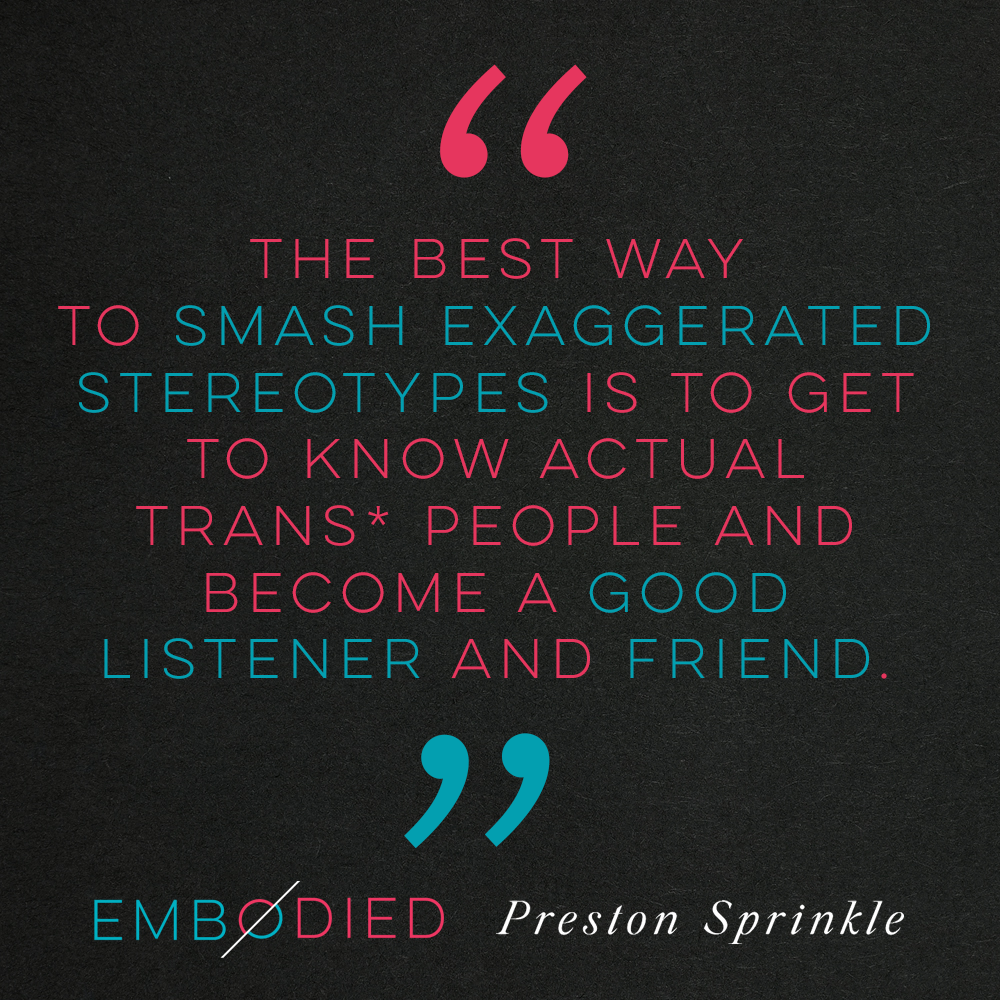
In Preston Sprinkle’s Embodied, the author sets up the book very well in that it emphasizes a variety of stories of persons whom Preston knows, who fall all over the spectrum of transgendered experiences. This is critically important to understand because there is simply no one, single category that defines transgendered experience. Psychologists will typically call transgendered experiences an expression of gender dysphoria, which the American Psychiatric Association defines as “psychological distress that results from an incongruence between one’s sex assigned at birth and one’s gender identity.”
The first step that Preston encourages every Christian to cultivate is an attitude of listening, and learning to know and better understand the experience of someone with gender dysphoria. The second step that Preston encourages is to realize that transgendered experiences are complex, they differ greatly from person to person, and the definition of terms is critically important in an effort to have good conversations with others.
The Problem with Words: How Do You Even Start a Conversation?
The problem of words, and their definitions, and how those definitions can change over time, can not be underestimated. What is the difference between male and female? What is the difference between sex and gender? The list goes on, but thankfully, Preston takes great care to define terms, acknowledging that not everyone even accepts his definitions. For example, Preston prefers the term “trans” over “transgender.” Who knew there was a difference? Though primarily a theologian, and not a scientist, Preston does a good job interacting with the science, and explaining different points of view, as expressed in the scientific literature, that is accessible to the general public. But the problem of words and their meanings remains…… And this is not just about pronouns.
Here is a good example of the problem. Preston has a chapter about “intersex,” which involves the problem of persons at birth possessing some of sort ambiguity regarding their sex identification. Doctors will put the “sex” of the child on the birth certificate. But what if there is some biological confusion, that makes it difficult to assign one’s “sex” with a high degree certainty?
When I was discussing this with my wife, I told her that this “intersex” condition is “rare.” It sometimes requires surgery to resolve, but not always. Different authoritative resources regarding intersex will agree that calculating the frequency of intersex conditions assumes that there is a spectrum of difficulties in making a clear determination of a person’s sex. I told my wife that one particular estimate of at least some possible condition on the intersex spectrum impacts roughly 1 out of 2000 babies (some of the more rarer conditions rank 1 out of 100,000 or more).
In my mind, that type of ratio, 1 out of 2000, means that intersex is “rare.” But my wife objected. In her mind, 1 out of 2000 is not some statistic that could be trusted in that it implies that intersex is rather “common.” As a result, she is suspicious of such statistics, as she believes that such “scientific” estimates are more informed by political concerns, and less by science. She believes that such “science” is being used to push an anti-Christian, anti-biblical agenda in the cultural sphere.
Well, 1 out of 2000 still sounds “rare” to me. I mean, compare that to the relatively much more “common” condition of someone on the autism spectrum, which in 2016 has been calculated to be 1 out of 54, by the American Center for Disease Control. But the debate I had with my wife just shows how difficult it can be to navigate such discussions about such a complex topic. How we define words in our conversations make a big difference.
Preston includes some thought provoking chapters on other topics, such as “what about the eunuch?,” as Scripture talks about; the ongoing debate about the “material” body versus “immaterial” soul, and how that all relates to gender identity; brain science and sexual differentiation; and the recent explosion of rapid onset gender dysphoria, that is producing intense anxiety for many teenagers today. The overriding theme is that Christians should become better informed about these topics, and when doing so, should exhibit some caution towards coming to premature conclusions.
For people in the workplace, or in school, surely the most difficult question, over the use of words, and their meanings, comes down to what pronoun you should use when talking with a transgendered person: “He?” “She?” “Surely not ‘it.’ “But what then?” “By using a certain pronoun, am I implicitly endorsing an alien belief system?” “How can I let someone know that I want to be their friend? “
This is a complex topic, with concerns about ideological dogmatism, when it comes to enforcing language codes, which is an affront to free speech, on the one side, versus concerns over offering hospitality to the other person, for the sake of maintaining a friendly relationship. Preston offers an excellent chapter in Embodied, dedicated primarily to this one issue, which is worth the price of the book, on its own.
What Does the Bible Say about Transgender?
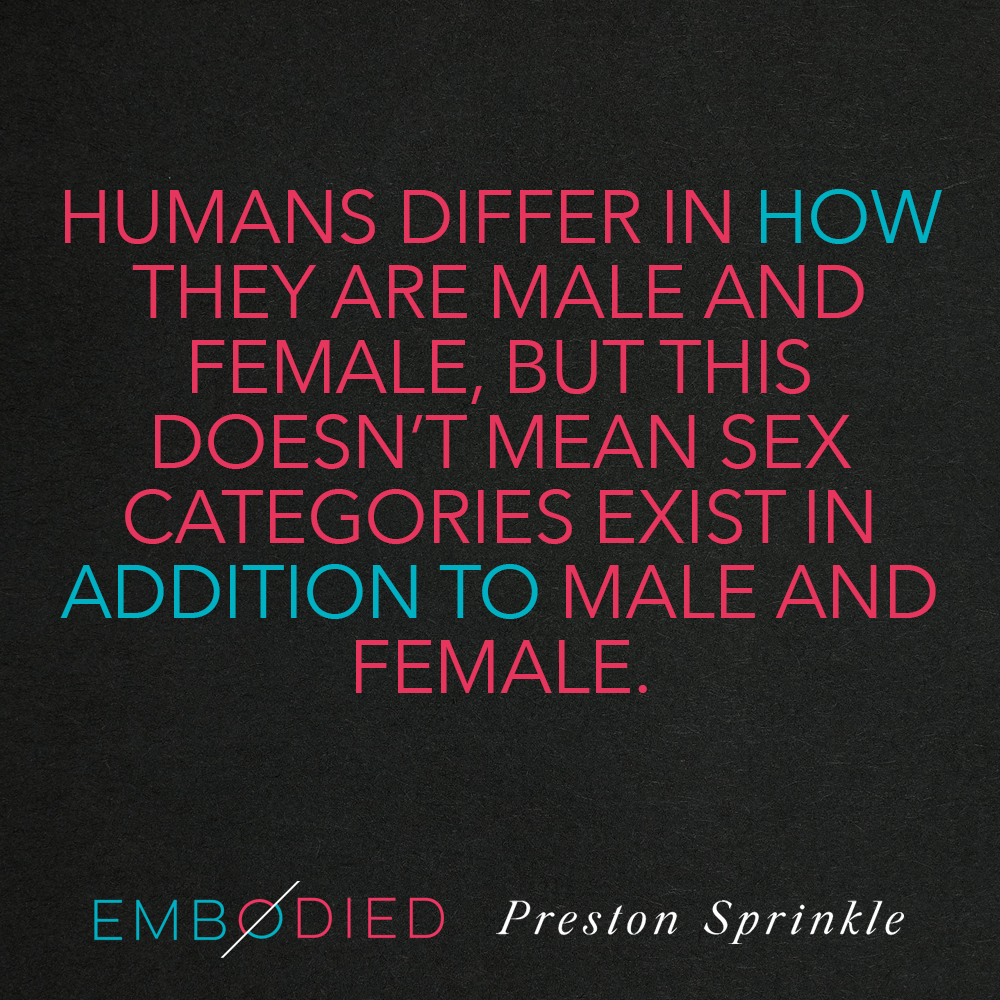
The most important chapter in Preston’s book is regarding what the Bible says about how being male and female is related to God’s good creation. The footnotes alone for this chapter will stimulate the student of Scripture to dig deeper and deeper into God’s Word. The bottom line is that according to what is taught in the Bible in Genesis, we are all created in the image of God, male and female. Therefore, fundamentally, sex and ultimately gender are not social constructs. Biological sex plays the much larger definitive role in determining what is male versus female, as opposed to culturally defined expectations of gender characteristics. Someone’s gendered experience may not match up with social stereotypes, as it did for a relatively short period of time in my youth.
Large swathes of our society give us very culturally-bound ideas of gender, some that are uniquely Western. For example, American men typically do not hold hands with one another, though women holding hands together is a lot more common. Compare that with the fact that in many developing countries, men will often hold hands with other men. This does not mean that such men are gay, or that they are having some transgendered experience. This simply means that men holding hands with other men are but one cultural expression of gender, a sign of showing affection in male to male friendship. But these varying cultural stereotypes do not mean that being male and female are simply products of culture, in every respect. Instead, the fundamental Christian claim, according to the Bible, is that being created male and female matters to God, and that such differences in being male and female ultimately transcend culture.
Preston does interact with theological viewpoints that do not line up with historically, orthodox Christianity, making a good faith attempt to be as generous as possible with critics. I would probably give Embodied a fully deserved 5-star review, if it were not for the fact that Preston sometimes is overly cautious to a fault, when landing on a firm theological footing (I would give Embodied a 4.5, but Amazon does not allow for fractional reviews, so I decided for a more conservative evaluation and round down slightly). Now, let me be clear here, in case a potential reader might be nervous: Preston does eventually get to and affirm an historical, orthodox theological perspective. But in the process of getting there, through pages and pages of back and forth, yet rightly thorough analysis, Preston may leave some readers puzzled as to why he is as cautious as he is. He puzzled me in a couple of cases.
For example, Preston briefly addresses the question of whether or not intersex is a product of the fall. He has generally opted to say that intersex is indeed a product of the fall of humanity, but that in researching for the book, he has become more cautious in making such a conclusion.
I understand why Preston brings out some caution, and he clearly acknowledges that one of his intersex friends firmly acknowledges that the intersex condition is indeed part of “the fall,” and that this knowledge provides a form of comfort. But if that is the case (and I would agree with the viewpoint of Preston’s intersex friend), I am puzzled as to why Preston is so cautious as he is. Perhaps it comes down to one’s definition and understanding of what “the fall” entails.
How Our Theology of “The Fall” Can Guide Us Through the Transgender Conversation
Going back to my own experience, I grew up also with a significant speech impediment. I stuttered quite frequently during my elementary and middle school years. Thankfully, my stuttering eventually subsided somewhat, and I learned to gain more confidence when I speak with other people. One of my greatest joys in my college years was that I even became a disc jockey for about a year and half, hosting a jazz music program on my college’s radio station. I would never have been able to do anything like that, if I had continued stuttering as severely as I did in elementary school.
But I would definitely say that my speech impediment was (and still is) a product of the fall of humanity. I do not believe that God would intentionally create me with a speech impediment, as part of his good design for creation. I look forward to that Resurrection Day, when I will no longer have to worry about how my verbal speech with come out, and embarrass me in front of others.
Nevertheless, God has given me a type of gift, due to that experience of the fall. I am more hesitant to speak, because I am sometimes self-conscious about messing up with my words and syllables in public. As a result, I often find myself more inclined to listen. In a world where so many people want to be heard, I have realized the gift that God has given me to use my hesitancy towards speaking, in learning how to better effectively listen to others, thus gaining more empathy with them.
I would think that experiences of intersexed persons, and transgendered persons (otherwise known as simply “trans”), who go through periods of gender dysphoria, would best frame their experiences in such a theological framework. The experience of being “trans” for a follower of Jesus would lead to the realization that such consequences of the fall also provides opportunities for God to give good gifts to such a person, that most other people will never, ever have. Sin does have consequences, and can impact people through no obvious fault of their own. But God is a God of redemption, who can turn what the Evil One meant for evil into something good. In the process, God’s children are given gifts that bring God the most glory possible…. and that is Good News! I think Preston Sprinkle would still agree with me here. I just wish he had come out more firmly on this with less hesitation.
Listening with Compassion, with Theological Clarity
With that caveat in mind, please do not let that deter any reader from picking up Preston Sprinkle’s Embodied. The author does a fantastic job giving the reader encouragement, that having experiences of gender dysphoria does not disqualify anyone from being a genuine follower of Jesus. Preston is quite frank in admitting that he has friends, having a “trans” background, who are often some of the most loving and Christ-like persons he has ever met. One need not follow the secular culture, in order to be fully human. No one needs to be dismissive over what Scripture teaches regarding being created in the image of God, as male and female. Instead, we are all challenged to enter in the mystery of celebrating our differences as male and female.
My experience of gender dysphoria, as a young teenager, was pretty mild and short-lived. I rarely ever think about it any more. Others though, have had severe problems, that persist into adulthood, ultimately leading such persons to pursue transitioning into a gender identity contrary to their birth, sexual identity, through various types of medical procedures, such as hormonal treatments, or even surgery. An alarming, growing number of such transitions happen among children. Sadly, many have gone through such experiences, only to ultimately regret such decisions to go through with such hormonal treatments and/or surgery. Preston rightly points out that the mental health risks for those who transition to another gender identity, through surgery, are significantly higher than for those who do not transition. It is a lot more difficult to transition back, than it is to transition in the first place. Sometimes transitioning back is medically impossible. Those reasons alone are important enough, simply from a medical perspective, for those considering transitioning to not take that step of transitioning in the first place, or at least to delay it as much as possible. In many cases, such gender dysphoria disappears over time, assuming a person has a loving environment that supports them.
What about people who have already transitioned? Preston admits that this is a really difficult situation to deal with, for a Christian befriending someone else who has transitioned, whether that other person is a Christian or not. In such situations, it is really best to walk alongside those people who have taken that step, first and foremost as listeners and as a friends, and trust that God will intervene in such a way to bring about healing, according to God’s own timing and purposes.
More and more people who have transitioned to the opposite of their birth sex, have been transitioning back, and Preston observes that this number is continually growing, despite the social pressures against transitioning back. But in the final analysis, Prestron rightly affirms that it should be the truth of Scripture that should guide us, and not concerns over what is practical or not.
The Failure and Opportunity of the Church to Model Biblical Masculinity and Femininity
One big problem in many churches today, particularly Protestant evangelical ones, is that many have not figured out a way to model what Christian masculinity and Christian femininity look like. Some fall back on traditional cultural stereotypes. Some Christians are so freaked out by the rise of radical feminism, that women are almost completely marginalized in the use of their God-given gifts for ministry. Others go for the stereotype where the women pretty much do 90% of the “spiritual” work, and the men are just dragged kicking and screaming to church.
Other churches, on the less traditional side of things, have become too quick to show how men and women, particularly in church leadership, are simply interchangeable, whereby there is no real fundamental difference theologically between men and women. Sadly, the whole debate between complementarians and egalitarians, tends to narrowly focus on whether or not women can serve as church officials; particularly as elders, thus missing the more fundamental theological reality, of distinguishing between male and female, within the context of corporate worship (I have written extensively about this particular topic elsewhere on Veracity).
As a result, the sacramental expression of what it means to be a man, and what it means to be a woman, in the life of the church, gets cast aside. Children growing up into adulthood suffer the most, as few young people have an effective means to work through their anxiety, as to what it means to be male and female, in the sight of God, as opposed to simply following cultural imposed patterns of what masculinity and femininity look like.
Rapid changes in Western culture are only making the problem worse. Preston Sprinkle highlights the shocking statistic, just from one study in the United Kingdom, where the number of males questioning their gender has risen by 1460%, and the number of females questioning their gender has risen by 5337%, just in the last ten years.
1460%. 5337%. Those are real numbers. Experiences with gender confusion among American teenagers are not too far behind, as such startling statistics appear to be becoming part of the norm. Christian parents trying to raise their children in today’s anxiety ridden culture do not have the luxury of ignoring these massive cultural shifts.
Strangely, the silence of evangelical churches, when it comes to discussing this transgender identity crisis, has become deafening. And when it does get mentioned, if at all, such as in a sermon, it is typically either within the context of just how rotten the culture has become, or chiding less “enlightened” people for their “bigotry.”
The idea of men mentoring men (and boys) and women mentoring women (and girls) has become a lost art, in too many churches. How many churches still have men’s groups, where they talk about what it means to be a Christian man? How many churches still have women’s groups, where they talk about what it means to be a Christian woman? If we want to stem the tide against efforts by the culture to aggressively “normalize” ideologically driven concepts of “transgenderism” (a pejorative label, for some), churches need to do better in modeling what it means to be male and female, even in how we conduct worship services. No matter what churches do, cultivating the art of listening is essential, in figuring out ways to give young people permission to talk about their doubts and experiences.
Our Western culture today has made it socially acceptable to discuss issues related to “trans” people. That is a good thing. Evangelical churches tend to be behind the eight-ball on this, but at least, the secular world offers a variety of counseling, medical, and psychotherapy options for young people to process their anxieties.
On the other hand, the growing rate at which young people are considering themselves to be somewhere on the “trans” spectrum is particularly alarming. The drive to somehow “normalize” such “trans” experiences, even in psychological counseling, is particularly outrageous. We hear stories of concerned parents who want to immediately rush to give their child sex hormone therapy, if the child begins to experience even the mildest form of gender dysphoria. The shocking rise of rapid onset gender dysphoria, particularly among girls, over the past decade is horrifying….. and yes, there are legitimate concerns that Target’s bathroom policy might invite “fake” trans-people to take advantage of such policies and invade the private space of women. Who will speak out for the protection of women, who feel threatened by cultural shifts like this? Or will they experience the disdain of “cancel culture,” that the Harry Potter author, J.K. Rowling experienced?
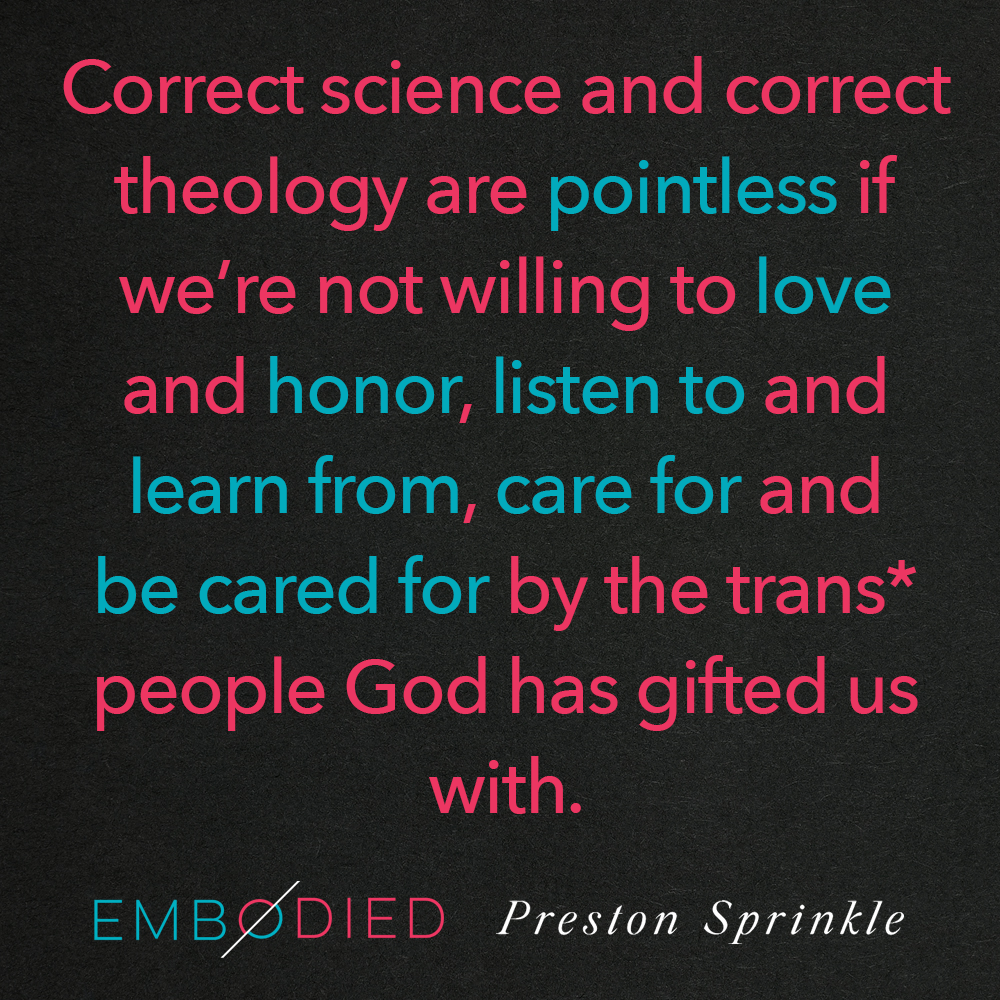
But as Preston Sprinkle reminds the reader, fits of outrage and horror do not lead to healing and real change. Instead, it is through the expression of the love of Christ, through listening to others, that real change happens. We need less of our love for outrage and more outrageous love.
Listen.
Take a deep breath.
Be a part of the conversation, instead of always rushing to pontificate on just how awful the culture has become…. or how closed-minded others on your Facebook page appear.
One simple (though perhaps still expensive) suggestion for churches, would be to offer single-person-use bathrooms in church facilities (what some might call “family restrooms”). That one act, of providing a restroom where a “trans” person can discreetly take care of business, is an excellent way to offer hospitality to someone who is new to your church, that might lower the anxiety and stress level of a visitor. Installing signage, that indicates that a single-person-use restroom is just down the hall, is a great way of saying to a “trans” person that they are welcome to visit your church.
Extending Outrageous Love to Trans-Persons
Preston tells one story that really stands out to me, that of Lesli, who was biologically born female, but who went through a confusing, difficult period of gender dysphoria. When she confided her struggles with her pastor, the pastor escorted her out the church back door, and told her never to come back again. She left the Christian faith at that point. She ended up becoming a lesbian, and married another woman. But when her same-sex marriage partner died, she wanted to find some way for her spouse to have a decent funeral. Lesli finally worked up the courage to call some church office, out of the blue, and ask if the pastor there could perform the funeral for her deceased partner. Instead of giving Lesli a knee-jerk theological justification for condemning homosexuality and the transgender “lifestyles”, the pastor simply said, “We would be honored to [help out, and perform the funeral service].” It was that loving expression by that Christian pastor that eventually led Lesli to return to the Christian faith.
That is a challenging message. Yet that is the challenging message that undergirds Preston Sprinkle’s excellent Embodied. We need to land somewhere between oversimplifying the growing transgender awareness in our culture, as merely a Satanically-inspired political conspiracy, and on the other side, a fear-based resolve that we must choose between transitioning and suicide, as the only alternatives for moving through transgender conversations.
Sadly, some of the folks I know who would probably benefit the most from reading Embodied are most likely those ones who will not read it. I am just as horrified, as are many other Christians, as to how aggressively “transgenderism”, as a negative ideological category, has become a forceful cultural, even an activist, political movement. Likewise, I am also deeply concerned about the connection between suicide rates and gender insecurities.
But what this is ultimately about is people. People who wrestle with some form a gender dysphoria are people whom Jesus sought to die for, that they might be reconciled to God and find healing. What is really needed is a way for Christians to trust Jesus enough to give them the wisdom necessary to know how to best extend the hand of Christian friendship, to someone who wrestles with transgendered experiences.
In the following discussion between Preston Sprinkle and Christina Beardsley, an openly transgender person, who is also a priest in the Church of England, I found the conversation to be difficult to follow at times, but it just shows how complex the cultural conversation is. One of the best ways we can love a transgender person is to try to figure out how people define the words they use in conversations.
Most Christians know that temptation is what can lead us into sin. However, when we experience temptation, is that experience, in and of itself, sin?
There has been a very lively debate in evangelical theological circles in recent months, on this very question. The occasion for the debate has been the Revoice Conference controversy, the question of same-sex attraction, and how it relates to sexual orientation, lust, and behavior. But the implications are far reaching, as the debate gets to the very heart of how all believers progress in our sanctification.
Sanctification 101: Temptation vs. Sin
As a new believer, back in my teenage years, I struggled intensely, just as almost every high school boy does, with sexual lust. I really needed help in this area, and I got some great advice once at a Christian youth music festival.
The main speaker put it this way: If you see a girl, and you find yourself attracted to her, that is not sin, in and of itself. Instead, that is an opportunity for you to thank God that you can appreciate the beauty of another human being. So, praise God for beauty, but then take your eyes off of that girl, lest you fall into sin! You have been presented with an opportunity to sin, but it is a temptation, for which you can resist, and say no to. In our obedience, God can give us those little victories, as we progress forward in following Jesus, by trusting in the work of the Holy Spirit to transform us.
But if you find yourself drawn to take a second look at that girl, and allow your imagination to run away, then you are in real trouble. That would be lust, and lust would be sin (Matthew 5:27-28 ESV). Resisting temptation at that point is not enough. You must repent of your sin, and seek the Lord’s forgiveness. In other words, there is a clear distinction between temptation and sin, and the two are not necessarily the same. We resist the one, and repent of the other.
That nugget of wisdom has served me well over the years, convicting me at times where I have needed to be convicted of my sin, which is sadly, yet honestly, a continuing difficulty for all Christians, and giving victory at other times, when God gave the strength to say, “No,” and I followed in that obedience.
Apparently, it is not enough for some Christians to reject same-sex relations, either in thought (fantasizing about it) or deed (physically engaging in such behavior). Pay attention to that, as it is important. The teaching goes beyond that.
Consider the words of prominent Baptist theologian, Albert Mohler, (from The Briefing), who gives an otherwise thoughtful, trenchant critique of the tendency to confuse one’s sexual identity with one’s spiritual identity in Christ. He raises some important questions, observations, and cautions, with which I support. Yet despite having a prophetic outlook, and crucial voice in the conversation, in this essay, Dr. Mohler makes this shockingly broad statement: “The Bible identifies internal temptation as sin….We are called to repent both of sin and of any inner temptation to sin.”
What are we to make of this?
Repenting of sin, I get. But repentance of temptation?? How does one go about doing that? Was the advice I received as a teenage boy, as applied to thinking about girls, in error?
For such Christians, in a nutshell, the mere presence of same-sex attraction in a person’s life is inherently lust, and therefore, it is inherently sin. Same-sex attraction, awakened by temptation, is surely a disordered desire, a fallen part of human nature, and it can lead to sin, but is it actually sin itself?
If you extrapolate that way of thinking out to include all sexual attraction, consistently, outside of marriage, heterosexual as well as homosexual, you reach a very, very strange conclusion. Let me explain, in a few steps, why I believe that this view is misguided at best, a theological error that has far reaching negative consequences, if left unchecked.
These are weighty issues where sound bite answers will not suffice. Here is a meager attempt to hit the highlights. So here we go… Continue reading








 Veracity