Tag Archives: premillennialism

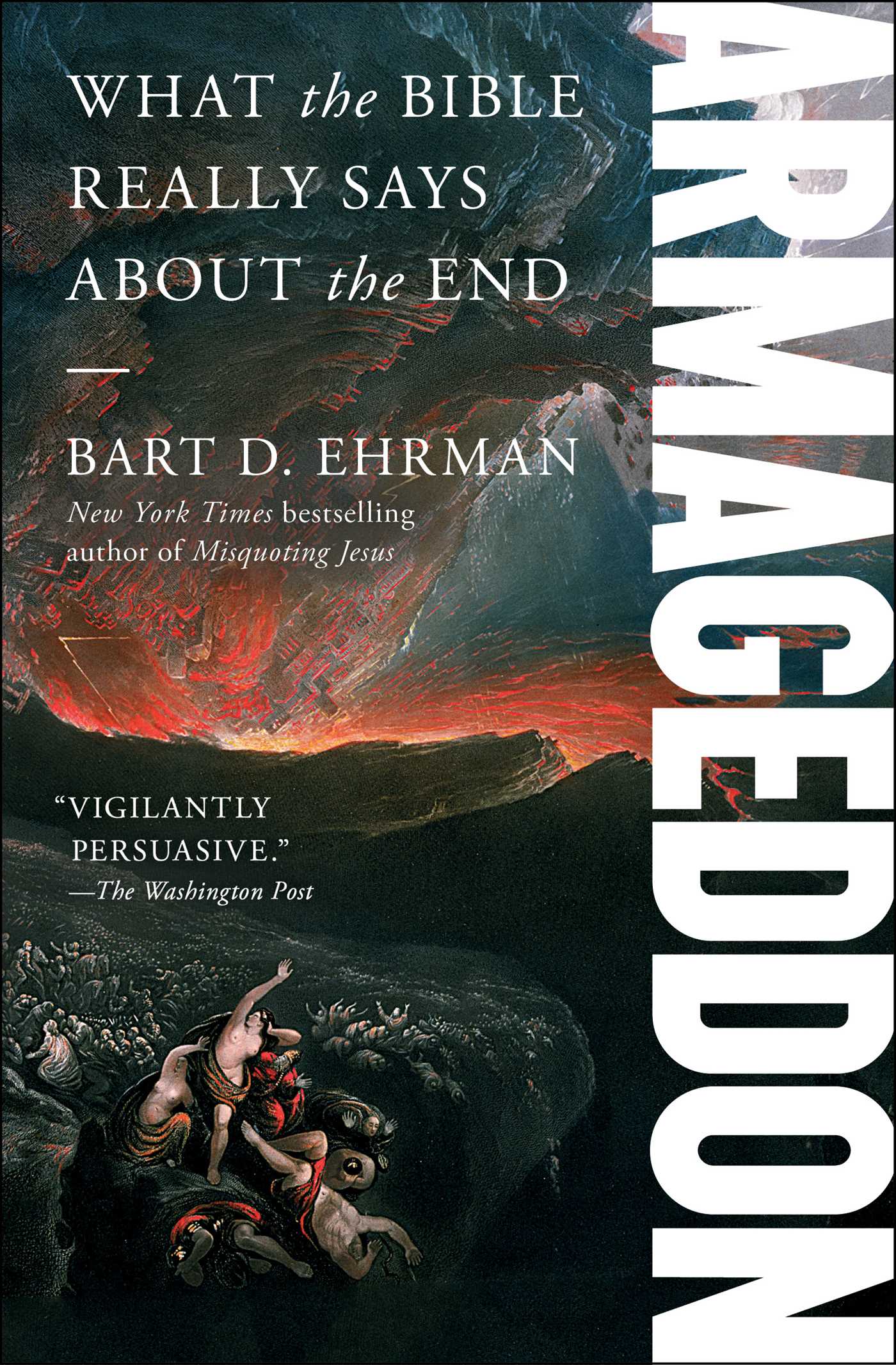
Reviewing Bart Ehrman’s Armageddon, Part Two: Why Is Revelation So Difficult to Understand?

The Book of Revelation is not only the last book in the Bible. It was also one of the last books to have gained full acceptance into the New Testament canon of Scripture. Interestingly, controversy about Revelation arose starting around the 3rd century, despite its general acceptance in the 2nd century. Hesitancy about the book was largely due to various difficulties readers had in trying to understand what the author, named John, was trying to teach.

Back when I was in high school, I managed to read the entire New Testament cover-to-cover over several days…. EXCEPT for the Book of Revelation.

Frankly, I could not make sense of it. I gave up on it, until I picked it back up again in briefly in college, and more intensely years later in seminary. Over the years since then, I have learned that I was not alone with my initial confusion about the book.

Even the great conservative stalwart Protestant of the 16th century, Martin Luther, had his own doubts about the very inspiration of the Book of Revelation, as Bart Ehrman tells us, saying that Luther “can in nothing detect that it [Revelation] was provided by the Holy Spirit” (Armageddon, Ehrman, p. 32). Nevertheless, Luther submitted to the collective mind of the early church as accepting Revelation as part of canonical Scripture, translating it into his German version of the New Testament, though he did place the book in his New Testament translation in an appendix and not the main body of the translation (Ehrman, p. 31). Despite Luther’s personal skepticism, traditional Lutherans today still accept the Book of Revelation as inspired Word of God, as do all historically orthodox Christians.

The late Protestant Bible teacher, R.C. Sproul, once said that the canon of Scripture is a fallible list of infallible books. My Roman Catholic and Eastern Orthodox friends might push back a little on this, and Sproul’s statement can sound a little odd even to Protestants. Nevertheless, all historically orthodox Christians affirm the Book of Revelation as infallible…. though difficult to interpret when it comes to some of the nuts and bolts of the text.

Revelation can be a hard book to understand. But why?

In the first part of this book review of Armageddon: What the Bible Really Says About the End, some consideration was made as to the violent imagery we find in the book, analyzing the type of literature the book is (apocalyptic), and concluding with a look into the controversy regarding the millennium. While every biblical scholar knows that Revelation contains a great deal of symbolism, much of the controversies in interpreting the book come down to (a) how much is symbolism being used, and (2) when you do find symbolic language, what do these symbols mean?

In this second and last part of this review, some of the other difficulties are explored, along with an analysis of what Bart Ehrman thinks the book is really about. I then hope to show why Ehrman’s solution is itself problematic.
 

Continue reading


Reviewing Bart Ehrman’s Armageddon, Part One: Why is the Book of Revelation So Violent?

Did Jesus want a woman raped and her children killed in the Book of Revelation?

To start off this post with such a question is shocking. But it was just as shocking to me when I heard this claim made in Bart Ehrman’s 2023 best seller, Armageddon: What the Bible Really Says About the End. What follows is a PG-13 rated Veracity book review.

The Book of Revelation is one of the most difficult books of the Bible to understand. It is also one of the most fascinating books of the Bible. Over the past ten years, a number of Christian bible studies in my town across multiple churches have tried to tackle this last book of the Bible, in order to figure out its enigmatic teachings. From the blowing of trumpets, to the bowls of God’s wrath, to the mark of the beast, etc., the images we read of in Revelation have both disturbed and inspired Christians down through the ages. Revelation is of particular interest in the cultural moment of our day, when political controversies in the United States have been tearing people and families apart, cultural change sparked by social media ripples across society, and reports of civil unrest and horrific wars across the world come across daily in our news feeds.

Are we living in the end times? It sometimes feels like it. People look to the Book of Revelation to try to find the answer.

Continue reading


When A Jew Rules the World: Joel Richardson’s Defense of Future Israel, An Extended Review

Young author, Joel Richardson, makes a measured yet passionate plea for a premillennial view of the End Times, that includes a definite future for ethnic Israel, as an antidote to Christian Antisemitic sentiment.

Prophecy teacher and author, Joel Richardson, makes a measured yet passionate plea for a premillennial view of the End Times, that includes a definite future for ethnic, national Israel. But hold onto your Bible: Is this an antidote to Christian Antisemitism?

And now, time for an in-depth book review… so pour yourself a beverage, before you dive in…

Are Christians in danger of forgetting national, ethnic Israel’s role in God’s “End Times” program?

According to New York Times bestselling author, Joel Richardson, the answer is “yes.” Joel Richardson is a fairly young, articulate spokesperson promoting Christian Zionism, hosting an Internet biblical prophecy program, “The Underground.” Joel Richardson travels widely in the Middle East, with a genuine excitement about God’s mission to proclaim the Gospel in that part of the world. He is passionate about keeping Christians informed about the Middle East through various books and films. Nevertheless, Joel Richardson is deeply concerned. In a promotional advertisement for Richardson’s 2015 book, When a Jew Rules the World: What the Bible Really Says About Israel and the Plan of God, we read, “In the past thirty years, the trend among American evangelical’s view of Israel has shifted dramatically.”

As Richardson’s ad continues on later, “A new generation of Christians are not only turning away from traditional support for Israel, but from the very belief that there yet remains any ongoing calling and election upon the Jewish people. As this portentous shift is seen on a growing number of evangelical seminaries, and even on Facebook, are Scripturally-grounded Christians prepared to provide solid responses?

When A Jew Rules the World, which I recently finished in an audiobook form, is designed to present arguments to reverse this trend. I wanted to read this book, since I keep hearing quite a bit about the dangers of so-called “replacement theology” these days. The terminology of “replacement theology” was something unknown to me until about five years ago, so I wanted to understand what the fuss was all about. If “replacement theology” was a theological error that needed to be addressed in the evangelical church, I figured that Joel Richardson might be able to help me out.

Prophecy teacher Joel Richardson impresses me as an articulate, well-informed defender of an Israel-centric view of the End Times, which stands at the heart of the concern over “replacement theology.” This is a hard-hitting book, and it deserves wider exposure, for those not familiar with the arguments proposed by folks like Richardson. But I would be careful before you raise the issues that concern Richardson in your small group Bible study. For example, in that same Richardson ad, there is also an extraordinary claim: “There is a sudden rise of anti-Israel and anti-Semitic sentiment among Christians today. ”

There is? Really? In the wider culture, I thought being Jewish was cool. In a post-Holocaust era, with movies like Steven Spielberg’s Schindler’s List permeating popular consciousness, have Christians bucked the cultural trend and grown more hateful towards Jewish people in recent years? Continue reading