When my wife and I visited Rome in 2018, we had the opportunity to visit the famed Colosseum. In my mind I beheld images of Christians cowering in the corner, as the lions were being released, while Rome’s pagan citizenry cheered on Emperor Nero’s animals to destroy those who confessed the name of Jesus. Though a gruesome thought, it is still a sobering and inspiring demonstration of the resiliency of Christian faith.
I guess I really did not know my history as well as I thought I did….
The Colosseum of Rome. In our trip to Rome in 2018, my wife and I learned that contrary to popular belief, Christians were not “fed to the lions” simply because of their faith here. Instead, the story is more complicated.
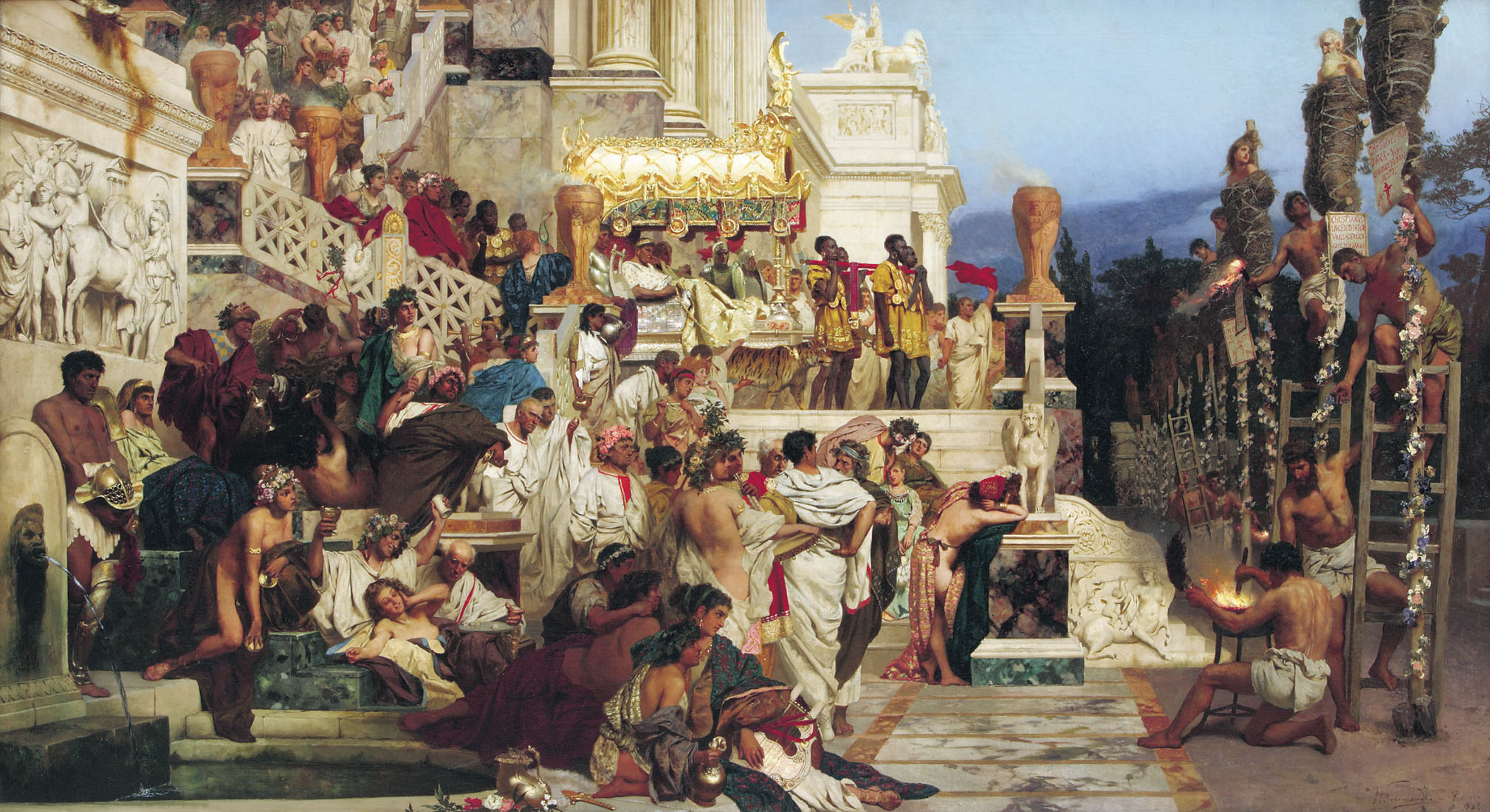
Nero’s Torches , 1876, by Henryk Siemiradzki (1843–1902). Nero used Christians as torches in Rome, in the last days of Paul.
Who was the Apostle Paul, and what was it like to be a Christian in Nero’s Rome, in the A.D. 60’s? Paul, Apostle of Christ, a film directed by Andrew Hyatt, and made by Affirm Films (who also made Fireproof and Courageous), tells the gripping story in a creative way.
Normally, I am a bit skeptical about Christian films, but this one was fantastic. The premise behind the film is that Luke, a physician and companion of Paul, comes to visit Paul, when he is imprisoned in Rome’s Mamertine prison, awaiting execution. Unfortunately, while the film’s premise is very interesting, there is a lot we do no know about the last days of Paul, or how Luke wrote Acts, with any particular degree of certainty. We know from Eusebius, an early church historian, that Paul was held in the Mamertine, and we also know that the madman, Emperor Nero had blamed the great fire in Rome on the Christians, using Christians as torches to light the city.
Did Luke write the Book of Acts, in Rome, during the last years of Paul’s life? Were Priscilla and Aquila in Rome, when Luke came to visit? We have no evidence for these speculations made in the movie. But to focus on these historical questions misses the point of the film. In Paul, Apostle of Christ, we get a glimpse into what motivated Paul, as well asking some very real questions as to how the Christians might have thought about Nero’s persecutions.
Should the Christians fight back and resist Nero? Should they flee Rome itself, and avoid the Romans? Should they stay in Rome and pursue a non-violent course? These are tough questions, and the film rightly explores them, as the persecuted Christian community looks to their imprisoned leader Paul, for help.
Many Christians today think of the so-called “Great Tribulation” solely in terms of a future event, that will happen prior to the Second Coming of Christ. Yet Paul, Apostle of Christ makes a very convincing case that the “Great Tribulation” was just as real, and bad enough, in those terrifying days, in Nero’s Rome. Along the same lines, another recent film, Tortured for Christ, tells us that such “Great Tribulation” even happens in our own day, but that much of American Christianity seems rather oblivious to that reality.
If anything, viewing Paul, Apostle of Christ, should encourage any person, believer or non-believer to take the time and seriously read the Book of Acts. Be thankful for the freedoms that many of us take for granted. Find your faith in the Risen Jesus, just as Paul did. Pray for the persecuted church.
Richard Wurmbrand was a Lutheran pastor in Romania. The Communists threw him into prison for fourteen years. They tortured him, trying to persuade him to reveal the identities and locations of secret Christian believers. However, even solitary confinement in an underground cell did not force him to break his faith.
As a young Christian, one of the standard reasons often given to me for the truth of Jesus’ Resurrection is that all of apostles, with the exception of John, died as martyrs. Why would the apostles have died for a known lie? The only sensible conclusion is that the martyrdom of these apostles proves that the Resurrection is true.
The problem with this approach, as argued by such scholars as Candida Moss, reviewed a few years ago on here on Veracity, is that the Bible and other early sources tell us very little about the death of the earliest apostles. We are forced mainly to rely on traditions, that in a number of cases, date to a few hundred years after the martyrdom events took place. Can such traditions really be trusted?
Sean McDowell’s new book, The Fate of the Apostles: Examining the Martyrdom Accounts of the Closest Followers of Jesus, is the result of his PhD dissertation research, an exploration into the historical accounts of how the first apostles of Jesus died. Sean McDowell, Biola University professor in apologetics and the son of another popular apologist, Josh McDowell, has investigated many of the traditions associated with the martyrdom claims, weighing the evidence as to which accounts are most probably reliable and which ones are more doubtful.
Here is my application takeaway from thinking about this, though I know that some might challenge me on it: The tendency to stretch the truth a bit, when it really is not necessary, simply to make an important case for something, was a problem in the early church just as much as it is a problem in our day. We must carefully guard the Truth for the sake of the integrity of the Gospel.
Folks, we need not fear the Truth as believers, even when that Truth exposes common, popular overstatements with seemingly good intentions. Sometimes, believers have a knee-jerk reaction to criticism that can devolve into a paranoid persecution complex, that tragically trivializes real persecution being experienced by our Christian brothers and sisters in places like Syria and Iraq. Instead, as Christians, we can look to fair-minded, intelligent, Biblically-sound scholarship and sober thinking to give solid reasons for our faith, even when we are challenged. Taking responsibility for our own personal discipleship, is something we strongly advocate here on this blog, and it is important now more than ever. We must be careful not to give into smooth and slick talk in an effort to “protect Christianity.”
A growing number of secular-minded college campuses are not extending the welcome mat to evangelical Christians today. Is the central issue regarding sexual discrimination, or is it an erosion of religious freedom?






 Veracity