Tag Archives: Norman Geisler

How We Got the Bible (Part 1)

“We should not imagine a committee of church fathers with a large pile of books and these five guiding principles before them when we speak of the process of canonization. No ecumenical committee was commissioned to canonize the Bible.”

Norman L. Geisler and William E. Nix, From God To Us Revised and Expanded: How We Got Our Bible
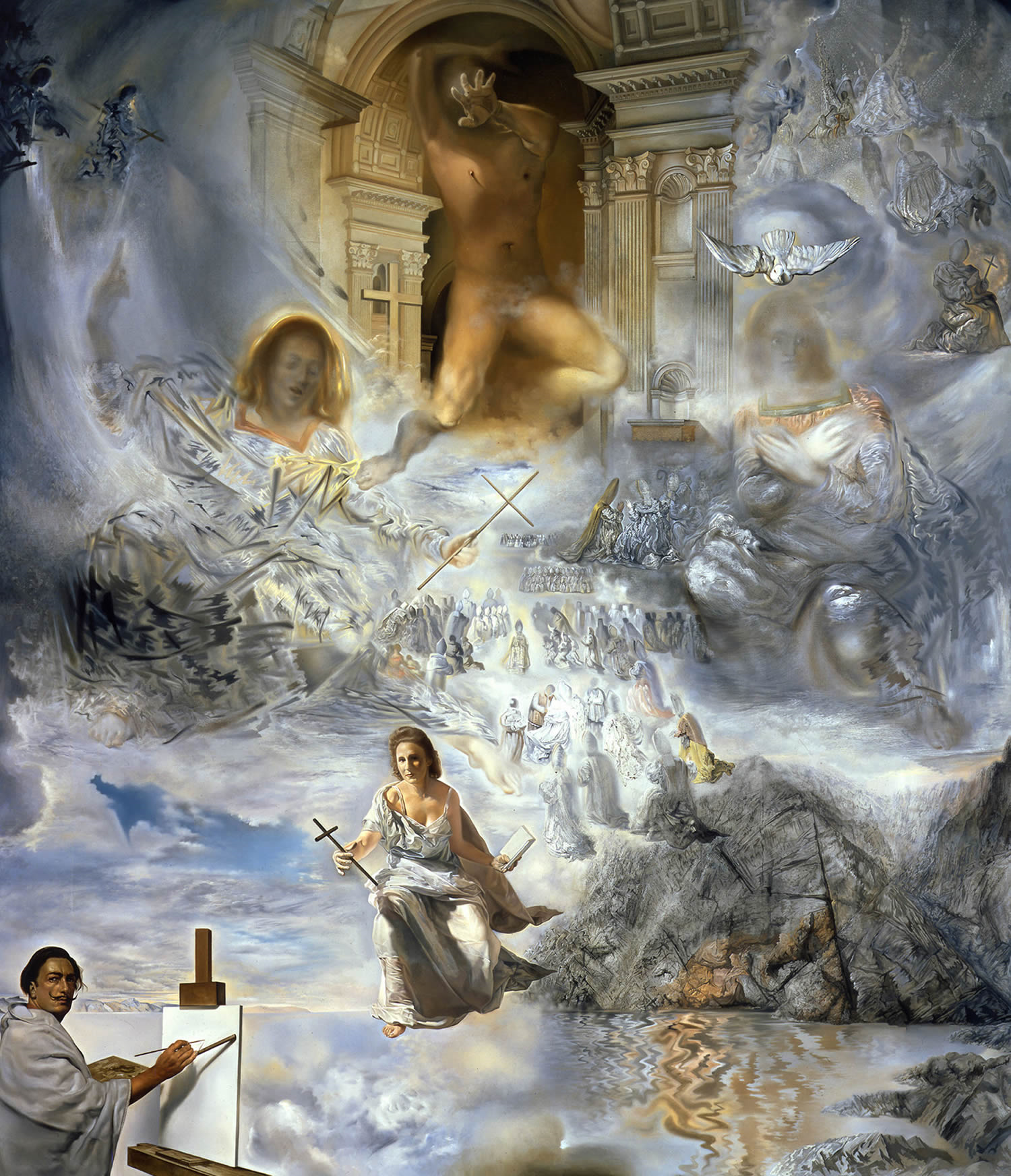
The Ecumenical Council

The Ecumenical Council by Salvador Dali, 1960


Our church’s Statement of Faith is pretty minimal. We only list eight core beliefs, the second of which states that we believe “in the inspiration of all the Scriptures by the Holy Spirit, and that they are the final authority for our faith and practice.”

“…final authority for our faith and practice?” Really?!

Our founders didn’t draft up this idea—it is delineated in the historic confessions of the Christian church. Consider the absolute implications of this statement. It means the Bible contains the foundations for Christian faith and practice, and that we are bound to it in all matters. We don’t get to impart our personal, alternative views. We don’t get to cherry pick which parts we like or which parts we would write differently. We don’t get to interpret what it says in ways that are contradictory to it. When we disagree with someone else’s view or interpretation, we submit to the final authority of the Bible. No appeals. We believe the Bible comprises God’s special revelation to us.

If you’ve been reading Veracity for any length of time, you know that we are big on personal discipleship—which we define as the process in which a believer or seeker takes personal responsibility for investigating the claims and content of the Bible. Personal Discipleship is based on the Bible.

Exactly how did we get the Bible?

Welcome to our latest Veracity series.  If you’re like me or Salvador Dali you may have developed some loose derivative notions such as:

  • God told a select group of human authors what to write,
  • Their writings were evaluated by committees of men in silly hats,
  • These ecumenical councils voted on which writings would be in “the Bible,” and
  • Later ecumenical councils clarified and solidified the final selection (and some modified it).

In fact, if you read what Wikipedia has to say about Ecumenical Councils it sounds like a pretty cut-and-dried historical process. But is that all there is to it? For that matter are these notions even correct? Are we to live our lives under the complete authority of documents that were assembled by ancient and medieval committees? How do we know that the Bible we hold in our hands today is what God intended for us to have? What if it was corrupted in its translations or transmission? How do we know that we have the right books, and why do we disagree along denominational lines about what should be included in the ‘Holy’ Bible?

In preparing for this series I read a lot of texts that come at these questions from a canonical perspective (focusing on how the official list of biblical texts was created and adopted). I must confess, that was originally my interest as well. But Drs. Norman Geisler and William Nix have a more comprehensive, full-orbed understanding, which they explain in From God To Us Revised and Expanded: How We Got Our Bible. So let’s dig in and see what these and other scholars have to bring to our understanding of how we got the Bible.

Introduction

Over the course of this series we will look at the inspiration, canonization, transmission, and translation of the Bible. But before we dive into the topic of inspiration here’s a Mini Bible College audio clip from Dick Woodward to give us the big picture.

Dick did a masterful job summarizing the basics for us, and Geisler and Nix will delve more deeply into the details (particularly when we get to the process of canonization). We’ll go slowly and see what we can learn about the book that comprises the authoritative basis for our Christian faith and practice.

Additional Resources
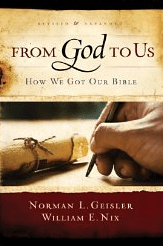
From God To UsNorman L. Geisler and William E. Nix, From God To Us Revised and Expanded: How We Got Our Bible.

Michael J. Kruger, The Question of Canon: Challenging the Status Quo in the New Testament Debate.

Dick Woodward, Mini Bible College Audio Download.

Robert Laird Harris, Inspiration and Canonicity of the Bible: An Historical and Exegetical Study.

Jack P. Lewis, Jamnia After Forty Years.

Brooke Foss Westcott, A General Survey of the History of the Canon of the New Testament during the First Four Centuries.
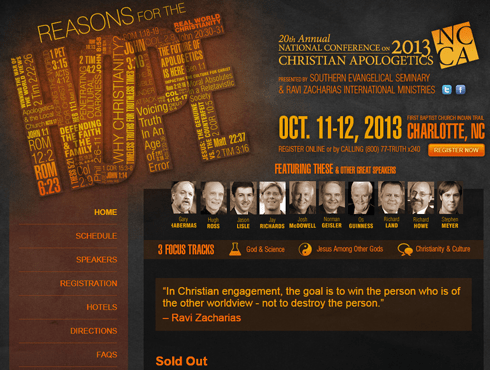



2013 National Conference on Christian Apologetics

“As iron sharpens iron, so one person sharpens another.”
Proverbs 27:17 (NIV)

2013 National Conference on Christian Apologetics

If you want suggestions about how to keep your devotional life fresh, try apologetics. Specifically, try attending an apologetics conference. I just returned from the 2013 National Conference on Christian Apologetics in Charlotte, North Carolina, and thoroughly enjoyed thinking and dialoguing at high levels of reasoning for two days.  As an active blogger, I really don’t have issues with my spiritual life becoming stale, but I have to admit it was a truly uplifting experience.

John Paine, Norman Geisler, Ken Petzinger

Dr. Norman Geisler and Dr. Ken Petzinger (a physicist).  Our rocket scientist friend did not wish to contribute to my wife’s embarrassment by posing with us.

I was travelling with some wonderful people, including a rocket scientist (no kidding), a physicist, a lawyer, and a librarian (who is also an interpretive dancer). We had some conversations; wish you could have been there with us.

For whatever reasons there was a doubling of registrations (to 2,000) from the prior year, so we stopped by Thursday evening to see if we could register before the crowd on Friday morning.  We ran into Dr. Norman Geisler roaming the halls, and he graciously agreed to pose for a photo.  After we parted I thought of all the things I should have said to him. You know, like: thanks for architecting the Chicago Statement on Biblical Inerrancy, and thanks for several books that have shaped my thinking (like Making Sense of Bible Difficulties and From God to Us, How We Got our Bible). Continue reading


How to Handle the Curve

“If you believe what you like in the Gospel, and reject what you don’t like, it is not the Gospel you believe, but yourself.”
Augustine of Hippo

Bob Feller

The Heater Makes History by Graig Kreindler, 2009


How do you respond when you’re sharing or discussing your faith, and the conversation suddenly tails off to the left or right? How do you handle the curve?

There has never been a shortage of people able to mangle Scripture to accommodate their particular worldview (or their missteps). I’m not talking about fielding the gibes of atheists or those holding anti-Christian sentiments—rather people who want to hold to the Bible, but feel that certain parts are more applicable than others. Or they misinterpret or misapply or over-extrapolate. An-eye-for-an-eye and all that. Often they’ll argue that certain ideas are culturally dated and need to be reinterpreted or reconsidered. Really?!

OK, before I ride that high horse, a little confession—there are some ethics in the Bible I might change if it were solely up to me. The world according to me. Sounds great, right? A chicken in every pot, and free high-speed Internet for all. Half off your tithe. While that may be a great way to get elected, it looks just like rebellion to a loving God. Continue reading


Apologetics Thomas Aquinas Style

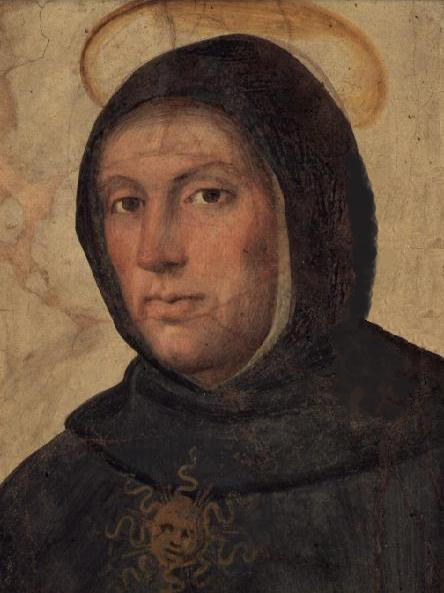
Thomas Aquinas, by Fra Bartolomeo.  During a period  of Islamic ascendancy in medieval  Europe, Aquinas let the way as a follower of Jesus to transform history.

Thomas Aquinas, by Fra Bartolomeo. During a period of Islamic ascendancy in medieval Europe, Aquinas led the way as a follower of Jesus to transform history.

According to the U.S. Census of 2010, Islam is the fastest growing religious movement  in America, increasing 66.7% over the previous ten years, as compared to only a 1.7% increase among evangelical Protestants. How do we best relate the Gospel to Muslims? Here is a nugget from church history on Thomas Aquinas and the influx of Islam into medieval Europe with lessons for today.

So, how did the medieval church respond to the overwhelming cultural influence carried by the Arab Muslims into Christian Europe? Enter in Thomas Aquinas. Aquinas was a young Dominican monk in the 13th century as he thought about the growing influence of Islam throughout the known “Christian” world. But Aquinas knew that the famous ancient Greek philosopher, Aristotle, was perhaps the most important thinker enlisted by the Muslims to support Islamic belief. Aquinas began a nearly lifelong study of Aristotle. His magisterial Summa contra Gentiles was written in about 1264 largely as an apologetic treatise for use by Christian missionaries when explaining the faith to Muslim critics. In Summa contra Gentiles, he comments extensively on Aristotle, the great pagan thinker, in an effort to defend the Gospel.

Continue reading


Bible Genome

Bible Genome

Map of Direct Citations in the Bible

What Scriptures were most influential to the writers of the Bible?  Who cited whom? Which writers were most schooled in Scripture?  Which Gospel writer referred the most to other Scriptures?  How big a role did Revelation play in their thinking and teaching?  How about Genesis and Job?  How are the parts of the Bible connected?  Which books appear to have been written at the same time?

From God To Us Revised and Expanded: How We Got Our Bible by Norman Geisler and William Nix is a foundational text for those interested in the topic, and I can highly recommend pretty much anything by Dr. Geisler (more on that in a future post).

“Jesus and New Testament writers amply illustrate their belief in the full and complete inspiration of the Old Testament by quoting from every part of the Scriptures as authoritative, including some of its most disputed teachings. The creation of Adam and Eve (Matt. 19:4–6), the destruction of the world by a flood, the miracle of Jonah and the great fish (Matt. 12:39–40), and many other incidents are quoted authoritatively by Jesus. No part of Sacred Writ claims less than full and complete authority. Biblical inspiration is plenary.”
Geisler, Norman L.; Nix, William E. From God To Us Revised and Expanded: How We Got Our Bible. Moody Publishers.

Continue reading