Tag Archives: New Testament

Forgery and Counterforgery, by Bart Ehrman. A Multi-Part Review

Is it possible that some of the books found in our Bible were actually literary forgeries, deceptively written books snuck into the canon of Scripture, unbeknownst to unsuspecting leaders in the early church?

Understandably, most Christians shrink back in horror or disbelief at the very thought, as such a suggestion might shake their faith in the trustworthiness of Scripture. If such an accusation were true, the consequences for the Christian faith would be significant. Nevertheless, a number of critical scholars today have been exploring that very question, a question that has consumed a lot of ink since the days of the 18th century Enlightenment.

Bart Ehrman’s Forgery and Counterforgery: The Use of Literary Deceit in Early Christian Polemics argues that up to 70% of the New Testament material is made up of forged documents. How well do the claims of Bart Ehrman stand up to scrutiny?


Is the “Historical Criticism” of the New Testament a Threat to Christianity?

About seven years ago, I partnered in a discussion with one of my pastors, Hunter Ruch, in front of our congregation, to answer the specific objection raised by critics that the Apostle Paul never wrote 2 Timothy2 Timothy 3:16 has a very well known verse of the Bible which I memorized years ago, “All Scripture is inspired by God and is profitable for teaching, for rebuking, for correcting, for training in righteousness (CSB).” The video itself is no longer available, but my aim in that discussion was so that our confidence in the integrity of Scripture might be affirmed.

But not everyone received it that way. After the service, one very distraught gentleman confronted me and asked why I even bothered raising the topic in a church worship service. In his mind, this gentleman believed that we should simply take the Bible for what it says to be true, and that should be the end of it. A full consideration of the evidence was a waste of time.

Apparently, this gentleman did not see the value in studying Christian apologetics. He was also unaware of what is being taught in hundreds of religion departments in secular, and even some Christian universities, to thousands of students on a yearly basis.

His advice to me also indicated that he was unfamiliar with something called “social media,” through Tik-Tok and YouTube Short videos. This gentleman was clearly old enough to have teenage children, and yet as he walked away from me I kept wondering if his child possessed a smartphone with ready access to an Instagram or Facebook account.

The following 2-minute YouTube video was recorded by a credentialed, skeptic-leaning biblical scholar, Dan McClellan, just a few thumb clicks away from any smartphone in the hands of a teenager. How would you respond to this?

The onslaught of skepticism about Christianity in the age of the Internet is relentless. Granted, parents or anyone else can feel overwhelmed when faced with these challenges which seem almost endless. However, there are some basic-level apologetic tools available that can assist believers in having greater confidence in their faith.

Daniel McClellan is an accomplished scholar in the area of “historical criticism,” with some helpful videos, addressing dubious claims in popular preaching today, as well as exposing complete nonsense. But a number of Dr. McClellan’s other claims deserve better scrutiny. Several things that are said here in the particular video shown above are contentious, and a couple of them are worth commenting on.

Dr. McClellan’s second point can be addressed first: Dr. McClellan makes the assertion that Paul could not have authored 2 Timothy because it was written decades after his death.This raises the whole spectre of forgery as to what we find in our Bibles, which will be the subject of this and subsequent blog posts in this series.

On the first point in the video, when many Christians read 2 Timothy 3:16 talking about “all Scripture is breathed out by God,” they often think this is a reference to the Bible as we have it now, the Old Testament and all 27 books of the New Testaments combined. However, Daniel McClellan is mainly right here. With respect to the Old Testament, the Jewish community in the time of Paul was not entirely in agreement with what constituted the boundary for the Old Testament writings. While the 39 books within the Protestant canon of the Old Testament were well established, a debate continued for perhaps another several hundred years or so as to whether or not there were more books within that canon of Old Testament texts. Protestant Christians typically associate these debated extra books with the “Apocrypha.”

Regarding the New Testament,  even if you take a very conservative view as to the dating of when 2 Timothy was written, it probably could not have meant to include the whole of the New Testament as “Scripture” as we know it today, as the letters of Paul are generally considered to be the earliest writings found in our New Testament. For example, it is difficult to conceive how Paul might have had the Gospel of John included in his mind as “Scripture,” if it had not been written yet!

Most Christians today retrospectively conclude that 2 Timothy 3:16 can now be taken to mean not just the Old Testament writings as “Scripture,” but the entire collection of New Testament writings as well. Yet this raises the question as to how all the books of the New Testament eventually became regarded as “Scripture,” which theologians define as the development of the “canon” of Scripture or “rule or faith,” long after 2 Timothy was originally penned.

A knee-jerk reaction to Dr. McClellan might be tempting, but he does raise some important questions.

The Development of the New Testament Canon

So, how did we get the exact books which make up our New Testament? An often related question gets asked a lot: “Who chose the books of the New Testament canon?

It is an understandable question, but it is also a misleading one. Dr. Michael Kruger, the president of Reformed Theological Seminary in Charlotte, North Carolina, suggests that the idea of who “chose” the books of the New Testament canon “conjures images of some meeting, or council, where people voted on books—some books making the cut, and others left out.” But this simply is not the case. The historical record shows a much more organic process to the development of the canon of Scripture:

“If you had lived in the second century and asked the average Christian on the street, ‘Why did you guys pick Matthew, Mark, Luke, and John?,’ I think you would have received some very strange looks. Indeed, I don’t think the question would have made any sense to the average Christian. They didn’t view themselves as choosing anything……”

“….. asking Christians why they chose the Gospels would be akin to asking someone why they chose their parents. No one chooses their parents. They were just kind of ‘there’ from as far back as they can remember.”1

Nevertheless, some people still have questions. I remember a high school friend of mine telling me when he realized that as a young teenager, his parents were not his “real” parents. Instead, he learned that he was adopted at a very young age. It was quite upsetting for him to hear this truth. But it did make me wonder about my own history. When I asked my mom about it, she pulled out a copy of my birth certificate, and that pretty much settled the matter right then and there. All it took was some direct evidence to answer my question.

What evidence then do we have for the New Testament?

Codex Sinaiticus, one of the earliest copies of the Bible, including the New Testament.  But how much of it was written by the people who claimed to have written it?  (credit: bible archaeology.org)


Bart Ehrman and the Issue of Forgeries(???)  in Early Christianity

University of North Carolina, Chapel Hill, professor Bart Ehrman, who is a professional skeptical scholar like Dan McClellan in the above video, is considered to be one of the most well-known critics of historically orthodox Christianity. In 2011, Ehrman published Forged: Writing in the Name of God — Why the Bible’s Authors Are Not Who We Think They Are, a book written for a popular audience that addresses the problems associated with the canon of the New Testament. Ehman claims that between 8 and 11 of the 27 books of Christian New Testament were written as “forgeries.” This would include the longest book of the New Testament, the Book of Acts, effectively saying that up to 70% of the New Testament is made up of forged documents.

This is a startling claim for Christians unfamiliar with the modern discipline of New Testament studies, as taught in hundreds and hundreds of universities today. However, anyone studying religion at the college level will probably hear such a claim being made in the classroom. Some variation of this claim has been promoted in academia for roughly 200 years, going back at least to the time of the early 19th century German biblical scholar, Ferdinand Christian Baur. The ubiquitous character of social media in the early first quarter of the 21st century only makes such challenges ever ready and accessible to the modern smartphone user. Even more disturbing, such ideas have even found their way into the church, through the door of “progressive Christianity.”2

Bart Ehrman is a New York Times bestselling author, having published over a dozen books like this which challenge historic, orthodox Christian views of the Bible. His videos on YouTube regularly receive each thousands of views, driven mainly by an audience with a skeptical outlook upon the Bible and rejection of conservative evangelical Christian faith. His Misquoting Jesus YouTube podcast, launched just a year ago, has already received well over a million views on social media.

Despite significant disagreements between scholars like Erhman and conservative evangelical scholars, both Erhman and conservative evangelical scholars reject the misguided notion of so-called “Jesus Mythicism,” an avant garde intellectual movement popular in certain atheistic circles which denies the existence of Jesus of Nazareth as an historical figure. Disagreeable as Dr. Ehrman will sound among conservative Christians, Bart Ehrman is not an extremist. With this background in mind, it is important for Christians to understand the types of arguments which Dr. Ehrman brings to the table. Interestingly, long before Bart Ehrman became a household name in the secular media, the Dr. Kruger mentioned above had Bart Ehrman as a religion professor when Kruger was an undergraduate student at Chapel Hill.

In 2012, Ehrman wrote a more academic treatment of the same topic of New Testament origins, Forgery and Counterforgery: The Use of Literary Deceit in Early Christian Polemics., which is the subject of this book review. My aim is to offer an analysis of Ehrman’s primary claims, and address these issues of the canon of the New Testament and its integrity from an historically orthodox Christian perspective.

Last year, I read Bart Ehrman’s popular level book addressing the issues regarding the afterlife in the Bible, Heaven and Hell: A History of the Afterlife. In that Veracity book review, I identified several presuppositions which undergird Dr. Ehrman’s approach to these topics, framing his overall mode of analysis, and guiding him towards his conclusions. I would urge readers to review that blog post as that will aid the reader to understand the big ideas that Bart Ehrman brings to the table, ideas which also undergird his arguments as found in Forgery and Counterforgery. While it is too much to go into here about where Ehrman gets these from, the two primary presuppositions summarized are:

(1) The Bible is inherently a collection of writings which possess a wide range of differences in these texts. However, not only can these differences not be reconciled with one another, the student of the Bible should not try to harmonize such differences as such harmonizations essentially alter and obscure the true meaning associated with these texts. This inherent contradictory nature of the Bible stems from the fundamental diversity present in the Christian movement from the very beginning of Christianity. This essential and irreconcilable diversity is supported by a thesis proposed by an early 20th century German Bible scholar, Walter Bauer.3

(2) Jesus was a failed apocalyptic prophet. He predicted that a great, cataclysmic end of the world would happen within his generation, but that Jesus’ prediction failed to materialize. The shape and character of our New Testament, as well as that of Christianity more broadly, grew out of the Christian movement’s attempt to rethink the teachings of Jesus, in view of this failure of prophecy. This understanding of the apocalyptic character of Christianity was popularized by the famous early 20th century Bible scholar, Albert Schweitzer.


If you are looking for Bart Ehrman’s quick “hot take” on these points, here are a couple of YouTube “shorts,” videos that rarely last more than 1 minute each, which briefly summarize the key elements to these two ideas which undergird Ehrman’s work.  The first video is a quick summary of the Walter Bauer thesis, namely that Christianity was highly diverse, even more-so than what we find in Christianity today, right from the very beginning. The second video argues that the three earlier Gospels: Matthew, Mark, and Luke, has Jesus predicting a great, catalclysmic end of the world happening within a generation of Christ’s earliest disciples, as argued by Albert Schweitzer, whereas this apocalyptic message essentially disappears in the Gospel of John, which is generally thought to have been written last, perhaps towards the end of the first century. The implication drawn from this suggests that the great cataclysmic apocalyptic event which Jesus predicted never materialized:

A Thumbnail Sketch of the Walter Bauer Thesis


A Thumbnail Sketch of the Albert Schweitzer Thesis


Both of these governing ideas drive the argumentation which Dr. Ehrman presents in Forgery and Counterforgery. That being said, there are elements of Bart Ehrman’s thesis which deserve careful consideration. Despite my disagreements with Dr. Ehrman, he is nevertheless a very accomplished, world-class scholar, an excellent communicator, and he comes across to me as quite likable in his interviews.

So, I want to try to interact with Dr. Ehrman’s book both fairly and generously, as much as possible. Due to the length of the book, over 600 written pages, which I listened to for nearly 26 hours through an Audible audiobook, this book review will be split up over multiple blog posts, each with a central nugget of digestible thought. I will not even try to critique everything Bart Ehrman says, since that would probably end up being another big book in and of itself!

This first post will be introductory in nature, discussing some of the fundamental ideas in Ehrman’s book, focusing mainly on the difficulty in defining what is a “forgery.” For some readers, this blog post will be sufficient to offer a rough outline of a response to Forgery and Counterforgery.

In the second blog post, we will examine some of the specific arguments used by Ehrman which attempt to demonstrate that forgeries exist within our New Testament. Reading this will give you a flavor of the method Ehrman uses to draw his conclusions.

The third blog post will examine the particular issues associated with the most controversial of the Pauline letters, what is known to be the “pastoral letters,”  1 Timothy, 2 Timothy, and Titus. I will also show how some “progressive Christian” scholars echo some of the same arguments advanced by Dr. Ehrman.

In the fourth blog post, we will consider the concept of allonymity, used by some conservative evangelical scholars to explain how certain pseudepigraphical writings in our New Testament can still be accepted as being authoritative, without succumbing to the negative assessment associated with the category of “forgery.”

In the fifth and last blog post, we will engage in a thought experiment: What if Bart Ehrman is correct about forgeries in our New Testament? What would be the consequences to Christian faith if a number of Ehrman’s arguments proved to be correct? At the end of that post, I will offer a summary response to Forgery and Counterforgery.

Bart Ehrman, yyy

Bart Ehrman (Agnostic critic of the Bible)


What is the Definition of “Forgery?”

What is a “forgery?” The definition of “forgery” is a crucial question to address at the outset. A basic definition which Bart Ehrman uses is “a book written with a false authorial claim.” Some object to the use of the term “forgery,” in that it has negative connotations. Some prefer a more neutral, if not obfuscated word to use, such as “pseudepigraphy,” or “pseudonymous.”

A “pseudonymous” writing can have a broad range of meaning associated with it, where such a work may not necessarily suggest morally objectionable intent. For example, consider the use of pen names. Samuel Clemens famously used the pen name “Mark Twain” to sign his literary work, and yet lovers of great literature see the use of a pen name here more in a benign sense, as opposed to a purely deceptive sense. Some associate the concept of “ghostwriting” with this concept of a more benign sense of pseudonymity, whereby a well-known author hires another writer to produce written material which matches the content, and even the vocabulary and style of the well-known author, with the full acknowledgement and permission of that well-known author. Several contemporary and famous Christians authors, including the late Billy Graham and the late Tim LaHaye, have made use of ghostwriters in their many written works. In contrast with these more benign type of writings, Ehrman links his use of the term “forgery” to a more specific sense of pseudonymity, that of “pseudepigraphy,” whereby “a book appears under the name of a well-known person who did not, in fact, write it.”4

The term “counter-forgery” is related to “forgery,” as Ehrman uses it. A “counter-forgery” acts a forged document written as a polemic against another forged document.

Other scholars will challenge Ehrman’s strict, if not completely synonymous link between “forgery” and “pseudepigraphy.” For example, the well-regarded conservative evangelical scholar, D. A. Carson argues:

A literary forgery is a work written or modified with the intent to deceive. All literary forgeries are pseudepigraphical, but not all pseudepigrapha are literary forgeries. There is a substantial class of pseudepigraphical writings that, in the course of their transmission, somehow became associated with some figure or other. These connections between a text and an ancient figure, however fallacious, were judgments made with the best will in the world.5

The late Old Testament and conservative evangelical scholar, Michael Heiser, offers several examples of pseudepigraphy in the Old Testament, whereby a particular name was attached to a book, despite the fact that no “no evidence exists that their namesake did any of the writing.” Such books include Job, 1 and 2 Samuel, and Joshua. Even though the Book of Joshua became associated with the name of the great military leader and successor to Moses, there is no sense of deceit involved. Technically, the Book of Joshua is pseudonymous, in that Joshua did not himself write the book, but there is no indication that ascribing Joshua’s name to the book was meant to deceive.6

Even in the New Testament, we have evidence that certain New Testament books quote from other pseudepigraphical works. In particular, the Book of Enoch, is both quoted and alluded to in Jude and Peter. Early church fathers praised much of the theology as found in the Book of Enoch, while still acknowledging that Enoch could not have possibly written that book itself, even though the name of Enoch is attached to it.7

Likewise, the conservative evangelical and New Testament scholar, Ben Witherington clarifies the distinction between a falsely written versus a genuine letter of the New Testament:

“The real dividing line between a genuine letter and a pseudepigraphon is whether the material comes from the mind of particular person, not whether it fully reflects that person’s grammar and syntax and vocabulary. To this I would add that a genuine letter comes not only from the mind, but also from the hand, of the author, or is inscribed upon the author’s request or behalf.”8

Witherington’s point is that in an age where the art of writing was more of a professional endeavor, when papyrus was less flexible than the use of modern paper, and illiteracy in the Greco-Roman world was very high, the use of secretaries to produce literary work was actually quite common. Authors could give their professional scribes great leeway in their writing, which can account for variances in grammar, syntax, and vocabulary. In other words, an author could “authorize” a secretary to express their ideas in a manner more fitting to the purposes at hand.

Do we have forgeries in our New Testament? Veracity investigates the claims found in Bart Ehrman’s Forgery and Counterforgery: The Use of Literary Deceit in Early Christian Polemics.


“Pseudepigraphy” versus “Forgery:” What is the Difference?

It would therefore appear that the definition of pseudepigraphy is the subject of some dispute, as there are cases where such a possible work might have certain suspicions surrounding it, while still being held in high esteem in the Bible, depending on the circumstances. So, are there other cases where an alignment between “pseudepigraphy” and “forgery” are less clear?

For example, there are no known New Testament scholars, conservative or liberal, who dispute that Paul wrote the Book of Romans. Nevertheless, Romans 16:22 explicitly states that “I, Tertius, wrote this letter.” Clearly, Tertius was Paul’s secretary but he was writing under the full supervision of the great Apostle.

Bart Ehrman disputes the claim that the use of secretaries among ancient writers accounts for variations of style and vocabulary as supposed by evangelical Christian apologists, who seek to defend the inspiration of Scripture. But he also acknowledges that in and of themselves, literary style and vocabulary alone is insufficient to fully demonstrate that any particular writing is a forgery. What ultimately matters is the actual content and message of the literary work itself.

The problem is complicated by the fact that there are books in our Bible which lack a clear, undisputed author standing behind the work. The classic New Testament example of this is the Book of Hebrews. One will search the pages of Hebrews looking for the name of the author, but this is nowhere to be found. Some have claimed that Paul wrote Hebrews, while others say Luke wrote it, and some have speculated that a woman, Priscilla, wrote it. We may never know on this side of history who was the genuine author of Hebrews.

Nevertheless, the lack of a clear authorial attribution for Hebrews did not deter the early church from recognizing the book’s apostolic authority and authenticity. It was sufficient enough for the early church to acknowledge that an inspired New Testament book must have been written either by a well-known apostle, such as Paul or Peter, who is claimed to have had a particularly close, earthly encounter with Jesus, either before and/or after the Resurrection of Jesus. Or the early church also acknowledged writings from someone who traveled within that early apostolic circle, such as Luke.

Luke never had a close, earthly encounter with Jesus. But he was a well known traveling companion with Paul. Furthemore, for the early church fathers, the content of any authentic New Testament writing must have been theologically in tune with those early teachings of Jesus and his disciples. This theological consistency and coherency was known as “the rule of faith.” Therefore, even though Hebrews lacked a definitive authorial designation, the theology articulated in that letter was acknowledged to be fully inline with “the rule of faith,” as preached by the early church.

However, how did the early church know if a particular book met such qualifications of authenticity? Is it possible for a deceptively pseudonymous writing of some sort to have been accepted anyway into the New Testament?

Christian Use of the “Noble Lie”

Some speak of the concept of a “noble lie” as a justification for some types of pseudonymous writings, or certain speech acts in general. The Bible famously includes as one of the Ten Commandments the command to not “bear false witness against one’s neighbor.” Telling the truth is an essential moral rule which the Bible unequivocally elevates as being most important. At the same time, we read of the story of Rahab, the prostitute in Jericho, who famously lied to her fellow Canaanites, telling them that the Hebrew spies hiding in her house had already fled the town (Joshua 2). In acknowledgement of this deceitful bravery, which would have cost her life, not to mention the lives of the Hebrew spies she was protecting, if her lie had been discovered, she was nevertheless recognized and celebrated in Jesus’ genealogy (Matthew 1:5).

Jerome, an early church father and the great translator of the Latin Vulgate, believed that in Galatians 2:11-14, when Paul rebuked Peter publicly for not eating with Gentile believers, that this incident was actually a version of the “noble lie.” Ehrman writes about this:

In Jerome’s well-known position, Peter and Paul did not actually have a falling out. They put on a show, in a double act of dissimulation: Peter “pretended” to be subject to Jewish dietary laws for the sake of the brethren, knowing that he was not really subject to them, and Paul, cognizant of the true state of things, “pretended” to rebuke Peter in order to show the gentile Christians that he was on their side so as to keep from giving offense. (Ehrman, p. 453).

Saint Augustine, a contemporary of Jerome’s, was not impressed by Jerome’s interpretation of Galatians 2, as Augustine was known to be skeptical of the concept of the “noble lie.” Nevertheless, other examples of such lying are recorded in Scripture, where those who were in on the lie were celebrated for their actions.The Hebrew midwives lied to Pharaoh, and protected the lives of baby Hebrew boys, and the Bible honors them in their bravery through the telling of their lie (Exodus 1:15-22). Michal, David’s wife, lied to David’s pursuers, thus saving the life of the future king (1 Samuel 19:11-18).

While some Christians like Augustine balk at the use of the “noble lie,” other Christians have defended its use and honor those who participate in such deceptions. Ehrman even acknowledges that another well-regarded church father contemporaneous to Augustine, John Cassian, disputed Augustine’s rigid view against the “noble lie,” suggesting that even the Bible, as in the case of Rehab lying to protect Hebrew spies, approves of it (Ehrman, p. 538-539).

In more recent times, Corrie ten Boom, in her classic work The Hiding Place, tells about deceiving the Nazi’s who occupied her Dutch town by offering sanctuary to hundreds of Jews fleeing Nazi oppression. Countless other Christians during the Nazi era did the same, saving the lives of many, many Jews. Numerous Christians in the armed forces during periods of war have participated in espionage activities, thus deceiving their enemies, earning accolades from fellow Christians for these acts of bravery. The well-known and highly respected theologian Dietrich Bonhoeffer participated in a plot to assassinate Adolph Hitler, and was eventually arrested and executed for his deceptive acts.

Imagine you were a Christian living in Nazi-held Europe in the 1940s, and some Jews were seeking refuge from the Nazis, and you put them up for the night in your home. The next day, the Gestapo knocks on the door and asks, “Are there any Jews in your house?

Would you really respond with something like this?: “Why, yes. There are Jews here. Since I am a Christian, and Christians are not supposed to lie because of the Ninth Commandment, I am compelled to tell you that the Jews are down the hallway on the right. Not the first door on the right, but the second door on the right. If you look over this way, you can see them climbing out of the window right now. If you act quickly, Mr. Gestapo-person, you might still have time to catch them. In giving you all of this information, I now feel satisfied and self-vindicated that I have kept God’s commandment not to lie.

Hopefully, the absurdity of such a response is apparent. If a Christian quarterback on a football team were to throw a no-look pass, would he need to repent of his deceptive “sin” after the game?

Again, it should be evident that not everything that falls under the category of “deception” would be a violation of the Ninth Commandment. As the late Dr. Michael Heiser has written,

“The command ‘thou shalt not bear false witness’ refers to uttering words, and, in context, in a courtroom setting (the biblical ‘by two or three witnesses things will be known’ idea). …..Undoing or forbidding acts of heroism and courtesy is NOT the purpose of the ninth command. The command was not given to allow evil to proliferate, to have others suffer, to have children lose innocence, or to compel people to be rude.”

True, such an exception could easily be misused to justify the actual sin of bearing false witness against one’s neighbor. Delilah badgered Samson to reveal the truth about the source of his strength, and then deceived Samson by using that knowledge to betray Samson to the Philistines (Judges 16:19).

We should also remember that Ananias and Sapphira deceptively hid the fact that they withheld part of the proceeds of the sale of some property from the church, an example of bearing false witness which resulted in their immediate deaths (Acts 5:1-11). God takes truth-telling seriously. So, it does raise a good question as to when such deception fits into some category, like the “noble lie,” versus an act of deception intent on distorting the truth for self-gain, or some other corrupt motivation. Where is the line between the two?

A good argument can therefore be made to suggest that given the right circumstances, a type of pseudonymous writing might have made its way into the canon of Scripture, under the full inspiration of the Holy Spirit. Here is similar example: For if we have purposely fictitious stories called “parables,” which Jesus used as teaching tools in the Gospels, it would be difficult to completely rule out all fiction in the Bible as being inherently contradictory with the notion of Scriptural inspiration.

On the other hand, there are other cases where the presence of pseudepigraphy within the canon of Scripture would be disastrous for our understanding of the integrity of the Bible. For if an unscrupulous author were able to fake their identity in their written work, taking upon themselves the false claim of being Paul or Peter, for the purpose of misleading their readers, in order to promote an agenda contrary to that of the original apostles, then such pseudepigraphy would compromise our confidence in the Bible as truly being the Word of God. Therefore, discerning the difference between these two categories is essential.

A fragment of the Gospel of Peter found at Akhmim, in 1886. This copy has been dated to about the 8th or 9th century, C.E. The Gospel of Peter was rejected as being apocryphal by the early church, and therefore not appropriate for inclusion in the New Testament. It is most known for a reference to a “talking cross,” following the resurrection of Jesus. The Gospel of Peter is not simply a pseudonymous writing, it is specifically a forgery.


The Prevalence of Forgery and Pseudepigraphy in the Ancient World

There is no doubt among scholars, across the academic spectrum, that the problem of forgery existed within the early Christian movement. Forgery was a serious moral issue more broadly within the world of classical thought across the Roman Empire during the time of Jesus. Ancient authors often complained that other unscrupulous writers would write literary material in the name of another well-known person to give such work credibility and added authority. Nevertheless, we possess a variety of works from the ancient Greco-Roman world which are not regarded as forged, such as the historical writings of Suetonius and Plutarch. In some other cases, certain non-Christian pseudepigraphical works have survived which lack a definitive negative moral taint to them, despite disputes about their authorship.

For example, Aristophanes wrote his early plays under the names of the persons who directed his plays. Xenophon’s Anabasis was written in the third person, a kind of pseudepigraphic writing style, which most scholars today still attribute to the ancient Greek soldier and writer Xenophon. Even Bart Ehrman acknowledges cases where there were concerns to “protect the identity of the real author, in cases in which the safety or other personal concerns were an issue,” such as with the 5th century C.E. Archbishop Nestorius writing in the name of Heraclides in his Liber Heraclidis.9

Within the early Christian movement in particular, we face a similar situation. Numerous writings were clearly forged in the name of well-known Christian figures. Such works include:

  • The Gospel of Thomas
  • The Gospel of James
  • The Gospel of Philip
  • The Gospel of Peter
  • Third Corinthians
  • Paul’s Letter to the Laodiceans
  • The Apocalypse of Peter
  • The Apocalypse of Paul

All of the above writings among certain early Christian readers were assumed to be authentic at various times. However, in each case, the collective mind of the early church ultimately dismissed each one of these documents as forgeries, and therefore, ineligible to be included within the New Testament canon.

This did not mean that all Christians stopped reading such books once the canon was firmly established. As late as the 17th century, some Quakers adopted Paul’s Letter to the Laodiceans and considered that forged document to be on par with the rest of the New Testament. But for all practical purposes, the current list of 27 books of the New Testament remains the standard canon for all historically orthodox Christians.

What were the motivations behind such forgeries? In some cases, an over enthusiastic curiosity to explore unexplained events within the New Testament led to such writings. In other cases, a famous person’s name was used to write a polemical message, leveraging the authority of an apostle to spread a different teaching. Other writings could have been written with the possible intent to express an apostle’s teaching for a new generation of readers, and yet the forgeries were written so long after the death of the apostle that it would have been impossible to securely establish a valid reason for the pseudonymity.

Bart Ehrman’s view in Forgery and Counterforgery is that:

in every instance of forgery that I discuss, the intention of the forger was to deceive his readers into thinking he was someone other than who he was; his motivation was not only to receive a simple hearing of his views (although certainly that) but also to authorize his views through the authority provided by the status of his falsely assumed authorial name. His goal was to advance his own polemical agenda” (p. 153).


The Progressive Christian Attempt to Justify Forgery in the New Testament Without Calling it “Forgery”

Therefore, when it comes to the books that actually made it into our New Testament, the charge of forgery is quite serious, and yet some progressive Christian scholars do not seem too bothered by this.  A number of progressive Christian scholars today will argue that having the presence of certain dubious pseudonymous works in our New Testament is not problematic for our New Testament canon.  They would argue that while such works are indeed pseudepigraphy, using the name of a well-known Christian authority in a deliberate attempt to change the teachings of that authoritative person, they would hesitate to use the terminology of “forgery” to apply in such a situation.

Such logic is fallacious. This is one area where conservative Christian scholars can agree with a skeptic like Bart Ehrman. Ehrman convincingly demonstrates that in the classical world, a lie was considered as a lie, and the same type of logic applied to the thinking of the early church. As theologian Michael Kruger states in his review of Ehrman’s work,

It is fashionable today to suggest a ‘middle way’ where the pseudonymity of some NT books is affirmed and the canonicity of those books is also affirmed. However, Ehrman is absolutely correct that early Christians simply did not see it this way. To them, forgery was a lie, plain and simple. “10

There are legitimate reasons in certain cases, which we will cover in future blog posts, where a genuinely authentic, non-forged New Testament work might still have some characteristics of pseudonymity. However, it can be fairly stated that if someone tried to produce a New Testament writing that sought to twist and distort the teaching of someone like Paul, in an effort to deceive the reading audience, it should indeed be considered as a forgery. If that is the case, it would be better to be honest about the failure of the New Testament canonization of Scripture process.

However, as this review will attempt to do in subsequent blog posts, there is sufficient evidence to demonstrate the integrity of the New Testament canon. We can still have confidence that every book of the New Testament is truly the Word of God and not a forgery. But a careful examination of the evidence is required to substantiate the argument.

See you in the next installment of this multi-blog-post book review of Bart Ehrman’s Forgery and Counterforgery.


Notes:

1. See Michael Kruger’s “Canon Fodder” blog.  

2. Ferdinand Christian Baur (F.C. Baur) took an even more radical view of the New Testament, particularly that of Paul’s letters. Baur’s research suggested that “only the Epistles to the Galatians, Corinthians, and Romans can be confidently used as sources” for Paul’s theology (Albert Schweitzer, Paul and His Interpreters: A Critical History, p. 14). “Baur had distinguished three classes of Epistles. In the first he placed, as beyond doubt genuine, Galatians, [1 & 2] Corinthians, and Romans; Ephesians, Colossians, Philippians, Thessalonians, and Philemon formed the second class, being considered uncertain; the Pastoral Epistles formed the third class, and were regarded as proved to be spurious.” (Schweitzer, p. 25). While the so-called Tübingen school which Baur was associated with has been superseded in the academia, more refined critical views, like that of Bart Ehrman, continue to dominate secular academia. See this discussion on progressive Christianity.  For more on the history and role of “historical criticism” in the study of the Bible, see this Veracity blog series.  

3. See extended video discussion about the Walter Bauer thesis.

4. Forgery and Counterforgery, Bart Ehrman. p.29ff. Further citations will be in the text as “Ehrman.”

5. See D. A. Carson, “Pseudonymity and Pseudepigraphy,” ed. Craig A. Evans and Stanley E. Porter, Dictionary of New Testament Background: A Compendium of Contemporary Biblical Scholarship, as quoted in Michael Heiser, Reversing Hermon: Enoch, the Watchers, and the Forgotten Mission of Jesus Christ, p. 13

6. See Michael Heiser, Reversing Hermon. p. 13. See also Heiser’s blog post on “Lying and Deception.”

7. See Michael Heiser, Reversing Hermon. p. 216ff. See blog post on head coverings.

8. See Ben Witherington, Letters and Homilies for Hellenized Christians: A Socio-Rhetorical Commentary on Titus, 1-2 Timothy and 1-3 John, p. 26

9. Ehrman, Forgery and Counterforgery. p. 46-47. In the case of Xenophon’s Anabasis, Ehrman holds the judgment that Plutarch did as well, that this style of writing was “not innocent at all.” But does this mean that Xenophon’s work should be thoroughly discredited? Few historians would agree with that. As to the notion of protecting the identity of the real author, a case could be made this might be why the Book of Hebrews contains no acknowledgement of the author’s name, as various scholars contend that Hebrews was written during a time of persecution. It is reasonable then to assert that the lack of naming the author of Hebrews was done intentionally, in an effort to protect the identity of the author and/or the Christian community or communities such as author was hoping to encourage in a time of persecution.

10. See Michael Kruger’s review of Forged in the Themelios journal. The work of progressive Christian scholar John Barton is an illustrative example of how an attempt is made to say that some unknown writer ascribed the name of Paul to certain letters, in an effort to domesticate or substantially change the message of the great apostle, and yet still suggest that the inclusion of such a work in the New Testament may be of no great consequence, at least among some Christians. “The Pastorals [1 Timothy, 2 Timothy, Titus] have no place in attempting to reconstruct the thought of Paul, but there is nothing to prevent our studying the thought of the Pastorals, and finding it interesting and perhaps persuasive……Are Paul’s letters authoritative because they are by Paul? If so, then establishing that one of them is in fact pseudonymous presumably reduces or even annuls its authority. Or are they authoritative because they are in the Bible? If so, the question of who wrote them might be regarded as irrelevant. For most Christians, the answer is probably a blend of both factors, though this is arguably incoherent.” To be “arguably incoherent” on this latter point is an understatement here. Contra Barton, if the early church truly erred in falsely ascribing a New Testament document as being authentic, this would only bring great shame upon the Christian movement. John Barton, A History of the Bible: The Book and Its Faiths, p. 186-187. See Veracity book review for more details.


Christian Urban Legends

Were the shepherds at the birth of Christ really despised, social outcasts? This popular story makes for a great Christmas sermon message, namely that lowly, poor shepherds, having the social reputation equivalent to prostitutes, were given the honorary privilege of giving testimony to the birth of the Messiah. Though well intended, it turns out that this is largely an urban legend.

“Adoration of the Shepherds,” by Gerard van Honthorst, 1622. (credit Wikipedia: The Yorck Project: 10.000 Meisterwerke der Malerei. DVD-ROM, 2002. ISBN 3936122202)

Evangelical Bible scholar, David Croteau, the Dean of Columbia Biblical Seminary, and author of Urban Legends of the New Testament, acknowledges that many other scholars over the years have commented on the supposed despised nature of 1st century Jewish shepherds, citing sources like Aristotle and the Babylonian Talmud, for support. However, Croteau points out that Aristotle was not a Jew, and lived several hundreds of years before Christ, and the Babylonian Talmud was not produced until several centuries after Christ. Furthermore, British Bible scholar Ian Paul notes that the Babylonian Talmud’s denigration of shepherds might have been shaped more by an anti-Christian polemic, rather than the actual historical context. In other words, these are not the best expert witnesses as to how shepherds were viewed by 1st century Jews.

As it turns out, Croteau cites the best evidence that counterbalances this legend directly from the New Testament itself. Luke 2:18 tells us that “all who heard it were amazed at what the shepherds said to them,” when speaking of the appearance of angels. But the people were not amazed by the supposed fact that these were “lowly” shepherds. Rather, they were amazed by what the shepherds were talking about, that of the birth announcement of the Messiah.

Instead, the Bible holds the profession of shepherding in high respect. For example, Genesis 13 notes that Abraham had much livestock, herds, and flocks of sheep. Also, Exodus 3:1 tells us that Moses was a shepherd, and that before David was king, 1 Samuel 17 tells us that David himself was a shepherd. Jesus himself speaks of being “the good shepherd [laying] down his life for the sheep” (John 10:11).

True, shepherds were not wealthy, and belonged to the lower class, and thus represented the poor and humble, but they were hardly the social equivalent to prostitutes. With such an established pedigree, from Abraham to David, to ultimately Jesus, the traditional story of the “despised” Bethlehem shepherds simply does not fit the actual data.

Continue reading


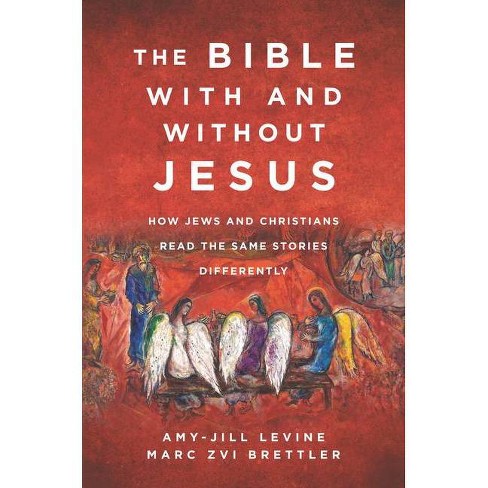
The Bible With and Without Jesus: Jews and Christians Reading Scripture Differently

Jews and Christians read the same stories in the Bible differently: So argues Jewish Bible scholars Amy-Jill Levine and Marc Zvi Brettler, as the sub-title to their 2020 book, The Bible With and Without Jesus: How Jews and Christians Read the Same Stories Differently.

So, why would I, as an evangelical Christian, read a book like this from two Jewish scholars titled as “The Bible With and Without Jesus?” Well, both Jews and Christians have at least one thing in common: The Old Testament, or what many Jews prefer to call “the Hebrew Bible,” or “the Hebrew Scriptures.” But one group reads the Old Testament with all eyes focused on finding Jesus in the text (the Christians), whereas the other group finds it difficult to see Jesus at all in the text (the Jews….. at least the non-Messianic Jews).

What do non-Christian Jews find in the Old Testament, if they do not find Jesus there? I was on a mission to find out. Having worked previously with a Jewish colleague of mine for seven years, with many hours of spiritual conversation, this was not just an academic interest. It was personal.

As Levine and Brettler put it, wherever there are two Jews, there you will find three opinions. This is as true now as it was in the time of Jesus, and in the few centuries leading up to Jesus’ birth.


How Jews and Christians Read the Bible in Different Ways

Last year, I read a history of the “time between the testaments,” Crucible of Faith: The Ancient Revolution That Made Our Modern Religious World, by Philip Jenkins (see this review on Veracity). Learning about the history covering several hundreds of years before Jesus was born helped me to better understand why sometimes understanding the Old Testament can be so tricky.

By the time Jesus walked the earth, different Jewish groups all held to the Law of Moses, yet came to different conclusions on certain important theological issues. The Pharisees believed in the resurrection, and the Sadducees rejected it. The Pharisees believed in an oral tradition, that had authority side by side with the written Law of Moses. The Sadducees rejected anything that was not in the written Law of Moses; that is, the first five books of the Bible. As for the rest of the books of what most Christians call the “Old Testament,” such as the Prophets (like Isaiah, Ezekiel, etc.), the Sadducees were highly suspicious as to their status as Scripture.

Other complexities abound: The Pharisees believed in a world filled with angels and demons, that interact with humans. The Sadducees rejected such grand diversity of supernatural beings, and present day communication with them, as being a bunch of nonsense, that obscured the reality of there being but one and only one ultimate divine power, that of God and God alone (Acts 23:8). The Sadducees emphasized the centrality of the Temple, whereas the Essenes (think “The Dead Sea Scrolls” people at Qumran, according to at least some scholars) rejected the Temple as a completely corrupt institution. But the Essenes went beyond even the Pharisees, as they considered books like 1st Enoch as part of Scripture…. but they interestingly dismissed Esther as not part of the Bible. This can be all quite confusing.

These type of differences, some of which are recorded in the New Testament, stem back to different ways of interpreting and translating the Hebrew Scriptures. Fast forward beyond the destruction of the Jerusalem Temple, in 70 C.E., the Jews eventually settled on a basic body of Scripture, and have since figured out ways of maintaining their tradition, without a central Temple. Nevertheless, Jews still today regularly debate the interpretation of many important aspects of their faith.

So, when I saw that Levine and Brettler had written a book that tries to show how Jews (in general) read the Bible differently than Christians, my curiosity was pricked, to dig into this issue some more. After all, I have long made the assumption that some of the most basic stories we find in the Old Testament are read the same way, by Jews and Christians alike. Apparently, my assumption has been quite embarrassingly wrong.

Levine and Brettler have been intimately involved in two major projects, that serious students of the Bible have found useful, one being The Jewish Study Bible (Brettler), taking an English translation of the Old Testament and providing study notes, written from a Jewish perspective, just like you would find in a Christian Bible. The other project is the Jewish Annotated New Testament (Brettler and Levine), which is geared towards introducing Jews to the thought world of the New Testament, but which has also helped me, as an additional resource to better understand a more Jewish context in reading the New Testament (see this book review at Themelios).

In The Bible With and Without Jesus, Levine and Brettler take some of the major theological themes as found in the New Testament, to compare how Christians view the same themes as found in the Old Testament, and contrast them with how such themes have been typically interpreted by Jews, who just read the Old Testament, by itself.

Jewish vs. Christian Understanding of Biblical Prophecy??

For example, biblical prophecy, especially as Christians have thought of Jesus fulfilling certain prophecies of the Old Testament, is a big issue. Since the Reformation, particularly after the first generation of folks like Luther and Calvin, many Protestant Bible teachers have tended to dismiss allegorical-type interpretations of the Old Testament, that were common in the medieval church, as such allegorical-type readings of the Bible tended to lead to doctrines that were considered to be theologically suspect, such as the perpetual virginity of Mary. As a result, most Protestant Reformed Christians have believed that only an historical-grammatical interpretation (sometimes called a “literal interpretation”) of the Bible is permissible when studying Scripture.

But this strict approach becomes a problem when trying to handle certain elements of biblical prophecy. For example, in Isaiah 7:14, we find the famous Christmas prophecy for the virgin birth of Jesus, as told by the Gospel of Matthew. The immediate historical-grammatical context shows that the prophecy was originally fulfilled in the birth of the prophet Isaiah’s son, in Isaiah 8. But many Jews acknowledge that there is an additional, deeper meaning of the prophecy, that finds its fulfillment in the birth of King Hezekiah. Christian scholars, even Protestant Reformed scholars, typically refer to this interpretive method as typology (or as many Roman Catholic apologists frame it, in terms of a somewhat different hermeneutical method called sensus plenior, or the “fuller sense” of the text). C.S. Lewis called this interpretive characteristic of the Old Testament to be the second meaning of the Hebrew Scriptures.

Levine and Brettler note Justin Martyr’s Dialogue with Trypho, where the early Christian apologist, Justin Martyr, engages in a debate with Trypho in the 2nd century C.E. As a Jew, unconvinced by the Christian message, Trypho was emphatic in insisting that Isaiah’s prophecy ultimately had King Hezekiah in mind back in the 6th century B.C.E, and not Jesus of Nazareth, centuries later. In other words, Isaiah 7:14 does not prophecy the coming of the Jewish Messiah. Justin Martyr, as a Christian, took a different approach, contending for the Gospel of Matthew’s claim that Jesus was the real reason and ultimate fulfillment for Isaiah’s prophecy.

The ESV translation reads Isaiah 7:14 as follows, “Therefore the Lord himself will give you a sign. Behold, the virgin shall conceive and bear a son, and shall call his name Immanuel.”  For most Jews, the “virgin” is said to be a mistranslation of the ancient Hebrew, since the translation of “virgin” comes from the Septuagint, the Greek translation of the Old Testament, favored by Greek-speaking Jews, including the earliest Christians, in the first century. However, the Septuagint’s translation may indicate an older, more authentic Hebrew tradition, that is currently lost. Or it may indicate some special insight that the Septuagint translators had, which was not made clear in the ancient Hebrew tradition, preserved by the Masoretic text. This Masoretic text, that most orthodox Jews believe to be authoritative, translates “virgin” simply as “young maiden.”

When the verse talks about “give you a sign,” Levine and Brettler note that the “you” is plural, which might suggest that the prophecy does, in fact, have a plural meaning, which might allow for one of the “you” to refer to the time of Joseph, the betrothed husband of Mary, in addition to the original reference to the time of Isaiah, through the birth of Isaiah’s son, or even the prophetic prediction of Hezekiah’s birth. Levine and Brettler’s discussion of this controversial passage reveals the complexities that show why Jews and Christians have differed in their interpretation of certain key texts of the Bible.

Psalm 22 provides another famous example of how New Testament writers used this Old Testament psalm to speak of Jesus, according to Levine and Brettler. In Matthew 27:46, we have Jesus’ well-known cry upon the cross, “My God, my God, why have you forsaken me?,” which is a direct quotation from Psalm 22:1. But certain Jewish traditions extending back to the time just before Christ treat Psalm 22 differently. In the Apocrypha version of the Book of Esther, part of what Roman Catholics call the deuterocanonical writings, we have a Greek commentary to the Hebrew version of the Book of Esther. The Hebrew version of Esther, commonly found in Protestant Bibles, has no reference to God found in the text. So, the Greek version offers a theological interpretation of Esther’s story, running throughout the text. But many Jews have noted that some significant parts of Esther contain direction allusions to Psalm 22, leading many Jews, even today, to say that Psalm 22 is not about Jesus, but rather, is about Esther.

However, it would be a mistake to conclude that the Hebrew Bible (Old Testament) can only be appreciated in a postmodern way; that is, by admitting that the original meaning intended by the original author has very little bearing on what the text says to us today. In postmodernism, what really matters is the reception history of the text; that is, how different reading communities over the centuries have articulated the meaning of the text, for themselves. Yet this would not be consistent with how Jews and Christians have understood the inspiration of Scripture, over thousands of years. Instead, the Bible has a progressive character of revelation to it, where God continues to unfold its meaning and the reading communities develop in their understanding of the text, as God intended it to be understood. In the case of the Christian, the culmination of this progressive revelation is the coming of Jesus of Nazareth, as the Messiah, whereas a non-Christian Jew sees the culmination of the message differently.

Helping Christians and Jews Understand Why They Read the Bible Differently

Levine and Brettler admit that their project is two-fold, to help Christians better understand how Jews approach the Bible, and to help Jews better understand how Christians read the Bible. As a Christian, I would say that both Levine and Brettler are to be warmly commended for treating the Christian tradition fairly.  I was won over by their effort, not to try to get everyone to agree on “the” interpretation of particular passages, but rather to encourage sympathy as to why Jews and Christians do indeed differ, in their reading of the text. Nevertheless, there is a polemic edge that pokes through in some spots The Bible With and Without Jesus. Their project is not an apologetic for any sort of relativism. Rather, their work is still an apologetic for their approach to Judaism.

For example, in their chapter on supersessionism in the Book of Hebrews, they correctly note the New Testament claim that the revelation of Jesus does supersede other Jewish interpretations of the Jewish Scriptural tradition. The author of Hebrews repeatedly tries to show how Jesus is better than the angels, better than Moses, better than Joshua, and better than the ancient Jewish sacrificial system. Levine and Brettler reject such a claim, as they consider themselves to be faithful Jews, unconvinced that the Christian message, that asserts that Jesus is the Messiah, is really true. In other words, Levine and Brettler are convinced that the Jewish tradition is still doing pretty well as it is, thank you very much, without having to make an appeal of accepting Jesus as the promised Messiah.

Furthermore, Levine and Brettler would not fit into a purely “conservative” category of scholarship, and this might bother some Jews, in addition to some conservative evangelical Christians who might read their work. For example, Levine and Brettler find a plethora of evidence in the Book of Jonah, that would indicate to them, that this short, popular story from the Old Testament is a work of historical fiction. A few conservative Christians scholars might agree with them, but a vast majority of Christians, and many Jews as well, will probably find such an idea difficult to swallow. But unlike other prophetic books, like Nahum, Hosea, and Haggai, the Book of Jonah has a completely different look and feel to it, which raises questions, both today and in the long history of Judaism and Christianity, as to what is really supposed to be going on in the Book of Jonah. Is it an allegory, a report of factual history, or something more complicated than that? While Levine and Brettler affirm that Jonah was a genuinely historical prophet, in Israelite history, they conclude that the story of Jonah and the big “whale” (thanks to William Tyndale’s translation of Matthew 12:40, that made its way into the King James Version of the Bible), and subsequent repentance of Nineveh was originally meant as a theological message, describing the merciful and compassionate character of God, and not as observable history.

Levine and Brettler happily argue that the Bible is ambiguous, or “slippery,” in its very nature. They would contend that such ambiguity is a virtue. To a certain degree, such ambiguity should cause Christians to embrace a kind of hermeneutical humility, particularly when Christians are unable to agree with one another, on certain Scriptural passages, involving non-essential matters of faith. Fair enough. However, there are limitations to this. Such limitations are found on both the Jewish and Christian sides of the discussion. But I will only focus on a Christian critique here.

For while The Bible With and Without Jesus succeeds in helping the reader to better appreciate why people can read the Bible so differently, thus creating a pathway for better conversation, it still can not get beyond the fact that the fundamental New Testament claim, that Jesus is the Messiah, stands in stark contrast with any other Jewish reading of the Old Testament. Effectively, the New Testament seeks to set forth the definitive commentary and critique challenging other (competitive?? for lack of a better term?) Jewish readings of the Old Testament. After all, Jesus, Paul, and many of the key figures in the early Jesus movement were all Jewish themselves. Yet the scandal of the New Testament is the claim, drawing on the testimony of Jesus as the Crucified and Risen Messiah, that the teachings of Jesus seek to properly interpret the true meaning of Israel’s Scriptures.

Applying this to the example of Isaiah’s prophecy noted above, Christians believe that Isaiah’s prophecy ultimately had Jesus in mind, despite how other Jews might interpret it. Why? Because the New Testament teaches that the birth of Jesus is the ultimate fulfillment of what is preserved in the Book of Isaiah.

Critics will indeed dispute this. The claim that Jesus is, in fact, the promised Jewish Messiah is stilly a gutsy bold claim. Grounded in the resurrection narrative, the claim of a once-died but now Risen Messiah still offends the sensibilities of most Jews.

Sadly, Christians like me, for the past 2,000 years, have at times assumed the worst about the Jews. After all, Christians over the centuries have sometimes settled for some rather odd, at best, or even conspiratorial, at worst, understandings of what Jews really think. In response, a number of Jewish critics have charged that it is the Christians who have been the ones to twist the Old Testament Scriptures to serve Christian purposes, thereby obscuring the message of the Torah.

But once we dive into the world of the New Testament, peeling back layers of tradition, we can see the essential Jewish character of the earliest Jesus movement. Far from being a Hellenized (Greek-influenced) heretical spin-off from Judaism, as popularly believed by some in modern times, or even more so by certain extreme skeptics, that Christianity was simply a “copy-cat” religion of other pagan faiths, the early Christian movement was rooted in the central debates of Jewish thought, that were alive and well in first century Palestine, and other surrounding Jewish communities.

The New Testament as Authoritative Commentary on the Old Testament (…. and Not Some Attempt to Paganize/Hellenize Judaism)

Contrary to many critics of Christianity today, there are good reasons to believe that the Christian faith is thoroughly rooted in a first century, Jewish theological context. Here is a good example of this, that blows my mind, every time I think of it, with respect to the work of Dr. Michael Heiser (see my review of Heiser’s groundbreaking book, Angels). Dr. Michael Heiser teaches about how Jesus uses the reference to the “cloud rider” and “one like a son of man,” in Daniel 7:13-14, to refer to himself, in his defense before Caiphas, the High Priest, in Matthew 26:62-65. For years, it really puzzled me as to why Caiphas immediately charged Jesus with uttering blasphemy, because of this statement by Jesus. However, during the inter-testamental period (that time between when the Old Testament and the New Testament were written), some Jews were actively thinking about how to best interpret Daniel’s mystifying statement.

It was as though Daniel was suggesting that Yahweh, the God of Israel, was giving a prophecy regarding the coming of Yahweh, in human-flesh form (“one like a son of man”). Does this mean that there were somehow “two Yahwehs,” one who was not like “a son of man,” and another who was? According to one Second Temple Judaism tradition, this is exactly what they believed.

This “two-Yahwehs” (or “two-powers”) theology was alive and well in the days of Jesus, which is really the reason why Caiphas freaked out, over Jesus’ claim made before the Sanhedrin. Interestingly though, the mainstream of Jewish thought eventually abandoned this interpretation of Daniel, during the early Christian era. Christians, in turn, found in this Jewish strand of thinking, the basis for affirming the divine nature of God the Son, simultaneously with the divine nature of the Father, thus serving as the Old Testament basis for the doctrine of the Trinity. If you have about 10-minutes, it is worth hearing Dr. Heiser summarize the whole thing:

For a 7-minute exploration of the topic at a deeper level, follow this link to YouTube. If both Christians and Jews are “people of the book,” what really separates them, when it comes to how they interpret Scripture? It is worth now taking a stab at an answer.

Whereas Jews can suffer through having multiple interpretations of their sacred texts, but still remain Jews together, due to their ethnic identities and traditions, this can not be said so easily of Christianity. Christianity is not about embracing a particular ethnic identity, rooted in tradition, as in Judaism. Rather, Christianity has an essential universal claim to truth that demands a response from any and all peoples, not just those who share a Jewish tradition. The Christian faith is ultimately bound up in its unified affirmation of fundamental Christian doctrinal teachings, primarily focused around the proclamation of a crucified Jesus as the Risen Messiah.

We Christians still have much to learn from our Jewish friends, in that many Christians still divide over and against one another, in non-essential areas of Christian doctrine. Many of these disputes have been ongoing for centuries, where it is unlikely that there will be any clear resolution to such controversies, prior to Christ’s final return. We can learn more than a few tips from our Jewish friends, in learning how to still view one another as fellow Christians, when we have disagreements with one another over non-essential matters of the faith. For that reason alone, I am grateful for Levine and Brettler’s book.

At the same time, there are essentials to the Christian faith that can not, and need not, be compromised. If you try to take away an essential to the Christian faith, you no longer have a Christian faith. Either Jesus is the crucified Messiah, Risen from the dead, or he is not. Either Jesus is the unique Son of God, or he is not. Either God has revealed himself  in the pages of the New Testament, thus completing what was started in the Old Testament, or he has not.

And so, this means, that Jews and Christian still have much to think about and talk about. Let the conversation continue.


The following 4-minute video clip is from an interview with Brettler and Levin about how Christians and Jews interpret the Sabbath commands of the Bible differently. I am not necessarily endorsing the video, but this section of the interview is surely food for thought.


How can a Christian worship Jesus, and still be a monotheist? For a more in-depth examination of the “two-Yahwehs” or “two-powers” theology, which was an important component of some Jewish thinking, during the time of Jesus, that prefigured the development of the divinity of Jesus and Trinitarian thinking in Christianity, please spend some time considering the following teaching by Dr. Michael Heiser:

For a longer and earlier version of this lecture (with somewhat inferior audio-quality), please consider this presentation of Dr. Heiser’s teaching:


Can We Still Believe the Bible? A Review

How can a 1962 film classic about the Korean War, help to teach us about  believing the Bible to be true?

This may sound like an odd way of introducing a book review, but hang with me….

In his 1959 novel, The Manchurian Candidate, Richard Cordon writes about an American serviceman, captured during the Korean War, who was brainwashed by the Communists. This former POW, and son of a prominent U.S. politician, was being manipulated to try to assassinate a U.S. Presidential candidate. The story was originally put to film in 1962, a classic starring Frank Sinatra.

Though fictional, The Manchurian Candidate was based on news reports of American soldiers, who were captured as Prisoners of War (POWs), but who refused to repatriate back to the United States, once a truce was agreed upon by both the United Nations and North Korea. Out of nearly 3,500 returning POWs, 23 Americans had chosen to stay in North Korea. Why did these 23 servicemen, in the latter category, defect?

In the 1970s, a study was done to try to learn why these Americans refused to come home, after the fighting had ceased. It was discovered that nearly all of these American defectors came from one, single United States military training camp. In that particular training camp, the military indoctrination trainers were teaching the troops that the North Koreans were evil to the core, that the North Koreans all hated Americans, and that they could not be trusted for anything. The experience in that camp was in contrast to the vast numbers of American POWs, who received either no indoctrination training, prior to capture, or whose indoctrination materials were more moderate in their description of the North Koreans.

According to author Peter Boghossian, in his How To Have Impossible Conversations, the research demonstrated, that when the captured American servicemen were actually treated with kindness and compassion, by their North Korean captors, the American POWs from the hardline indoctrination camp were far more likely to defect to North Korea, than were the vast majority of American POWs who returned to the U.S., who received either no indoctrination, or whose training was less extreme.

I call the defection of those American soldiers, to the Communists, an example of the “Manchurian Candidate Effect.”

Can We Still Believe the Bible? New Testament scholar Craig Blomberg says “YES!”

The Danger of Misrepresenting the Beliefs Held By Others, Who Do Not Exactly Hold Your Own Convictions about Christian Faith

In my years of doing Christian youth ministry, I have seen this scenario sadly played out multiple times: A worried Christian parent would tell me that they were fearful that their son or daughter was in danger of walking away from the faith, in which they were taught. In many of these cases, the parent’s concern was genuine, as harmful influences were indeed tugging away at the young person’s fidelity to their parent’s faith.

But every now and then, upon closer inspection, I would learn that the parent was teaching their kids ideas that misrepresented the character and/or beliefs of their child’s non-Christian, non-believing influencers. In some cases, such misrepresentations were even of other Christians, who were still orthodox in their Christian beliefs, but who held to particular views that were still out of step with what the parents believed.

Yet when the child began to learn that their agnostic, atheistic, etc. teacher, coach, or new friend, truly cared for them, and did not fit in with the caricature painted by their parent, this would inevitably raise questions in the mind of that child. The child would learn that not all atheists desperately hate God, or that their new sports teammate, from a Muslim home, was really a nice person, and not the terrorist that their parents imagined them to be. When that happened, the wayward child’s fidelity to their parent’s faith would begin to unravel. They would begin to wonder if their parents had mislead them about other, more fundamental teachings about the Christian faith, a form of doubt that would put their commitment to Christ in jeopardy.

Invariably, such misperceptions would also apply to other Christians, who might have read the Bible slightly differently from the child’s parents. For example, if the wayward child had a Christian friend, who adopted a different view of the age of the earth, or the historicity of the Book of Job, than that being taught by the child’s parents, the orthodoxy of the friend’s faith was viewed with grave suspicion, when in fact, the fundamental orthodoxy of the friend’s faith was never seriously in question. Again, like pulling a thread out of a nicely knit sweater, the complex structure of a rigid form of Christian belief would start to fall apart. This is the “Manchurian Candidate Effect” in motion.

At the same time, it is true that the forces that tug away at undermining Christian belief are constantly at work, and they do creep in and influence the church. Having discernment as to what properly constitutes those negative influences is essential. But like the hardline indoctrination received by those American defectors to North Korea, it is counterproductive to demonize other people in ways that completely misrepresent them.

There is no surefire way to prevent a child from abandoning the faith. No magic formula will guarantee that a child will adopt the faith of their parents. The obstacles to maintaining an orthodox view of Christian faith are extremely difficult, in a culture that is constantly bombarding believers with alternative messages. Biblical illiteracy is at an all-time high, even in many otherwise solid evangelical churches, and the attacks on Christianity, within the wider culture, only make the task of Christian discipleship all the more difficult.

Prayer is the key to see the Holy Spirit at work, but it is also deserving to have a fair look at why critics of the Christian Bible hold the positions that they do. A Christian can offer a reasonable defense, to such criticisms, without sticking one’s head into the sand.

What are the Top Questions that Critics Have About the Christian Bible?

Why is it that so many people today conclude that they can not believe the Bible? In the age of the Internet, social media, and the skepticism of popular scholars, like Bart Ehrman, such issues are unavoidable. I know that many of my Christian friends are not interested in these matters, but as I work on a college campus, I run into these type of issues, almost on a daily basis.

Here are some of the top questions that many are asking today:

  • Are not the copies of the Bible hopelessly corrupt?
  • Was not the selection of books for canon just political?
  • Can we trust any of translations of the Bible?
  • Do not the issues rule out biblical inerrancy?
  • Are not several narrative genres of the Bible unhistorical?
  • Do not all the miracles make the Bible mythical?

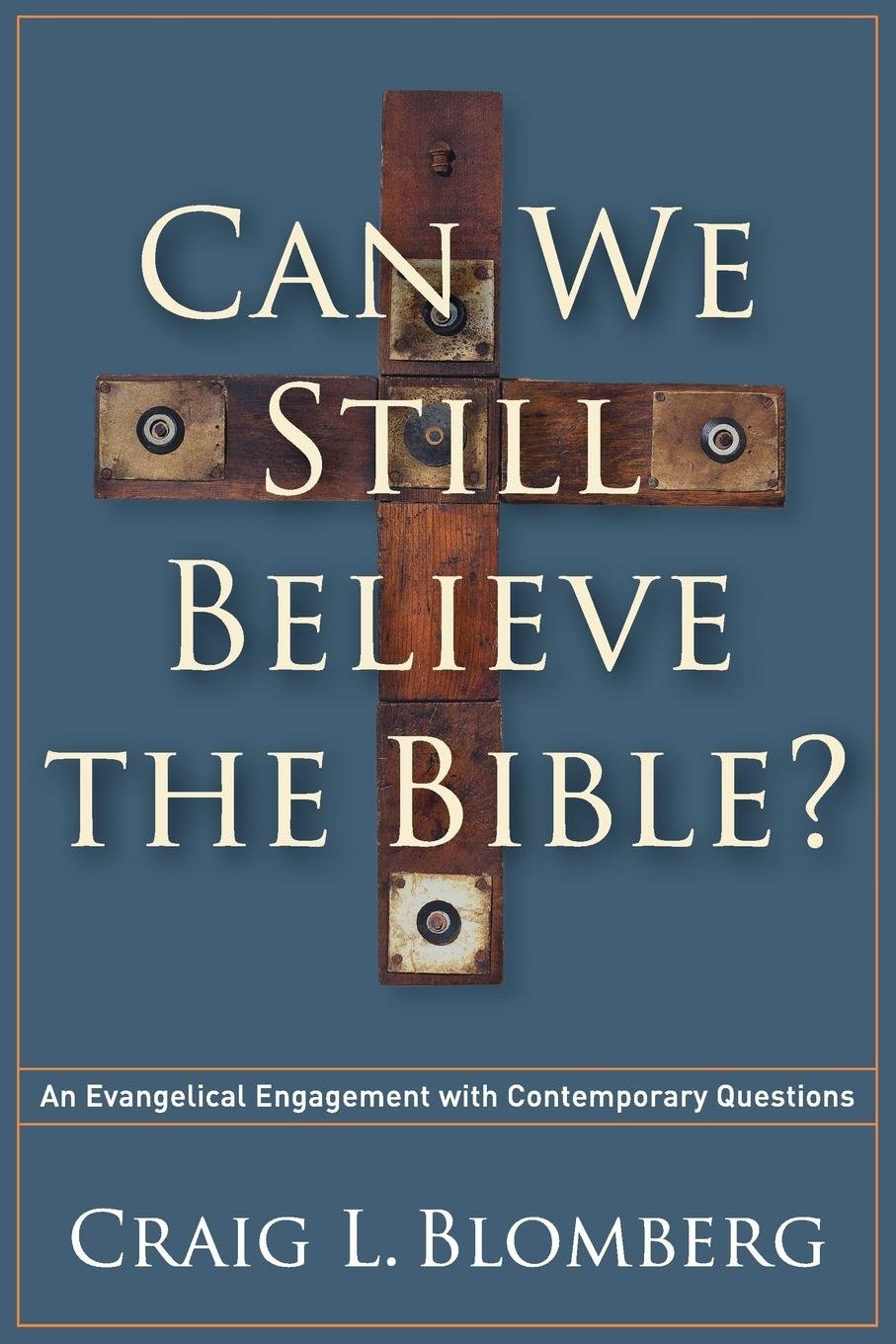
It is within the context of these questions about the Bible that Craig Blomberg’s Can We Still Believe the Bible?: An Evangelical Engagement with Contemporary Questions is a valuable resource for encouraging Christians to have a greater confidence in the Bible, as truly being the reliable Word of God. I bought this book at an apologetics conference five years ago, and I finally made my way through it just recently. In an age where godly, Scriptural discernment and responsible scholarship is sadly lacking in many corners of the church, Blomberg’s work is like a breath of fresh air and clarity, providing sound answers to all of the above questions.

Craig Blomberg is a professor of New Testament at Denver Seminary. For those readers unfamiliar with Blomberg, but perhaps familiar with the more well-known writings of Timothy Keller, it is helpful to know that Craig Blomberg is the “go-to” source for all of Timothy Keller’s research on the reliability of the New Testament documents.

There are a lot of areas where one could focus on the Bible’s trustworthiness, such as the Bible’s relationship to science, or the moral teachings of the Bible. But in Can We Still Believe the Bible?, Craig Blomberg focuses his attention on the six questions highlighted above. The passion out of which Blomberg writes is to defend the Bible against unbelieving critics, who would completely reject the trustworthiness and inerrancy of the Bible. We live in an age of relentless skepticism, and Craig Blomberg suggests that there are still good reasons to believe the Bible. Yet Blomberg finds dangers on the other side, advanced by those who contend for hyper-conservative views of the Bible, mischaracterizing more moderate voices, even to the point of labeling such moderate positions as “liberal” or “compromising.”

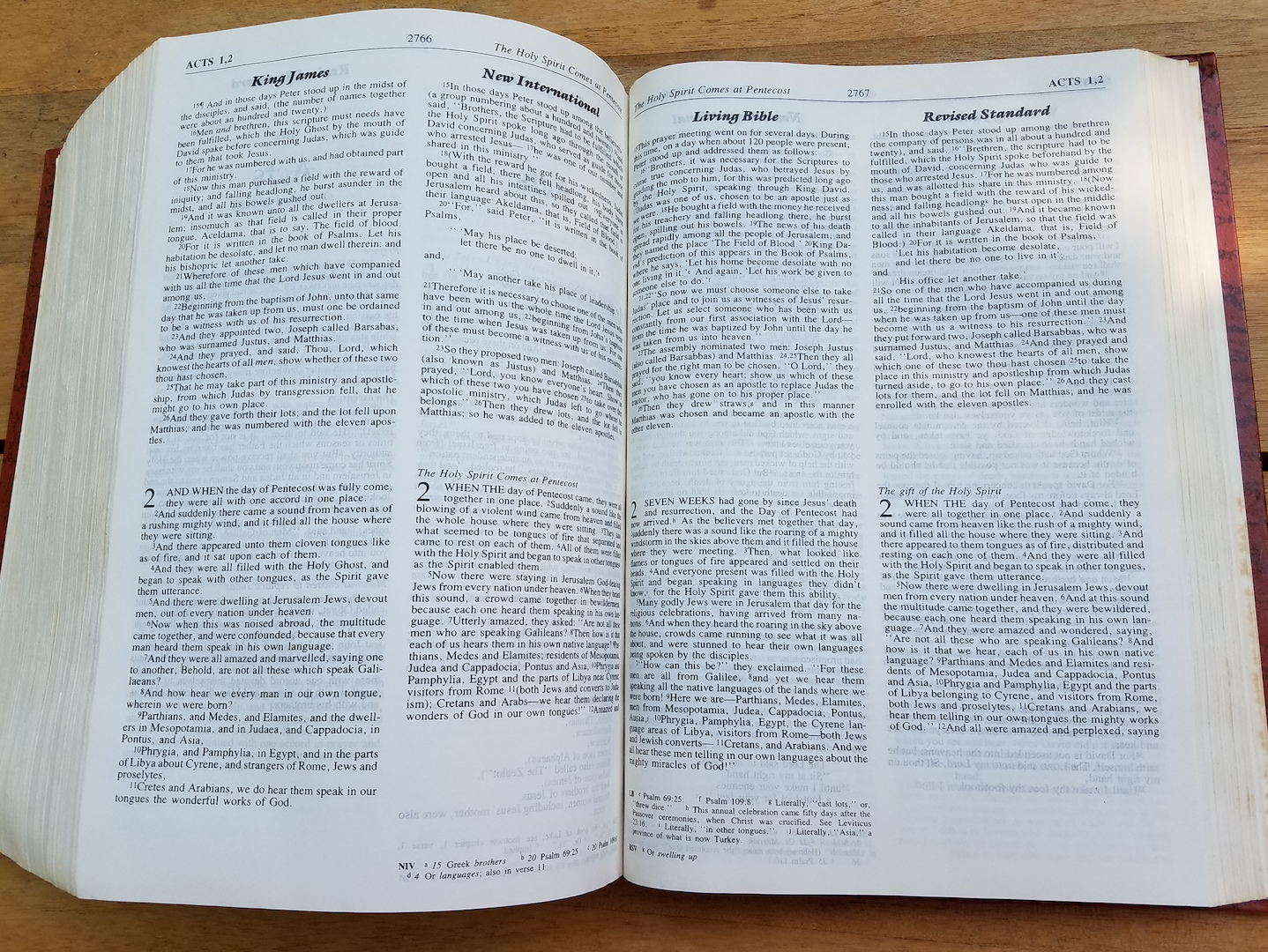
For example, some critics, like the famous agnostic Bart Ehrman, say that the New Testament we have today is made up of copies of copies, of copies, of copies, of copies, of copies, of original documents, that are completely lost to us today. This claim suggests that we simply have no reliable way to get back to the original New Testament documents, with the manuscript data we currently possess, making our degree of confidence in our English Bibles extremely low. Skeptical voices, like Bart Ehrman’s, dominate today’s media outlets, and percolates down to social media. But Blomberg demonstrates that such pessimism about the Bible is not the case. The plethora of New Testament manuscripts, available to scholars today, instead reveals an embarrassment of riches, demonstrating that we really can get back to the original writings, of say, Paul or Luke, with a very high degree of probability.

Likewise, on the hyper-conservative side, many King-James-Only (KJV) advocates strongly assert that modern Bible translations can not be trusted, as they are based on the false premise that the original Greek text, behind the New Testament of the older KJV translation, represents a more recent tradition, as opposed to an earlier tradition of reliable manuscript data. By misrepresenting modern Bible translations, this claim introduces a different form of doubt, in the minds of some Christians, who wonder if they can really trust their modern English translation. While such hyper-conservative arguments may succeed at keeping certain Christians within the KJV-Only fold, they may also trigger the “Manchurian Candidate Effect,” leading other Christians to distrust ALL Bible translations, and waver in their faith.

Again, Blomberg successfully shows how modern translations in no way take away from the fundamental teachings of Christian doctrine, such as the deity of Christ. In other words, if you use the ESV, or English Standard Version of the Bible, it is not the “English Satanic Version” of the Bible, as so many KJV-Only proponents claim. But rather, it is the result of years of faithful research into understanding how God has preserved the essential reliability of His Word, across the centuries.

Appreciating the Diversity of Literary Genre in the Bible

Perhaps the most contentious area that Blomberg addresses concerns the question of whether or not certain biblical narratives are historical. But Blomberg discusses the use of how different literary genres are employed throughout Scripture, even within otherwise primarily historical narratives, such as the Gospels. In particular, Blomberg argues that the trustworthiness of Scripture needs to be defined within the standards of antiquity, when the text was actually written, as opposed to arbitrarily imposing contemporary, 21st century standards upon the text.

Most Christian know that the parables told by Jesus are fictional in nature. Jesus actually, historically told these parables, but the parables themselves appeal to metaphor, and not observable history, to make their theological points. But are there other cases, where a mixture of literary genre exists within an otherwise historical narrative?

For example, is the story of the Rich Man and Lazarus, in Luke 16:19-31, to be considered as purely historical narrative? Since this is the only story told by Jesus, whereby Jesus gives names to the main characters, Lazarus and Abraham, in describing the afterlife, some contend that Jesus is describing a historical event, assuming a type of human eyewitness perspective. In other words, advocates of this view believe that Lazarus was a real, historical person who died, sometime before Jesus told this story to his followers, and Jesus is describing Lazarus’s experience in the afterlife, with the Rich Man, from the eye-witness perspective of sometime living in that afterlife world.

But since this story follows immediately after Jesus is telling his disciples three unambiguous parables, that are understood to be fictional, it is overwhelmingly likely that the Rich Man and Lazarus story is also a fictional account, designed to teach profound theological truth, just as the parables are designed to do.

Does the type of literary genre being used here by Luke in any way compromise the doctrine of biblical inerrancy? Craig Blomberg makes the most persuasive case that the answer is surely, “NO.” These are matters having to deal with the correct means of biblical interpretation, and they do not impinge on the trustworthiness of Scripture itself. Blomberg defends a more nuanced approach to the inerrancy of the Bible, that allows for scholars to hone in on a more accurate interpretation of the Scriptural data, without any compromise of inerrancy itself.

As a corollary to Blomberg’s discussion about genre, one might wonder if the story of Jonah and the big fish should be understood as a specific historical event. The great Oxford don, C.S. Lewis, had his doubts, as expressed in a letter to Corbin Carnell, dated April 4, 1953:

“….the question about Jonah and the great fish
does not turn simply on intrinsic probability. The point is that the whole
Book of Jonah has to me the air of being a moral romance, a quite different
kind of thing from, say, the account of King David or the New Testament
narratives, not pegged, like them, into any historical situation.”

C.S. Lewis, who is hailed as a hero by most evangelical Protestants today, undoubtedly did not embrace a strict definition of biblical inerrancy. Ironically, Lewis therefore would not be allowed to teach at many evangelical theological institutions today, that revere him so highly, partly because of his view of Jonah.

Yet perhaps the story of Jonah is indeed an historical narrative, but with a few metaphorical elements mixed in. Perhaps the metaphorical imagery of the great fish describes the calamity of Jonah’s being thrown overboard, and his miraculous survival, as opposed to asserting something like a massive whale shark, capable of supplying Jonah a ready supply of oxygen, for Jonah’s three day and three night underwater journey. Perhaps the great fish was a metaphor for Sheol, the realm of the dead, and the story of being vomited out upon the seashore testifies to how God rescued Jonah from death.

Craig Blomberg would not want to rule out the use of the fish as a fictional metaphor here, as an interpretive possibility. Jesus did attest to the story of Jonah and the big fish. But Jesus also used parables, which were clearly fiction, to teach essential theological truth.

Blomberg’s suggestion does not imply a flat-out skepticism of the miracles in the Bible, as a whole. Far from it. If one accepts the testimony of Jesus’ resurrection as an historical, bodily event, as one must to be a truly Bible-believing Christian, then that paves the way open to accepting any miracle story in the Bible as historical event, at least in principle. If we really are talking a great, non-metaphorical fish swallowing Jonah whole, then we need to be prepared to accept it. But it need not conflict with the possibility of God using something like the fish story, as a metaphorical image instead, to convey God’s Truth. The trustworthiness of various stories in the Bible need not be rejected, simply because we assume a particular way of reading, that would be alien to the intended literary purposes of the writer.

Interpretive decisions, regarding how one should read particular texts as metaphorical or non-metaphorical, must be made on a passage by passage basis, paying careful attention to the particular literary genre, and other elements of literary context. This is a nuanced, evidentially informed, sensible, and wise approach to the Bible. Blomberg’s work is balanced, a good example of how evangelical Bible scholarship has improved over the recent decades, avoiding the pitfalls of liberal critical scholars, who undermine the Bible’s authority, as well as hyper-conservative defenses of the Bible, that often invite ridicule. I wish I had something like Craig Blomberg’s book in my hands, when I was a 1980s college student, struggling with difficult questions about my faith, particularly regarding issues like biblical inerrancy.

When Christians are presented with challenges to their faith in Jesus, and their trust in the Bible, by antagonistic critics of Christianity, it obviously can be disturbing to those who feel like they are not prepared to defend their faith. But it can be even more disconcerting when otherwise well-intentioned “defenders” of the faith, misrepresent the views of other Christians, who also believe the Bible, but who nevertheless find themselves being the object of scorn by supposedly fellow Christians. It often feels like living through the backstory of The Manchurian Candidate.

Can We Still Believe the Bible? is not an exhaustive look at the issues about the Bible, as the Bible is indeed a big book, and scholars continue to pour their lives into the faithful study of what God is continually revealing to His church, about the plans and purposes of God. But Blomberg’s fantastic work, while being a bit technical for the average, casual reader, is an incredibly helpful resource for those who study the Bible with the utmost seriousness and intensity, who nevertheless find themselves asking good, honest questions about Scripture’s reliability. Craig Blomberg presents enough case studies in his research to make a profoundly compelling case that, yes, we can still believe the Bible. He effectively steers a middle course, between an unbridled skepticism and an overzealous, anti-intellectualism. Blomberg’s work has received enthusiastic reviews, from some evangelicalism’s top scholars, such as Michael Kruger, and Dan Wallace. For those who are concerned about whether the Bible can still be trusted, I heartedly recommend this work by Craig Blomberg.

Craig Blomberg wrote a followup to Can We Still Believe the Bible?, which focuses in greater detail on apologetic concerns within the New Testament. The Historical Reliability of the New Testament: Countering the Challenges to Evangelical Christian Beliefs (B&h Studies in Christian Apologetics) is on my “to-be-read” list, as it taps into Blomberg’s particular focus area of scholarship, the New Testament.

Can we still believe the Bible? In walking away from my reading of Craig Blomberg, the answer is clearly, “YES!”

The following is a 2016 lecture Dr. Blomberg gave at Cornell University, covering the main themes of Can We Still Believe the Bible?:


Discipleship Candy

The Promise and the Blessing

The Promise and the Blessing: a Historical Survey of the Old and New Testaments, by Michael A. Harbin

One of the really cool benefits of writing a blog like Veracity is all the backdoor sharing. People are constantly bringing things to our attention or sharing some thought, question or resource from their devotional lives.

This week I feel like a kid in a candy store. One of Marion’s coworkers loaned me her copy of The Promise and the Blessing: A Historical Survey of the Old and New Testaments, by Dr. Michael A. Harbin. I haven’t been able to put it down.

Dr. Harbin’s text is used in Old and New Testament ‘survey’ courses in colleges and seminaries. What makes it special is that it ties all the biblical text to the timeline of Judeo-Christian history while maintaining a brisk flow from Genesis to Revelation. The pieces are thoroughly connected. It’s packed full of illustrations and references and has no qualms about taking the reader off on interesting tangents with sidebars. Theological topics are introduced and adequately summarized, with fair treatment given to opposing doctrinal views.

One of my litmus tests for any resource is how much fresh and useful information it contains. I can’t seem to turn anywhere in this text that I don’t get new information or have the parts of the Bible presented in a fresh light.

Normally I advocate electronic versions of books, particularly when they can be accessed in the cloud with tools like Kindle Cloud Reader. Kindle puts all of my books in a library that I can access with any device, including my iPad, iPhone, and computer. The upshot of reading this way is that you can highlight and bookmark the text, and search it electronically. It makes books very portable and eliminates the need to flip through pages manually trying to find some passage you barely remember.

However…The Promise and the Blessing is such a beautifully composited book I recommend buying the hardcopy version, which you can do for minimal expense by clicking here. If you’d like to preview the book before you buy it, here is a link to the Browse Inside page.

Enjoy!


HT: Liz Marshall