
So, when we say that Jesus was Jewish, just how Jewish was he?
For most Christians, realizing that Jesus was Jewish is a no-brainer. But the above question is actually not as easy to answer than one would think. Like many other Christians, I have greatly enjoyed the popular film series, The Chosen. Nevertheless, for fans of The Chosen, the better answer to the question might cause you to rethink how accurately the film portrays the Jewishness of Jesus and his world.
We often bring assumptions to the table about who Jesus was that often reflects our own cultural understanding of who we think Jesus should be. However, when reading Matthew Thiessen’s most excellent Jesus and the Forces of Death, I learned just how short-sighted I was in appreciating Jesus as a first century Jew. Thiessen, the author of his also excellent The Jewish Paul, reviewed here also on Veracity, looked at the Jewishness of Paul. Theissen does the same thing with the Jesus of the Gospels, in Jesus and the Forces of Death.
A New Testament scholar at McMaster University, Matthew Thiessen focuses on how Jesus, as portrayed in the Gospels, understood the teachings in the Book of Leviticus, with respect to ritual impurity. Much like Daniel Boyarin’s The Jewish Gospels: The Story of the Jewish Christ and Michael Heiser’s Notes on Leviticus: from the Naked Bible Podcast, reviewed as well here on Veracity (Boyarin, Heiser), respectively, Jesus and the Forces of Death demonstrates convincingly that Jesus was thoroughly a first century Jew, who took the ancient Israelite regulations regarding ritual impurity seriously, contrary to what many scholars and lay persons believe about Jesus.
The eye opening thesis of Thiessen’s book is that he writes about skin disease, bodily discharges, nocturnal emissions, and corpses in a way you have never thought about before, but that makes a whole lot of sense, by diving deep into topics one would normally like to avoid in casual conversation. Simply put, ritual impurity for the first century Jew was about the forces of death. When Jesus as the Messiah came along, his mission had a lot to do with addressing ritual impurity, and combating those forces which lead to death.
Reading Jesus and the Forces of the Death has helped me to think about what is going on in Dallas Jenkins’ popular film series, The Chosen. For the most part, Jenkins’ does a fairly good job laying out the concept of Jewish ritual impurity, and its significance for the story of the Gospels. Nevertheless, even though The Chosen gets many things right about ritual impurity in Jesus’ day, the film series does drop the ball by going a bit over the top in a few other scenes, as will be explained below.1
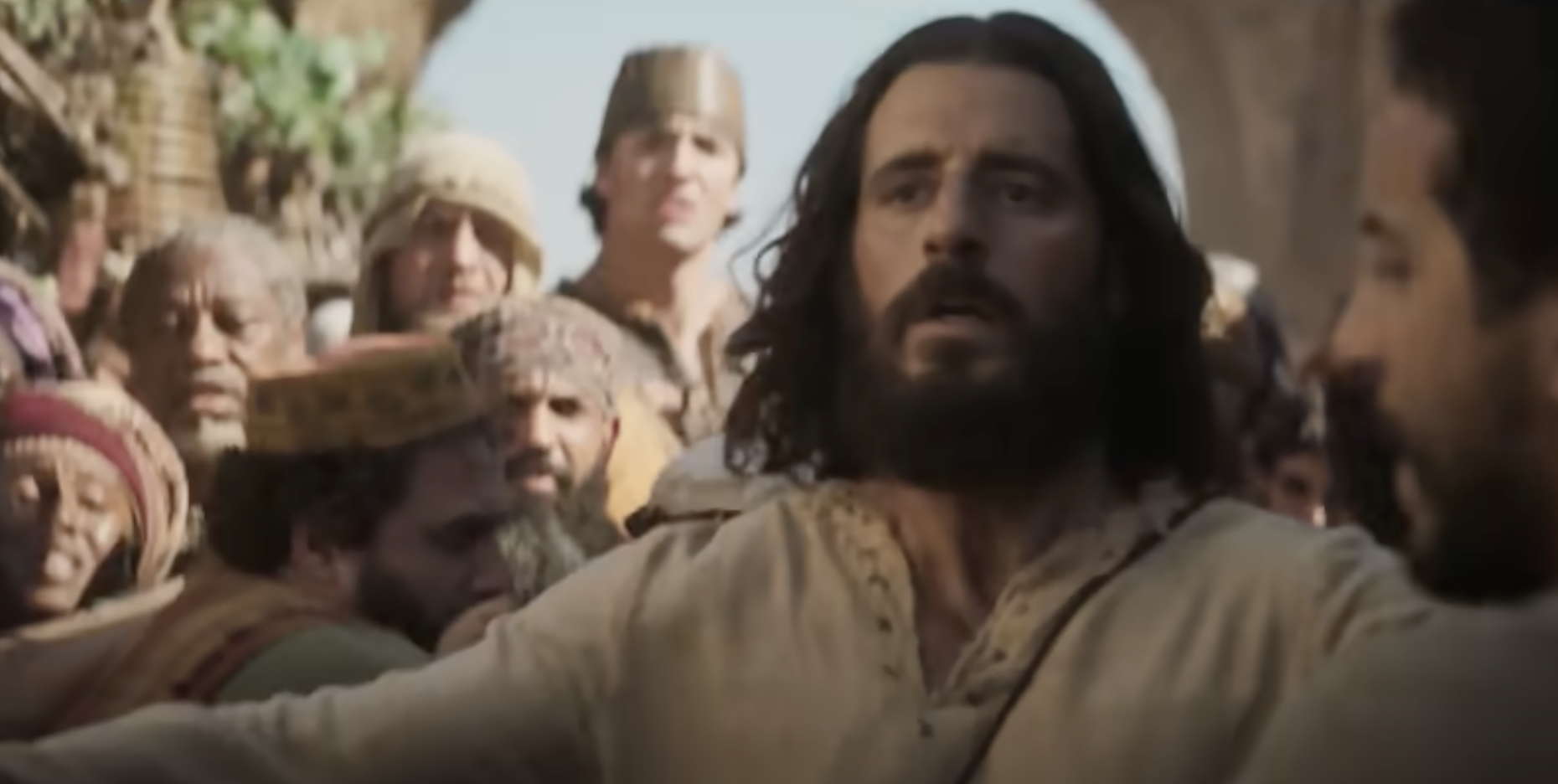
Jesus knew the power had gone out from him, when the woman with the 12-year issue of blood touched the fringe of his garment, one of the most moving moments in Dallas Jenkins’ film series, The Chosen.
Was Jesus “Compassionate” Towards the Leper, or Was He “Angry” With Him?
Here is one area where the concept of Jewish ritual impurity can explain a tricky part of the Bible: I first learned almost twenty years ago from a Bart Ehrman interview, covering his New York Times best selling book, Misquoting Jesus, that there is a textual variant in Mark 1:41, where Jesus says that he was either “angry” or “moved with pity” when he encountered a man, a leper, who asked if Jesus would desire to make him clean.
Translations differ on which variant to use. Both the ESV and NRSVue go with “moved with pity,” while the CSB has “moved with compassion.” Here is how the ESV puts it:
Moved with pity, he stretched out his hand and touched him and said to him, “I will; be clean.”
Other translations go with some word close to “angry,” such as “indignant” with the NET and NIV translations. The CEB goes with “incensed“:
Incensed, Jesus reached out his hand, touched him, and said, “I do want to. Be clean.”
So, which is it? Was Jesus moved by pity and compassion, or was Jesus incensed and angry? Ehrman, perhaps the world’s best known critic of conservative evangelical faith, simply observes that there is a serious discrepancy in how we should read this text. Does this indicate some kind of error in the Bible, as Ehrman insinuates? Yet Ehrman offers no reasoning as to why such variants might exist.
When I first learned about this, I mentally filed it away, curious to know what was going on here. Was Bart Ehrman right? Does this indicate an error in the Bible?
My first instinct has been to say that the ESV got this right, that Jesus was moved by compassion to heal this man. But why do other translations talk about Jesus being angry? Matthew Thiessen’s analysis solves the riddle as to why some early New Testament manuscripts have Jesus getting “angry” instead of “moved with pity” in Mark 1:41. It all goes back to how Christians have often misunderstood ritual impurity, something which Ehrman never explains in Misquoting Jesus.
Many have suggested that Jesus rejected the ancient Jewish ritual impurity system, during his earthly ministry, prior to his death and resurrection. The thought suggests that the whole system, with its supposedly rigid quarantine rules for those with leprosy, was something to which Jesus was completely opposed. Like the kosher food laws, circumcision, etc., Jesus was opposed to such superstitious things and he wanted to do away with them. Perhaps this might explain the textual variant in Mark 1:41 explaining why Jesus was “angry,” right? He was angry that his fellow Jews were making such a big deal about ritual impurity.
However, Thiessen demonstrates that this reasoning is wrong. Instead, Jesus wanted to affirm the ritual impurity system, while simultaneously addressing the conditions which lead to ritual impurity in the first place. As Thiessen shows, ritual impurity is regarded by Jesus as a real condition, but that being in a state of ritual impurity does not indicate that a person is in “sin” when someone is in that state of ritual impurity. For Jesus, as for any other first century Jew, ritual impurity was a real thing. But ritual impurity is not the same thing as moral impurity, in which the latter is “sin,” in classic Christian theology.2
Furthermore, our English translations have confused readers by suggesting that the condition of “leprosy” is primarily a medical condition, whereas what is really going on is a case of ritual impurity. We often think that to be a “leper” is to have the condition of Hansen’s disease, which is a serious medical condition, but such an association is misleading. For example, Leviticus 13 describes the Greek word “lepra” as having to do with having white, flaky skin. However, with Hansen’s disease, commonly called “leprosy,” the lesions are rarely if ever white. In fact, what we commonly think of as “leprosy,” as in Hansen’s disease, was unknown during the time of Leviticus, and did not show up in the Middle East for hundreds of years later (Thiessen, chapter 3, pp. 46-47).
In Jesus’ day, what we think of today as “leprosy” was actually called in Greek, “elephantiasis.” It was not until the late 8th or early 9th century when John of Damascus mistakenly identified “elephantiasis” with the “lepra” in Greek translations of Leviticus. John of Damascus’ error has been with us ever since (Thiessen, chapter 3, pp. 46-47).
Instead, to be a “leper” is to have “lepra,” a generic skin condition which is indeed physical but that represents being in a state of ritual impurity; that is, being “unclean,” and therefore unfit to enter into sacred space. To be in an “unclean” state would prevent the Jewish worshipper from going into the Jerusalem Temple to make an offering before the Lord. Thiessen argues that the “lepra” skin disease is instead a relatively minor medical condition, something more like scurvy, eczema, or psoriasis (Theissen, p. 48).
Nevertheless, someone in a state of ritual impurity due to lepra was expected to maintain some distance from others, as ritual impurity was thought to be contagious. Those with lepra were expected to stay outside of the community, at least for a period of time, though Jews in the Second Temple period debated with one another on the exact period of time this should be. The concern was that someone with lepra might unwittingly contaminate something holy, like sacred food, so different measures were take to prevent that. However, permanent cases of quarantine due to lepra were rare (Thiessen, pp. 48 ff).
Remember all of this the next time you go back and watch Season One of The Chosen, when Jesus heals the leper, from Matthew 8:1-4. As in Mark 1, the leper comes to Jesus in an “unclean” or ritually impure state. While there is some legitimate concern about the contagion of ritual impurity, the scene from the film series needlessly takes the conflict up several notches. One of Jesus’ disciples covers his mouth, while another even pulls out a knife and threatens the leper not to come any closer. You would think that the leper was infected with something like ebola.
The healing performed by Jesus is quite moving, and gives me goosebumps. But if Matthew Theissen was watching the scene with you, he would probably shake his head in embarrassment over the excessive freakout by Jesus’ disciples when the man first comes near to them. You would not want to trivialize the situation, but would you ever react this fanatically if someone approached you having a really bad case of dandruff?
Alas, Mark’s version of the story, if indeed this is identical to the episode in Matthew 8, has a more nuanced message behind it. The issue in Mark 1:41 is not about Jesus pronouncing judgment against the ritual impurity system. In fact, Jesus’ position is actually the opposite. He wants to affirm the integrity of the Jewish law. Afterall, Jesus came not to abolish the law, but rather to fulfill it (Matthew 5:17). This is why Jesus “sternly” (ESV) in Mark 1:43 warns the man with lepra, after Jesus heals him: “See that you say nothing to anyone, but go, show yourself to the priest and offer for your cleansing what Moses commanded, for a proof to them” (Mark 1:44).
However, the man who was healed disobeyed Jesus and spread the news about his healing. This prevented Jesus from openly entering any town, forcing Jesus to stay out in desolate places, where people came to him (Mark 1:45). Mark wants to portray Jesus as being compliant to the ancient Jewish ritual impurity system taught in Leviticus, which is why he urged the man with lepra to go to the priest and fulfill the legal requirements commanded by Moses.
Thiessen shows that what was at issue was the man’s questioning of Jesus’ desire to heal him. The man had confidence that Jesus could heal him, but he questioned Jesus’ desire: Would Jesus really want to heal him?
This is what stirred up Jesus’ indignation. Of course Jesus wanted to heal him! In a sense, while the “angry” reference is probably more likely, both readings are correct, in that Jesus was upset with the man questioning Jesus’ desire to heal, while also having compassion on those who are burdened by being in extended states of ritual impurity. Jesus wants people to follow through with the procedures described in the Law of Moses, while at the same time, dealing with that which leads people into states of ritual impurity to begin with. In this way, Jesus’ mission is to combat against the forces which lead to death.
Jesus wanted the healed man to fulfill the ritual obligation of going to the priest, to verify that the healed man was actually now healed, to show the religious authorities that Jesus himself had the power to address the root cause of how people ended up in states of being unclean. “Jesus destroys the impurity-creating condition, allowing the man to now observe the regulations of Leviticus 14 in removing the remaining ritual impurity” (Thiessen, chapter 3, p. 56). In other words, Jesus was not opposed to the ancient Jewish system which dealt with the existence of ritual impurity, based on its myriad of regulations and procedures to treat it. But he was opposed to ritual impurity itself. Instead of wanting to get rid of the Jewish ritual impurity system, which was right and good in Jesus’ view, he wanted to get rid of the need for the system by destroying the source of ritual impurity, the forces which lead to death in the first place.
If that last statement does not fire up your brain cells, then you need to go back and read that story told in Mark 1:40-45, preferably in multiple translations, and let it sink in. Each chapter in the main body of Thiessen’s book gives examples of where Jesus wants to destroy the source of ritual impurities, without suggesting that Jesus wanted to abolish the Jewish ritual impurity system as Jesus and his fellow Jews sought to practice.
Rethinking A Tendency Towards Anti-Jewish Ways of Reading the Bible
Thiessen wants to overturn an idea that has made its way into Christian thought, both at the scholarly and lay level. Too often, Jesus has been portrayed in positive ways at odds with the supposedly negative ways of his fellow Jews in Jesus’ day. For example, many believe that the Jews in Jesus’ day treated women as completely second-class citizens, whereas Jesus was a fully enlightened, egalitarian thinking person who lifted women up, thereby shaming traditional Jewish misogyny. For another example, Jesus was all about caring, compassion, and grace, whereas the Jews were all legalistic, works-righteousness oriented, without any thought or appreciation of God’s grace. For yet another example, Jesus was all about sensibility and freedom from silly taboos, whereas the Jews were superstitious, and obsessed with stupid rules about cleanliness versus uncleanliness. As Jewish bible scholar Amy-Jill Levine has put it, too often we have tried to make Jesus look good by making Jews look bad.
The ritual purity system itself, far from being silly and overly burdensome, was actually God’s compassionate system for enabling ancient Israelties to deal with their conditions of ritual impurity. Being in a state of ritual impurity, such as when one comes in contact with a dead corpse, was not sinful. The only time someone in a state of ritual impurity would cross the line over to becoming sinful was when someone in that state of untreated ritual impurity tried to enter into God’s sacred space, in the tabernacle/temple. The ritual impurity system described most fully in the book of Leviticus was designed as a compassionate way for a Yahweh worshipper to deal with their impurity, thereby enabling them to enter into sacred space, and have communion with a holy God.
The most important and fundamental chapter of Jesus and the Forces of Death, is chapter one, “Mapping Jesus’ World,” something that the reader should absolutely not skip. Leviticus 10:10 teaches that there is a matrix in Jewish thought that defines the ancient Jewish impurity system.
You are to distinguish between the holy and the common, and between the unclean and the clean (ESV).
Theissen describes this as two binaries: the first binary is the “holy” versus that which is “profane.” That which is holy is God’s sacred space. It is set apart by God, whether it be a particular place or places, or a person, or persons. That which is not holy is profane. The ESV translates the word profane as “common,” which gives the word a different angle, in that we often assume that what is profane is either dirty, impure, or sinful. But this is misleading. The word “common,” in contrast to that which is holy, is an acceptable word to use, which avoids any negative connotation. All things are either holy or profane, but most of the world is profane. Thiessen’s example is the Sabbath, whereby six days are profane (or common) and the seventh day is holy. In the Jewish mindset, there is nothing bad about Sunday through Friday. But Saturday is different, as it is holy. To be “holy” is to be set apart. To be “holy” is not about being better than that which is profane, or morally superior than that which is profane or common.
The second binary is that which is pure versus that which is impure. One could also translate this as that which is clean versus that which is unclean. But pure and holy are not synonyms, and neither are impure and profane synonyms. Furthermore, while being pure is the preferred category, to be impure (or unclean) could be either a result of sin, as moral impurity, or it could simply be something that is part of the normal course of everyday life, as in ritual impurity. In other words, not all impurity is a result of sin, whereas some impurity is connected to sin.
Through this matrix found in Leviticus, an Israelite person could be in either one of four states:
- Holy and Pure
- Holy and Impure
- Profane and Pure
- Profane and Impure
In order to enter sacred space, or that which is holy, one must be in a state of purity. Where things get dangerous, and even lethal, is when someone tries to enter that which is holy in a state of impurity. To try to enter God’s sacred holy space, while carrying some kind of impurity is to put your life at risk. The case of Nadab and Abihu in Leviticus 10 and their offer of “strange fire” was such an event which led to their deaths. Thiessen maps out this matrix based largely on the work of the Jewish biblical scholar, Jacob Milgrom.
However, it can be easy to confuse ritual impurity with moral impurity, Thiessen draws on the work of Jonathan Klawans in order to define the differences:
Ritual impurity is….
- … unavoidable
- … from a natural substance
- … communicable
- … something which can be bathed away
- … not an abomination
- … not sinful
Moral impurity is….
- … avoidable
- … from an action
- … noncommunicable
- … something which either can atoned for or which leads to punishment
- … an abomination
- … sinful
But while there is a distinction between ritual and moral impurity, the line can get blurred. If someone fails to follow the prescribed Levitical method and timing for dealing with ritual impurity, it could become sinful; that is, ritual impurity becomes moral impurity.
The Baptism of Jesus and Rituals of Purification
Have you ever considered why Jesus was baptized by John the Baptist?
While Thiessen does not come out with a definitive answer to this question, this matrix of holy vs. profane and pure vs. impure raises provocative questions which might lead to a sensible answer. For we often associate baptism with the forgiveness of sins. But if Jesus is without sin, why would he need to undergo baptism in order to remove non-existent sin?
However, as Thiessen points out in chapter 2 of his book, the rite of baptism for purification was a central part of life at the community of Qumran, where the Dead Sea Scrolls were found. Purification was not simply about the removal of moral impurity, but it was also about the removal of ritual impurity, which is inherently not sinful, unless someone tried to bring that ritual impurity into that which is holy; that is, sacred space. Is it possible that Jesus’ baptism was not about the removal of moral impurity, or sin, but rather was about ritual impurity? Was this part of Jesus’ way of affirming the principle of the Jewish impurity ritual system?
Some scholars, such as the eminent 20th century Roman Catholic Raymond Brown, have suggested that Luke was in error when in Luke 2:22 he describes the holy family going to the temple in Jerusalem shortly after Jesus’ birth for “their purification,” with the “their” being a plural referent, and not singular. For Brown, this conflicts with Leviticus 12:2-4, which describes the need for purification for the mother alone, after the birth of a child.
Thiessen in his chapter 2 shows that early Christian scribes who copied Luke wrestled with this tension as well. Whereas most of our earliest manuscripts have “their,” some copyists simply deleted the word “their,” thereby leaving the text saying something like: “And when the time came for [pronoun omitted] purification according to the Law of Moses, they brought him up to Jerusalem to present him to the Lord.” This would avoid the theological complication which might suggest that the baby Jesus somehow had some kind of need for purification. Still other copyists only complicated the issue by inserting a masculine pronoun, as “his purification.” Does this suggest that the need for purification was for Jesus’ father, Joseph, or for Jesus himself?
Nevertheless, Thiessen makes the case that Luke did not make a mistake. The holy family did go to the temple for “their purification,” and this actually affirms the idea that Luke, along with Jesus, was approving of the validity of the Jewish impurity system. This might suggest that indeed the baby Jesus underwent purification, but that this purification was for Jesus’ ritual impurity, and not any kind of moral impurity. Secondarily, Thiessen shows that some Second Temple Jews, as one would find in the Book of Jubilees, actually understood Leviticus as saying that when a mother becomes ritually impure through the childbirth that the child might also become ritually impure as well. In such a case, both Mary and Jesus underwent ritual purification at the temple.
The point is of interest for several reasons. First, it indicates that Luke did not commit an error here, thereby affirming the integrity of the Gospel text in its inspiration and inerrancy. Second, it shows that Luke, assuming he was the Gentile author of the text, was familiar with the particularities of the Jewish ritual impurity system, something one would not necessarily expect from a Gentile convert to Christianity. Far from being a “mistake,” thus requiring some tortured harmonization to resolve the supposed discrepancy, Luke did what he did on purpose.
Jesus Deals with Ritual Impurity Regarding Bodily Fluids
Matthew Thiessen is not afraid of addressing Jesus’ interaction with people who have become ritually impure, due to natural situations involving bodily fluids. Mark 5:25-34, paralleled in other places like Luke 8:42-48, deals with an extreme case whereby one woman would repeatedly experience a discharge of blood for twelve years. Thiessen gives the reader the Old Testament background for why this woman was considered ritually impure, but he rejects the arguments of other scholars who say that Jesus’ healing of this woman was a demonstration by Jesus of his rejection of the entire Jewish ritual impurity system.
For example, Thiessen sees that Leviticus 15 in no way instructs that a woman in this hemorrhaging condition should be sequestered in strict quarantine. Instead, she is only forbidden from entering sacred space, that which is holy; that is, “the tabernacle or temple apparatus” (Thiessen, p. 72). This is a good bit different from how the popular understanding of this story is generally interpreted, among both scholars and lay persons alike.
The popular film series, The Chosen, in Season 3, features an emotionally powerful, dramatized reenactment of the episode from Jesus’ ministry. The woman with the issue of blood is essentially ostracized from society, forced to effectively live outside of populated areas. When she hears that Jesus is making his way through town, the woman takes a social risk and pursues Jesus. However, several people try to stop her, horrified that this unclean woman would appear in public like this. Yet she desperately reaches out through the crowds to touch the hem of Jesus’ garment, and through her faith she is instantly healed. I get goosebumps every time I watch this scene:
While the overall framing of the narrative is faithful to Scripture, the characterization of the Jewish ritual impurity system is woefully over-the-top to a New Testament scholar like Matthew Thiessen. Part of the problem is that the “unclean,” or ritually impure status of the woman is regarded as though it was morally sinful, which according to Leviticus is not the case. Even today, without a temple, practicing Jews mostly view themselves as existing most of the time in a state of ritual impurity. But this does not suggest an implicit moral judgment. Yes, there were concerns about the woman’s ritual impurity being contagious, but it need not suggest that the woman would have been treated as being such a pariah by her fellow Jews as she is portrayed early on in this scene from the film, and other previous scenes including her in The Chosen.
While it is true that Jesus is said to have healed this woman, the main point that the Gospel authors want to communicate is that Jesus has the power to destroy the forces of death. For when the woman reaches out to touch Jesus’ garment, the text tells us that “power had gone out from him” (Mark 5:30).
Thiessen goes on and says that because of this woman’s near perpetual state of ritual impurity due to her medical condition, it would not have been possible for her to have children. The woman’s healing probably also made her fertile again. “The woman who has had a dead womb for twelve years is dead no longer; she is now able to have children” (Thiessen, p. 83).
This power that uncontrollably comes out from Jesus shows that Jesus’ body contains “some sort of contagious holiness” (Thiessen, p. 84). Instead of the contagion of ritual impurity being extended to Jesus, the exact opposite happens, thereby healing the woman. The power of Jesus reverses the contagion and attacks the source of the ritual impurity. Thiessen concludes: “Jesus does not intend to destroy the ritual purity system; rather, his body naturally destroys the source of ritual impurities” (Thiessen, p. 85).
Corpses and Ritual Impurity
Touching a corpse in ancient Judaism was fairly unique in that it led to a kind of ritual impurity, even if a person does not touch a dead person. All you needed to be was in the same room as the dead person, and that made you unclean for a seven-day period (Numbers 19:14-16).
As in other chapters of Thiessen’s book, his chapter on corpse ritual impurity goes into detail about how other cultures surrounding ancient Israel viewed corpse ritual impurity as well. Again, coming in contact with a dead person, either through touching or mere physical presence in the same room, was not sinful. But it did create a state of ritual impurity. During the Second Temple period of Judaism, even a woman who suffered a miscarriage would become ritually impure.
During the years of Jesus’ youth, Herod Antipas built a city on the shore of the Sea of Galilee, named after the emperor Tiberius. But he had a difficult time convincing Jews to live there, as the city was built on a graveyard. To live on a graveyard puts you in a state of ritual impurity, requiring a seven-day purification ritual before traveling to the Jerusalem temple for worship. Why go through that hassle? (Thiessen, chapter 5, pp. 104-105).
When Jesus goes to heal the daughter of Jairus (Mark 5), the girl is dead before Jesus even gets there. In order to enter the dead girl’s room, Jesus enters into a state of ritual impurity. Again, there is nothing which suggests that this ritually impure state involved any sin of any kind. But what is different about Jesus is that he heals the daughter, and she is brought back to life. While the physical miracle itself is impressive, it is more than that. Instead of showing disdain for the ritual impurity system, Jesus accepts the validity of it. Furthermore, Jesus’ healing actually reverses the flow of ritual impurity. The little girl has the source of death removed from her.
“The girl’s body has been separated from the source of her impurity—death. This revivification is both miraculous and previously unimagined in priestly laws pertaining to corpse impurity” (Theissen, chapter 5, p. 105).
Likewise, at the moment of Jesus’ death described in Matthew 27:50-53, the corpses of many are brought to life, an episode unique in that Gospel. The point which Matthew is making is that there is something about Jesus which defeats the power of death, reversing the effects of ritual impurity.
“In the death of Jesus, people who had apparently become irreversibly impure in death were raised and therefore set on the path to purity…. And Jesus’s death, the moment when the forces of impurity appeared to overwhelm Jesus himself, results in the holy ones undergoing the first step toward purification while in their tombs and then coming out of these places of impurity in order to enter into the holy city of Jerusalem.” (Thiessen, chapter 5, p. 105-106).
Again, the episode regarding the “raised saints” at the moment of Jesus’ death is not just some random weird event, such that none of the other Gospels simply ignore. Rather, it is something that Matthew does intentionally in order to accentuate and establish Jesus’ character and validate his mission.
One of Luke’s most well known stories is the parable of the Good Samaritan, in Luke 10:25-37. Many often interpret the story as a rebuke against the supposed legalism of the priests and Levites. But according to Matthew Thiessen, Jesus is actually affirming the Jewish system of dealing with ritual impurity, but he is ruling against how the system is to be applied. In verse 30, the beaten man is left “half dead” on the side of the road after being beaten by robbers. But is he really dead? How does one know?
According to Leviticus 21:1-3, a priest or Levite was forbidden to touch a corpse, unless it was the body of a close relative, lest they become ritually impure. But in order to see if a person laying on the side of the road was really dead, they would have to risk becoming ritually impure. So, the priest and Levite avoid the situation. But Jesus is saying that the teaching about loving one’s neighbor, in Leviticus 19:18, takes precedence over Leviticus 21:1-3. Thiessen adds that the compassion of the Samaritan leads to less ritual impurity and not more:3
“In Jesus’s story, a priest or Levite who contracts corpse contamination in order to see whether the man is still alive does so with the result that he either (a) preserves the life of the beaten man and therefore saves the world from one more corpse and its concomitant, never-ending ability to pollute or (b) buries the man’s remains, thereby honoring and loving the dead man, and marks the burial site so that other people do not unwittingly contract corpse contamination. Either scenario inevitably leads to less corpse impurity” (Thiessen, chapter 5, p. 108)
Therefore, instead of dismissing the Levitical anxiety about avoiding ritual impurity, and condemning the ritual impurity system as a whole, Jesus is affirming that the better way of the Samaritan reduces the amount of ritual impurity one has to deal with. In other words, the priest and Levite have wrongly interpreted and applied Levitical law in this case. Remember, there is no sin in becoming ritually impure, but a lack of compassion would be linked to moral impurity, which is sin. Jesus is about removing as much ritual impurity as possible, but he is not against the Jewish ritual impurity system in principle, as some kind of cold-hearted legalism.
The point of Theissen’s detailed examination of Jesus and ritual impurity gained from contact with corpses suggests that Jesus’ exposure to the dead, while leading to his own ritual impurity, nevertheless is not the end of the story. Instead, Jesus’ presence indicates that he had the power to reverse the course of ritual impurity, attacking the very source of those forces which lead to death. “Jesus was a source of holiness that was even more powerful than death itself” (Thiessen, chapter 5, p. 119).
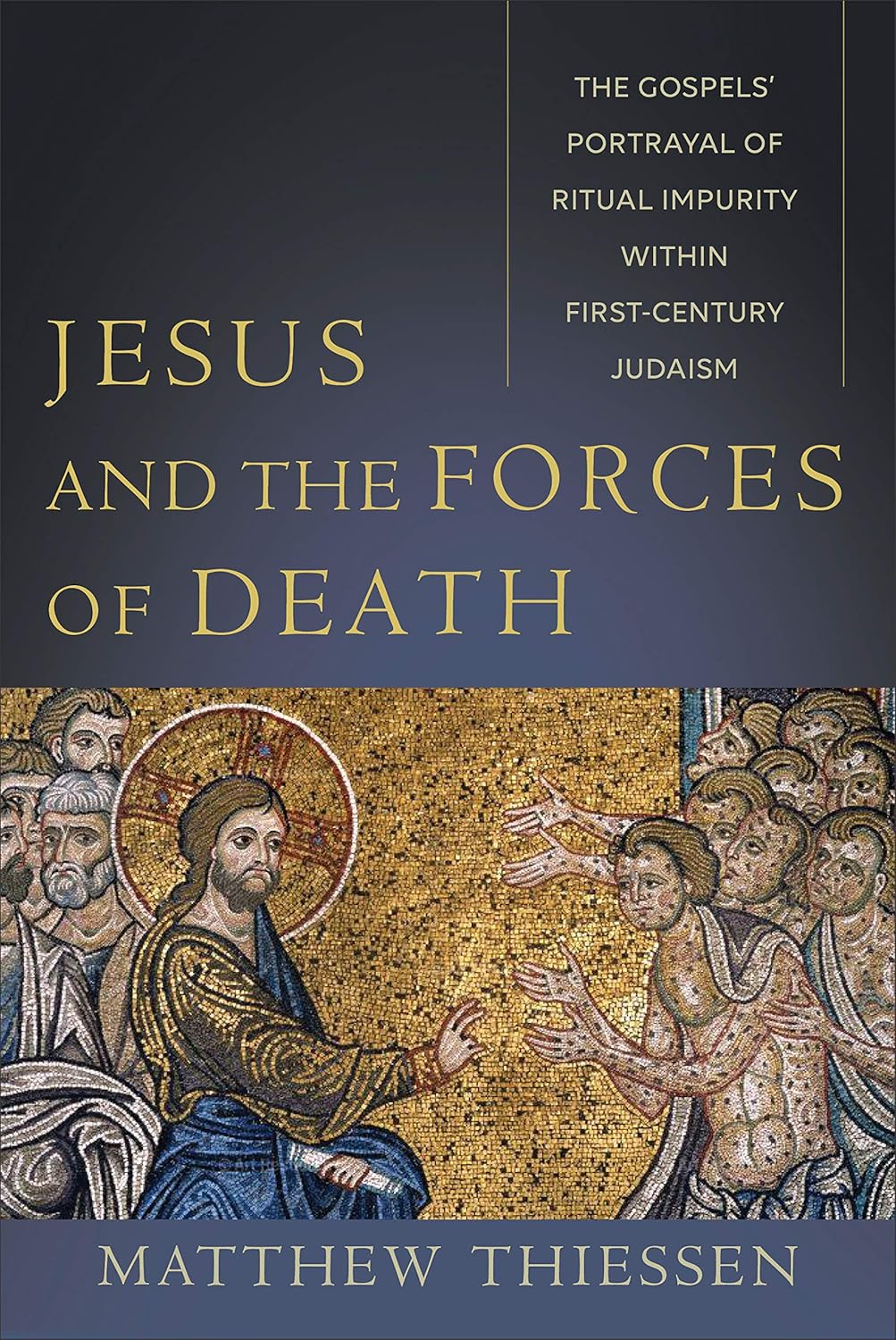
Matthew Thiessen, not to be confused with the Relient K musician, is a biblical scholar who wrote Jesus and the Forces of Death: The Gospel’s Portrayal of Ritual Impurity Within First-Century Judaism
Impure Spirits as Demons
Two chapters towards the end of Jesus and the Forces of Death continues with this idea that Jesus was not against the Jewish system of dealing with ritual impurity, but that Jesus was about destroying the sources which lead to states of ritual impurity in people. In his chapter on “Jesus and Demonic Impurity,” Thiessen argues that the demons which possess people in the Gospels, such as the Gerasene demoniac of Matthew 8:28-34, Mark 5:1-20, and Luke 8:26-39, are actually impure “pneuma“; that is, impure spirits, the Greek word “pneuma” corresponds to the English word “spirit.”
The demons which encounter Jesus are afraid of Jesus, fearing that Jesus has come to destroy them. The first demonic encounter in Mark’s Gospel has the demon saying: “What have you to do with us? Have you come to destroy us?” (Mark 1:24)
One idea that came to mind as I was reading Thiessen is to consider why demonic possession seems relatively less prevalent now, while being a prominent feature in the Gospels. Thiessen cites rabbinic traditions after the New Testament era which suggests that the establishment of God’s tabernacle with Moses expelled demons from the earth. Could it be that Jesus’ power to destroy the forces of death accomplished a great victory through the life, death, and resurrection of Jesus, some 2,000 years ago? Reports of demonic activity have surely not gone away in the modern age. But perhaps the incarnation of the divine Jesus in earthly humanity centuries ago, where God tabernacled among us (John 1:14), resulted in such heightened, dramatic stories of exorcism, a great spiritual showdown, triggered by the arrival of the death defeating power of Jesus in world history.
The coming of Jesus precipitated a great onslaught of demonic activity, spiritual warfare between Jesus and the forces of death. In the end, Jesus’ own death and subsequent resurrection defeated those powers of darkness. We can take courage that any spiritual warfare we experience today means that the death defeating power of Jesus is still present to have victory over those dark powers.
Jesus’ View of the Sabbath: Observe the Sabbath, Except When Other Principles in Jewish Law Take Precedence
In Thiessen’s final chapter on the Sabbath, the author makes the argument that Jesus was not against the Levitical system which taught Jews to honor the Sabbath. Rather, Jesus taught that mercy and charity takes precedence over strict Sabbath observance at certain times, an interpretation of Torah which actually was not unique to the Jewish Jesus.
For example, in the controversy about Jesus’ disciples picking and eating grain on the Sabbath, Thiessen acknowledges that Mark’s version (Mark 2:23-28) makes some assumptions from Mark’s readers, which are not apparent. Matthew’s version (Matthew 12:1-8) fills in the details which Mark omits.
In Matthew, Jesus asks his critics: “Or have you not read in the law that on the Sabbath the priests in the temple profane the Sabbath and yet are blameless?” (Matt. 12:5). This is where Matthew makes explicit that which Mark assumes implicitly. Perhaps what Jesus’ disciples are doing is kind of a temple service, similar to what the priests did in the temple.
Interestingly, Thiessen cites a passage from the Book of Jubilees, a prominent work from Second Temple Judaism, which suggests that there is a type of work, performed by the priests of the Temple, which can be done on the Sabbath. Even in the Mishnah, a product of post-Second Temple Judaism, at least some Jews recognized that temple service trumps Sabbath observance, and that this was well within bounds of a proper interpretation of Levitical law (Thiessen, p. 157).
Nevertheless, Jesus in Matthew states that there is something greater than the temple here (Matthew 12:6). Quoting from the Septuagint version of Hosea 6:6, Jesus in Matthew 12:7 says that God desires mercy, not sacrifice. Not only does temple service trump the Sabbath, so does extending mercy trump temple service. Therefore, mercy trumps the Sabbath. Since Jesus’ disciples were hungry, in need of food, by plucking the grain in order to eat, this meant that Jesus believed extending charity outweighed concerns about the technical requirements for Sabbath observance.
Clearly, not all Jews agreed with Jesus, Jubilees, or the later Mishnah. If anything, this demonstrates that there is no such thing as “the” Jewish interpretation of the Books of Moses. As the common adage today even goes, wherever you find two Jews, you will find three different interpretations. Within the context of Second Temple Judaism, it is better to think of multiple “Judaisms” in Jesus’ day as opposed to some idealistic, monolithic Judaism. Two of the most famous rabbis of the first century BCE, Shammai and Hillel, disagreed on what took priority. Shammai prioritized Sabbath observance over acts of charity and mercy, whereas Hillel aligned with Jesus, prioritizing acts of charity and mercy over the Sabbath (Thiessen, p. 157).
Conflicting interpretations of how to practice Sabbath were simply a part of the “Judaisms” of Jesus’ day, in other areas as well. Regarding warfare, some Jews believed that Jews should not fight on the Sabbath, suggesting that Sabbath observance trumped military engagement. Other Jews believed just that opposite, that Jews were obligated to defend themselves, even if attacked on the Sabbath. Much like the Christian debate today about pacifism, Jews during the Second Temple period were not all of one mind as to what took precedence: military engagement, even in cases of defense, versus strict observance of the Sabbath.
This might upset some Christians who would prefer to see no conflict in the Law of Moses. But the idea that certain Levitical rules outweigh other Levitical rules, in terms of precedence, is difficult to ignore. The primary point is to say that Jesus is not being dismissive about the Sabbath. Rather, Jesus honors the Sabbath, but he does allow for other principles from Levitical law to come into play, and take precedence over Sabbath observance when the situation calls for it.4
Concluding Thoughts
There is some room here to criticize certain aspects of Thiessen’s otherwise wonderful book. Thiessen does a commendable job focusing on his thesis, one that should resonate with Christians across the theological spectrum. He succeeds in his aim to push back against certain anti-Jewish mindsets into the Gospels, which should be a concern for all readers of the Bible. However, there are a few moments where a tendency to simply assert common critical conclusions about the Bible betrays a kind of aversion to a purely historically orthodox Christian perspective, albeit in Thiessen’s modest, toned-down form. For example, Thiessen casually asserts that the Book of Daniel was written in the second-century BCE, without any mention as to why he accepts this date, an assertion which will undoubtedly disturb the minds of those who hold to a more traditional, sixth-century BCE date for Daniel (Thiessen, p. 182).
In another example, Thiessen repeats a skeptical claim famously made by Bart Ehrman, that Mark’s Gospel makes a “mistake” by confusing Abiathar with Ahimelech as the high priest, in Jesus’ retelling of the story of David and his men eating the showbread, recalled in Mark 2:23-28 (Thiessen, p. 153-156). This supposed “mistake” has been answered thoughtfully by British Bible teacher, Andrew Wilson. Mark’s supposed “mistake” that Abiathar was the high priest when David and his men ate the showbread was actually an intentional allusion to the old priestly line represented by Abiathar which went away under Solomon, to make way for a new priesthood. Symbolically, the priests in Jesus’ day had been Abiathar. Yet with the arrival of the Messiah, Jesus is now the new David and Jesus’ disciples are the new priests, a typological allusion in keeping with Thiessen’s thesis. In other words, modern readers might consider Mark to be mistaken. Yet a first century Jewish reader, saturated in the world of the Old Testament, would probably have picked up on Jesus’ allusion and seen his point.5
But as with his other excellent work, The Jewish Paul, these ever-so-slight tips towards controversial critical conclusions about the Bible need not keep the reader from benefiting greatly from Theissen’s overall thesis, and his detailed argumentation. Thiessen’s exegesis is careful and precise, so readers who just want the bottom line might be frustrated with all of that detail, but frankly, I appreciate that sort of thing. Afterall, the author is trying to mount a strong case that Jesus as presented in the Gospels has been terribly misread. To argue that a highly respected scholar such as Raymond Brown could get Jesus seriously wrong at points, is a daunting task. I think Thieseen succeeds.
One thing I do greatly admire about Theissen is that he confesses that getting a purely objective understanding of Jesus and the world of the New Testament is a bit of hubris. He effectively shows that much of both conservative and progressive scholarship over the past many decades has managed to fashion a Jesus that loses sight of his full Jewishness. We all have our biases, which tends to color our conclusions.
Also, I wish Thiessen, in his chapter on the Sabbath, would have done more in understanding the Sabbath’s particular relationship with Levitical law, with respect to the Sabbath’s role in God’s creation purposes. There is indeed a sense in which the Sabbath is tied to temple practices, but we also have the theme of Sabbath established at creation, in Genesis. It is not clear from Thiessen as to how Sabbath is understood by Jesus, with respect to creation. However, my hunch is that whereas Sabbath in Levitical law is highly regulated, Sabbath at creation is more of a general principle without explicit directives associated with it; such as, the Sabbath being tied to a particular day of the week, as opposed to another day.
I have one additional criticism: Thiessen does not really help the reader to understand how Jesus’ teaching and actions with respect to ritual impurity can help the Christian to apply certain lessons regarding ritual impurity today. In other words, gaining a better understanding of how Jesus upheld the legitimacy of the ancient Jewish ritual impurity system, while opposing the sources of ritual impurity itself, does help us to read Scripture better. But how does it actually impact our ability to apply Jesus’ teaching to our lives today? This is particularly important in view of the historical fact that the Jewish temple, which was “ground zero” for Torah observance, was destroyed in 70 CE. Judaism had to basically reinvent itself, re-envisioning how to deal with ritual impurity now in a world without a temple. What is the significance of ritual impurity today, for the Christian?
I would argue that it is primarily the Apostle Paul who helps us out here. As the designated apostle to the Gentiles, Paul is placed in a position where he articulates his Gospel, which enables the inclusion of those Gentiles who believe Jesus to be the promised Messiah, without requiring those Gentiles to embrace the full standard of Jewish impurity regulations. This would not be because Paul was somehow dismissive of the Levitical impurity system either. Like Jesus, Paul saw that the Levitical prescriptions for dealing with ritual impurity were actually good things. Nevertheless, the question I am left with is how Christians today should think about ritual impurity, if at all, in terms of living the Christian life.6
Yet as the late Michael Heiser has argued, Paul in our New Testament gives us the fullest expression of a new definition of sacred space, expanding the territory of the holy with respect to the profane. No longer is the temple in Jerusalem the primary entity which marks out sacred space. Now it is the church, those Jews and Gentiles who believe in Jesus. Heiser argues that the Greek term hagios, often translated as “saints” in the translations like the ESV, in places like Colossians 1:2, is better translated as God’s “holy ones.” The saints of God, members of Christ’s body, the church, are actually the “holy ones.” Through progressive revelation, the people of God, all of those who believe in Jesus, Jew or Gentile, have become “holy ones.”
One might add that Jesus was not concerned about becoming ritually impure himself. Rather, he had the power to overcome the source of ritual impurity, and reverse its ill effects. Furthermore, the same Holy Spirit that dwells in Jesus is the same Spirit who dwells in us as believers in Jesus, and empowers the church for ministry, to destroy the forces of death. We should be like Jesus in working towards that which also destroys the forces of death.
Again, to be “holy” is not primarily about being without sin, though it still indicates that moral impurity is something that Christians still need to fight against. It does suggest that part of the Gospel message is that God is taking that which is profane and supernaturally making it holy, an idea which totally reframes the whole of the ancient Jewish ritual impurity system. Perhaps Matthew Thiessen will write yet another book which fleshes this idea out a bit more. In the meantime, Jesus and the Forces of Death is a great way to start thinking about how Jesus’ mission was about destroying the forces which lead to death.
Notes:
1. A good example from the The Chosen film series can be found in the recent Season Five, Episode Two, when Jesus and the disciples are in Jerusalem for the Passover, at the beginning of what we now consider to be Holy Week. In one scene, John the Son of Zebedee joins his father to present anointing oils to the house of the High Priest. Malchus, a servant to the High Priest, greets the Zebedees and says that in order to deliver the oils, they need to say to an older religious leader that they have not done anything that might render them ritually impure. John’s father is allowed to step forward, but John himself is turned away. Presumably, John is turned away due to some form of ritual impurity. In the next scene, John discusses with Malchus what led to John being in a state of ritual impurity. John confesses that it was contact with “leprosy” that did it, and Malchus says he also did the same; that is, made contact with “leprosy.” But is this what really happened? The laugh that John and Malchus have together is punctuated by Malchus saying that the “old men” are “punishing us young men for having bodies.” I did not catch it the first time, but it is apparent that John (and Malchus) became ritually impure due to experiencing nocturnal emissions. Director Dallas Jenkins admits that this unspoken, comical moment is indeed about a bodily discharge experienced by these young men, thus making them ritually impure.
↩
2. I highly recommend that Veracity readers go back and carefully read the reviews of both Daniel Boyarin and Michael Heiser’s books for more background. Such background is also covered in greater detail in Matthew Thiessen’s book, which primarily focuses on Jesus’ approach to questions of ritual impurity.↩
3. In a 2021 YouTube interview with the author, Matthew Thiessen argues that Jewish study of the Torah recognizes that sometimes the application of specific Levitical regulations would at times come in conflict with one another. Jewish Torah meditation, both ancient and modern, have been concerned about which Levitical instructions should take precedence over others when there is conflict.↩
4. I might add that Thiessen includes an appendix which echoes the argument made by Daniel Boyarin, in his The Jewish Gospels, reviewed here on Veracity. In Boyarin’s book, Boyarin contends that most translations of Mark 7:19 are often mistranslated as that Jesus “declared all foods clean.” This mistranslation suggests that Jesus abrogated the kosher food laws. Thiessen makes the same case as Boyarin, that Jesus kept kosher.↩
5. See Veracity article on the Abiathar/Ahimelech controversy as explained by Andrew Wilson, which avoids ad-hoc harmonization advocated by some well-meaning Christians. As to the Book of Daniel, I hope to write a blog post some day with an alternatively explanation for the dating of the Book of Daniel. ↩
6. In a 2021 YouTube interview with the author, Matthew Thiessen cites the work of other scholars who argue that ritual impurity does not apply for Gentiles, according to the Hebrew Scriptures. Ritual impurity only had to deal with the tabernacle/temple system, and so, without a temple, the entire schema behind ritual impurity needs to be rethought. Many Jews today are simply content to live within the reality that they are in a state of ritual purity perpetually without a temple. Nevertheless, Gentiles visiting the temple area were only allowed into the Court of the Gentiles, in the Jerusalem temple built by Herod when it stood, but that court was not technically part of the temple. Other cultures contemporaneous with ancient Judaism had their own concepts of ritual impurity, but they did not exactly correspond with Jewish ways of thought. Thiessen’s bottom line is that ritual impurity is something that Christians today no longer need to think about in terms of practicing their own faith. In another interview on the Mere Orthodoxy podcast, Thiessen argues that for the most part, the Apostle Paul does not think that concerns of ritual impurity are relevant for Gentile believers. But there are some exceptions, where certain notions of ritual impurity thinking still matter. For example, Gentile Christians are warned in 1 Corinthians 11:17-34 not to partake of the Lord’s supper in an unworthy manner. For when Christians do such a thing they reap judgment upon themselves, explaining why some Christians have gotten sick and even died. ↩




 Veracity