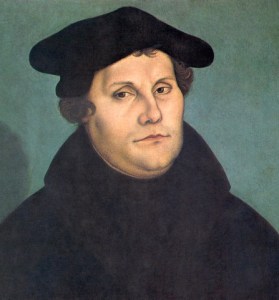
Martin Luther (1483-1546), by Cranach. Zealous champion of the Gospel, but with a horrific personal flaw (credit: Wikipedia)
“To forget the victims means to kill them a second time. So I couldn’t prevent the first death. I surely must be capable of saving them from a second death. “
“Antisemitism”, commonly understood to be the discrimination against the Jewish people, has never, ever been approved doctrine by any orthodox branch of the Christian church. After all, Jesus Himself was Jewish.
However, there have been a number of very terrible instances when antisemitic sentiment found itself promoted by a supposedly “Christianized” culture, and even supported by some practicing and prominent Christians themselves. As we continue this blog series on Christian Zionism, we take a closer look at one of the greatest tragedies in Christian history, stemming back to the famous Protestant reformer, Martin Luther. Continue reading
Martin Luther nails his Ninety-Five Theses to the Wittenberg church door on All Hallows Eve, 1517. Most people associate October 31st with Halloween, but students of church history know this as “Reformation Day”
Like any kid growing up in an American secularized society, I liked the whole Halloween thing. I have a serious weakness for chocolate, so I always looked forward to going door to door to see how many chocolate treats I could get. Sure, there were horror stories about people sneaking razor blades into mini-candy bars, but I was willing to take the risk. As I got a little older, I would try to terrify the neighborhood kids by playing Pink Floyd’s Echoes album through my bedroom speakers out the window as costumed figures approached our house.
Okay. I stopped that pretty quick when my mother learned about it and reprimanded me for making a few of the little kids cry.
When I began to take my spiritual journey with Jesus Christ seriously in high school, I began to hear other types of horror stories about Halloween from my new church friends. There were tales about its connection to Satanism at worst, or perhaps just only a milder, yet just as bad, connection to Wiccan, Druid and other forms of pagan religions… and those “dreadful” Harry Potter books.
I began to see a shift in evangelical churches away from celebrating “All Hallows Eve” towards things like having “Harvest Parties” or “Fall Festivals.” Well, I can surely appreciate the effort to shift the focus, but I am not so sure how successful it has been.
Instead, I think if we really want to shift the focus away from the negative aspects of Halloween, then we should instead take a page or two from church history. On October 31st, 1517, Martin Luther approached the door of the Wittenberg church with a list of his Ninety-Five Theses regarding abuses in the Roman church. What he nailed to the door of that church that day has forever changed the face of Western Christianity… and the whole world!
Martin Luther had kicked started the Protestant Reformation, a movement that resulted in perhaps the greatest revival of spiritual vitality and love for the Scriptures that the world has ever seen. But Martin Luther’s Reformation belongs not just to Protestants. It belongs to the whole Christian church. Even those Roman Catholics who murmured about Luther must admit that change was necessary to correct some serious problems. It was through the efforts of people like Martin Luther that the Bible came to the common people in their native tongue, a privilege that most Christians today simply take for granted. It was also through the turmoil of the Reformation that made the Western world into what it is today, providing the intellectual and cultural incubator for the growth of modern science and capitalism. So even if someone is not a Christian, Luther’s Reformation has made an incredible impact upon world history.
So, instead of getting all flustered about those trick or treaters coming to our doors to unwittingly fan the flames of pagan traditions, let us as believers consider a completely different approach, encouraging people to remember this day in world history, where one man with a hammer in hand and a powerful set of ideas birthed in Scripture changed the world.
“This is my Body… This is my Blood.” Matthew 26:26-28. Literal or symbolic interpretation?
Zwingli, with tears in his eyes, extended the hand of fellowship, but Martin Luther steadfastly refused: “Yours is a different spirit from ours“. Luther walked out. The split was final. The unity of the Protestant Reformation movement was in tatters.
Marburg, Germany. 1529. Martin Luther’s attempt to reform the Roman Catholic church and restore confidence in the Bible “alone” was in full swing. Years earlier, he had nailed his famous 95 theses to the Wittenburg church door, protesting abuses within the church. Four hundred miles away, in Zurich, Switzerland, a young renegade priest, Huldrich Zwingli, was beginning to do the same thing Luther had started in Germany. Both Luther and Zwingli felt that the Church of Rome had lost its way. Christianity needed to return to the Holy Scriptures as the pure, unadulterated Word of God. The medieval church had allowed man’s traditions to creep in and compromise the truth of the Gospel. Luther and Zwingli were hoping to stand together against what they saw as the corruption within the Roman church. Continue reading






 Veracity