
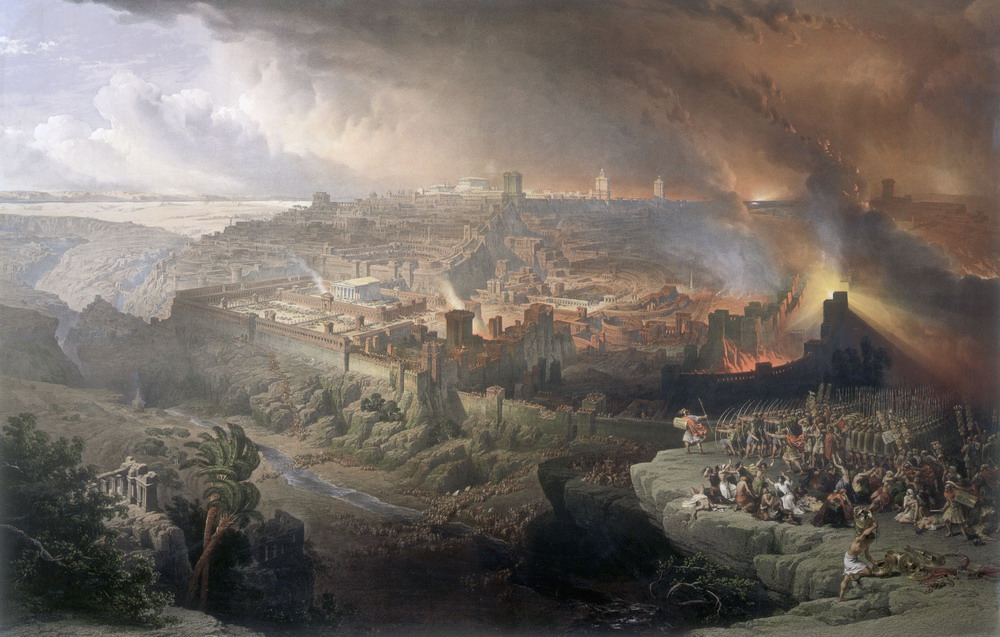
The Roman army under Titus destroyed Jerusalem and its Temple, by the year 70 AD. Does this catastrophic event in the first century offer any insight into understanding the “Seventy Weeks” prophecy found in Daniel 9:24-27?
(a painting by David Roberts, 1796-1849).
Up to this point in this series ( post #1, post #2), we have been exploring the dispensationalist approach to the “Seventy Weeks” of Daniel 9:24-27. Let us jump into the text again, first:
“Seventy weeks are decreed about your people and your holy city, to finish the transgression, to put an end to sin, and to atone for iniquity, to bring in everlasting righteousness, to seal both vision and prophet, and to anoint a most holy place. Know therefore and understand that from the going out of the word to restore and build Jerusalem to the coming of an anointed one, a prince, there shall be seven weeks. Then for sixty-two weeks it shall be built again with squares and moat, but in a troubled time. And after the sixty-two weeks, an anointed one shall be cut off and shall have nothing. And the people of the prince who is to come shall destroy the city and the sanctuary. Its end shall come with a flood, and to the end there shall be war. Desolations are decreed. And he shall make a strong covenant with many for one week, and for half of the week he shall put an end to sacrifice and offering. And on the wing of abominations shall come one who makes desolate, until the decreed end is poured out on the desolator” (Daniel 9:24-27 ESV).
So, is the dispensationalist reading of this passage the best way to understand the text?
Let us explore some of the issues in this blog post. Different Bible interpreters over the years have looked at Daniel 9 in very different ways. When you examine each approach, you learn that there are some ambiguities in the text that force the interpreter to make some assumptions as to how a particular ambiguity in the text might be resolved.
So, what are these ambiguities? Have you ever heard of Hank Hanegraaff, known in radio-land as the “Bible Answer Man?” Continue reading





 Veracity