
The Crusades. Racism. Slavery. Sexual abuse scandals….among Christian leaders, and even in contemporary Christian music (… the Newsboys???) .
The history of Christianity often gets a bad rap in the culture these days. Is it possible to be honest about Christians behaving badly over the centuries, without becoming cynical about it?
In recent decades, a lot of apologies have been coming forth about Christians not acting much like Christians. Back in 1992, the Vatican apologized for the mistreatment of Galileo, admitting that Galileo was right and the church was wrong. In 2015, President Barack Obama acknowledged that during the Crusades, “people committed terrible deeds in the name of Christ.” In the year 2020, we heard all about the horrific legacy of slavery and racism in America, and its links to Christianity, particularly of the fundamentalist variety.
Such apologies have been lauded for their honesty, but have cast serious doubt on the integrity of Christianity. This has led many to believe that the Christian church has done more harm than good in the world. So, is it time to ditch the Christian faith for something better? Or is there more to the story?
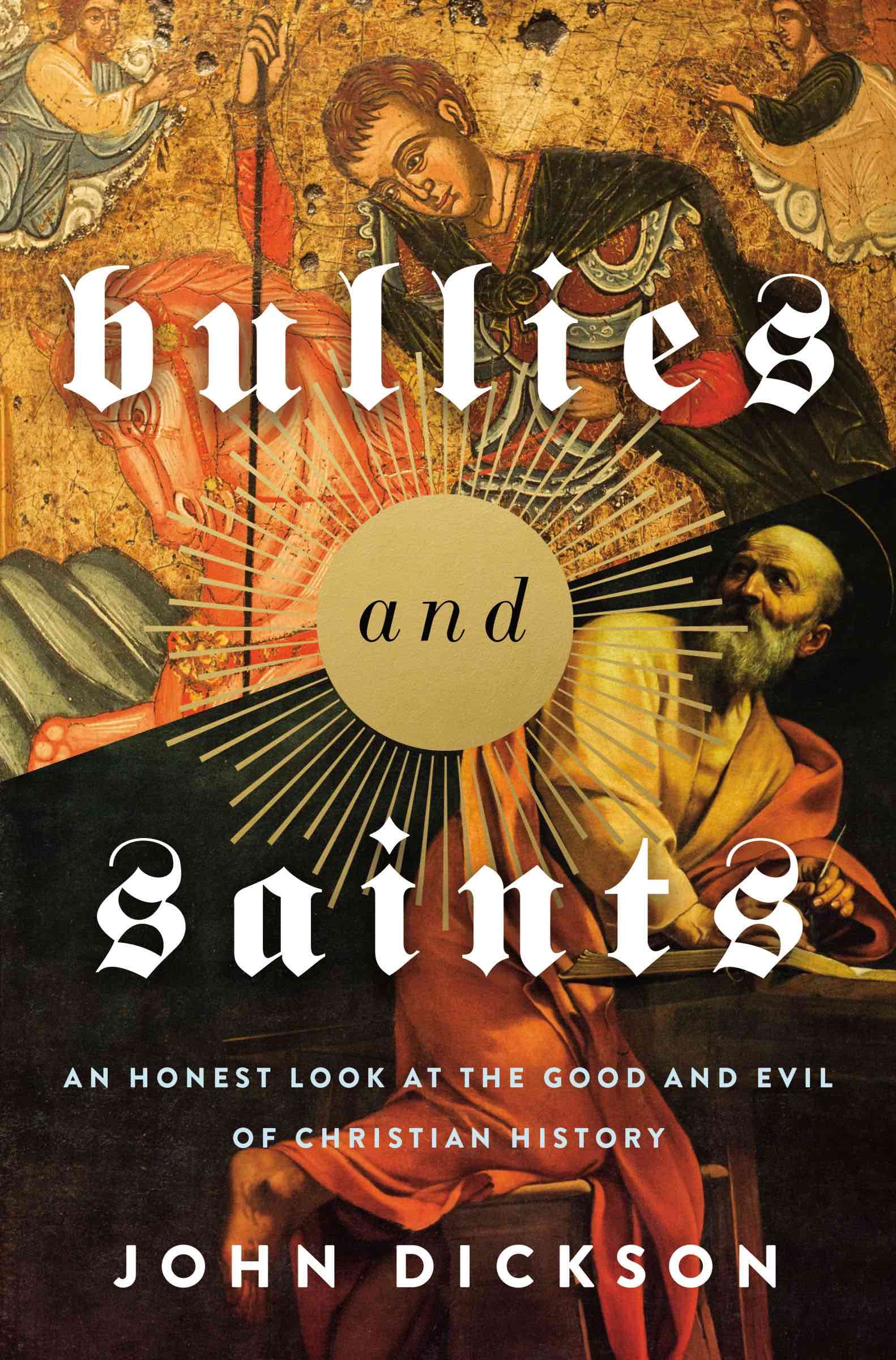
Bullies and Saints: An Honest Look at the Good and Evil of Christian History, by John Dickson, looks at both the good and bad side of church history.
Dealing with “Church Hurt”
I recently finished reading Bullies and Saints: An Honest Look at the Good and Evil of Christian History, by John Dickson, host of Australia’s number one religion podcast, Undeceptions. Dickson has been known in Australia for producing several documentaries about church history, a lot of it about the darker side of Christian history.
In Bullies and Saints, Dickson takes a hard look about both the good side and the darker side of church history. Some have objected that the exposure of that darker side is like airing someone’s dirty laundry. How unpleasant can that be?
In response, John Dickson takes a balanced approach. Whenever Dickson faces the challenge that he is focused too much on the negative, his response is that one of the first things that Jesus taught his disciples is that “they should be willing to admit their own failure to love, their own moral bankruptcy” (Dickson, p. 37). Citing Jesus’ sermon on the mount, we hear Jesus’ saying “Blessed are the poor in spirit.”
The vocation of the Christian is to be a prophetic voice, to call out the existence of injustice in our world. But as Jesus taught in that same sermon, “Why do you see the speck in your neighbor’s eye, but do not notice the log in your own eye?” Christians really have no right to call out sin in the world around them until Christians are willing to call out sin in their own lives.
There is a lot of “church hurt,” experienced by people who have spent time in a Christian church, only to walk away from the experience with a bad taste in their mouth. But as John Dickson argues, an instrumentalist may play a musical piece written by Beethoven poorly, leaving the audience disappointed. But the fault for such a bad performance is not the fault of Beethoven. It is the fault of the poorly trained instrumentalist instead.
Likewise, simply because Christians fail to live up to standards set by Jesus Christ, this does not mean that Christianity as defined by Jesus is faulty, or untrue. Rather, it means that such Christians are at fault, either due to their own ignorance, or a failure to understand what being a Christian is all about. The wisdom of G.K. Chesterton is appropriate: “The Christian ideal has not been tried and found wanting. It has been found difficult; and left untried.”
Christians behaving badly need not require that Jesus himself and his message be rejected. In fact, the opposite is the case. The existence of bullies in the church confirms Jesus’ own teachings, and that what Jesus said and did was and indeed is still true. This is the bottomline message in John Dickson’s Bullies and Saints, and he makes an historically responsible case for it. Bullies and Saints is a fantastic, enjoyable, and learned book, a one-stop shop for a balanced look at the good and bad parts of church history across the centuries.
(As an aside, I also consulted John Dickson’s work a good bit in the Veracity complementarian/egalitarian controversy “women in ministry” series, particularly in my review of Kevin DeYoung’s Men and Women in the Church. Spoiler alert: I think John Dickson is mostly right, and has the better end of the argument than does Kevin DeYoung… but that is quite another topic)
A Balanced Approach to Bullies and Saints in Church History
In Bullies and Saints, we learn about the bullying tactics sadly on display by those who have taken up the name of Christ. A few anecdotes are worth reporting.
During the Crusades, church leaders, including one of the most revered and saintly, Bernard of Clairvaux, encouraged knights and others who marched off to defeat the Turks. Bernard wrote a letter around 1145 to some of his followers, promising that such military efforts were to be viewed as a kind of spiritual pilgrimage, an act of penance to blur out and erase one’s own sins: “…Where it is glory to conquer and gain to die. Take the sign of the cross, and you shall gain pardon for every sin that you confess with a contrite heart” (quoted in Dickson, p. 10).
On the other hand, in Bullies and Saints we also learn about some very positive contributions to society in church history. Emperor Constantine is often described as a villain who wedded the Christian church to state power, thereby corrupting the church in the process. Yet Constantine, the Roman emperor who first granted toleration to Christianity with the Edict of Milan in the early 4th century, also passed a legal ruling to make divorce more difficult, one of the first efforts in human history to promote women’s rights.
In Roman history before Constantine, divorce laws put women at a distinct disadvantage. In that culture, a woman’s family was required to bring a dowry, whether that be a sum of money or other material wealth, to a marriage. But if the marriage was abruptly cut off by the husband, the wife would often be left in a state of significant financial loss. Based on Christian teaching that God created both man and woman in the image of God, Constantine ruled that if a husband divorced his wife on trivial grounds:
….he must restore her entire dowry, and he shall not marry another woman. But if he should do this [i.e., marry another woman after divorcing on trivial grounds], his former wife shall be given the right to enter and seize his home by force and to transfer to herself the entire dowry of his later wife in recompense for the outrage inflicted upon her” (quoted in Dickson, p. 75).
Think about it. A 4th century Roman emperor is saying stuff that mirrors the 21st century #MeToo movement. That surely made an unfaithful husband think twice before “shacking up” with another woman. Pagan Roman society before Christianity came along offered very little defensive support of women taken advantage of by undisciplined men.
Constantine also passed an early version of legal code outlawing the abandonment of infants. In pre-Christian Roman society, it was perfectly legal and moral to leave a baby abandoned if the family did not want the baby, subjecting the helpless child to certain death, unless someone else wandered along to either rescue the child, or to be picked up by a child trafficker (Dickson, p. 75).
Score yet again another point in favor of the influence of Christianity. It balances out the common negative narrative popularized on the Internet today.
Church History is a Complicated, Mixed Bag: A 5th Century Version of the 2020 “George Floyd” Riots
John Dickson corrects a number of misunderstandings about church history, such as the following example. This is a bit of a rabbit trail, but I found it all fascinating, and why you can not always trust popular revisionist history.
Similar to the George Floyd riots in the summer of 2020, Christians rioted in the city of Alexandria, Egypt, in the early 5th century. The 2020 death of George Floyd triggered riots across the United States, encouraging thousands to vent their frustrations after being subject for months to social-distancing restrictions in the wake of the COVID-19 pandemic.
Spurred on by social media algorithms designed to get more clicks, the riots spread across the world, leading to the dismantling of statues honoring leaders of the 19th century southern Confederacy, while also inspiring calls to take down statues of venerable modern heroes, like that of Jefferson and Washington in the U.S., and of Winston Churchill in London, the British statesman who stood up against Hitler’s Nazi Germany. Even a statue of Captain James Cook, the English sailor who “discovered” the eastern seaboard of Australia in the 18th century, needed a police guard established in John Dickson’s native Australia (Dickson, p. 118).
Likewise, when the Christians rioted in Alexandria, Egypt, less than a few decades after Christianity was declared the official religion of the Roman Empire, the violence that erupted left its mark upon history. Knowing at least something about church history, I had always thought of Cyril of Alexandria, the bishop in that city at the time, as a great Christian hero, despite some theological controversy along the way. Cyril was engaged in an important dispute with a bishop at Constantinople, Nestorius, that the average Protestant evangelical Christian knows nothing about. (If you do not know who Nestorius was, just consider the idea that the Christian movement that he led eventually brought the Christian faith into faraway places, like China, hundreds of years before the Protestant missionary movement. Supporters of Nestorius today say that Cyril of Alexandria misunderstood Nestorius). Though Cyril’s ideas received further tweaking, Cyril campaigned against his opponents in favor of the theological concept of Jesus having both a divine nature and a human nature, united together.
Jesus is both God and man, at the same time, though the details of this union of natures remain a mystery. Cyril’s campaign helped to pave the way to the Council of Chalcedon in 451, which affirmed the full divinity and the full humanity of Jesus Christ, which the vast majority of Christians continue to affirm to this day.
The history of Christianity would have been quite different without Cyril of Alexandria, especially regarding the Incarnation, a core Christian doctrine most believers in the 21st century take for granted. Cyril is regarded as a saint in both Roman Catholic and Eastern Orthodox communions. But Cyril’s legacy is actually quite complicated, something I knew very little about before reading Bullies and Saints.
Many critics of Christianity blame Cyril for inspiring a mob to attack and murder one of the greatest philosophers of the day, a woman named Hypatia, a leading advocate for reason and science. Such critics cast Cyril as an anti-intellectual zealot, who promoted hatred against science and against women. Unfortunately, such criticism has been mainstreamed into popular history story-telling in contemporary Western culture.
This narrative about Cyril of Alexandria has been promoted by both Edward Gibbons in his 1776 The Decline and Fall of the Roman Empire, and more recently, the world-renowned scientist Carl Sagan in his widely-acclaimed 1981 PBS documentary Cosmos. As a PBS fan back in the 1980s, I took in the message of Cosmos as pure “gospel truth,” though I remember little about the television program now. But there is more to the story, including details that Sagan failed to tell his television viewers, viewers like me.
Yes, a mob who looked up to Cyril did murder Hypatia. But what is often overlooked is that the reason for the attack had little to do with hatred of philosophy, the fact that Hypatia was a woman, or even issues directly related to Christianity. Political and socio-economic factors played a much larger role.
John Dickson and the sources he uses fill in the gaps of the common narrative: Tensions between Jews and Christians in Alexandria had become very intense in Cyril’s Egypt. Relations between Jews and pagans in Alexandria were arguably just as bad, if not worse, and had been that way for several centuries before Cyril.
Pogroms led by Alexandrian pagans against the city’s Jewish population resulted in perhaps thousands of deaths, as early as a decade after Jesus’ death. The Christian movement had barely got off of the ground at that point. Mistrust of the pagan elites by the relatively poorer Jewish community was inevitable, in the intervening centuries. Yet as time moved on and Christianity eventually eclipsed paganism in political influence in Alexandria, with many former pagans becoming Christians, much of that same hostility from the Jewish community was now redirected towards the new Christian elite.
Bishop Cyril came to believe that the current governor of Alexandria, ironically a baptized Christian named Orestes, had sided against the Christians in favor of the Jews in that city. Orestes had ordered an outspoken Christian to be tortured, resulting from a public dispute this man had with the Jews.
The influential bishop Cyril resented Orestes’ actions. Orestes appealed to Hypatia, a pagan philosopher respected by both pagans and Christians, in order to find a peaceful solution to a crisis that was spiraling out of control. But some of Cyril’s supporters from the lower classes got out of hand and rioted, confronting Hypatia themselves. The confrontation escalated, and the philosopher was killed. The Christian rioters had thought that the pagan Hypatia was aligned with the Christian Orestes, in favor of the Jews against the Christians under Cyril’s influence.
Hypatia, whose family were members of the ruling class as well, had been caught up in a dispute between two professing Christians, the bishop Cyril and the governor Orestes. These elements of the story are never told in Carl Sagan’s Cosmos documentary. (Atheist YouTuber and history blogger Tim O’Neill sets the record straight, as does John Dickson in Bullies and Saints).
Did Cyril order his followers to have Hypatia killed, or did he simply turn a blind eye to enthusiasts who supported him? Historians debate this point. Either way, it would be easy to conclude that Hypatia’s death was a clear example of Christians behaving badly, even with the story’s complications.
However, what is also often neglected is that several of the most vocal supporters of Hypatia were Christians themselves, and these Christians strongly rebuked Cyril and his hot-headed enthusiastic followers, which included easily swayed monks. Much of the history about Hypatia was preserved by Christians sympathetic to her.
In reading Bullies and Saints, you get the picture that the controversy over Hypatia’s death was more of a class dispute as opposed to a religious dispute. Cyril of Alexandria is still in many ways a hero to me, but I can see his clay feet more clearly now. While Cyril’s behavior is certainly less than exemplary, the complex details of the story undermine Sagan’s oversimplified narrative of anti-intellectual, misogynistic Christians attacking a pagan, scientifically-learned female philosopher.
Recommended for a Fair Analysis of the Good and Bad of Church History
Stories like these are peppered throughout Bullies and Saints, offering a balanced analysis of Christians acting as saints as well as being bullies. I have only covered the highlights from the first third of the book. Dickson goes on with stories beyond the era of the early church, from Augustine’s sophisticated rationale with “just war theory,” to the Inquisition of the medieval period, to the clerical abuse of children by clergy in the modern era. Dickson hits all of the highlights (and “lowlights”) of church history, correcting misinformation with good information along the way.
Dickson moves with ease, acknowledging on the one hand, the anomaly of Charlemagne’s forced conversions of the Saxons (followed by Charlemagne’s eventual relaxation of such a policy, due to the saintly influence of Alcuin of York). On the other hand, Dickson exposes the highly problematic arguments in Stephen Greenblatt’s The Swerve, a popular atheistic attempt to blame Christianity for the medieval “dark ages,” and the Christian church’s supposed rejection of science and the intellect.
C.S. Lewis has been known for criticizing “chronological snobbery,” the tendency to think that we as modern people are more morally upright than our ancient and medieval predecessors. Bullies and Saints has the receipts that demonstrate the truth of Lewis’ argument.
A few surprises met me along the way through Bullies and Saints. For example, have you ever heard of the Prayer of Saint Francis? “Lord make me an instrument of your peace. Where there is hatred, let me bring love.”
I have sung songs based on this prayer ever since I was a little kid. The theme of peace was certainly a mark of Francis of Assisi’s spirituality, but the words of the prayer itself do not originate with him. I did not know that. Instead they were first published in a Roman Catholic magazine in 1912 by an unknown author, a poem that was extremely popular during the years of and following World War I.
Bullies and Saints makes for an extraordinary engaging read. I listened to it in Audible form, and John Dickson does a great job reading the text himself.
Tim O’Neill, an atheist blogger, gives Bullies and Saints a very fair, considerate, and ultimately positive review, as O’Neill is known for his integrity when he comes to assessing popular history writing.
I highly recommend John Dickson’s Bullies and Saints as a well-rounded, balanced tour through church history, showing that one can acknowledge the many positive contributions of Christianity to the world, while being honest about the failures of Christians over the past twenty centuries, without descending into cynicism.



 Veracity