Tag Archives: Genesis

Does Genesis 1 and 2 Contradict One Another?

The Naming of the Animals, by John Miles of Northleach 1781-1849 (media credit: sothebys.com)

The Naming of the Animals, by John Miles of Northleach 1781-1849 (media credit: sothebys.com)

One of the most common objections to Christianity is the claim that there are contradictions in the Bible when it is interpreted literally. In many cases, these supposed “contradictions” are not contradictions at all. Differences in details can be harmonized in an acceptable way. However, there are examples where harmonization is not necessary. Such harmonization becomes irrelevant once we have a better appreciation for the intent of the author. We may be too hasty in our judgments about “contradictions” because we fail to understand what the Biblical author is trying to do. Here is a case in point.

In Genesis 1 , one finds the classic expression of God creating the world in six days. There one finds a progression of creative acts, such as the creation of vegetation, starting in verse 11, and then of animals, starting in verse 20, culminating with the creation of humans as the last step,  in verse 26.

In Genesis 2, beginning at verse 4, one reads what appears to be a new narrative. It is as though the story of creation is being retold in a different way, focusing on the creation of humanity, with the purpose that humans were created for work, as with the tending of the garden, and the need for humans to have companionship with other humans, most notably described by the institution of marriage. It was not good for Adam to be alone, so God created Eve (verse 18-25).

The problem for many people is that Adam first shows up in Genesis 2 in verse 7, with a garden planted in verse 8, and then animals are fashioned from the ground to bring before Adam as potential companions in verse 19. One thing that jumps out is this question: if in Genesis 1, animals were created before humans, and in Genesis 2, animals came after Adam was created, is this not a contradiction? If this is the case, how can you trust the Bible if it has contradictions like this?

There are many who believe that the early chapters of Genesis in their entirety are intended to give us a play-by-play, chronological account of God’s creative activity from the perspective of a human eyewitness observer writing down these events as they happened. Imagine, if you will, that the writer of Genesis is acting like a modern journalist with a video camera in hand, making written observations as they occur, from a vantage point where they can see all that is going on. This is driven by a principle some call “the literal interpretation of Scripture.”  Nevertheless, this “literal” view raises the prospect of a contradiction, between the order of God’s creative activities, between chapters one and two of Genesis. Can such a difficulty be resolved?

While it might be possible to harmonize the narrative details of Genesis 1 and 2 chronologically, I can not help but wonder if there is a better way to look at this. Is this really a type of “contradiction” that needs to be resolved, or is it simply a difference intended by the author for a different purpose?

Continue reading


Agreeing to Disagree

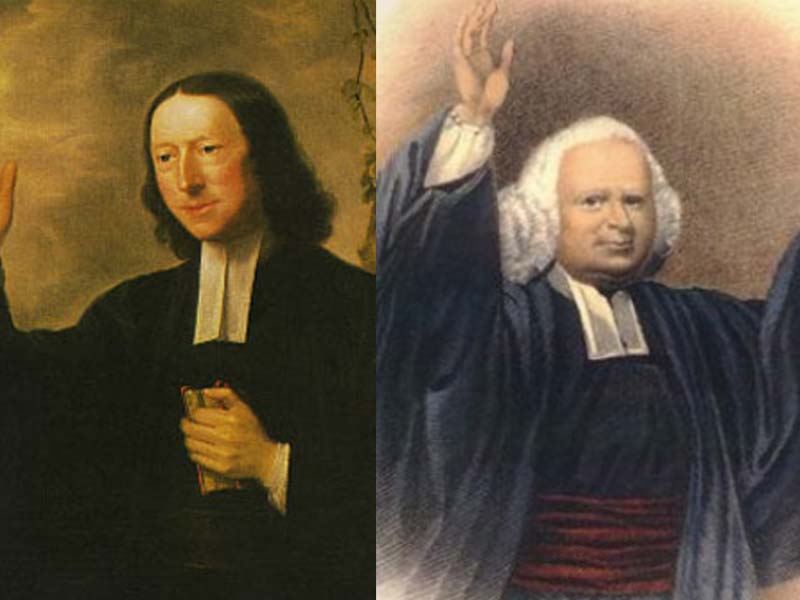
John Wesley (1703-1791) and George Whitefield (1714-1770) were the most well-known Christian leaders in the English-speaking world of the 18th century. Yet they struggled with each other regarding some significant points of Christian doctrine.

John Wesley (1703-1791) and George Whitefield (1714-1770) were the most well-known Christian leaders in the English-speaking world of the 18th century. They struggled with each other regarding some significant points of Christian doctrine, and through their dialogue they introduced the notion of “agreeing to disagree” into Christian discourse.

Sometimes “agreeing to disagree” with fellow believers can be difficult. I know. I have been there. But first, let me give you some historical background…

In 18th century England and America, two of the most celebrated figures were George Whitefield and John Wesley. Whitefield and Wesley would travel up and down the American Eastern seaboard and across the British Isles preaching in the open air. The first “Great Awakening” can largely be attributed to how God used these two men to lead many thousands into a relationship with Jesus Christ, perhaps one of the greatest spiritual revivals in the history of the church.

But Whitefield and Wesley had some rough spots in their relationship with one another. In one important matter, they differed in terms of some significant Christian doctrine. George Whitefield, a Calvinist theologically, believed that when Jesus Christ died on the cross, He died only for the elect who would come to know Christ. If you were not among the predestined elect, Whitefield concluded that the Bible taught that Jesus had not died for you. John Wesley, an Arminian theologically, vehemently rejected this teaching. For Wesley, Jesus Christ died for all of humanity, whether someone received Christ or not. Though these men clearly differed on the extent of Christ’s atoning work on the cross and how that related to predestination, they were united in many more things in terms of doctrine than over that which they were divided.

The prolonged controversy between Whitefield and Wesley was at times very tense. Though I do not recall the reference, my understanding is that John Wesley was the more quarrelsome of the two men. But it is to John Wesley’s credit that eventually when he was asked to deliver a memorial sermon when George Whitefield died, he was extremely charitable to his evangelistic counterpart. In that sermon, Wesley uttered a most memorable phrase:

“There are many doctrines of a less essential nature … In these we may think and let think; we may ‘agree to disagree.’ But, meantime, let us hold fast the essentials…”

Since that remarkable sermon, Christians over the years have recalled Wesley’s words that he at times exchanged with his colleague Whitefield about “agreeing to disagree.” Though these men still had their points of conflict, in the end, they were able to consider each other not as enemies but rather as friends, as brothers in Christ, despite their disputes over some points of doctrine.

It is a lesson that the evangelical church today still needs to hear.
Continue reading


No Compromise?

Was Galileo right?  Or did he take the Christian church down the path of compromise, eventually leading to the contemporary secularization of the traditionally Christian societies, weakening the witness of the church?

Was Galileo right? Or did he take the Christian church down the path of compromise, eventually leading to the contemporary secularization of  traditionally Christian societies, and weakening the witness of the church?

Millions of years. The age of the earth. Established scientific fact based on evidence? Or fatal compromise of biblical inerrancy and the integrity of the Gospel?

Answers in Genesis (AiG) is the premier Young Earth Creationist organization in the world. Their basic mission is to try to help Christians have a restored confidence in the full inerrancy of the Bible, starting at the “very first verse” in Genesis. One of their primary claims is that evangelicalism has allowed apostasy to enter the church by accommodating to the modern scientific idea of a “millions of years” Old Earth. Over time, this gradual movement away from a literal 24-hour day interpretation of the Creation account, with a Creation date of less than 10,000 years ago, has led to all sorts of  other confusions of Bible doctrine. Secular critics scoff, church leaders fumble on the questions, and many bewildered young people in our churches go right out the door and leave the faith, according to AiG.
Continue reading
