Tag Archives: eschatology

Revelation … (and the Rapture Reboot)

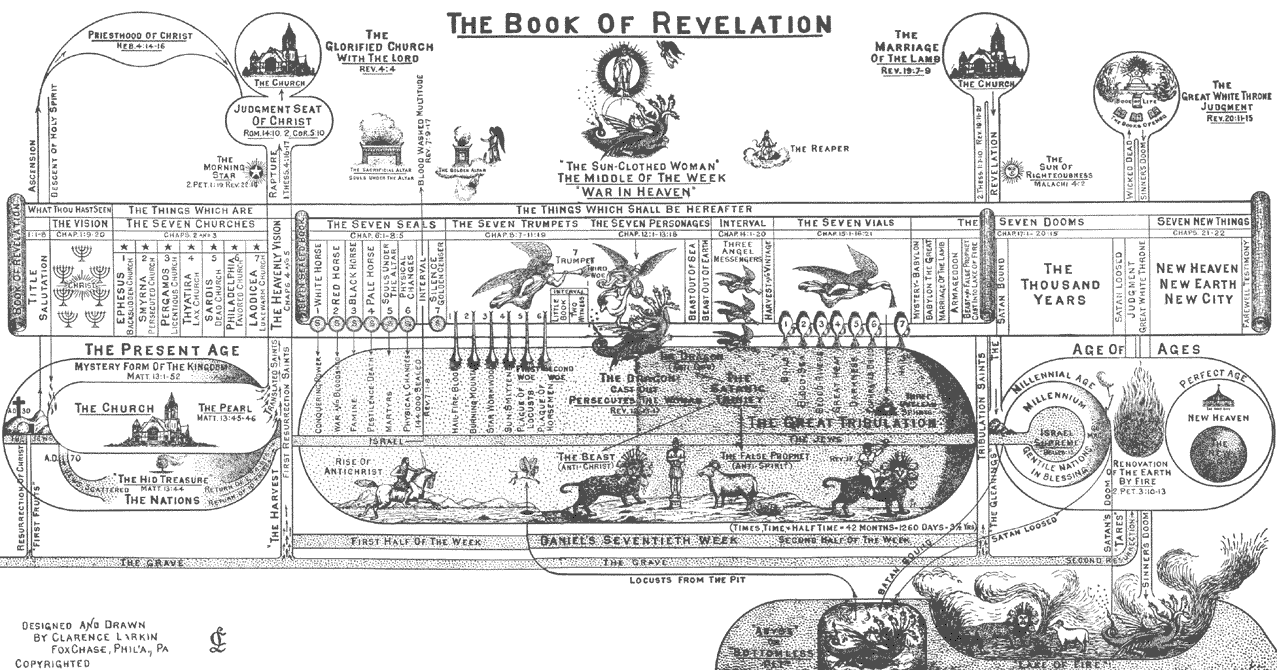
Clarence Larkin (1850–1924), a Baptist pastor, produced this intricately detailed chart showing the structure of the events described in the Book of Revelation according to a dispensationalist system of Bible interpretation. Note how Larkin splits the event of the Second Coming, into two parts: the first where Christ "raptures" the church and the second where the Christ comes in glory with his Church to begin the millennial reign. In between the two parts of the Second Coming is the "seventieth week of Daniel," which forms the basic narrative of the last book of the Bible.

Clarence Larkin (1850–1924), a Baptist pastor, produced this marvelously intricate and detailed chart showing the structure of events described in the Book of Revelation according to a dispensationalist system of Bible interpretation (Click to enlarge). Note how Larkin splits the event of the Second Coming, into two parts: the first where Christ “raptures” the church out of the world and the second where Christ comes in glory with his Church to begin the millennial reign. In between the two parts of the Second Coming is the “seventieth week of Daniel,” which forms the basic, if not sometimes terrifying, narrative of the last book of the Bible… You really need a chart to keep track of everything! (Source: clarencelarkincharts.com)

The subject of the End Times can be very daunting. Various places in the New Testament address the topic, but by far the most fascinating discussion in the Holy Scriptures that digs into End Times issues can be found in the very last book of the Bible: The Revelation.

As I was nearly completing this blog post on the Book of Revelation, I read about a new Christian movie coming out this year, Left Behind. What? Nicholas Cage in a Christian movie?

Yep. That’s right. What a great lead in on a blog post about the Book of Revelation! How did this all come about?

Well, the story is that some years ago, best selling Christian authors Tim LaHaye and Jerry B. Jenkins wrote a series of popular books of the same name. The only book series that has topped Left Behind in sales in recent years is Harry Potter.

In 2000, Cloud Ten Pictures released a theatrical version of the book, starring Christian actor Kirk Cameron. Left Behind: The Movie was a total bust at the box office. Unlike the Harry Potter films, Left Behind: The Movie never went very far.

In response to the poor sales and lackluster quality, author Tim LaHaye sued the film company claiming a breach of contract. LaHaye was expecting a much better movie and wanted Cloud Ten to make amends. Cloud Ten eventually settled with the author and agreed to remake the movie. As the subject of the film is “the Rapture,” you can call it a “Rapture Reboot.”

Well, here is the trailer. Does this look like your idea of a Christian film?

I am still working on the concept of Nicholas Cage being in this film…. Anyway… Undoubtedly, the film will be controversial, particularly among Christians. Fans of the book series might flock to the theatre, just to see if the “Rapture Reboot” with Nicholas Cage was really that much of an improvement over Kirk Cameron. Nevertheless, the film does raise a lot of questions about the Bible, the type of issues you simply will not be able to resolve just by going to a movie theater, or viewing later on Netflix.
Continue reading

Replacing Replacement Theology?

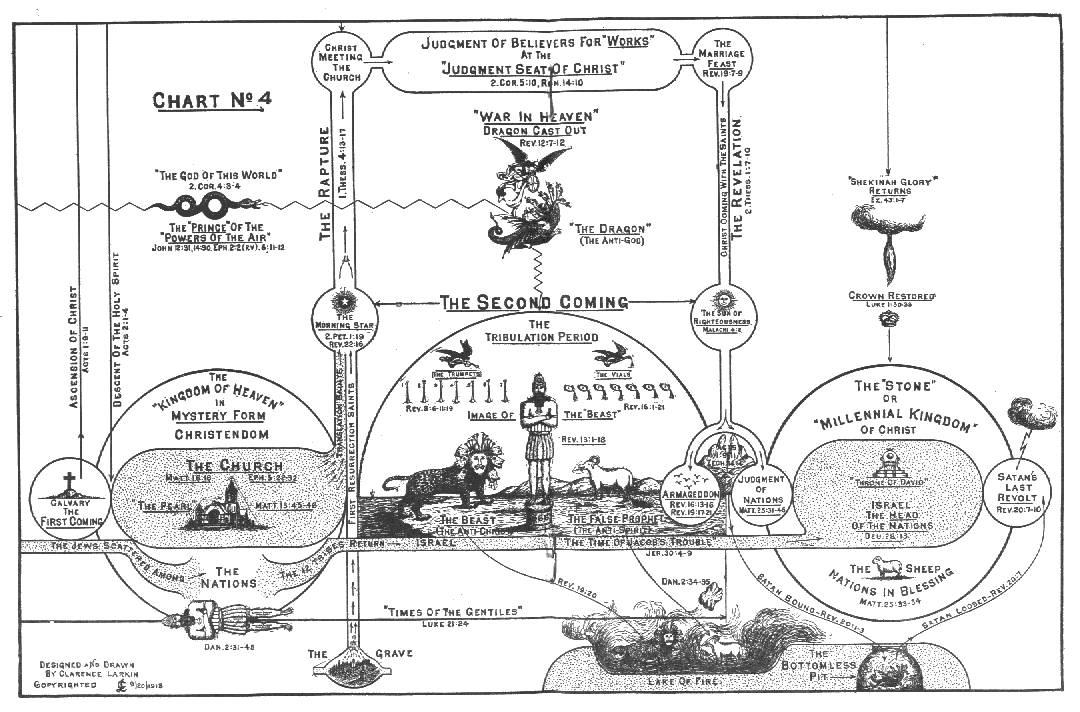
Clarence Larken (1850-1924) was an American Baptist pastor who developed charts like these that depict a dispensationalist view of the End Times. If you click on the image to expand the detail, you will see how Larkin divided the church on the left from Israel on the right. Contemporary followers of Larkin accuse "replacement theology" of wiping out Israel's place in Biblical prophecy.

Clarence Larkin (1850-1924) was an American Baptist pastor who developed charts like these that depict a dispensationalist view of the End Times, as popularized in the immensely influential Scofield Reference Bible. If you click on the image to expand the detail, you will see how Larkin divided the church on the left from Israel on the right. Contemporary followers of Larkin sometimes accuse “replacement theology” of wiping out Israel’s essential place in Biblical prophecy.

What is “replacement theology?”

About twenty years ago, I had the opportunity to visit the Holy Land. I looked out over the Sea of Galilee. I climbed part of the great mountain fortress of Masada. I witnessed orthodox Jews praying at the Western Wall. I walked the streets of Jerusalem down the Via Dolorosa, the Israeli flag flying high and proudly over several of these streets. It was a breathtaking experience.

However, the exhilaration was soberly offset by a conversation I had with the bus driver for our tour group. Like many other Palestinian Christians, his family had lived in the land for centuries with their Jewish and Muslim neighbors, mostly at peace. However, the events of the past 60+ years between the Israelis and their Arab neighbors have resulted in persecution for his family. He never went into the details, but I was always puzzled by what he meant by that.

Later on in the tour, when our group came to a stone gate in East Jerusalem, our bus driver nervously pointed out the bullet holes where Israeli and Jordanian fighters clashed with one another during the electrifying 1967 Six Day War. On the one hand, I felt then the thrill of the Israeli victory and reclamation of the ancient city that was discussed in this previous Veracity post.

But I had become also deeply troubled: what side was our Christian bus driver’s family on during that bitter conflict, or were they simply caught in the middle of the violence (like in this recent piece of news)? As I am writing this in July, 2014, Israel and Gaza’s Hamas have for weeks been involved in a deadly exchange, and Christians like this Baptist church in Gaza are vulnerable to the crossfire.

What is a Christian to think about the prophetic promises regarding national Israel, while also considering the challenges faced by Palestinian Christians living in the contested land in Middle East today, like my bus driver? What does the Bible have to say?

The study of Bible prophecy is a complicated subject and passions run very, very deep when people talk about “Israel.” Most evangelical Christians believe that “Israel” has a special place in God’s future plans, but there is a growing widespread confusion as to what this really means. So I must admit that I get conflicted when some Christians begin to talk about  the errors of “replacement theology.”  What is being meant when people speak of “replacement theology?” Granted, some criticisms are indeed valid, but a quick survey of what you find on YouTube can be rather troubling. Here is the ever colorful television personality Jack Van Impe:

Well,… uh, ok… now… what in the world is this guy talking about??????????
Continue reading


Oh, Jerusalem: A Biographical Lament

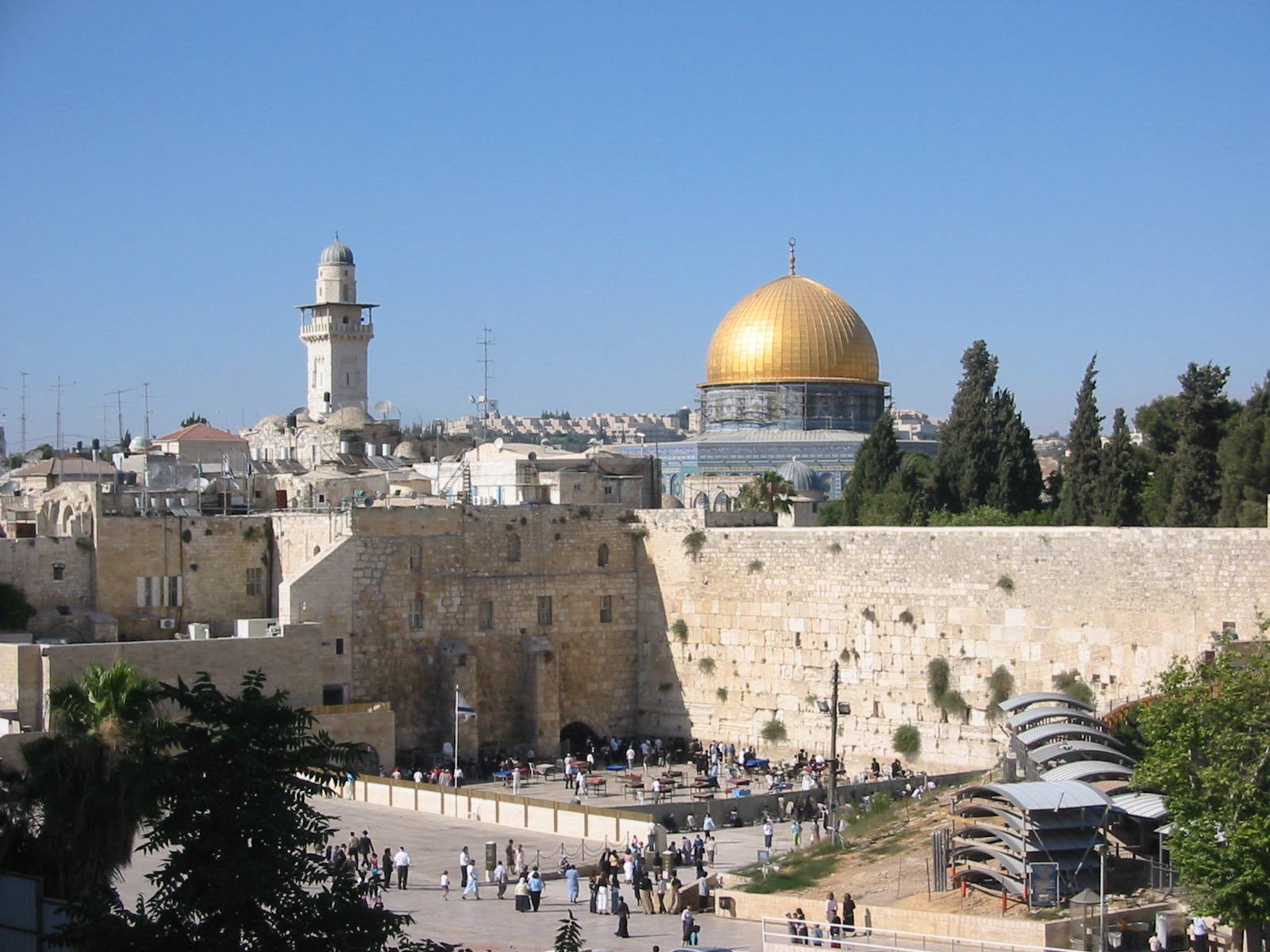
The Western Wall of the Temple Mount in that Holy City: Jerusalem

The Western Wall of the Temple Mount in that Holy City: Jerusalem (photo credit: TripAdvisor.com)

“O Jerusalem, Jerusalem, the city that kills the prophets and stones those who are sent to it! How often would I have gathered your children together as a hen gathers her brood under her wings, and you were not willing!”(Matthew 23:37 ESV)

Jesus said these words upon his last week in Jerusalem prior to His death. It pretty much sums up the theme of Simon Sebag Montefiore‘s monumentual book, Jerusalem: The Biography. I finished listening to it as an audiobook from Audible.com not too long ago. At 25 hours and 26 minutes, it is a very long listen. But as I have been doing tedious work as part of an upstairs remodeling effort, it helps to have had a set of headphones to listen to this fascinating work of history while I try to cover up my tile grout mistakes. Montefiore traces the story of Jerusalem, starting back at its Canaanite origins thousands of years ago up through the present era, stopping at the end of the Six-Day War in 1967.

It has been taking me over a year to get through Jerusalem, having to take a break every now and then just to work through the emotional energy required to take in such a vast topic. Jerusalem’s name is often associated with being “The City of Peace”. But the long and tumultuous story is evidence that this sacred and holy place has been anything but peaceful.
Continue reading