Joshua Harris was only 21-years old when his blockbuster, best-seller I Kissed Dating Goodbye was published. The book spread like wildfire through evangelical churches. “Purity” and “courtship” were the watchwords of the day.
So, what do you do when 22 years later, the much acclaimed author informs his followers that he and his wife are pursing separation? (ALSO: See update near the end of this post, made after this blog post was originally posted)
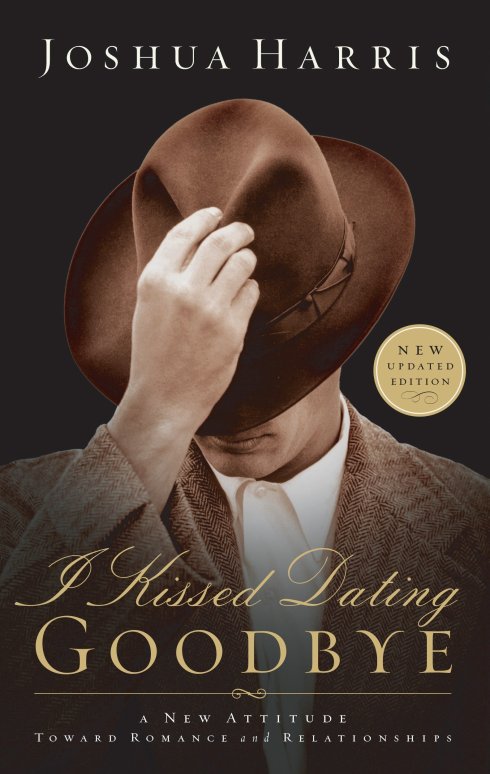
This book will soon be a collectors item, as the publisher will cease further printings, per the request of the author.
In the mid-to-late 1990s, Harris’ message was that young, single people should avoid the modern practice of dating, and pursue “courtship” instead. In courtship, single people should only pursue a relationship with a member of the opposite sex, with the intention of becoming married. Modern dating had simply become a training ground for divorce. Therefore, if you want a successful marriage, casual dating should be avoided.
In those years, just as it still is today, the Christian emphasis on avoiding the dangers of sexual relations outside of marriage was being disregarded, in the wider culture. Premature physical intimacy, and lack of boundaries in dating, was dehumanizing, thereby confusing self-gratification with intimacy, and eventually destroying marriages.
Harris’ solution was to “avoid everything that leads up to that consequence.” Part of that included the advice, that you should not even kiss your prospective mate until your wedding day. Holding hands? Forget that, too.
What about emotional intimacy, characteristic of dating? That should be avoided as well, as “giving your heart away” before you get married, to someone else, only decreases your ability to give fully to the one you end up marrying.
I had been single for a long time before Harris’ book ever came out, but I could appreciate its appeal, when it eventually did. There had been infamously little published by Christian authors, about dating, throughout the 1980s into the early 1990s…. and I had made a series of mistakes. Sadly, the confusing and conflicting advice I got in my twenties, in those years, from other sincere Christians, did not help very much.
However, there was Elisabeth Elliot‘s 1984 book, Passion and Purity: Learning to Bring Your Love Life Under Christ’s Control, that got passed around in my InterVarsity Christian Fellowship circles. Elliot, the surviving spouse of the martyred missionary in Ecuador, Jim Elliot, sought to address issues of the cultural obsession with dating, sex, and intimacy, with direct boldness. It was a message that many Christian young people, in my generation, needed to hear.
I was gripped with her message. Elisabeth Elliot wrote with confident authority, but there were a few things that were nagging in my mind, that I was not completely sure about. Reruns of Elliot’s radio programs are still available at the Bible Broadcasting Network.
As a teenager, Joshua Harris made some mistakes of his own. Reading Elliot’s book emboldened him to radically change course, and try to retell Elliot’s message for a new generation. Nervously, Joshua Harris even sent a copy of his yet unpublished manuscript for I Kissed Dating Goodbye to Elisabeth Elliot, to get her impressions. Harris was elated to hear back from Ms. Elliot, who affirmed Harris for writing a “worthwhile book.” Harris sent his manuscript out to be published shortly thereafter. In 2013, Harris returned the favor by writing the forward to a reprint edition of Passion and Purity, in which he tells the story I just summarized.
The success of I Kissed Dating Goodbye, was founded upon a hard-hitting, counter-cultural message. On the positive side, I Kissed Dating Goodbye affirmed God’s good purposes for marriage, and for reserving sexual relations within the context of marriage. But on the controversial side, those Christians who still practiced “dating” were treated with spiritual contempt, among other things. Plus, and sadly, a number of those marriages, founded upon Harris’ principles of “courtship,” ended in divorce anyway.
Harris for years overlooked the views of his detractors. Harris went onto become an instant evangelical celebrity, following the amazing popularity of his book. While still in his twenties, Harris got married, started a family, and soon became a pastor of a mega-church, at age 30. He took on this pastoral responsibility, without ever having had any seminary-level, advanced, theological training.
The Sovereign Grace Ministries network of churches, of which he was a pastor of one, got embroiled in a controversy, over claims of child and sexual abuse, in the churches’ ministry programs. The incidents that started the controversy happened prior to Harris’ tenure, but the issue was never adequately resolved. The controversy eventually led Joshua Harris to step down as lead pastor, in 2015, in order to pursue advanced theological training at Regent College, in British Columbia, Canada.
It was roughly during this time that Harris began to have second thoughts about the message of his book. Some tied the criticisms of his book with his belief in complementarianism, that men and women are different, emphasizing male-only leadership in churches, combined with the particular, extreme slant that Harris had been promoting. In an interview with Sojourner’s magazine, Harris concedes:
Harris began to interact with readers of his book, listening to their stories. He chronicled his journey, in a documentary film entitled I Survived I Kissed Dating Goodbye. If you were ever troubled by Harris’ book, you would do well to watch this film and discuss it with others.
His conclusion? Josh Harris came to admit that he gave millions of people the wrong advice. Harris had condemned dating as being “unbiblical,” despite the fact that the Bible nowhere addresses the topic of dating. In an effort to try to help people live lives of purity, Harris ultimately realized that his solution was heaping toxic doses of legalism and fear, upon the consciences of his readers.
Josh Harris still believes in abstinence before marriage. But Josh Harris now believes that healthy dating can be a good thing, recommending books like Dr. Henry Cloud’s Boundaries in Dating, and Debra Fileta’s True Love Dates, instead of his own.
Reactions to Harris’ rethinking about his book have ranged the gamut. Some believe Harris has gone too far in condemning his own book, believing that “courtship” is still the way to go, and giving up too easily on otherwise good and sound principles.
Others believe that Harris did not go far enough, in making an apology. Nevertheless, Josh Harris made the decision to ask the publisher to discontinue the publication of I Kissed Dating Goodbye, along with two other books, that stress the same themes.
The popular conservative, and indeed, Reformed, Christian blogger, Tim Challies, interestingly agrees with Josh Harris’ critical analysis of his own book:
- There are times when a kind of weirdness settles over evangelicalism, when for a while people are swept away by strange and flawed ideas. This usually happens when Christians are attempting to counter ideas that are prevalent outside the church. Instead of reacting in a measured way, we collectively over-react.
The type of self-chastisement that Josh Harris has been going through, despite being so confident in his previous views for so long, buoyed by constant affirmations of others who wanted to think the same way, can have devastating consequences.
Sadly, Josh Harris announced in July, 2019 that he and his wife are separating, after 20 years of marriage.
In thinking about the story of Josh Harris and I Kissed Dating Goodbye, I can think of several lessons for Christians:
- Relationships are hard. While indeed helpful to many, there was nevertheless a subtle, deceptive allure to Josh Harris’ book, that sought to bypass that truth: Relationships are hard.
- Friendships with members of the opposite sex are a good thing.
- Doing fun things together is great, particularly in a group. Setting boundaries in relationships is essential. Avoid late-night solo dates. Revive the art of letter writing. An extreme focus on purity can actually backfire.
- One can take to heart Josh Harris’ self-critical reflections of his own book, without abandoning a commitment to traditional, Scriptural sexual ethics.
- The “purity” movement and the “courtship” movement have had some good things about them. But even the best of ideas can descend into an unhealthy form of legalism.
- Christians may have good intentions in rejecting certain cultural trends, but we must caution against accepting ideas that are reading modern concepts into the Bible.
- The “courtship” movement can set people up to have the wrong expectations about marriage, that are completely unrealistic, just as much as “dating” can do.
- The idea of “courtship” works best when you have people in your life, who know you well, and who also know your potential spouse well. Such people can point out blindspots that you and your potential mate may miss. But cultivating the type of community, where such people can exist in your life, can be a difficult task, in and of itself. Ideally, such community should be experienced within a local church (but a lot of these points can apply to “dating,” too).
- Churches should avoid recruiting young people, in their twenties, into becoming pastors of mega-churches, at such young ages, and they should make sure that whoever pastors their churches have adequate theological training, before assuming such leadership positions… also, getting advice from a 21-year old on how to prepare for, build and sustain a life-long marriage is rather insane.
- Mentoring younger singles, and even young couples, by older, more mature married believers, is a critical need in our day.
- The local church surely has a business-side to it, but first and foremost, a local church is a family, and not a business. Churches are ultimately families, governed by seasoned fathers and mothers, and not by corporately-minded CEOs.
- There are good forms of complementarianism, and there are bad forms of complementarianism.
- A lot of egalitarian types of thinking are, in reality, over-reacting towards such bad forms of complementarianism.
I happen to hold to a moderate form of complementarianism, but there are bad forms of complementarianism, that should be rejected. For example, there are those who teach that women are not to be in spiritual authority over men, because in their reading of 1 Timothy 2:11-15, such teachers contend that Eve was deceived; that is, from the text, “Adam was not deceived, but the woman was deceived, ” because women are inherently more susceptible to becoming deceived than men. And because women are more deceivable, women should not be entrusted in positions of spiritual authority.
A more moderate approach to complementarianism will affirm that only men are to serve as elders/pastors in a local church. But this does NOT mean that this has anything to do with women being more susceptible to becoming deceived, than men. If anything, a healthy approach to complementarian theology would encourage women to give their perspective to men in the spiritual leadership of the church, while encouraging such men to receive such input gladly, with ready hearts and minds. Women and men can help one another see things that the other can not see.
The text of 1 Timothy 2:11-15 simply states an observation as to what happened in Creation. To try to read into the text some type of innate characteristic, created by God, that distinguishes men from women, as to their intellectual or spiritual capabilities, is an abuse of Scripture, reading something into the Bible that simply does not exist. To put it bluntly, the Bible does not teach that women are more spiritually gullible than men. This is an example of the type of patriarchal, bad complementarian theology that Josh Harris is now against. I have tried to articulate a more sacramentally-informed, non-authoritarian-istic perspective on complementarian theology in a twenty-part blog post series.
Such bad theology has inflicted an untold amount of pain and suffering in evangelical churches today. Josh Harris is surely working through a lot of the guilt and shame associated with his own promotion of such bad theology.
It might be best for Christians, who know of Josh Harris, to remember Josh and his wife in your prayers. This is a difficult time for the both of them.
I am sure that Josh Harris and his wife are both wonderful people, and I do hope the best for them. If there is any good news to come out of this whole story, it is this: It takes a lot of courage to admit that you were wrong. Josh Harris has displayed this courage, and I commend him for it. Would we all have such courage.
UPDATED: Monday, July 29, 2019
After posting this a few days ago, I have learned today, that along with Josh Harris’ announcement about his separation, he also announced that he no longer considers himself to be a Christian. In particular, he announced on Instagram that he regrets his previous posture regarding the LGBTQ community, and that he now fully affirms “marriage equality.” Christianity Today magazine has a very helpful followup essay, on this topic. According to Harris, “Many people tell me that there is a different way to practice faith and I want to remain open to this, but I’m not there now.” I pray that Josh Harris finds his way back onto the path, in God’s timing, and more deeply experiences the grace of God.








 Veracity