Veracity thanks everyone who participated in the panel discussion over the past two weeks in the Williamsburg area, those on the panel, as well as everyone who put their questions forward. I personally learned a lot, and it prompts me to study God’s Word even more! Hopefully, this will be a blessing for those who wrestle these issues, engaging the heart and the mind.
UPDATE: 10/19/2016
Hunter Ruch went to the trouble of going through the video and marking the time segments, allowing you to skip to particular questions you are interested in. Thanks, Hunter (though it was his wife’s idea to do this)!
WEEK 2 (9/4):
Introduction, Review & Definition of Terms by Clarke Morledge (0:00-23:11)
Question #1: Election and Salvation? Why do I need to understand the theory of election? (23:12-34:11)
Question #2: Clarify the use of “Hebrew,” “Israelites,” and “Jews.” (34:12-42:26)
Question #3: The Land of Israel? (42:27-1:00:45)
Question #4: One or Two Paths to God? (1:00:46-1:02:44)
Question #5: The Dangers of Neglecting Ethnic Israel? (1:02:45-1:08:49)
Question #6: Obsession vs. Negative Views of Israel? (1:08:49-1:18:57)
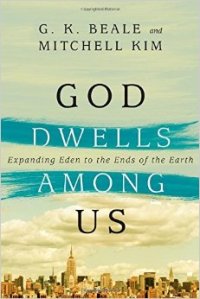
G. K. Beale and Mitchell Kim’s God Dwells Among Us: Expanding Eden to the End of the Earth offers a grand portrait of how the theme of the temple throughout the Bible propels the church forward into mission, as a light to a dark and hurting world.
Have you ever wondered how the whole message of the Bible fits together? Moreover, how does that message impact your life and the mission of the church?
We have sixty-six books in Holy Scripture, and if you have ever read through it all, it can be puzzling to think about how everything fits in with each other. Biblical theologian Gregory Beale and pastor Mitchell Kim have put together a book that helps you gain the big picture of the Bible from Genesis to Revelation, following one theme, one particular thread tying the whole thing together.
God Dwells Among Us: Expanding Eden to the Ends of the Earth is a collection of sermons mainly by Mitchell Kim, based on a more academic work by Gregory Beale, The Temple and the Church’s Mission: A Biblical Theology of the Dwelling Place of God. In condensing and simplifying Beale’s profound work of biblical theology, Kim and Beale take the theme of the temple of God, and trace it beginning from Eden to the last chapters of the Book of Revelation. Kim and Beale’s main thesis is that God’s temple is the dwelling place of God, embodying the presence of God in creation. The temple of God is where we as humans were created to worship God, and that worship catapults the people of God into mission, whereby God’s temple is expanded throughout the whole world.
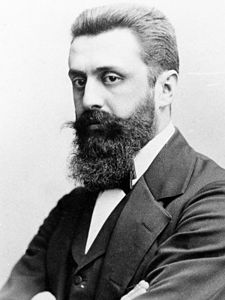
Theodor Herzl (1860-1904), one of the chief visionaries behind modern Zionist, the desire for a Jewish state in Palestine (credit: Wikipedia)
Was biblical prophecy fulfilled when the modern nation state of Israel was founded in 1948? Well, the story in its historical context is rather complex. Efforts to establish a Zionist state in the Holy Land began many years before 1948, and the impact of that history continues to be felt today.
The best place to start this part of the story is with a young Austria-Hungarian Jew in the late 19th century, Theodor Herzl.
Theodor Herzl (1860-1904) had gone to France to embark on a career as a journalist. There he followed the sensational Dreyfus Affair, where a French Jewish army officer was falsely accused and convicted of spying for the Germans. It was evident to many, including Herzl, that antisemitism was behind the entire trial, and that the future for Jews in Europe was rather bleak. As we saw in an earlier blog post, antisemitism was a terrible stain on traditionally “Christian” Europe. Continue reading
Who is a “true” Jew, according to the New Testament?
Throughout the Old Testament, generally speaking, a “Jew” is someone who is a member of God’s covenant people, bound together by the Law of Moses given on Mount Sinai, as defined by the first five books of the Bible. In contrast, a “Gentile” is someone who is not a Jew[1]. For example, Jews keep the requirement of male circumcision, whereas Gentiles do not. Historically however, those who can trace their ancestral lineage back to this special nation of people, Israel, are still considered to be “Jewish,” even if they do not keep all of the rules associated with Moses. I have known a number of Jewish people who would consider themselves to be agnostics or atheists. These people are “ethnically Jewish,” though not “religiously Jewish.” But this distinction often causes confusion.
So, when we think of someone who is a “Jew,” do we mean someone who is ethnically Jewish? Or do we mean someone who is a practicing or believing Jew, someone who really believes in the God of Abraham, Isaac, and Jacob? Does the New Testament help us out here? Continue reading
So, I was in for a confusing shock as a young person in college at a Bible study meeting. An engineering student next to me, wearing blue jeans, flannel shirt, and an old pair of sneakers, was puzzled over a passage of the Bible. To find an answer, he began to read from the notes of his new Charles Ryrie Study Bible. Across from the engineer sat a young brunette woman, dressed to the “nines,” propped up in her high heels and adorned with plenty of makeup. Though evidently they were friends, she nevertheless visibly glared at the engineer, as he spoke for about five minutes. Suddenly, this woman, who later told me, she was the daughter of an executive at Pat Robertson’s Christian Broadcasting Network (CBN), sat up straight in her chair and challenged the engineering student. “That is not what my Bible teaches! Who does this ,’Charles Ryrie,’ think he is?”
The atmosphere in the room had become so thick, you could cut it with a knife.
After a few minutes of rigorous back and forth, the casual engineering student and the dolled up brunette finally made peace with one another, but I sat there stunned. I had no idea what kind of mess I just found myself in. I had no clue what these folks were talking about. I had no idea who this ‘Charles Ryrie’ even was. But I was determined now to find out.
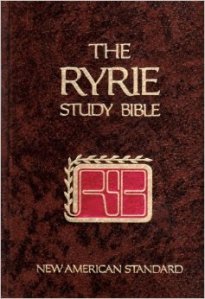
The Ryrie Study Bible. One of the most influential (and, at times, controversial) aids for understanding the English Bible for almost four decades.
In the twentieth century, Charles Ryrie was among the most influential conservative evangelical Bible scholars on the American scene. I would consider him to be one of the last, great classic dispensationalist theologians. Before Tim LaHaye’s Left Behind novel series overtook the church by storm, there was the Ryrie Study Bible. Classic dispensationalism championed ideas still commonly taught in many evangelical circles today, particularly the importance of a literal, futuristic interpretation of Bible prophecy, and the distinction between Israel and the church, as one of the primary interpretive keys for understanding the unity of the Bible. Is there a common thread of logic that unites the Old and New Testaments together, and the Bible’s vision of the future? Ryrie sought to tackle these type of grand questions.
Among Charles Ryrie’s mentors, dispensationalists commonly held a hard and fast distinction between the term “kingdom of God” and the similar phrase used in the Gospel of Matthew, “kingdom of Heaven.” Some even refused to utter the Lord’s Prayer as a part of corporate worship, believing that the Lord’s Prayer belonged strictly to a future dispensation. Charles Ryrie began to question such rigid, hyper-systematic interpretations of the Bible, that were originally intended to combat the prevailing liberal Protestant theologies of the early 20th century. But classic dispensationalism also rubbed against the mindset of those older conservative evangelicals who embraced covenant theology. The “iron sharpening iron” effect of these different schools of theology eventually caused the more conciliatory Ryrie Study Bible to supersede (pun intended!) the older Scofield Reference Bible that dominated previous generations in many Bible-believing churches.
Young Millennial Christians have never heard of Charles Ryrie, and thus the Ryrie Study Bible has lost its popularity for the new generation. Nevertheless, the influence of this forceful and yet gentle scholar of the Bible remains within the evangelical church, his legacy encouraging believers today to grow in their knowledge, love, and obedience towards the Scriptures.




 Veracity