Tag Archives: Dick Woodward

Process of Suffering

Do you ever think about why God works by processes?  After all, why doesn’t God just ‘poof’ everything to be the way he wants it to be?  Why take 13.7 billion years to get to today?  Why take 4.6 billion years to build the earth and shape its climate?  Why did Jesus have to suffer?

Why do people have to suffer?

Countless theologians have taken aim at that question.  Most dissect it from the standpoint of purpose—as in “What is the purpose of suffering?”  The realities of suffering remain among the biggest stumbling blocks for atheists and believers alike.

When it comes to suffeDick Woodwardring, I have no credentials.  But I do know an expert.  Here are two messages Dick Woodward preached on the topic (from among many cataloged here) that get to the heart of suffering.

Some questions we just can’t answer.  Other questions we should never even try to answer.  Just like the difference between knowledge (knowing the answers to questions) and wisdom (knowing which questions count), it’s really important to know when to keep our mouth shut.

Here’s a short video that illustrates the value of “showing up and shutting up.”

It also highlights the processes by which God redeems us from suffering—not just for the care receiver, but the caregiver, the pastor, and everyone else.  Redemption is a process.  For whatever reasons, God followed his own rules, and suffered ultimately for our redemption.  There was no way to ‘poof’ the redemption of mankind—God had to prove it.

“For my thoughts are not your thoughts, neither are your ways my ways,” declares the LORD.  “As the heavens are higher than the earth, so are my ways higher than your ways and my thoughts than your thoughts.”
Isaiah 55:8,9 (NIV)

“The only thing that counts is faith expressing itself through love.”
Apostle Paul, Galatians 5:6b (NIV)

The above story has a happy ending.  All three men interviewed in that video are ministers—and very good ones at that.  All three will tell you when people are suffering the most important thing you can do is show up.  And don’t pretend to know the reason for their suffering.

Sometimes we see the happy ending.  Sometimes the ending is just too hard to bear.  It’s hard sometimes to understand that God makes the rules, knows what he is doing, has a plan for each of us, values sincerity, doesn’t need us to attempt to explain anything for him, and intends ultimately for us not to have an ending.  But let’s keep our mouths shut and just use our feet and ears and arms when people are suffering.  The process is important.

HT: Steve Flanary, John Green, Bill Warrick, Steve Hooge, Dick Woodward

The Ascension Was Not Enough

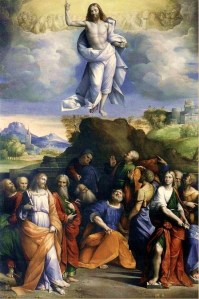
Ascension of ChristHave you ever thought about the events that transformed the apostles from runaway associates of Jesus into witnesses willing to be martyred for his message? The ‘About’ page on the Veracity blog encourages readers to “figure some things out.” That’s precisely what the apostles did between Good Friday (on the eve of the Jewish festival of Passover) and Pentecost (during the Jewish festival of Shavuot). But what they figured out wasn’t good enough.

The apostles witnessed all the miracles of Jesus while shadowing him for three years, but when the Roman soldiers showed up in Gethsemane all they had processed during those three years was quickly abandoned. They distanced themselves from him. So much for being bolstered by intellect. Obviously they were focusing on self-preservation and avoiding the pain and suffering that was about to be inflicted upon Jesus—just like you and I would have done. They knew that Jesus was God and that he had the power to raise the dead. They were there for the miracles, the transfiguration, the raising of Lazarus.  Intellectually and experientially they knew—but they followed their feet.

Forty days after the resurrection, they witnessed the ascension. But as mind-blowing as that event must have been—particularly in the afterglow of the resurrection—it wasn’t enough to change the apostles from cowards to revolutionaries. Jesus told them to wait in Jerusalem (for Pentecost, 10 days later).

This video from Glo Bible and our friends at Day of Discovery summarizes the events leading up to the ascension.

Jesus knew that his ascension would not be enough when he told the apostles beforehand, “…you will receive power when the Holy Spirit comes on you; and you will be my witnesses in Jerusalem, and in all Judea and Samaria, and to the ends of the earth.”  The anointing of the Holy Spirit wasn’t icing on the cake, and it wasn’t an unplanned or spontaneous result of all the teaching that transpired before Pentecost. It wasn’t an insurance run in case the apostles didn’t get it. It was a vital part of God’s plan, preordained, and God’s provision for equipping disciples.

Ray Vander Laan has an amazing lesson on Pentecost (on the Southern Stairs of Herod’s Temple). It is one of the clips from the Faith Lessons DVDs, that should be in your personal library. This is teaching as good as it gets, and you can understand why Ray gets choked up when he describes the significance of being on those steps.

So…after all they had witnessed in the 51 days after Good Friday, particularly the resurrected Christ and his ascension, the apostles still didn’t have what it takes. We may like to think that if we had seen the ascension we would have been fully convicted and empowered. But the truth is it takes more. It takes God with us, not merely God before us. God knew that. God knows that.

When Christ gave the Great Commission in Matthew 28, he commanded his disciples to go to all the nations and baptize in the name of the Father, the Son, and the Holy Spirit.  The ascension was not enough. It took Pentecost. It takes the power and person of the Holy Spirit. Dick Woodward has a lot of teaching about the Holy Spirit, as does the Apostle Paul. If we’re going to get anywhere in our devotional lives, it takes the Holy Spirit. There are rich blessings behind the preceding two hyperlinks.

Why is it important to appreciate the ten days between Christ’s ascension and Pentecost? It gets to the heart of the Trinity, and understanding that God is manifest in three persons—and that we need the power of all three in our lives. It also clearly demonstrates God’s plan for us—we are not only his children, but his anointed children. Without that anointing, it’s not enough.


Sermon on the Mount

The core teachings of Jesus Christ are recorded in Matthew’s account of the Sermon on the Mount.  This video is an experiment, using the Glo Bible and other online resources to build upon Dick Woodward’s Mini Bible College lessons.  Dick has some unique views on the context and content of Jesus’ formative teaching.

[vimeo 30211208]

Veracity Blavatar


Start Reading

Whether they know it or not, everyone has a position on the Bible. Some believe it to be the holy, inspired word of God. Some have no clue what it might be about. Many are in the middle and haven’t processed what the implications might be if it is true. Some people are confused—many with good reason (life isn’t fair and can be very harsh). Atheists believe that God does not exist. Agnostics are uncertain. Some people get caught up in our competitive and uncaring culture and just become apathetic.  And in others the mere mention of faith in God can provoke an ugly reaction, sometimes even rage.

Welcome.  So we disagree.  No surprise there. 

If you are ever going to get to the truth about the Bible, there are certain axioms.  First, we don’t get to make the rules, God does.   Dick Woodward figured this out years ago, and his first axiom is “I’m not, but He is.”  (Dick has boiled it down to what he calls “The Four Spiritual Secrets,” and they are the  proof text of his ministry.)

Second, there are a lot more people arguing over the Bible than there are people who actually read it (on both sides).

Reading and understanding the Bible can be a daunting task, particularly without help.  (It can also be incredibly rewarding and exciting.)  There are a lot of good resources available to help you understand what the Bible is all about—and that’s one of the main goals of this blog.  But at some point, to have anything more than an unsubstantiated or ignorant opinion, you’ve got to start reading.

The video below provides some introduction and background to the biographies of Jesus Christ, namely the four Gospels.  Check it out, then start reading.  Odds are you’ll discover a Jesus who is not a milquetoast pacifist who wants to please everybody, but a wise, radical, tell-it-like-it-is Savior who fights by sacrificing Himself to show how much He loves us.  Do you know this Jesus?  Think again.


A Fresh Approach

Here’s a video that captures the essence and purpose of this blog.

If you’re not getting much out of studying the Bible, consider these examples of the kind of material that can help you ‘see’ the Bible in a new, realistic light.

The events recorded in the Bible did not happen “long ago and far away,” as in a fairy tale.   Take the Apostle Paul for instance.  Paul was real, lived in real places under the harshest of conditions, and had a real reason for carrying out his mission.  Paul knew the truth.  His willingness to suffer for the sake of spreading the Gospel message is a powerful apologetic in its own right.

Paul’s writings contain a consistent prescription for peace and joy, perhaps best documented in Romans 12 and 1 Thessalonians 5:12-22.  The video concludes with a special interpretation of Paul’s central theme.

In the Bible we have Paul’s lengthy first-hand testimony, an amazingly accurate biography from Luke (i.e. the book of Acts), and an acknowledgment from Peter.  Study the accounts.  As you do, ask yourself why Paul would take the punishment and suffering that came along with his mission. 2 Timothy is a great place to start if you’re picking up the Bible for the first time.  It’s Paul’s last will and testament.  Listen to Dick Woodward’s teaching on 2 Timothy from his Mini Bible College audio series before you read the Scripture.  Then by all means read the text of 2 Timothy and develop an appreciation for the incredible man who wrote half of the New Testament.
