
Tag Archives: Dick Woodward

Personal Discipleship

The Life Line

The Life Line by Winslow Homer, 1884

Personal discipleship has been a lifeline for me between what had become a comfortable and complacent Christian experience, and one that became vibrant, exciting, and very real.

If you search for “personal discipleship” on the Internet, you’ll find a variety of  not-very-standardized definitions.  So up front, here’s my homegrown definition: personal discipleship is the process in which a believer or seeker takes personal responsibility for investigating the claims and content of the Bible.

While we all appreciate hearing a well-turned sermon in a moving worship service, sitting in a pew is a passive experience.  None of us would get very far academically if all we ever did was attend lectures.  We have to read, study, work some problems through, write, engage others in discussion, apply ourselves, and prepare to be tested.  And so it is with our faith.

Kierkegaard argued that Christians should take the initiative to work out our own relationship to God.[1]  But this wasn’t Kierkegaard’s original idea, it came from the Apostle Paul.

“Therefore, my beloved, as you have always obeyed, so now, not only as in my presence but much more in my absence, work out your own salvation with fear and trembling, for it is God who works in you, both to will and to work for his good pleasure. Do all things without grumbling or questioning,”
Philippians 2:12-14 (ESV)

Here the more literal ESV translation of the text leads to great doctrine.  This is not the Talmud instructing students to “Find thyself a teacher.”  It’s the author of half the New Testament telling disciples to work out our own salvation with fear and trembling.  Not to make up our ideas of God, but to reverently and humbly work on our relationship with him.  Not to have anyone do the work for us, but to do it ourselves. Continue reading
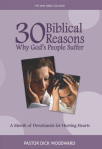

Why Does God Allow Evil and Suffering?

When God gave us His Word, He was not in denial regarding the suffering of His people. Have you discovered the Bible is filled with Scriptures that answer the ‘why’ questions the people of God ask when they are hurting? I have been in a wheelchair since 1983 and have been totally paralyzed for many years. What I have written here is not unproven theory from passages in the Bible. I have personally needed to search the Scriptures and find these “Thirty Biblical Reasons Why God’s People Suffer.” If you are suffering, or you know someone who is, join me as I explore thirty biblical responses of God to people with hurting hearts.
Dick Woodward, 30 Biblical Reasons Why God’s People Suffer

30 Biblical Reasons Why God's People SufferHow can an all-powerful and good god allow evil and suffering?  As William Lane Craig points out, the problem of evil and suffering is the primary argument against the existence of God.  In this presentation he argues that “Christian theism is man’s last, best hope for a solution to the problem of evil,” distinguishing between the intellectual and emotional versions of the problem of evil.

But the question is so profound that it can be particularly difficult to separate emotions from intellect.  It can gnaw at our soul. Even those who accept the existence of God can have a hard time resolving evil and suffering. Continue reading


How Does God Reveal Himself?

According to a recent study, 80 percent of Americans never doubt the existence of God.  No surprise really; there are many powerful arguments to support theism.  The simplest arguments for God’s existence—and some of the most effective—involve the fine tuning we observe all around us.  Nature gives us innumerable reasons to believe.

Check out this stunning time-lapse video from TSO Photography.

The Mountain

It’s no accident that gazing up into the firmament inspires awe for our Creator.  Our Creator intended that it should.  God clearly reveals himself in the world around us. Continue reading


Is Christianity Reasonable? A Devotional Answer

Is Christianity reasonable? As absurd as this question might seem, there are major religions founded on the premise that faith does not have to be reasonable. Fortunately, Christianity is not one of them.

How would you go about convincing someone that the Christian faith is reasonable? (Okay, this is a trick question—it’s not really our job to convince anyone, but it is our job to think.)

There are massive apologetic resources dedicated to defending the faith and making sound arguments in support of Christianity.  Check out Matt Slick’s CARM site, William Lane Craig’s Reasonable Faith site, Lee Strobel, Ravi Zacharias, Hugh Ross’ Reasons To Believe, the Poached Egg, or the One Minute Apologist.

But it is incumbent upon all Christians—not just big-name apologists, theologians, and pastors—to think.  As Tim Keller says in the following message, “You cannot be a Christian without using your brain to its uttermost.”

Jesus says (in Matthew 6) if you want to have faith, “Think, consider, deduce.” Why does thinking lead to faith? The Bible tells us that if you don’t let your thinking take you all the way to Jesus Christ it will end in despair. Martin Luther’s thinking led him to see there is a God. Then his thinking led him further to see that God must be a personal God. Then he thought, “If there is a personal God, I want to please him.” But Luther couldn’t obey even the Golden Rule, and wondered how he could please God. The Bible tells us there is only one way: Jesus Christ.
Tim Keller, paraphrased from Faith is Reason clip on YouTube

Oftentimes apologetics can be an uppercut.  And it can be an intellectual salve. Great apologists are convincing debaters, loaded with sound arguments to defend their position, and truth be told most of us wish we could dial up their arguments in our normal conversations. But there is an inherent danger in all the eloquence and logic of good apologetics—we can lose sight of the object of apologetics.

Continue reading


Podcasts & Podcatching

DowncastThis post describes how you can tap into a wealth of audio and video resources in the form of podcasts.

If you’re not familiar with podcasts, they are essentially online audio and video files that you can listen to or watch on your computer, iPod, iPad, iPhone, and many other portable devices.

Videos, music, sermons, radio programs, TV shows,  lectures, debates—you name it—can all be delivered free or inexpensively and played back whenever and wherever you like.

Interested in personal discipleship?  Podcasts give you easy access to teachers like Andy Stanley, Tim Keller and Dick Woodward. Go for a walk while listening to Dan Wallace describe exciting work at the Center for the Study of New Testament Manuscripts.  Listen to Hugh Ross explain why the universe is the way it is while stuck in traffic.  Cook dinner while Ray Vander Laan teaches about the Dead Sea Scrolls.  How about Mark Driscoll while waiting at the doctor’s office? OK, you may want to wait on that last one, but you get the idea.  Great teaching is easier to access than ever before.

There are lots of ways you can get podcasts, which is why I’m writing this post.  It’s easy to get lost in jargon and apps and how-to guidance.  There is a great app for podcatching (that avoids synching with iTunes) called “Downcast”  but there isn’t a lot of documentation.  So here’s a quick video to get you up to speed.

If you decide to use the Downcast app, here are a few more videos that go deeper into the features.  Enjoy!

1. Downcast Features

2. Downcast Additional Features

3. Downcast on iPhone and meet the Developer