Cameron is in many ways a popular evangelical Christian influencer, an evangelist and a spokesperson on conservative political issues as well. He admittedly acknowledges that he is not a scholar, and some of his amateur misunderstandings of things have come out in at least one filmed “prayer meeting” a few years ago, and on an historical documentary he produced on American history, which I have critiqued.
Kirk Cameron made a historical documentary film Monumental back in 2012, among his many other projects. Cameron has become a trustworthy and influential popular spokesperson among many evangelical Christians. But some now are concerned that Kirk has gone off the deep end…. or has he?
Is Kirk Cameron Now a “Heretic,” or Is He Simply Thinking Through Some Really Important Questions, and Wants to Talk About It?
Alas, Kirk Cameron means well, and to many in his audience, he seems trustworthy. So it really shocked some people, myself included, when he announced that he has shifted towards upholding a doctrine of conditional immortality.
The doctrine of conditional immortality differs from the traditional doctrine of eternal conscious torment. In the latter view, those who are eternally separated from God will undergo a never-ending experience of divine punishment resulting from their sin. However, the doctrine of conditional immortality, otherwise known as annihilationism, argues that those eternally separated from God will be punished, but that the punishment will have a terminus. To use a common expression, the punishment (of God) will fit the crime (of the sinner). Once the punishment, as rightly determined by God’s judgment, is rightly finished, the person will be annihilated. That person, separated from God, will no longer exist, eternally.
So, to answer the question posed by the title of this post: No, Kirk Cameron is not denying the doctrine of hell. But he is framing the way to think about hell in a category that might be unfamiliar and unsettling to others.
The debate of the exact nature of hell has been going on since the days of the early church. There are three main views on the topic: (1) the doctrine of eternal conscious torment, (2) the doctrine of conditional immortality, and (3) the doctrine of universalism. Universalism, which in its most popular form in Christians circles, as suggested by those like theologian David Bentley Hart, or William Paul Young, the author of The Shack, teaches that hell is really a kind of purgatory, whereby God will purge sin from the non-believer and eventually win that person to salvation, eventually, in the next life. In other words, hell is primarily restorative and redemptive, as opposed to being punitive.
While Christian universalism has had its proponents, even in the early church era, the doctrine was rejected as veering away from historic Christian orthodoxy. Names like Origen, and possibly Gregory of Nyssa, on up to more recent times, as with C.S. Lewis’ intellectual hero, the 19th century author George MacDonald, have espoused some form of universalism. But the orthodoxy of universalism has been rightly questioned.
It was really Saint Augustine of Hippo, an avid proponent of the doctrine of conscious eternal torment in the 5th century, who effectively put the nail in the coffin on general acceptance of conditional immortality…. at least for many Christians. Augustine’s massive influence pretty much made conscious eternal torment the traditional view of hell for centuries. But every now and then, conditional immortality makes a comeback, at least among a few Christians, in nearly every age of the church. So, Kirk Cameron’s musings on the doctrine of hell are far from new.
I take an agnostic view on the debate between these two perspectives at the present time. Dr. Mohler cites Matthew 25:46 as the main “go-to” verse to favor the doctrine of eternal conscious torment: “And these will go away into eternal punishment, but the righteous into eternal life.” But then there is Paul’s statement in 1 Thessalonians 2:9: “They will suffer the punishment of eternal destruction, away from the presence of the Lord and from the glory of his might.”
Eternal destruction sounds a lot like annihilation, at least to me. But I get Dr. Mohler’s point about Matthew 25:46. I am concerned about slippery slope tendencies on controversial topics, like Mohler, but these can be complex issues where different people will come to varying conclusions based on different ways of thinking. What matters more to me is how people arrive at their conclusion, as opposed to not just the exact conclusion they land on.
This is one of those doctrinal disputes which I have wanted to study, but I have not done a thorough enough job to make any firm, informed conclusion. About thirteen years ago, I read Robert A. Peterson’s Hell on Trial: The Case For Eternal Punishment, a 272 page articulate text which I highly recommend. Peterson makes a strong argument for eternal conscious torment, while acknowledging that some verses in the New Testament do lean towards conditional immortality. I have not yet read thoroughly any counter-perspective from the conditional immortality side of the discussion. I simply have not yet had the mental bandwidth to take on such a project, and I doubt I will get to it anytime soon (though I have wanted to).
An Appeal to Have More Charitable Dialogue on Controversial Topics Among Christians
But what concerns me the most about the controversy concerning Kirk Cameron are some of the outlandish comments, which have called into question Cameron’s spiritual integrity. Some have claimed that Kirk Cameron is embracing “heresy” now with his views on hell. That simply is not true. Kirk Cameron might indeed be wrong about conditional immortality, but that does not make him a “heretic.”
“With @KirkCameron announcing his position on conditionalism I’m seeing a lot of people attempting to critique it. I hold to ECT, but I do understand the topic of conditional immortality and I have yet to see anyone actually give a rebuttal that shows me they’ve interacted with the arguments and biblical reasoning from the other side. To condemn conditionalism/annihilationism as heresy is to say that John Stott, Edward Fudge, F. F. Bruce, potentially even Athanasius of Alexandria, are all heretics. This is, with all due respect, ridiculous. While the position might be unorthodox it is not heresy. If you actually want to interact with someone who knows the topic reach out to my friends @datechris and/or @DanPaterson7. Both are solid, fair minded, well educated and articulate holders of conditionalism.”
Gavin Ortlund, another theologian who holds to the traditional doctrine of conscious eternal torment, has a video which echoes Wesley Huff’s call for more charitable discussion. In Gavin’s four-layered model for how to go about “theological triage,” when Christians disagree with one another, from his book Finding the Right Hills To Die On, Gavin does not place this debate about the nature of hell as a “Tier 1,” top-level issue. It is an important issue to consider, a “Tier 3” issue, but Christians of good faith may come to different conclusions regarding the nature of hell. This is a good reminder that we should all strive for more charity in having discussions with one another on controversial topics.
I mean, if Kirk Cameron is no longer “safe,” then is anybody really “safe” anymore?
I have a couple more blogposts to put out before the end of the year, but this topic was too important not to pass up!
Philippians 2 includes some verses that advocates of universalism often quote to argue that every human individual will be saved in the end. Let us take a look at that claim, and see if it stands up under scrutiny. First, here is the passage, Philippians 2:4-11:
4 Let each of you look not only to his own interests, but also to the interests of others.5 Have this mind among yourselves, which is yours in Christ Jesus, 6 who, though he was in the form of God, did not count equality with God a thing to be grasped, 7 but emptied himself, by taking the form of a servant, being born in the likeness of men.8 And being found in human form, he humbled himself by becoming obedient to the point of death, even death on a cross.9 Therefore God has highly exalted him and bestowed on him the name that is above every name,10 so that at the name of Jesus every knee should bow, in heaven and on earth and under the earth,11 and every tongue confess that Jesus Christ is Lord, to the glory of God the Father (ESV).
The highlighted part, in verses 9-11, has phrases that puzzle many readers of the Bible, like “at the name of Jesus every knee should bow,” and “every tongue confess that Jesus Christ is Lord, to the glory of God the Father.”
What does that really mean?
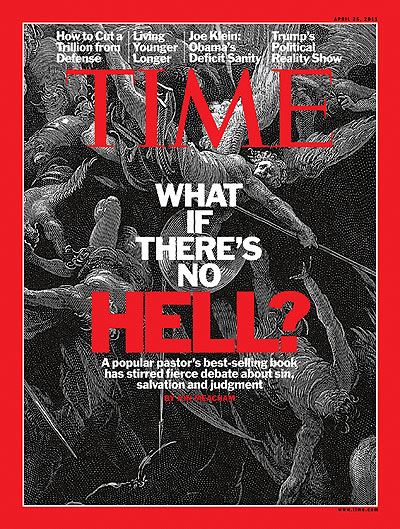
Time magazine’s April 25. 2011 cover was inspired by former megachurch pastor Rob Bell’s controversial book Love Wins, with a revisionist look at the classic doctrine of hell, that eventually led to Rob Bell leaving the pastorate.
What is “Christian Universalism?”
Now, before we dive any deeper, it is important to define what is meant by “universalism.” There is a popular form of “universalism,” embraced by those who have only a shallow knowledge about the Bible, which basically argues that there is no such thing as hell. Instead, when any and every human dies they are automatically ushered into the presence of “God,” and warmly received there.
This is essentially a typical “man on the street” view of what life after death looks like. However, this rather generic view of the afterlife is to be distinguished from a specifically “Christian Universalism,” that actually engages the Bible and affirms a doctrine of hell, but that frames the experience of the afterlife in terms that are quite different from what most other Christians believe.
Advocates of “Christian Universalism” make the claim that Philippians 2 teaches that, in the end, every human individual will eventually find salvation in Christ, because this passage teaches that everyone will ultimately make a profession of belief in Jesus. In other words, even those who do not make a profession of faith in Christ in this life will eventually be won over to the Gospel in the next life.
Not all “Christian Universalists” articulate their argument in exactly the same way, but there is a common thread of logic: A “Christian Universalism” perspective argues that the experience of hell, in the afterlife, does not have a purely punitive effect. Rather, hell has a purgative effect, of redeeming the lost sinner, who has refused the Gospel in the earthly realm, only finally to be united with God, once the experience of hell removes their rebellion and hostility towards God. At the risk of oversimplifying the position, a “Christian Universalism” is basically an attempt to treat the medieval doctrine of purgatory as being applicable to all human beings, where God will ultimately sanctify every person, ranging from your kind yet eccentric uncle or aunt, who spouts atheistic sentiments, to the most terrifying persons, like an Adolf Hitler and a Joseph Stalin.
Cautions About Prejudging Any Discussion Regarding Universalism
It is necessary to say a couple of more things, before diving into the Scriptures regarding this passage. First, it must be acknowledged that over the years of the Christian church, outspoken advocates for a “Christian Universalism” have made their case for this particular point of view. Back in the early church, those like Origen, and perhaps(???) Gregory of Nyssa, have promoted some form of universalism. In the 19th century, the famed Scottish fantasy writer George MacDonald wrote in favor of a “Christian Universalism,” while others have made the claim that the great Swiss theologian, Karl Barth, did so, too (albeit in a rather obfuscated way).
In other words, let those who believe in eternal damnation be damned themselves.
While some may find such a view of eternity as attractive, accompanied by a sigh of relief, it must be stated that “Christian Universalism” has been a minority view in the long history of the Christian church. More often than not, Christians over the centuries have typically viewed such purveyors of “Christian Universalism” with contempt.
Some Christians have believed that all historically orthodox Christians should shun such “Christian Universalism” proponents as being nothing more than pure heretics, that deserve full-on condemnation and the utter rejection of all of their writings and teachings. However, we should be careful not to sanction a blanket dismissal of such persons. Consider just a few of these things:
Origen wrote the first Christian systematic theology, in defense of a Christian worldview, in the early church of the 2nd century. After Saint Paul, we owe pretty much the entire intellectual development of a “Christian mind” to the seminal writings of Origen.
Gregory of Nyssa championed both the doctrine of the Trinity as well as being one of the first persons to advocate for the elimination of slavery, hundreds of years prior to the Atlantic slave trade of Africans to America.
George MacDonald’s fantasy books played a large role in bringing the well-known apologist C.S. Lewis out of atheism to having faith in Christ.
Karl Barth has been credited as almost single-handedly recovering the doctrine of the Triune nature of God, for 20th century Christians, back in the day when many Christians were ready to abandon the Trinity.
David Bentley Hart, one of the world’s most prominent theologians, has written perhaps the most lucid, extraordinarily witty, and highly acclaimed critiques against the “New Atheists,” Atheist Delusions.
One can respectfully and strongly disagree with someone on a very important point of doctrinal controversy without having to feel the need to completely throw that other person without mercy under a bus. Christian Universalists can still be quite orthodox in other doctrinal matters. Christians can learn even from those who have heretical tendencies, on certain doctrinal matters. Or to put it another way, if you have a Christian friend who believes in universalism, it is okay for you to let your friend be wrong.
Secondly, very few thoughtful Christians relish the idea of the doctrine of hell, and for good reason. The doctrine of hell raises really difficult questions, that even the most devout Christian struggles with from time to time.
The late J.I. Packer put it this way:
“No evangelical, I think, need hesitate to admit that in his heart of hearts he would like universalism to be true. Who can take pleasure in the thought of people being eternally lost? If you want to see folk damned, there is something wrong with you!”
Likewise, I want the universalists to be right. I do not want people, for whom I deeply love and care for, to perish eternally separated from God. Even if universalism was not true, and yet there was still a way for people to somehow have an opportunity, post-mortem, to come to faith in Jesus (as some have argued), I would want that to be true. Better yet, I would want everyone to come to know Jesus, in this lifetime!
But just because I want something to be true, does not make it true. If the Bible teaches something that I have a difficult time accepting or understanding, that still does not give me the liberty to pick and choose what to believe, from the Bible. If the Bible really teaches that not everyone will be saved in the end, a viewpoint which I will argue is indeed found in the Holy Scriptures, then it is incumbent on me to be willing to submit to that teaching, out of obedience to God. If the evidence found within the Bible points towards a particular direction in establishing a doctrinal truth, then I need to hold onto that, and not waiver, even if from my limited point of view, I do not like it.
Sure, there are difficulties, such as the fate of the unevangelized, that every Christian reading the Bible needs to deal with. But one answer to that would be for Christians to be gripped with the urgency of the missionary enterprise, and do everything we can to make disciples of all of the nations. One of the biggest criticisms aimed at the “Christian Universalist” position, is that it undercuts the impetus behind world evangelization.
Alternatively, by taking seriously the Great Commission, we demonstrate obedience towards following the commandments our our Lord Jesus Christ (Matthew 28:16-20). Still, when all is said and done, it is one thing to hope for and pray for God to make a way for someone to come to know Jesus, in a manner that might completely defy our understanding. But it is quite another to dogmatically assert a belief which can not be wholly be reconciled with Scripture (I will have to save any discussion of conditional immortality, or annihilationism, as a possible alternative to the doctrine of conscious eternal torment to a future blog post).2
Thirdly, what makes “Christian Universalism” so attractive to many is that it is perceived as a solution to one particular aspect to the problem of evil. Therefore, one can share empathy with such a concern on an emotional level without giving into a denial of sound doctrine. Here is the objection: For if God so loved world that he gave his Son for us, why would God not also just save the entire world, with every person in it? The doctrine of hell, in this context, comes across as triggering a sense of unfairness, that begs for an answer, for many non-believers and believers alike. In many ways, “Christian Universalism” addresses yet another dimension of any supposed unfairness being imposed on humanity by God. However, this is where Christians need to tread carefully, for what might appear to be unfair from a human perspective many not accurately correspond to what God deems to be unfair. A truly Christian view of God requires us to have the confidence that God is indeed right and good in ways that we as humans do not fully understand.
The bottom line is this: I am called to put my trust in God, and his goodness, and therefore I must accept the judgments of Scripture, and not defiantly question the Scriptures themselves as our authority. I may have doubts and struggles, and even honest questions, but I do not have the freedom to outright reject the truth of something taught within the pages of the Sacred Text, if I truly consider myself to be follower of Jesus.
Medieval depiction of purgatory, Très Riches Heures du Duc de Berry (credit: Wikipedia). For “Christian Univeralists,” the experience of hell is real, albeit in a disputed sense, but not eternal. Rather, it is the rough equivalent to the Roman Catholic doctrine of purgatory. Those who do not accept Jesus in this life will eventually be purged of their sins in hell, before becoming ultimately reconciled to God in the next life.
So, What About “Every Knee Shall Bow” and “Every Tongue Confess?”
Now, with those introductory remarks out of the way, we can explore what Philippians 2 is teaching, with more clarity. Contextually speaking, Paul in Philippians 2 is making a case for the incarnation of God, as expressed through Jesus Christ. What is true of God the Father is also true of God the Son. Furthermore, we need to follow Christ’s example, in his humility in becoming human, for our sake, considering others better than ourselves. It is through this humility that Jesus the Son of God is, in turn, lifted up to be given honor and glory, just as the Father is.
What then does this “every knee should bow” and “every tongue confess” regarding the Lordship of Jesus really mean? Some advocates of the doctrine of hell, in the form of eternal conscious torment, suggest that Philippians 2 is teaching that the sinner, separated from God in hell, will ultimately offer some begrudging acknowledgement in the superiority and/or worshipful-status of Jesus as Lord.
The problem with this interpretation is that in just a few verses later Paul urges his readers at Philippi to “do all things without grumbling or disputing” (verse 14). Yet this would be a strange thing to say, if indeed in a couple of prior verses Paul teaches that this form of acknowledging the Lordship of Jesus would include those who do so under duress, in a begrudging manner. Why would Paul teach this “begrudging” view of Christ’s Lordship, only to flip the application upside down a few verses later to warn against “grumbling or disputing?”
Some reinforce this “begrudging” view by suggesting that those “under the earth,” in verse 10, will included Satan and the powers of evil. But the phrase “under the earth” need not necessarily refer to such evil powers. It could just as easily refer to those who have died, including those who are buried; that is, “under the earth“, who are awaiting resurrection and salvation, upon the Second Coming of Jesus.
Still, a case might be viable for a “Christian Universalism,” at this point, if this “begrudging” view is to be rejected. But is this really what the Apostle Paul had in mind? A better answer would be to consider where this language of “every knee should bow” and “every tongue confess” actually came from.
The key is to remember that the mind of the Apostle Paul, as a Jew, was saturated in the world of the Old Testament. The language of “every knee should bow” and “every tongue confess” can be found in Isaiah 45:23:
By myself I have sworn; from my mouth has gone out in righteousness a word that shall not return: ‘To me every knee shall bow, every tongue shall swear allegiance.’ (ESV)
In other words, Paul is forcing the reader to look back at what the prophet Isaiah was talking about, and that this gives us the clue as to what Paul is really after here. When Isaiah was writing this, he was referring to Cyrus the Great, the Persian ruler, who ended the Babylonian Exile, for the Jews in 6th c. BCE, and instructed the Jews to return back to their Promised Land (Isaiah 45:1). The favor that Cyrus extends towards the Jews in Exile is a sign of God’s faithfulness to the Jews, and therefore, the people should bow in reverence and allegiance to the God of Israel.
Interestingly, this passage of Isaiah also makes reference, not just to the restoration of the Jewish homeland, but a calling to the Gentile peoples to repent and come to know and worship the God of Israel (Isaiah 45:20,22 ESV):
“Assemble yourselves and come; draw near together, you survivors of the nations! They have no knowledge who carry about their wooden idols, and keep on praying to a god that cannot save….
“Turn to me and be saved, all the ends of the earth! For I am God, and there is no other.
In other words, the prophet Isaiah is talking about “every knee” and “every tongue,” not the sense of “every individual,” but rather, in terms of “every kind of person.” For Isaiah, this means that God is interested having “every kind of person,” including not just Jews, but Gentiles as well, including all “the nations,” coming to know the God of Israel.
Furthermore, Paul argues throughout nearly all of letters for a view of salvation, that not only includes Jews, but Gentiles as well. This ties in perfectly with the message of Isaiah, that Paul has brought to mind in Philippians. He specifically brings up the Jewish/Gentile issue in Philippians 3. Therefore, it is more consistent and exegetically responsible to say that the “every knee” and “every tongue” in Philippians 2 is about “every kind of person,” including not just Jews, but Gentiles as well, acknowledging that Jesus as the Son is just as much divine as the Father is.
However, for the sake of the argument, what if the “Christian Universalist” is right, by suggesting that “every knee” and “every tongue,” in this passage, is about “every individual,” as opposed to “every kind of person,” both Jew and Gentile? While this case is not likely, it is important to consider briefly what else Paul might be thinking regarding the permanence of hell.
It is true that the Apostle Paul never talks about hell specifically in any of his letters. But this does not mean that he does not address the topic. In 2 Thessalonians 1:5-10, Paul writes that at his Second Coming, the Lord Jesus will inflict “vengeance on those who do not know God and on those who do not obey the gospel of our Lord Jesus.” Regarding the permanence of this punishment, he goes onto say that “they will suffer the punishment of eternal destruction, away from the presence of the Lord,” which indicates a certain finality to the eternal judgment against those who reject the Gospel. It is just really difficult to imagine how anyone can read this passage, while still making a compelling argument for “Christian Universalism,” though some have tried. While Paul admittedly focuses on the message of eternal life for those who do know the Lord, by always urging his readers to believe the Gospel, he never ignores the sad reality of God’s condemnation of the lost.
You really can not get away with trying to make a case for universalism from Philippians 2 without running against a central argument that both Isaiah in the Old Testament, and Paul in the New Testament, are trying to make. When we allow our “wishful thinking” for something to be true to distort our evaluation of the evidence for or against a particular doctrine, we end up creating a situation that creates more problems than it solves. In other words, “Christian Universalism” may sound like a great thing, and some might still hope for it, but you really have to bend over backwards with awkward exegetical somersaults and hermeneutical handstands to try to “make it work” with the Bible. Instead, we should soberly accept that the failure to acknowledge Jesus as Lord in this life has eternal consequences that lead to an ultimate separation from God.
To summarize the points of this post, readers might want to view the following video interviewing Dr. Russell Moore, public theologian at Christianity Today magazine. After that, for a quick summary as to why “Christian Universalism” does not work with the teachings of the Bible, take a few minutes to listen to Old Testament scholar, Dr. Michael Heiser.
2. In Christian circles, there are basically three views regarding the doctrine of hell: (1) the doctrine of conscious eternal torment, the most traditional view, (2) the doctrine of conditional immortality, whereby the wicked are annihilated in hell, once they have fully experienced God’s judgment against them, and (3) Christian Universalism, whereby all people are saved. There has also been a revised interest in purgatory, among some evangelicals, in recent years. Obviously, this relatively short blog post is not the place to advance any sustained argument regarding any particular view of hell. Rather, my aim here is to address one particular objection raised by “Christian Universalists” regarding one particular Bible passage, by examining the larger Scriptural context for that one Bible passage. ↩
Why are Christians so hesitant about talking about hell? Is it because we are not really sure what hell even is? A new edition of a Zondervan Counterpoints book, Four Views on Hell, provides some help, looking at the Bible for answers.
It is rare when a Christian mega-church pastor winds up somehow on the cover of TIME magazine. But when a story about (now former) pastor Rob Bell was plastered on the front of TIME five years ago in 2011, people took notice.
As the mind behind the popular Nooma series of videos, Rob Bell had written a controversial book, Love Wins: A Book About Heaven, Hell, and the Fate of Every Person Who Ever Lived. In the book, Bell raises a lot of provocative questions about the classic Christian doctrine of hell, but he does not provide very firm answers. In his engaging and winsome way, Bell believes that when people experience rough times in this earthly life, such experiences can be truly hell. Who can argue with that? But as to whether or not hell exists in the next life, Bell is not so sure.







 Veracity