Tag Archives: Bible study

Heaven

The Ecstasy of St. Paul

The Ecstasy of St. Paul (Johann Liss, 1648)

Contrary to what most people might believe, the Bible has a tremendous amount to say about Heaven.

There are two Heavens: the Intermediate (or Present) Heaven and the New Earth (the Heaven to come).

One reason life on Earth can be so difficult is that we were not designed or intended ultimately for life on Earth—Earth is not the final destination.  Earth is a testing place.  Jesus described Earth as a place of trials and tests and persecutions.  He offered rewards in Heaven (not on Earth).

All of this is part of God’s plan to redeem fallen humanity.

Hell is a place and Heaven is a place (although we probably don’t fully understand the idea of ‘place’ in this context).

We can take some clues from our world here on Earth what the New Earth might be like.  Beautiful mountains, sunsets, pastoral scenes, laughter, love—all hint at God’s glory and power to create.

God creates new worlds constantly (look on astronomy web sites at the nebulae and galaxies he is constantly creating).  So it will be with the New Earth.

Our acceptance into Heaven does NOT depend upon our works, only upon our faith in Jesus Christ.

There is continuity from our lives on Earth to our lives in Heaven.  We retain our identities in Heaven.

We will have glorified bodies in Heaven, and most probably physical and mental capabilities that we do not possess on Earth.

We will know our (believing) family and friends, and be able to spend time with them.

We will have jobs in Heaven, and will rule with Christ.  We will not float around on clouds all day and play the harp.

Our jobs and servant roles will bring us great pleasure.  We will NOT be bored.  We will learn, and we will achieve.

We will not be married as on Earth—our spouse will be Christ, and everything that we seek to do will be centered around loving and honoring him.

The focal place of the New Earth will be the New Jerusalem.

The afterlife is an eternal proposition—we have a very hard time even imagining how long eternity is.

When a believer dies, they face the “Judgment of Faith.” Based on their acceptance of Jesus Christ as Lord and Saviour during their life on earth, they immediately (no soul sleep) are in the presence of Christ, where Christ dwells in the Intermediate Heaven.

Our relatives and friends in Heaven are aware of what is happening on Earth, and can pray for us.

There’s no free pass—you can’t believe on someone else’s behalf.  This is great motivation to fulfill the Great Commission.  Ultimately the Judgment of Faith does not depend upon how good a person we were—only on our faith in Christ.

When Christ returns, he will bring with him the New Earth, as the Apostle John described in Revelation.

There will be a “Final Judgment,” and in this respect the decisions and activities in a person’s life matter (beyond our acceptance and trust in Christ).

Scripture leaves room to debate the order and duration of the events of end times.  This is called ‘eschatology’, and you’ll hear terms like premillennial, postmillennial or amillennial depending upon specific beliefs.  Ultimately, debates about eschatology are not as important as understanding that you are saved by faith in Christ.

As Dick Woodward says, your destiny does nodepend upon how you will do at a final exam in theology.


Where Heaven by Randy Alcorndo these ideas come from?  Largely from Randy Alcorn’s Heaven, a well researched text based on biblical, theological, and doctrinal references.  The book jacket contains this quote by a reviewer: “Other than the Bible itself, this may well be the single most life-changing book you’ll ever read.”  If you are interested in the topic of Heaven, this text is a great place to start.

In some respects it’s ridiculous to even try to bullet-list basic ideas about Heaven. There is a lot that can (and should) be debated, and much is up to interpretation.  Granted.  But what if you only had a few minutes to tell someone about Heaven?  What would you say?  We asked Pastor Bill Warrick just that question.  Bill had some very profound and personal answers, including some different perspectives on the above list.  Watch for that video soon on Veracity.  And by all means, spend some time figuring out what you believe and why.

The Subtraction of Easter

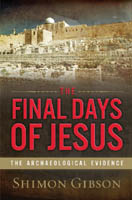
The Final Days of Jesus

The Final Days of Jesus: The Archaeological Evidence

Every year at this time (Holy Week) there is a dramatic increase in documentaries about the ‘real’ Jesus and the meaning of Easter.

To believers, it is difficult to fully appreciate the depth of God’s love for us—his fallen creatures—that in his redemptive plan he allowed himself to be tortured on our behalf.  However we accept that Jesus’ crucifixion was an historical event, and that his resurrection from death is the cornerstone of our faith (as the Apostle Paul stated in 1 Corinthians 15).

To skeptics, it’s difficult or impossible to believe.

But there are those in between that have no particular biases (or at least are willing to investigate the claims of Christianity objectively).  They are interested in figuring it out—essentially adding up the evidence before making up their own mind.  Undoubtedly this can be a great pathway to a strong faith.  Ask Lee Strobel.  Ask Hugh Ross.  Ask Josh McDowell.

In prior posts, we looked at what happened when and where on Good Friday, and the importance of the Resurrection.  But what I most want to share today is an example of getting to the Resurrection by subtraction.

Shimon Gibson is an esteemed archaeologist, arguably one of the foremost authorities on the archaeology of Jerusalem.  In his book, The Final Days of Jesus: The Archaeological Evidence, Dr. Gibson documents his interpretation of the archaeology of Holy Week.  Theologically his title is a bit provocative, but he does a good job relating the environment and settings.

I read Dr. Gibson’s book more than six months ago, but what really sticks with me is what one of his colleagues wrote about the book in a blog post.  Dr. James Tabor praised the book for its scholarship stating,

“There is no doubt in my mind that the rich contents of this wonderful and engaging book will make it a standard in the field of Christian origins. It is an indispensable handbook for the scholar, and a thrilling investigative read for the non-specialist wanting to know more of those last critical days of Jesus.”

But Dr. Tabor also wrote in the same post,

“I find Gibson’s closing lines of his last chapter, “Who Moved the Stone,” somewhat counterproductive in terms of what we might be able to responsibly say as historians. He writes: “The reality is that there is no historical explanation for the empty tomb, other than if we adopt a theological one, i.e., the resurrection. I leave it up to the reader to make up his own mind.” I have to disagree here. Though I freely admit our sources might never allow us to definitely state what happened that Easter weekend, I think by definition the explanation “God took Jesus bodily to heaven,” is not one that historians can responsibly entertain, as historians.”

“The reality is that there is no historical explanation for the empty tomb, other than if we adopt a theological one, i.e., the resurrection. I leave it up to the reader to make up his own mind.”  There are a lot of theologians who make just that point as the bottom line for belief in Jesus Christ and the Resurrection—the tomb is empty.

Dr. Gibson concluded his book immediately after making the empty-tomb statement with this statement,

“Some readers might think it is presumptuous of me, an archaeologist, to write about the character, achievements, and goals of such an important figure as Jesus.  After all, billions of people across the planet worship him as Christ the Saviour, and the Son of God.  But my views are expressed here honestly based on an analysis of archaeological and historical data available to me; I have no personal or religious axe to grind, one way or another, and I definitely have no wish to offend anyone, even though some of the things I say may be radical and controversial.”

Thank you Dr. Gibson for your honest lesson in subtraction.

Once you do your own subtraction and come to the realization that the Resurrection really is an historical event, then the evidence does demand a verdict.  What was that all about?  Who is that all aboutTruth is a person and the tomb is empty.  Happy Easter!


God Creates

I’m taking a fascinating apologetics course entitled “Creation and the Bible” offered by Reasons To Believe.  The course provides a great opportunity to take a different tack to Bible study.  It’s like strapping a lawnmower engine to the back of your devotional life and yanking the starter cord.  Wow, what a blessing!

Mystic Mountain

Mystic Mountain in the Carina Nebula

In the midst of a great deal of cerebral reading about Special and General Revelation, Martin Luther’s ideas on Sola Scriptura, Old-Earth Creationism, Dual Revelation, and Philosophical Reductionism (no one will speak to me at parties now—I’m sure), I started reflecting on the magnificence of the Creator and his ongoing creation. We can read the creation account in Genesis 1 & 2, and struggle  to fathom what that was like 13.7 billion years ago, but to really appreciate its magnificence, look at the science of astronomy.  Yes, God created, but importantly, he creates.

Gas Pillars

Gas Pillars in the Eagle Nebula (M16): Pillars of Creation in a Star-Forming Region

These whimsical, other-worldly images are photos from the Hubble Telescope. Photos! So if you want to debate whether or not God can do any particular thing, look at the worlds he is creating right now.  It’s pretty hard to argue—God has impressive credentials.

Dave Rudy recently sent this link that demonstrates the scale of the Universe (it requires Flash). Scroll your mouse wheel to go into to the smallest theoretical building blocks of matter or back out to the outer limits of space.  As you get way out there, you’ll begin to appreciate how massive these created worlds are.  And there are billions of them in the night sky.

Psalm 19 states, “The heavens declare the glory of God; the skies proclaim the work of his hands.  Day after day they pour forth speech; night after night they display knowledge.  There is no speech or language where their voice is not heard.”  The Apostle Paul wrote in Romans 1:20, “For since the creation of the world God’s invisible qualities—his eternal power and divine nature—have been clearly seen, being understood from what has been made, so that men are without excuse.”  These verses support the doctrine of General Revelation—that God reveals himself through his physical creation (nature), and that this revelation is universally evident.  The Bible (Scripture) is his inspired Special Revelation, where he makes clear those things which cannot be revealed by observing the natural world, such as the person and teaching of Jesus Christ and the resurrection.

As Lon Solomon would say, “So what?”  So we have two categories of revelation.  Great.  Huzzah for theologians.  But before yawning over General and Special Revelation consider this: what if all that groundbreaking scientific research can bring to bear regarding our understanding of the Universe actually supported God’s special revelation in the Scriptures?  In other words, how exciting would it be to discover that faith and science are not in conflict, but actually compliment each other?  What if some of the smartest and most gifted scientists—men and women who had distinguished themselves in fields like astrophysics and bioengineering—could use their studied observations about the physical world to corroborate what we read in the Bible?  Apologetics offers all that and more.  All it takes on our part is a little effort to hear them out.  You might be very surprised, as I am, to discover just how far these brainiacs can run with hard scientific evidence that proves what was written thousands of years ago by inspired writers.  It’s not just a few thoughts by a few scientists—it’s a landslide of evidence offered by an intellectual multitude.

If you want a real treat, get the Dual Revelation DVD—it gave me goosebumps.  These apologists have a powerful and refreshing way of looking at faith and the Bible.  You don’t have to park your brains at the door to be a Christian.  More to the point, our physical world does declare the glory of God.  But then again, someone came to that conclusion a long time ago.


Paul’s Missionary Journeys

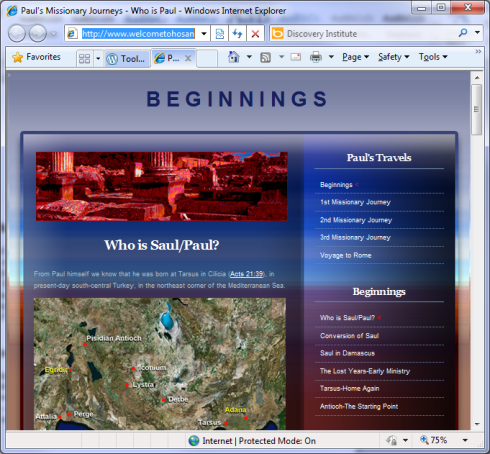
Here’s one of the best resources I’ve found for studying the Apostle Paul.  Dale Bargmann created a photo tour that traces Paul’s missionary journeys, with lots of sidebars and original material (Dale is a gifted photographer and has spent quite a bit of time photographing these locations and putting this material together).

Paul's Missionary Journeys

Paul's Missionary Journeys, by Dale Bargmann

To follow in an orderly (Kaqexeß) fashion, read down the left pane, and click the link at the bottom of each page.  Alternatively, use the navigation on the right to jump around.  You will find an amazing number of insightful comments while developing an appreciation for Paul and his ministry by ‘touring’ though this site.

Thanks Dale!


Agnes Gonxha Bojaxhiu

The Apostle Paul was scrawny, hard on the eyes, not a good speaker, and constantly paid the price for his style and message.  He had lots of scars and baggage.  He made mistakes.  He considered himself, “…less than the least of all God’s people .”  And yet he was one of the most influential people who ever lived.  Two thousand years after his death, his letters are among the most reproduced documents in the history of mankind.

In 2 Corinthians 10 Paul responded to attacks against his ministry and his person.  He acknowledged that he was “timid when face to face” (v. 1),  and  that people were saying, “His letters are weighty and forceful, but in person he is unimpressive and his speaking amounts to nothing” (v. 10).

It occurred to me this week, while thinking about Paul, that I had seen and heard someone who fit the description of being a less-than-impressive speaker, but having a powerful message that touched mankind.  Her name was Agnes Gonxha Bojaxhiu, and she was often called ‘diminutive’.  And like Paul she had detractors.  But she had the courage of her convictions and she was able to demonstrate the mercy and love of Jesus Christ in incredible ways.  And for that she was memorable.

In 1994 she gave a speech at the National Prayer Breakfast, attended by President Bill Clinton and a room full of dignitaries.  I remember that I could barely see her head above the podium, could barely make out what she was saying above the acoustics in the room, and that nevertheless she received a standing ovation.  It’s difficult to watch her speech (below) in some respects because she was not an impressive speaker.  But don’t miss the last minute when she stepped down from the podium.

So what did she say?  Here’s the impressive part—her transcript.  Many parts of her message confronted the views of the powerful people in the room, but she delivered it passionately anyway, to please an audience of one.  She had lived through unspeakable suffering to develop her message.  It’s the living Gospel ,with mandates and complete conviction.  Mother Teresa really walked the walk.  And she had a lot in common with the Apostle Paul.

Here’s a photograph of two renowned women—one was a beautiful lady who brought peace and joy to millions of people, and the other was a princess.

Princess Diana Meets Mother Teresa

Princess Diana Meets Mother Teresa