
All Christians believe that Jesus died for our sins. But what exactly does that mean? Christians disagree as to how Jesus died for our sin. Getting our theology right about the meaning of the cross tells us a lot about how we view the Gospel.
I first read John R. W. Stott’s The Cross of Christ some thirty years ago. Stott, one of the most respected evangelical leaders of the late 20th century, died fifteen years ago in 2010, having been one of the U.K.’s finest and most influential preachers. Stott teamed up to support evangelist Billy Graham for crusades across the United Kingdom in the 1950s, to pioneer the Lausanne movement which championed world missions. But Stott was also a prolific author, and in my view, The Cross of Christ stands as his finest book, giving us a mature, robust understanding of what it means to say that “Jesus died for our sins,” defending in irenic fashion the doctrine of penal substitutionary atonement against various critics.
The Cross of Christ has a message that is needed today. There are very good reasons why The Cross of Christ is a classic, and why Christians should continue to read it.
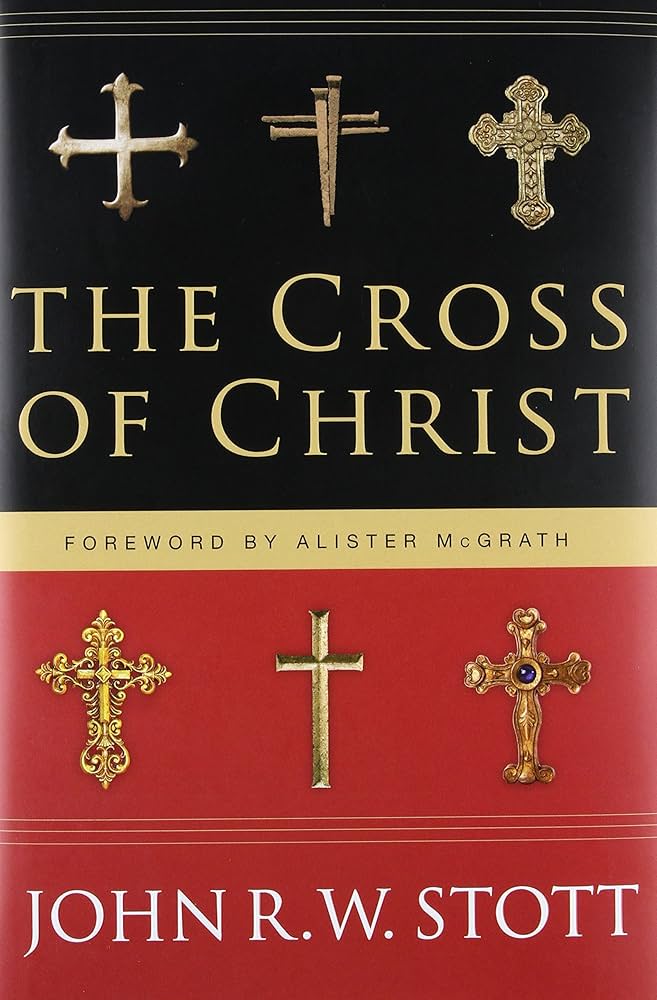
John R. W. Stott’s The Cross of Christ remains a classic defense of an evangelical view of the atoning work of Christ on the cross, offering a nuanced perspective on penal substitutionary atonement theory.
The Controversy Over Penal Substitutionary Atonement
The idea of “penal substitutionary atonement” is controversial today, even in evangelical circles. Google’s AI engine tells us that penal substitutionary atonement, abbreviated here as “PSA,” is a “theological concept explaining Jesus Christ’s death on the cross as a substitutionary punishment for humanity’s sins. It posits that Christ bore the penalty (punishment) that humanity deserved for sin, satisfying God’s justice and allowing for forgiveness and reconciliation.” To talk about “penal substitutionary atonement” (PSA) is a mouthful, and as result, can be a bit confusing to figure out.
For example, Missouri pastor Brian Zahnd acknowledges the atonement work of Christ on the cross, but he rejects the concept of “penal substitution.” Jesus died for our sins, but not in a PSA way. Zahnd believes that the concept of “penal substitution” makes God into a monster, a monster who would kill even his own Son:
“Some theories [of atonement] are merely inadequate, while others are repellent. Especially odious are those theories that ultimately portray God as sharing the petty attributes of the primitive and pagan deities who can only be placated by the barbarism of child sacrifice….. The cross is many things, but it is not a quid pro quo to mollify an angry God….
…. The cross is not a picture of payment — the cross is a picture of forgiveness. Good Friday is not about divine wrath — Good Friday is about divine love. Calvary is not where we see how violent God is — Calvary is where we see how violent our civilization is. The cross is not where God finds a whipping boy to vent his rage upon — the cross is where God saves the world through self-sacrificing love…
…. When the cross is viewed through the theological lens of punishment, God is seen as an inherently violent being who can only be appeased by a violent ritual sacrifice.”
Is PSA about finding a “whipping boy” to vent God’s rage upon? Zahnd rejects the penal language about atonement, such as “the theological lens of punishment,” and the language of substitution does not fare much better. If all you heard or read about PSA was from Brian Zahnd, you might think that he is right, and that PSA is not a good way to think about the cross of Christ.
Christians Singing About Penal Substitutionary Atonement
And yet, Christians sing about it all the time. All of the buzzwords which Zahnd finds as “odious” are embedded in dozens of worship songs sung nearly every week in evangelical churches.
Consider the “wrath” of God in Stuart Townend’s and Keith Getty’s widely sung “In Christ Alone”:
“On that cross, as Jesus died, the wrath of God was satisfied.”
Or consider the language of “payment,” as in various contemporary versions of the 19th century hymn “Jesus Paid It All,” originally written by Elvina Marble Hall, in 1865:
“Jesus paid it all, all to Him I owe, sin had left a crimson stain, He washed it white as snow”
And this other line:
Oh, praise the One who paid my debt, And raised this life up from the dead.
Or even a fairly recent song by Shane and Shane, “All Sufficient Merit”:
“It is done, it is finished, no more dеbt I owe
Paid in full, all-sufficient merit now my own”
Reach back into 18th century for this classic from Charles Wesley, “And Can It Be?”
And can it be that I should gain
An int’rest in the Savior’s blood?
Died He for me, who caused His pain?
For me, who Him to death pursued?
Amazing love! how can it be
That Thou, my God, should die for me?
Lots of substitution language in Wesley’s famous hymn. Too much for Brian Zahnd?
You would have to purge hymnals and Powerpoint slides of projected screen lyrics of a lot of standard worship song phrases to remove the references which Zahnd finds objectionable.
Will The Real “Penal Substitutionary Atonement” Please Stand Up?
But is Zahnd somehow onto something? Much of the controversy comes down to how key terms like “penal” and “substitutionary” are defined which makes the difference.
Frankly, you can find evidence to support Zahnd’s critique by listening to various sermons given by some vigorous defenders of PSA. Minneapolis preacher John Piper has given the following explanation as to when Caiaphas, the high priest of the time of Jesus’ crucifixion, in John 11:50, said that was better to have Jesus killed than it was that the whole nation should perish:
“In the mind of Caiaphas, the substitution was this: We kill Jesus so the Romans won’t kill us. We substitute Jesus for ourselves. In the mind of God, the substitution was this: I will kill my Son so I don’t have to kill you. God substitutes Jesus for his enemies.”
Did God really kill Jesus? Did the Father really kill his Son? Zahnd would probably interpret Piper as saying yes, that God, the Father, killed the Son, in order to satisfy the wrath of the Father against sinful humanity. For Zahnd, Piper’s explanation makes Jesus, as the Son, into “a whipping boy to vent [God’s, the Father’s] rage upon,” the very idea which Zahnd rejects as being the core of PSA.
This is where Stott’s chapter on “The Self-Substitution of God” is alone worth the price of the book. Take note of what John Stott says about certain well-intended defenders of PSA, who end up delivering a caricature of what the work of Christ is really about on the cross:
“In the one [caricatured] case Christ is pictured as intervening in order to pacify an angry God and wrest from him a grudging salvation. In the other [caricature], the intervention is ascribed to God, who proceeds to punish the innocent Jesus in place of us the guilty sinners who had deserved the punishment. In both cases God and Christ are sundered from one another: either Christ persuades God or God punishes Christ. What is characteristic of both presentations is they denigrate the Father. Reluctant to suffer himself, he victimizes Christ instead. Reluctant to forgive, he is prevailed on by Christ to do so. He is seen as a pitiless ogre whose wrath has to be assuaged, whose disinclination to act has to be overcome, by the loving self-sacrifice of Jesus.
Such crude interpretations of the cross still emerge in some of our evangelical illustrations, as when we describe Christ as coming to rescue us from the judgment of God, or when we portray him as a whipping-boy who is punished instead of the real culprit, or as the lightning conductor to which the lethal electrical charge is deflected.” (Stott, The Cross of Christ, p. 149-50)
Ah, here we see Zahnd’s despised “whipping-boy” complaint against PSA. However, in contrast, Stott sees certain “whipping-boy” illustrations as indicative of caricatures which distorts a genuine understanding of PSA. It makes the casual observer wonder what PSA really is all about.
It Is Possible to Misread the Bible in Support of PSA
Furthermore, Stott is careful not to overstate his case. For example, it is quite common in evangelical circles to say that Jesus paid the debt for our sin in full on the cross, as many worship songs declare. In support of this view, Jesus’ last words on the cross as recorded in John 19:30, as “it is finished,” is translated from the single Greek word tetelestai.
Many bible teachers have been taught, and pass onto their congregations, particularly over the past hundred years, that this word tetelestai in an economic context means “paid in full,” which fits in nicely with the motif of penal substitutionary atonement. In the early 20th century, it was commonly thought that tetelestai was found on ancient papyri receipts in Egypt denoting a paid off debt or taxes.
Unfortunately, newer research has shown that this identification for the word “tetelestai” is actually erroneous. Such papyri receipts have a word close to tetelestai on them, but it is indeed different from what is cited as Jesus’ last word(s) in John 19:30. In other words, neither Jesus’ hearers nor John’s readers would have readily picked up on the idea that Jesus acknowledged paying off a sin debt by uttering these word(s).
Thankfully, John Stott does not lead the reader down that rabbit hole, which is actually a dead end. Stott goes along with the majority of English translations today of John 19:30 to argue that tetelestai simply means “it has been and will for ever remain finished” (Stott, p. 82). Like previous interpreters such as Leo the Great in the 5th century and Martin Luther in the 16th has suggested, for Jesus to have said “it is finished” would sufficiently mean that the work of Christ, however it would be understood, was finished, and that Scripture was indeed fulfilled.
We may still conclude that Jesus paid off our sin debt in full, after deeper reflection. But it would be overstating the case to argue that Jesus’ last statement on the cross specifically says this.
Self-Substitution On God’s Part Regarding the Cross
The key to grasping how John Stott can defend penal substitutionary atonement, while rejecting well-intended yet misguided caricatures, is in Stott’s concept of self-substitution, whereby God the Father through his Son offers himself as the very substitute to satisfy his own wrath against human sin. In Stott’s framework, there is no need to pit the wrath of the Father against the love and mercy of the Son. The Son and the Father are not working at cross purposes against one another. The Son shares in the wrath of the Father against sin. Likewise, the Father shares in the love and mercy of the Son on behalf of sinful humanity.
As Stott would go onto say:
“We must not, then, speak of God punishing Jesus or of Jesus persuading God, for to do so is to set them over against each other as if they acted independently of each other or were even in conflict with each other. We must never make Christ the object of God’s punishment or God the object of Christ’s persuasion, for both God and Christ were subjects not objects, taking the initiative together to save sinners. Whatever happened on the cross in terms of “God-forsakenness” was voluntarily accepted by both in the same holy love that made atonement necessary…There was no unwillingness in either. On the contrary, their wills coincided in the perfect self-sacrifice of love.” (Stott, p. 151)
In a certain broad sense, John Piper might be correct to say that out of respect to God’s sovereignty and his providential activity in the world that “God killed Jesus.” But the saying is misleading. Saying that “God killed Jesus” is not that much different from saying that when your dear grandmother dies of cancer that “God killed your grandmother.” Really? With all due respect to John Piper, Piper’s comments are highly problematic.
The danger in making such an assessment is that it invites the kind of caricatures which critics of PSA, such as Brian Zahnd , will make against the PSA position as a whole. Honoring the sovereignty of God as part of a theodicy, which says that even in the face of evil, God’s will remains supreme, arguably means well. But if it leaves the impression that God is somehow a capricious monster, whose anger must be placated in a manner no different than the pagan gods, then the assessment is counterproductive at best, a horrific scandal at worst.
Rumors of that scandal only encourages preachers like Brian Zahnd to double-down on their critique of PSA, as a corruption of pure Christian doctrine.
Thankfully, John Stott’s position avoids the pitfalls exposed by both misguided attempts to rescue the pure atoning work of Christ away from the supposedly painful grip of “penal substitution,” on the one hand, and overzealous apologetics which say that “God killed Jesus,” on the other. I have had to re-read these sentences from John Stott several times to let it all sink in, as Stott sprinkles in quotes from P. T. Forsyth, the late 19th and 20th century Scottish theologian:
“[God] was unwilling to act in love at the expense of his holiness or in holiness at the expense of his love. So we may say that he satisfied his holy love by himself dying the death and so bearing the judgment which sinners deserved. He both exacted and accepted the penalty of human sin. And he did it ‘so as to be just and the one who justifies the man who has faith in Jesus’ (Rom. 3:26). There is no question now either of the Father inflicting punishment on the Son or of the Son intervening on our behalf with the Father, for it is the Father himself who takes the initiative in his love, bears the penalty of sin himself, and so dies. Thus the priority is neither ‘man’s demand on God’ nor ‘God’s demand on men’, but supremely ‘God’s demand on God, God’s meeting his own demand’ “(Stott, p. 152).
Does Stott’s characterization of God’s “self-substitution” regarding the cross of Christ go against any traditional sense of penal substitutionary theory? Is Stott redefining terms like “penal,” “substitution,” or even “atonement” to make PSA as traditionally understood unrecognizable? To my knowledge, Stott stands firmly within the traditional camp while rightfully rejecting extreme, excessive expressions of the traditional PSA view. I find it curious that contemporary critics of PSA, including those acting in good faith who are not merely throwing stones at PSA with overworn tropes (like saying that Jesus’ death on the cross was an act of “cosmic child abuse”), rarely interact with Stott’s classic work on the topic. If I am wrong about this, I would like to be corrected.
Applying the Doctrine of the Cross of Christ
While Stott’s careful discussion about God’s self-substitutionary act of atonement through the work of Christ on the cross is the most valuable contribution of Stott’s book, The Cross of Christ has many other benefits. Stott finds that the language of penal and substitutionary atonement is complemented by other biblical ideas that flesh out the doctrine in full.
Stott reminds Christians of the oft forgotten aspect of Christ’s defeat over the powers of sin, death, and evil, which was recovered for Western Christians by the early-to-mid 20th century Swedish theologian, Gustav Aulen, through his influential 1930 work Christus Victor. The Christus Victor motif puts emphasis on Christ’s victory over the powers of darkness, a feature long held prominent in Eastern Orthodoxy (Stott, p. 228ff).
Stott also finds value in certain aspects of Peter Abelard’s “moral influence” theory of the atonement. In the “moral influence” view, Christ’s death on the cross is an expression of the love of God, in which Christians are called to emulate that same kind of love, in our relationships with God and others. Jesus laid down his life for us out of love, therefore we are to lay down our lives for others. Abelard was reacting against his contemporary fellow 12th century theologian colleague Anselm, who pioneered the language of “satisfaction,” for describing the work of Christ, with respect to uphold God’s honor (Stott, p. 217ff). Stott finds some fault with Anselm, who “should have laid more emphasis on God’s love” (Stott, p. 221).
However, Stott finds some fault with those critics like Abelard and Aulen, for their focus on their respective efforts to emphasize the subjective aspect of atonement at the expense of the objective aspect of atonement, championed by Anselm. It is the objective character of the atonement that enables the subjective aspect. In other words, penal substitution is not at odds with either Christus Victor or moral influence motifs, but complement each other. Yet Stott suggests that penal substitution makes Christus Victor and moral influence possible. As Stott says, “the cross can be seen as a proof of God’s love [the subjective element] only when it is at the same time seen as a proof of his justice [the objective element]” (Stott, p. 220).
The last portion of The Cross of Christ focuses on the application of the doctrine of the cross for Christian practice. Because of the cross of Christ, Christians are called to sacrificially love others just as Christ has shown his love towards us. It is through meditation on the cross of Christ where we are enabled to love even our enemies. When we partake of the Lord’s Supper, we are reminded of the suffering of Christ which helps the believer to find support when we experience times of suffering for Christ’s sake.
Some have criticized that the doctrine of penal substitutionary atonement has led Christians to not “take up our cross and follow him.” A careful read of Stott’s pastorally rewarding last portion of the book should alleviate such concerns. A full appreciation of Christ’s work on the cross will lead the believer to follow in Christ’s footsteps, as opposed to walking the other way. A whole host of other practical nuggets show that the doctrine of atonement is not merely an abstract set of concepts.
Some Critique of Stott’s Exposition of the Cross of the Christ
Despite its strengths, The Cross of Christ has missteps in a few places. In analyzing the 1856 century Scottish work The Nature of the Atonement, by John McLeod Campbell, Stott acknowledges that Campbell upholds the substitutionary aspect of the cross while saying that Campbell dismisses the penal aspect of the cross. Stott claims that for Campbell, substitution dissolves “into vicarious penitence, instead of vicarious punishment.” As a result, Stott dismisses Campbell’s effort to “retain the language of substitution and sin-bearing, while changing its meaning.” Such effort “must be pronounced a failure. It creates more confusion than clarity.” (Stott, pp. 141-143).
Stott’s critique is not entirely fair. While the substitutionary aspect of Campbell’s approach remains sound, the penal aspect of atonement we should admit is harder to defend, primarily because it is so easily misunderstood. Is God’s wrath concerning sinful humanity directed towards sinful humans or sin itself? While it might seem more pious to say that God’s wrath is directed towards sinful humans, this is only because sin has become so regretfully intertwined in humanity that it becomes exceedingly difficult to separate our sin from our core human identity. Yet a more proper way is to say that God mainly focuses his wrath against sin itself, and not the people for whom Christ has died.
Stott also has very little discussion, if any, analyzing the difference between ritual purity and moral impurity, two fundamental concepts standing behind the sacrificial system described in the Book of Leviticus. Any genuine New Testament theology of cross is indebted to the Book of Leviticus. But the concept of atonement as described in Leviticus is quite complex and nuanced, and Stott only makes scattered references to it. More recent research shows that Christian interpreters have tended to overlook or minimize Jewish views regarding atonement and the Levitical ritual impurity system when articulating the doctrine of the cross. For example, numerous scholars today hail the work of the Jewish scholar Jacob Milgrom on Leviticus as transformative, most of Milgrom’s work on Leviticus having been published after Stott published The Cross of Christ in 1986. In other words, while Stott’s description of the atoning work of Christ is robust, it is still not as robust as it could have been.
Despite these few shortcomings, John R. W. Stott’s The Cross of Christ remains a trustworthy and helpful guide for understanding and applying the truths behind the death of Christ for our sins. The various motifs surrounding the work of Christ, including penal substitution, Christus Victor, and the moral influence of Christ, all contribute to a rich theology that can nourish the church down through the ages. If I could name one contemporary book, even though it was first written back in 1986, which adequately defends PSA thoroughly against a wide variety of critics, Stott’s The Cross of Christ would be my go-to recommended resource.
One Final Thought:
Christian opponents of penal substitutionary atonement (PSA) undoubtedly mean well. They are not all “woke,” progressive Christians, as some strict defenders of PSA over-enthusiastically claim, though undoubtedly some very much are.
As evidenced by John Stott’s The Cross of Christ, much of the critique of PSA depends on all-too-common caricatures which Stott effectively dismantles. Just because someone props up a caricature of PSA as a defense of PSA does not mean that they understand what PSA really is.
Here is something to keep in mind: Some have suggested that the Eastern church never accepted any kind of doctrine of penal substitutionary atonement, and continues to reject penal substitution as a theological innovation of the Western church. But one should not be too hasty in drawing such a conclusion.
Saint Athanasius, surely a hero in Eastern Orthodoxy, wrote this in a letter to Marcellinus:
“He suffered for us, and bore in himself the wrath that was the penalty of our transgression, even as Isaiah says, Himself bore our weaknesses.”
Saint Cyril of Alexandria in his commentary on John’s Gospel wrote this:
“We were, then, accursed and condemned, by the sense of God, through Adam’s transgression, and through breach of the Law laid down after him; but the Savior wiped out the hand-writing against us, by nailing the title to his cross…For our sake he paid the penalty for our sins.”
More recently, Saint Philaret of Moscow, wrote in a catechism for Eastern Orthodoxy:
“Jesus Christ, the Son of God … endured all the penalties due to all the sins of men, and death itself, in order to deliver us from sin and death….. His voluntary suffering and death on the cross for us, being of infinite value and merit, as the death of one sinless, God and man in one Person, is…a perfect satisfaction to the justice of God, which had condemned us for sin to death…to give us sinners pardon of our sins…”
All of the typical theological trigger words which opponents of penal substitution find to be so odious find their affirmation in the writings of these Eastern Orthodox leaders: Athanasius wrote of “wrath” and “penalty.” Cyril wrote of Christ as the one who “paid” the “penalty” for our sins. Philaret approved of the language of “satisfaction” to describe the work of Christ on the cross. So, before someone wants to rewrite many of our worship songs, we should reckon with the words of these highly respected church fathers of the East.
We can preserve the best of the tradition that gave us a theology of penal substitutionary atonement, while also embracing other themes and motifs that fill in the colors of the portrait of Christ on the cross, such as Christus Victor and moral influence. John R. W. Stott’s The Cross of Christ helps us to do just that.
An Addendum: A Timely Debate When I Post This Book Review!…..
Just a few weeks after I finished re-reading Stott’s The Cross of Christ, Christian evangelical Twitter (or X) blew up when popular bible teacher John Mark Comer came out to say that he recently read a book which delivers a “knock out blow to PSA.” Into the flurry of comments, some more responsibly nuanced than others, with a lot of back and forth, Protestant apologist Gavin Ortlund gives a summary of classic understandings of penal substitutionary atonement in the following video, offering a modest Stott-like defense, while rejecting caricatures of PSA. John Mark Comer has since walked back some on his earlier statement, stating that he still believes in some form of substitutionary atonement, but the debate continues. Some even wonder if an evangelical can truly be an academic, or do doctrinal commitments prevent someone from rethinking a long cherished belief. Andrew Rillera’s Lamb of the Free is at the heart of the controversy. Even John Mark Comer, in a recent follow-up statement acknowledges that Rillera “completely denies all substitution, which seems untenable biblically to me.” Derek Rishmawy, a blogger whom I follow occasionally, has written a response to John Mark Comer’s concerns about PSA. Rillera’s book is on my “to-be-read” list. I am open to being challenged, but you have to make a pretty compelling case to dismiss a Christian doctrine that goes back hundreds of years to the early church:



 Veracity