How Christians Change Words

I am doing a study on how Christians use words, taking a look at reading some of the Inklings, namely Owen Barfield and C. S. Lewis. But I ran into this nugget from a blog post by Logos software bible scholar, Mark Ward, author of the extraordinary Authorized: The Use and Misuse of the King James Bible, that I reviewed last summer.

So, what is a “pastor?” Furthermore, what is an “elder?”

I have already written about that elusive term “elder.” So, let us focus on the former here.

Oddly enough, for the word “pastor,” the venerable King James Bible (KJV) only uses that exact word once in the whole Bible, Ephesians 4:11. Otherwise, the term “pastor,” from the Greek word poimen, is translated as “shepherd,” as in being a shepherd of sheep.

Notice that in Ephesians 4:11, the word pastor does not describe an office, but rather a particular spiritual gift. Elsewhere, the concept of pastor/shepherd describes a certain function in the church. Notably, that same concept of shepherding is used to describe the function of the elders (from the Greek, presbyters) of the church in Ephesus, who are charged by Paul (Acts 20), to care for the flock, and protect them from spiritual wolves, that threaten to come in and devour the sheep (Acts 20:28-30).

The word elder, and its related term, overseer, do correspond to a type of office in the church, as in 1 Timothy 3, as one who is “able to teach,” “not a recent convert,” and so on. This meshes well with the function of pastoring the flock.

At the risk of oversimplifying a complex topic, or beating it to death, ponder a moment again about that word elder. Oddly though, Christians today typically do not always regard the word elder has having the same sense of pastor. Often, we split the concept of elder from pastor. Many churches will have a group of elders, but those elders are different than the pastor or pastors, which can be really confusing.

Then there is the term overseer. The old King James Version translation of that Greek word, episcopos, “bishop,” does get used by different denominational groups. Furthermore, for those traditions that tend to predate the Reformation, there is the terminology of priest, that is sort of, but not quite, synonymous with the Protestant pastor, but that is another whole intricate discussion.

But for some odd reason, the term pastor appears to win out, above them all, to describe the leader of a church, in many evangelical circles. I typically hear someone called “Pastor Bob,” but never “Shepherd Bob,” and only sometimes “Elder Bob.” Never have I heard someone called “Overseer Bob,” or “Church Leader Bob,” despite the fact that most modern translations of 1 Timothy 3:1 speak of the word overseer or the phrase church leader, to describe an elder. Rarely do you hear “Elder Bob” mentioned as the “Pastor.”

As Mark Ward points out, this is an example of when a metaphor, becomes so stable over time, that it effectively becomes a whole new word. If I could pay money to get every student of the Bible to grasp this, I would surely go broke.

To be a pastor was once used to describe a practice in animal husbandry. Now a pastor has become almost exclusively an ecclesiastical term. You rarely see a shepherd caring for their flock of sheep, in industrial, modern societies. But when observed, I never hear the term pastor used, only shepherd.

A pastor is nowadays almost always a “religious” term.

What was once a metaphor to describe the function of an office, has now become the office itself. Rightly or wrongly, that is what Christians do to words. Language changes.

…..Which just goes to prove that a lot of the discussions we have in our churches today about church governance can be exceedingly difficult, when we do not share a common vocabulary, by not recognizing how metaphors change character over time, to create new meanings.


How Modernity Influenced the Evolution of English Words

I have been reading Owen Barfield’s History in English Words, and it has some amazing insights into how language changes.

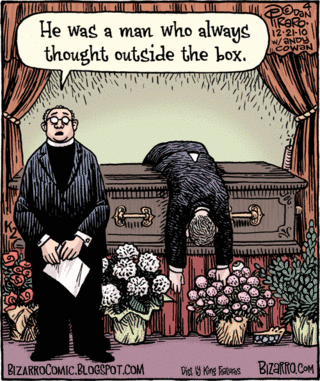
By way of introduction, consider the cartoon above, about “thinking outside of the box.” Today, “thinking outside of the box” is thought of as a virtue. It suggests getting outside of one’s traditional, conceptual world, and considering a larger context for thought. The adage is promoted all over the English-speaking world, ranging from staff development training sessions in corporations, to our political discussions, and in how we think about our view of the world more broadly.

But is it really possible to completely “think outside of the box?” Or is it more accurate to say that humans who uphold such a virtue are really just jumping from one box into another box, merely fooling themselves that they are somehow above the “boxes” that others impose on them? What about the boxes we all impose on ourselves, without realizing it? What happens when you think you are “thinking outside of the box,” only to eventually discover yourself living inside some other box?

The age of the “Enlightenment,” or what some call “modernity,” represents that period in Western history when science developed in ways unimagined heretofore. Now, there have always been Christians, like myself, who believe that science and faith go hand-in-hand with one another, or at the very least, say that science and faith are not at war with one another. But the rise of science, and along with it, the more metaphysically-minded belief of scientism, has had a massive influence on how the English language has changed over just the past few centuries, as scientism leans towards having a more ideological focus, intent on supplanting Christianity…. as though scientism seeks to “think outside of the box” of Christianity.

For example, Barfield in his chapter on Mechanism (p.183-200) notes that the practice of adding the tag of “-ism” to an end of the word, as in scientism, is a modern development, indicating a change in how modern people have a more “contemplative attitude towards all we ourselves do and feel and think,” as Barfield framed it. Perhaps this is because we live in a world that is so captivated by science, along with the accoutrements of technology, with our washing machines, and other labor-saving devices, with our cell phones and Google, all affording us the time and energy to be more contemplative, at least for some. We then take something like science, and give it a more ideological component, by adding the “-ism” tag to the ending of the word. Also, there is the word feminine, which gives us now the related feminism, as well as the word human, and its modern related humanism. The list can go on.

Then there is the whole trend towards the secular, in an attempt to marginalize the spiritual. The growth of scientism has enabled the popularity of words like determinism, as a secular alternative to the word predestination, allowing one to speak of such things without the theological assumptions of the latter.

The practice of prepending “self-” to a whole variety of words, is in particular a product of the Enlightenment, as with words like self-acceptanceself-respect and self-help. You never had self-help books written prior to 19th century, but we are completely overwhelmed with the self-help genre in books today.

The word pious once meant describing someone as devout and spiritually faithful. Now it has the connotation of feeble-mindedness. Even the word religion, which once meant something to describe the whole of human life, with respect to one’s relationship with God, has now been placed in a special category. To be religious is be someone who believes in God, as though religion is a type of add-on to human existence, and not something essential to human existence. In other words, everyone is a human being, but only some are religious, a way of thinking that would have been unthinkable a few hundred years ago.

All of these changes are new, as the modern world has sought to divide the natural and supernatural realms, which were formerly united.

Methinks that the advocates of scientism today have simply jumped out of one box, into another box, without knowing it.


The Problem with Words

You all will probably think I am weird.

But for some upcoming blog posts, I plan on blogging some thoughts every now and then about the problem with words.

Over the past year or so, it occurred to me that many Christians get hung up on how we use certain words, in theological discussion. A lot of strife between believers is due to not having a basic agreement on terminology, when we engage in important discussions about the Bible.

This is not uniquely a Christian problem. It is a problem with the whole human race. Somewhere, I am sure that our sinfulness figures into the equation. But Christians are especially susceptible to the problem because we look to a text, namely “the Bible,” as our authority. So, when you deal with a text, you are dealing with words, and often, words gets lost in translation, and in our communication with other believers.

I confess, that I am not always good at it myself.

When confusion results, because of our failure to grasp a common vocabulary, this is not good for people who believe that God has revealed Himself through the pages of Scripture. So, I decided to read some of the writings of “The Inklings,” that 20th century British braintrust, that met together weekly in a pub, to discuss the really big things in life, to give me some help.

In particular, I checked out C.S. Lewis’ Studies in Words, and Owen Barfield’s History in English Words. Both Lewis and Barfield were experts in philology, or the study of language. Barfield’s theology is a bit strange, compared to Lewis’ “mere Christianity,” but both writers give us tremendous insight into some of the challenges in how language evolves over time, and how we end up using words, in our communication.

For a quick example, Owen Barfield (p.66) writes about a certain Sir John Cheke, a 16th English Reformer, who worked on an English translation of the Book of Matthew. For about a thousand years prior to Cheke, the only readily available translation of the Bible in England was St. Jerome’s Latin Vulgate. But like more well-known Reformers, such as William Tyndale, Cheke believed that the Bible should be accessible in the mother tongue of his native England, in a language that everyone could read, as the average person understood very little of Latin.

But Cheke was very creative in his English translation of Matthew, looking for uniquely English words, or closely English-like words, to translate certain terms, instead of trying to borrow from Latin.  The King James Version (KJV) of the Bible translates Matthew 4:24 like this:

And his fame went throughout all Syria: and they brought unto him all sick people that were taken with divers diseases and torments, and those which were possessed with devils, and those which were lunatick, and those that had the palsy; and he healed them.

Notice how the KJV translators used the word “lunatick” to describe someone who was probably mentally ill. Cheke thought “lunatick,” or our more modern, “lunatic,” to be too Latinized. So, he came up with his own word, derived from the traditional English word, for that brightest object in the nighttime sky, “moond.”

Have you ever thought of a crazy person as being “moond?”  No, I did not think so. Neither did I.

The etymology for the word, luna, the root for lunatic, is derived from an old Latin name for the “goddess of the moon.” Perhaps Cheke believed that the pagan or occultic ideas associated with the word lunatic were inappropriate for use in the Bible, whereas the traditional English moon, could be slightly altered to signify the same idea, with less pagan connotations. I do not know, but it is fascinating to think about.

As an aside, this helps me to better understand why some Christians refuse to use the word “Easter” to speak of Christ’s Resurrection, claiming that the concept of Easter is rooted in pagan mythology.

As a further aside, Barfield notes (p. 65,) that John Wycliffe, the 14th century translator of the Bible into English, used the English-sounding word againrising to translate the Latin word resurrectio, as well as the English-sounding undeadliness to translate the Latin word immortalitas.

I often wonder what the English-speaking world would be like if Wycliffe’s translation of these words would have won out over the traditional Latin transliterations into English.

Anyway, back to Sir John Cheke….

Here are a few more examples of Cheke’s attempt to de-Latinize the Bible:

  • Instead of the Latin word centurion, as in a “Roman centurion,” Cheke opted for the word hundreder.
  • Instead of the Latin word apostle, Cheke chose the word frosent.  This strange word frosent, was derived from a short phrase “from-sent,” since an apostle basically means someone who is sent out by someone else; as in when Jesus sends out the twelve apostles, in Matthew 10.
  • Instead of the Latin word crucified, Cheke translated that as crossed.
  • Instead of the Latin word proselyte, Cheke translated that as freshman.

That all sounds really quirky to us today, for the simple reason that Cheke’s translation of the Book of Matthew never really caught on with 16th century English readers.

Which is why most people have never heard of Sir John Cheke.

Which is why we find more Latinized words, even in some of our more modern translations still today, like centurion, apostle, crucified, proselyte, …. and lunatic.

Words are funny things, are they not?

.     .     .

Other posts in this series:

How Modernity Influenced the Evolution of English Words

How Christians Change Words

Verbicide

Conservative and Liberal as Christian Labels

Concluding Thoughts on Owen Barfield’s History in English Words


Andy Stanley and Jeff Durbin: An “Unbelievable” Discussion About Apologetics

Veracity readers will know that I have posted several times about Andy Stanley, pastor of one of the largest churches in America. Last month, my wife and I attended the Buckhead branch of Andy Stanley’s church in Atlanta, Georgia. Though pastor Stanley was not preaching that week, it was eye-opening to experience how Stanley’s NorthPoint community network of churches function, to reach a large city like Atlanta.

Andy Stanley has become rather “infamous” for coining the phrase that Christians should “unhitch” their faith from the Old Testament, a theme present in his bestselling book Irresistible. Despite what one might think of this controversy, Andy Stanley is more fundamentally known as a preacher who engages in what is called evidentialist apologetics, in an attempt to reach the non-believer with the Gospel. Evidentialist apologetics is a way of establishing common ground with a skeptical non-believer, seeking to share the Truth of Christ, by making an appeal to scientific and historical evidences that support the validity of the Christian faith. Some good examples of Christian apologists who make use of evidentialist apologetics include J. Warner Wallace, Frank Turek, Michael Licona, and the most well-known of them all, William Lane Craig.

In Andy Stanley’s particular approach, Andy Stanley says we should not start with the Bible, but rather start with the Resurrection of Jesus. We build our case for Christ by making a series of arguments in sequence, beginning with the reality of Christ’s resurrection, which leads to establishing the divine authority of Jesus, which then leads to the authority of the Bible, and its salvation message. The simplest way to put it is that it is the event of the Resurrection that gives us the text of the Bible, as we have it today, and not the other way around.

So, I was really excited to learn that Justin Brierley, of the British apologetics podcast, Unbelievable?, was able to get Andy Stanley together with presuppositionalist apologist Jeff Durbin, in order to discuss the nature of apologetics. In contrast with evidentialist apologetics, presuppositional apologetics takes a different approach, whereby you begin with the self-attestation of the truthfulness of Scripture first, and only then speak of the various doctrinal claims of the Christian faith, including Christ’s resurrection. Jeff Durbin himself is a pastor in Phoenix, Arizona, who has been mentored by perhaps the most influential presuppositional apologist, of a Calvinist persuasion, of our day, James White, of Alpha Omega Ministries, also headquartered in Phoenix, Arizona. Durbin, a popular YouTube Reformed apologist, has the unique distinction of being cast in several martial arts movies.

While I do believe that presuppositionalist apologetics does have its place, I am more of an evidentialist. Perhaps that is because that is how God reached me with the Gospel. I tend to differ with Durbin’s brand of apologetics, as presuppositionalist apologetics often begs the question: How do you build a case for Jesus, based on the Bible, when the non-believer does not believe the Bible to be trustworthy in the first place?

Sure, you could begin an evangelistic discussion by asking your listener to pretend that the Bible is reliable and true. But there is a big gap between pretending to believe the Bible, versus actually believing the evidence that exists, to support the authenticity of its message.

Even Christians often come to the Bible with their own negative judgments. An evidentialist approach seeks to build a bridge, that can help the skeptic or puzzled Christian to rethink their own reason for looking down at the Bible, or certain parts of the Bible. A presuppositional approach works great, if the person shares the same presuppositions. But a purely presuppositional approach tends to lead people to talk right past one another. In the worst cases, the presuppositional approach blows up bridges instead of building bridges, in our evangelistic or discipleship conversations.

A more troublesome question for presuppositional apologetics is this: Why start with the Bible? Why not the Book of Mormon? Or the Koran? Or the Bhagavad Gita?

Even if you start with the Bible, as opposed to starting with the evidence for the Resurrection, you still have to figure out which systematic view of the Bible you plan to go with: A Calvinist view? An Arminian view? A dispensationalist view? A charismatic view? Which one?

Andy Stanley’s particular approach does have some problems, as I have discussed before, so it is great to have someone like a Jeff Durbin, with whom I still have more disagreements with, on the other side of the debate, to challenge him. In the end, it is quite clear that there is no “one size fits all” approach to Christian apologetics that works for everyone. The discussion between Stanley and Durbin is great way to figure out where you stand, with respect to how you defend your faith, when engaging a skeptical non-believer. A riveting 90-minutes. This really is an amazing discussion!!


To Know With Certainty: A Perfect Present for a High School Graduate

On a recent trip down to Florida, my wife and I met up with a cousin of my mom’s, Dr. G. Lee Southard. Lee has been retired for a few years, living with his wife, Nancy, in Ft. Myers, Florida. After a successful career in pharmaceuticals, Lee has now become a Christian author. So, if you are looking for a great book, to give to a high school graduate, I can make the perfect recommendation, as I personally know the author!

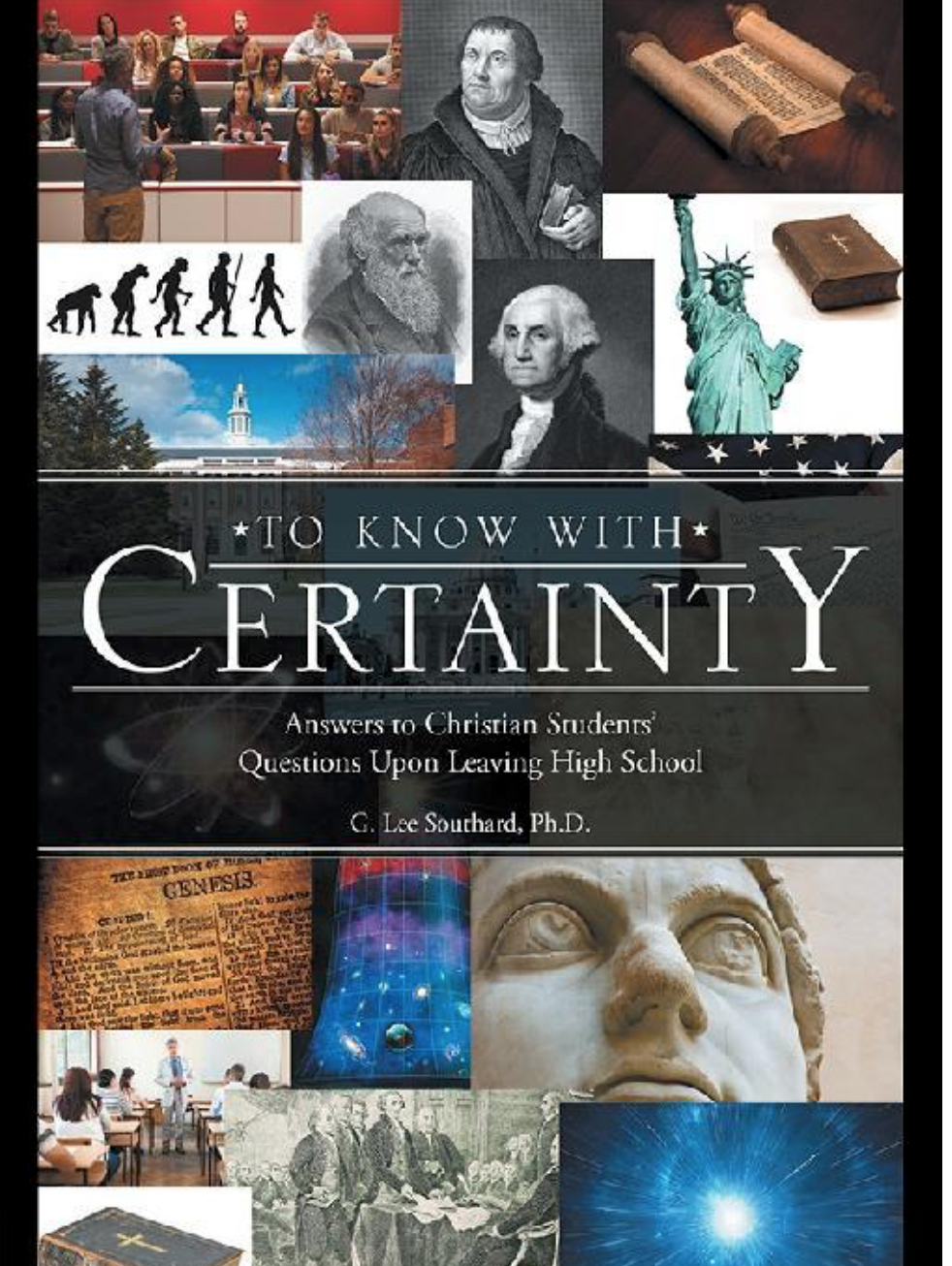
The title is pretty self-explanatory, To Know With Certainty: Answers to Christian Students’ Questions Upon Leaving High School. As a proud grandfather, Lee has become burdened with what he sees is a crisis among today’s Christian youth. In his book, Lee cites a troublesome statistic, that roughly 1 out of 3 kids growing up, in Christian homes today, will probably leave the church, sometime after hitting age 18, never to return back to the church. Like me, Lee believes that most young people, in evangelical churches, are woefully unprepared, to survive the cultural pressures that exist to desensitize young Christian people from sticking with the Christian faith. Many Christian parents and even youth leaders and pastors, are either unaware of the challenges that young people face today, or they lack the resources to know how to help equip young people to face these challenges.

After taking a quick read, I am excited to say that Lee has written a most excellent book. To Know With Certainty has several features that make this such a great gift to a high school graduate:

  • To Know with Certainty is unpretentious, and down-to-earth, without being shallow. Lee opens the book with a forward, by a former classmate of his, Bobby Ross, a retired college football head coach (The Citadel, University of Maryland) and retired NFL football head coach (San Diego Chargers and Detroit Lions). Lee’s writing shows that he is a thoughtful writer, as you get a sense of his strive for excellence and detail, harkening back to his years getting a PhD in chemistry.
  • To Know with Certainty is short, without being skimpy. At under 130 pages, this book is far from being overwhelming. But he hits all of the major topics, and challenges facing students today, in Christian apologetics.
  • Want to know about the challenges to a young person’s faith, once they leave high school? Read this book. Does God exist? Who is Jesus? Is the New Testament true? How did the Christian church develop? Is America a Christian nation? What about the supposed conflict between science and faith? These and many more topics make this a very comprehensive, compact tool.
  • To Know with Certainty is fair and balanced. This is what I liked the most about the book, in that a lot of books, in this genre, can sound like they have an axe to grind. But Lee is really good about laying out some facts and ideas, and encouraging the reader to do their own research, and think for themselves.

I know I sound like I am gushing with enthusiasm for To Know with Certainty, as I know the author, but it really is wonderful. Nevertheless, I would change up just a few things, if I was writing this book.

For example, Lee’s treatment of Christianity’s role in American history is very good, yet I would not make as much use of the work of populist historian David Barton, as Lee apparently did. There are much more reliable evangelical Christian historians out there, who can give an accurate reading of American history, with respect to the story of Christianity.

Also, Lee uses the terminology of “theistic evolution,” to describe the efforts of some Christians, to try to find compatibility between Neo-Darwinian biological theory and the Christian faith. A lot of “theistic evolution” advocates are all over the place theologically, and do not necessarily present the best case for reconciling the Bible with contemporary science. Alternatively, those who intentionally speak of “evolutionary Creationism,” are generally better advocates for a view of science that is compatible with conservative evangelical Christianity, a point that Lee does not bring up clearly. However, Lee does a great job showcasing some of the leading ideas, being advanced by Christians, including Young Earth Creationism and Old Earth Creationism. Nevertheless, it is clear that Lee favors an Old Earth Creationist approach, blended with arguments for Intelligent Design, which is arguably a centrist position in the Creation debate.

Lee also does not address timely, cultural issues regarding race, and particularly gender, ranging from same-sex marriage to the transgender trend, that confuses a lot of young people today. Having just a short chapter on such topics would have rounded out the book a bit more completely.

But these criticisms are minor, as the book is really geared as an introduction towards your typical high school graduate, and their parents. I just ordered several copies, to give out to some young people, who are finishing high school this June, to encourage them in their faith journey. If you want to learn more about the book, go to Lee’s website.  He might even send you an autographed copy, just like I got!! Or just go over to Amazon, and order that gift to that young person leaving high school soon!