Gary, the Mormon kid on South Park.
Some friends of mine are Latter-day Saints (Mormons). They are some wonderful people.
But the more I dig into the history of Mormonism, the weirder the story of Joseph Smith gets. For example, in the early 1830s, Joseph Smith, the prophet of the Latter-day Saints movement, undertook the task to “correct” some of the “mistranslations” found in the King James Bible. Smith’s rationale for doing this is well documented:
- “From sundry revelations which had been received, it was apparent that many important points touching the salvation of man, had been taken from the Bible, or lost before it was compiled….I believe the Bible as it read when it came from the pen of the original writers. Ignorant translators, careless transcribers, or designing and corrupt priests have committed many errors.” (Documentary History of the Church, vol 1, p. 245 and vol. 6, p. 57).
Many Mormons are probably unaware that Joseph Smith ever made such a translation, and for good reasons. First, Smith never completely finished this new translation. Furthermore, some portions of this work appear in other Scriptures considered sacred to the Latter Day Saints, so no additional affirmation of these portions is considered necessary (as is the case of Smith’s The Book of Moses).
After Smith was killed in 1844, his surviving wife, Emma, obtained the manuscripts of his translation work, and joined what was called the RLDS, the Reorganized Church of Jesus Christ of Latter Day Saints (now known as the Community of Christ). The RLDS were a breakaway sect, led by Joseph Smith’s son, which eventually settled in Independence, Missouri. So, the RLDS should not to be confused with the main body of Mormons that moved to Utah. The RLDS retained the copyright for the “Joseph Smith Translation,” so technically, the main Utah group does not have an official claim to it (though selections from the translation are viewable from the main LDS.org website, under “Study Helps”).
Most of the changes are relatively benign. Some changes are like a sort of commentary on difficult parts of the Scriptures, that actually chime in well with what many Christians today believe.
For example, what does it mean to “take up his cross, and follow me?” Here is the King James (KJV) on Matthew 16:24-25:
- “Then said Jesus unto his disciples, If any man will come after me, let him deny himself, and take up his cross, and follow me. For whosoever will save his life shall lose it: and whosoever will lose his life for my sake shall find it.“
A lot of people wonder about this: What does it really mean to take up one’s cross, and follow Jesus? So, Smith added some explanatory verses:
-
And now for a man to take up his cross, is to deny himself all ungodliness, and every worldly lust, and keep my commandments. Break not my commandments for to save your lives; for whosoever will save his life in this world, shall lose it in the world to come. And whosoever will lose his life in this world, for my sake, shall find it in the world to come (Italics belong to Joseph Smith, from JST, Matthew 16:26-28).
I have heard numerous sermons over the years, that pretty much support the ideas that Smith inserts into the text. At first glance, it may seem credible.
Then there is Joseph Smith’s intellectual battle with Calvinism, reflecting on some of the struggles he had listening to some of the Presbyterian preachers of his youth. In the LDS official version of Joseph Smith’s famous “First Vision” account, Smith admits that he sought comfort for a time in attending the Methodist church, the Methodists being essentially an Arminian denomination, that often rejected key themes found in Calvinistic Presbyterianism. For example, consider a favorite prooftext for what many Calvinists call the “Reformed” doctrine of limited atonement:
-
No man can come to me, except the Father which hath sent me draw him: and I will raise him up at the last day (John 6:44 KJV).
Advocates of limited atonement find support in this verse for this idea: that Jesus only died for the elect, and not for all of humanity. For only someone who is drawn by the Father can truly know Jesus, and be truly saved.
The evidence that Joseph Smith chafed at this thought is evidenced by how he seeks to “correct” this verse, in his own translation. Note the italicized additions/changes that Smith inserted into the text:
-
No man can come unto me, except he doeth the will of my Father who hath sent me. And this is the will of him who hath sent me, that ye receive the Son; for the Father beareth record of him; and he who receiveth the testimony, and doeth the will of him who sent me, I will raise up in the resurrection of the just (John 6:44 JST).
Smith clearly sides with the Arminians, the opponents of historic Calvinism, who champion the alternative idea of universal atonement, that Jesus died for all people. In Joseph Smith’s rendering of this verse, he even goes farther than most Arminians, by suggesting that salvation is contingent on doing the will of the Father.
Furthermore, many Calvinists rest in the confidence of a doctrine of predestination, that emphasizes the calling of God:
-
But unto them which are called, both Jews and Greeks, Christ the power of God, and the wisdom of God. (I Corinthians 1:24 KJV).
But Joseph Smith will have none of this. It is not those who are “called” but those who “believe” will be saved:
- But unto them who believe, both Jews and Greeks, Christ the power of God, and the wisdom of God (1 Corinthians 1:24 JST).
Arminians: 2. Calvinists: 0…. Sorry, Calvinists.
But there are places where Smith just added some stuff, that, ….. well…. see what you can make out of it.
Here is the King James for 1 Corinthians 15:40:
- There are also celestial bodies, and bodies terrestrial: but the glory of the celestial is one, and the glory of the terrestrial is another.
Now, here is Joseph Smith on the same verse (the italics show the changes):
- There are three degrees of glory in the Resurrection. Also celestial bodies, and bodies terrestrial, and bodies telestial; but the glory of the celestial, one; and the terrestrial, another; and the telestial, another. (Joseph Smith Translation, 1 Corinthians 15:40).
What stands out here is that Smith takes the two realms (or degrees) from Paul’s letter, the celestial and the terrestrial, and then Smith adds a third realm, what he calls the “telestial.”
Does anybody know what “telestial” is? Not really.
Nobody really has a clue.
Now, here is a real head scratcher. In Hebrews 7:3, the KJV has a real brief description of Melchizedek:
- Without father, without mother, without descent, having neither beginning of days, nor end of life; but made like unto the Son of God; abideth a priest continually.
Joseph Smith goes on and fills out some more details. Here is his translation of Hebrews 7:3:
- For this Melchizedek was ordained a priest after the order of the Son of God, which order was without father, without mother, without descent, having neither beginning of days, nor end of life. And all those who are ordained unto this priesthood are made like unto the Son of God, abiding a priest continually. (Italics by Joseph Smith, from Joseph Smith Translation, Hebrews 7:3).
So, where did Smith get his information for this new translation? He had no background in any biblical language: Neither Hebrew, Greek, nor Aramaic. There is no known existing variant from New Testament sources that can account for Smith’s additions. Strangely enough (or strangely not), Smith’s commentary sounds a whole lot like what is known about the Mormon priesthood.
But here is the real kicker. In standard translations of Genesis, the book ends with Genesis 50:26. Not so with the Joseph Smith’s version. He adds a good 20+ verses to the end of the book. Here is just a portion of what Smith wrote. Keep in mind that there is a not a shred of physical evidence from antiquity to support Smith’s amendments. Note where the italics, belonging to Smith, start:
- And Joseph said unto his brethren, I die, and go unto my fathers; and I go down to my grave with joy. The God of my father Jacob be with you, to deliver you out of affliction in the days of your bondage; for the Lord hath visited me, and I have obtained a promise of the Lord, that out of the fruit of my loins, the Lord God will raise up a righteous branch out of my loins; and unto thee, whom my father Jacob hath named Israel, a prophet; (not the Messiah who is called Shilo;) and this prophet shall deliver my people out of Egypt in the days of thy bondage…. (Joseph Smith Translation, Genesis 50:24-26)
But here is more, towards the end:
- And that seer will I bless, and they that seek to destroy him shall be confounded; for this promise I give unto you; for I will remember you from generation to generation; and his name shall be called Joseph, and it shall be after the name of his father; and he shall be like unto you; for the thing which the Lord shall bring forth by his hand shall bring my people unto salvation. (Joseph Smith Translation, Genesis 50:33)
Notice that Smith adds that a descendant of the Genesis Joseph, whose name will also be called, “Joseph,” will be a prophet, who is to come.
Joseph Smith’s first name is “Joseph.” On top of that, Joseph Smith was a “Junior,” as his father’s name was “Joseph,” too.
Get the connection?
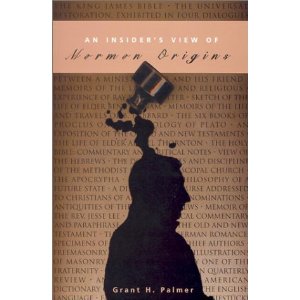
Grant Palmer’s An Insider’s View of Mormon Origins researches problems in LDS history: Many Mormons are completely unaware of the checkered past of their own church.
If anyone has read Grant Palmer’s An Insider’s View of Mormon Origins, you will know that during the early 1830s, Smith was under tremendous pressure, as some of the early witnesses to the Book of Mormon, were denying their testimony. By appealing to his own translation of Genesis 50, he could claim that his appointment as a prophet was established back in the Old Testament, centuries before his own birth! This surely helped to bolster the flagging faith of those who might be tempted to abandon Smith’s leadership.
On what basis does Joseph Smith make the claim that “ignorant translators” and “careless transcribers” made such grevious errors, such that he and he alone was qualified to make such corrections to the received Scriptural text of the Old and New Testaments? Apparently, Smith believed that he was under divine inspiration.
Mormonism has always had what scholars call a “Restorationist” impulse; that is, a movement towards trying to recover what the original Jesus and original Christianity was all about, and restoring things back to the way it was, before corruption set into Christianity as an organized faith. But rarely do the specifics of what those “corruptions” are get discussed, in the Mormon circles I have encountered. Here, in Joseph Smith’s Translation of the Bible itself, we get an idea of what Smith was really going after.
Will Mormonism survive, in its current form, as more of these details of Mormon history emerge? Who knows.
However, I am concerned that there any many, even among my fellow evangelical Christian believers, who are also unaware of these things, and who are all too willing to say that Mormonism is fundamentally no different than any other form of Christian faith, a problematic statement at best. (see previous Veracity postings about the LDS faith here, here, here, and here).
Weigh the evidence for yourself. But it really makes you pause to think about the legitimacy of Mormon origins, when its leading figure sees fit to “correct” the Bible, to serve the purposes of the movement, which he himself started.
For more detail, watch apologist Mike Winger’s video on this topic.
For other posts addressing problematic issues concerning the Mormon faith, please consult these previous Veracity blog posts:
Why attempts to somehow “whitewash” Mormon history fail to pass the historical evidence.
An overview of how Mormonism is changing (and not changing) today.