
There are just some books that have been sitting on my “to-be-read” list for years. C.S. Lewis’ Mere Christianity, until recently, was one of them.
Mere Christianity, based on a series of talks given by C.S. Lewis on BBC radio, during London’s darkest hour of the German bombing blitz of World War 2, is often regarded as one of the most popular apologetic books of all time. After finally finishing the audiobook version this past summer and early fall, I now know why.

C.S. Lewis.
Mere Christianity is Like Walking into the Main Hallway of a Great House
In those radio talks, Lewis endeavored to explain “mere Christianity” to a British radio listening public, many of whom had given up on the idea of the Christian God. C.S. Lewis gave these talks between 1941 and 1944, in which this Oxford intellectual would speak to the common British citizen.
Yet “mere Christianity” can be hard to define. The denominational differences among Christians can be quite bewildering to the outsider. Many even reject the faith for that reason, on the basis that any belief system that involves so many contradictory and irreconcilable readings of the Bible can not be true!
On the other hand, some even say that the incredible flexibility of Christian belief has enabled much of Christianity’s staying power, thus considering the diversity of Christian belief a virtue. Still, the various options for Christian belief easily confuses not only non-believers but believers as well. Lewis explains his perspective like this:
“[Mere Christianity] is more like a hall out of which doors open into several rooms. If I can bring anyone into that hall I shall have done what I attempted. But it is in the rooms, not in the hall, that there are fires and chairs and meals. The hall is a place to wait in, a place from which to try the various doors, not a place to live in” (p.5-6)
Part of the appeal of Lewis’ evangelistic project was in bringing others into the “hall” of “mere Christianity.” For many, this is a far easier task than trying to persuade someone to join one particular denominational tradition at the expense of another. But this optimistic view of “mere Christianity” comes at a cost, too. First of all, some rooms extending off that main hall are better equipped than others. Some waste their time wandering into a room or two, where things look very inviting at first. Yet the drink turns out to be cheap and the food is relatively poor, as compared to another room that provides better nourishment for the soul. In other words, not all versions of so-called “Christianity” are equally good, nor are they equally true.
Sadly, too many other Christians in our day just wander around in the hall, zipping in and out various rooms, or just peering into rooms from the hallway threshold, never bothering to sit down and enjoy the food. They content themselves with snacks on the hallway table that barely satisfy the hunger in one’s soul. One should be patient with those who wait out in the hallway. But it makes no sense to stay out in the hallway forever. Lewis goes on in delivering some wisdom:
“It is true that some people may find they have to wait in the hall for a considerable time, while others feel certain almost at once which door they must knock at. I do not know why there is this difference, but I am sure God keeps no one waiting unless He sees that it is good for him to wait. When you do get into your room you will find that the long wait has done you some kind of good which you would not have had otherwise” (p. 6).
The borders of what defines “mere Christianity” can be difficult to determine. Lewis probably had in mind that which is held in common by the three main branches of the faith: Protestant, Roman Catholic, and Eastern Orthodox. Even among Protestant evangelicals, like myself, a “mere Protestant evangelicalism” is quite an elusive concept. The need for dialogue between those in different rooms of the house of Christianity is more important than ever.

Lewis at his study….
Pushback that Some Give to C.S. Lewis’ “Mere Christianity”
Lewis’ particular “spin” on “mere Christianity” offers some provocative challenges. Lewis himself has been criticized for emphasizing certain elements too much and others not enough. For example, Lewis is big on the sacraments (quite rightly in my opinion):
“There are three things that spread the Christ life to us: baptism, belief, and that mysterious action which different Christians call by different names — Holy Communion, the mass, the Lord’s Supper. At least, those are the three ordinary methods…” (p.36).
Evangelicals will often elevate “belief” above the other two. On the other side, Lewis has been derided for not holding to the centrality of the penal substitutionary theory of the atonement:
“The central Christian belief is that Christ’s death has somehow put us right with God and given us a fresh start. Theories as to how it did this are another matter. A good many different theories have been held as to how it works; what all Christians are agreed on is that it does work. I will tell you what I think it is like. All sensible people know that if you are tired and hungry a meal will do you good. But the modern theory of nourishment — all about the vitamins and proteins — is a different thing. People ate their dinners and felt better long before the theory of vitamins was ever heard of: and if the theory of vitamins is some day abandoned they will go on eating their dinners just the same. Theories about Christ’s death are not Christianity: they are explanations about how it works” (p.33).
Lewis is right. Yet often the wrong thoughts about proper nutrition will have devastating consequences, if we cling to those wrong ideas too tightly. Likewise, a wrong view of doctrine can indeed damage the soul. This explains why a number of evangelicals have a cautious appreciation for Lewis’ “mere Christianity,” For example, Lewis’ “mere Christianity” does not insist on penal substitutionary atonement, though he does think that penal substitution is worth considering (p.34). Lewis offers a colorful sketch of what this penal substitution might look like:
“The [atonement theory] most people have heard is the one I mentioned before — the one about our being let off because Christ had volunteered to bear a punishment instead of us. Now on the face of it that is a very silly theory. If God was prepared to let us off, why on earth did He not do so? And what possible point could there be in punishing an innocent person instead? none at all that i can see, if you are thinking of punishment in the police-court sense. On the other hand, if you think of a debt, there is plenty of point in a person who has some assets paying it on behalf of someone who has not. Or if you take “paying the penalty,” not in the sense of being punished, but in the more general sense of “standing the racket” or “footing the bill,” then, of course, it is a matter of common experience that, when one person has got himself into a hole, the trouble of getting him out usually falls on a kind friend. Now what was the sort of “hole” man had got himself into? He had tried to set up on his own, to behave as if he belonged to himself. In other words, fallen man is not simply an imperfect creature who needs improvement: he is a rebel who must lay down his arms. Laying down your arms, surrendering, saying you are sorry, realising that you have been on the wrong track and getting ready to start life over again from the ground floor — that is the only way out of a “hole.” This process of surrender — this movement full speed astern — is what Christians call repentance. Now repentance is no fun at all. It is something much harder than merely eating humble pie. It means unlearning all the self-conceit and self-will that we have been training ourselves into for thousands of years. It means killing part of yourself, undergoing a kind of death. In fact, it needs a good man to repent. And here comes the catch. Only a bad person needs to repent: only a good person can repent perfectly. The worse you are the more you need it and the less you can do it. The only person who could do it perfectly would be a perfect person — and he would not need it” (p.34-35).
Lewis goes on in saying that Jesus Christ is that perfect person, God-become-man, who paid off that debt of the imperfect person (p.35). He then uses the illustration of someone drowning in a fast moving river, whereby someone on the river bank steps a foot into the waters, extending a hand out to save the other person. From the perspective of the drowning man:
“Ought I to shout back (between my gasps) “no, it’s not fair! You have an advantage! You’re keeping one foot on the bank”? That advantage — call it “unfair” if you like — is the only reason why he can be of any use to me. To what will you look for help if you will not look to that which is stronger than yourself? (p.35-36)”
Curiously, Lewis ends this discussion by suggesting if this type of explanation of the atonement is not helpful, then the reader should just drop it, indicating that some other theory might be better. I actually thought Lewis’ description, as sketchy as it was, was quite good!
Nevertheless, there are indications that Lewis saw some limitations in his concept of “mere Christianity.” Lewis remained a lifelong Anglican, a stalwart conservative in the Church of England, but he largely attributes his commitment to Anglicanism due to his Protestant roots growing up in Belfast, Ireland. Lewis died in 1963, decades before changes were introduced into Anglicanism which would have horrified Lewis. Some of Lewis’ most intimate friends conclude that had he lived long enough, Lewis would have eventually abandoned Anglicanism and become Roman Catholic. Whether he would have “crossed the Tiber” is only speculation, but he surely eschewed a variety of progressive theological trends.
The “Liar, Lunatic, or Lord” Trilemma
One of Lewis’ most famous illustrations is also one of the most criticized, that of answering the question of who is Jesus: A Liar, Lunatic, or Lord? Lewis did not originate this trilemma. It was actually first made by a Scottish preacher John Duncan, published in 1859-1860:
“Christ either deceived mankind by conscious fraud, or He was Himself deluded and self-deceived, or He was Divine. There is no getting out of this trilemma. It is inexorable.”
Here is C. S. Lewis’ well known version of the trilemma:
“I am trying here to prevent anyone saying the really foolish thing that people often say about Him: “I’m ready to accept Jesus as a great moral teacher, but I don’t accept His claim to be God.” That is the one thing we must not say. a man who was merely a man and said the sort of things Jesus said would not be a great moral teacher. He would either be a lunatic — on a level with the man who says he is a poached egg — or else he would be the devil of Hell. You must make your choice. Either this man was, and is, the Son of God: or else a madman or something worse. You can shut Him up for a fool, you can spit at Him and kill Him as a demon; or you can fall at His feet and call Him Lord and God. But let us not come with any patronising nonsense about His being a great human teacher. He has not left that open to us. He did not intend to” (p. 38).
Lewis powerfully critiques the Jesus is “a great moral teacher” posture. But there is another option aside from “Liar, Lunatic, or Lord.” It is “Legend.” For what makes Christianity so uniquely powerful, as opposed to many other belief systems, is that the claims of the Gospel are grounded in history. In another essay, Lewis grounds his Christian faith in history, as “Myth Became Fact.”
Nevertheless, since those 1940 radio addresses, certain “legendary” readings of the Bible have gained more traction, even among some evangelicals. While nearly all Christians acknowledge at least some degree of fictionalized elements within the Bible, notably Jesus’ telling of parables, there is a great debate within the church as to what is considered to be historically grounded versus that which is the stuff of legend, which only has an instructional value, much like what we now know of from the classic Greco-Roman myths.
A Fourth Option to Add Onto the Trilemma?
This may sound like a digression, but I believe this fits in well here: About seven years ago, I read Peter Enns’ The Bible Tells Me So, which illustrates this de-historicizing trend. Enns was an Old Testament professor at the highly conservative Westminster Theological Seminary, in Philadelphia. Enns lost his job following some publications by him that were deemed too progressive for the school.
In his book, The Bible Tells Me So, Enns wrestles with the problem of divinely sanctioned violence within the Old Testament. Exhibit A for Enns is Joshua’s conquest of Canaan, following the period in the Wilderness with Moses. Was the conquest of Canaan an act of divinely sanctioned “genocide,” where God instructs the people of God to wipe out God’s enemies in the land?
Enns then cites a widely accepted view among critical Old Testament scholars today, which suggests that we simply have no archaeological evidence to demonstrate that Joshua’s grand military conquest of Canaan ever happened historically. Not even a more scaled-down-in-size military conquest is compatible with this widely accepted view today. Instead, this view suggests that the story of Judges is the more historically reliable narrative, that of Israelite people arising mainly from pre-existing Canaanite people, in a relatively more peaceful manner. Pete Enns, who now teaches at Eastern University, is willing to let go of Joshua’s conquest of Canaan while still believing in the Bodily Resurrection of Jesus.
In other words, the problem of divinely sanctioned genocide in the Old Testament is no longer a problem, since the non-historical nature of the Book of Joshua renders the problem mute. While this might provide some comfort to those who wrestle with the topic of violence in the Old Testament, this comfort can come at a great cost. For if the crossing of the Red Sea and subsequent move to the Promised Land never happened, it casts serious doubt on the historical reliability of at least that part of the Bible. But if the Exodus/Promised Land story, a critical narrative that underpins the identity of Israel, is actually based on a legendary fiction, then it raises substantial questions as to where to draw the line elsewhere in the Bible, as to its historical foundations. In this way, Christian scholars like Pete Enns have supposedly “rescued” the Bible from a negative moral category, only to undermine the central origins story of Israel’s founding as a nation, as genuine history.
True, the story of the Exodus and conquest of Canaan, hundreds of years before Christ, is not at the same level of centrality as the historical person and work of Jesus of Nazareth, in the first century of the Christian era. Even C.S. Lewis acknowledges that not everything which comes across to some as recorded history in the Old Testament is in the exact same literary genre category as what we find in the Gospels. Lewis does not discount the possibility of miracles, yet he had some reservations about the historicity of books like Jonah and Esther, to name two examples.
On the other hand, in support of the more traditional acceptance of Old Testament history, there are still some very good reasons why the Exodus and Conquest narratives indeed are historical, assuming a more nuanced approach to both the Scriptural and archaeological data, which enables to me to continue to affirm the full inerrancy of the Bible (see these other blog posts: #1, #2, #3, #4). Furthermore, the tendency to label Joshua’s conquest narrative as “genocide” is highly problematic itself, as there is good evidence to suggest that the military effort to claim the Promised Land by the Israelites does not really belong in such a negative moral category. Too often, the supposed “genocide” of the Cananaites is assumed, without enough careful evidence to back up such a claim. In other words, there are faithful, acceptable ways of reading the Old Testament, which while affirming the underlying historical reliability of particular narratives does not necessarily require one to dismiss the Old Testament as endorsing immorality.
The moral here is this: The more you chip away at the history of the Bible, the more that the narrative of Jesus, and the Old Testament backdrop for the Jesus story, comes across as mere Legend, thus making Lewis’ trifold option of Jesus as “Liar, Lunatic, or Lord” less relevant today. For the more someone disconnects the Christian story from the historical record, the less confidence that person will have in the Truthfulness of the Bible. Christianity then becomes yet another set of myths, like the Greco-Roman myths that the Christian faith supplanted. To the contrary, Lewis believed that the story of the Gospel was “myth that became fact,” rooted in real history. Therefore, I argue that Lewis’ analogy should be revised to ask if Jesus is a “Liar, Lunatic, Legend, or Lord” instead.
Granted, for the average person, Lewis’ trilemma of “Liar, Lunatic, or Lord” is still applicable in the 21st century. The problem is that as more people are exposed to more controversial ways of doing history, the more they will be inclined to insist for the fourth option, that Jesus is a mere “Legend.” For example, there is the interesting phenomenon among certain atheists that insists that Jesus did not exist at all, commonly known as “Jesus Mythicism,” as well as sensational discoveries of various hitherto unknown or unfamiliar texts from the early Christian era, such as the Gospel of Judas or the Gospel of Thomas, that tend to enable conspiracy theories that cast serious doubt on the reliability of early, historically orthodox Christian tradition. An agnostic, atheist Bible scholar like Bart Ehrman sells book titles like Lost Christianities: The Battles for Scripture and the Faiths We Never Knew to a reading public who wonder if historically orthodox Christianity pulled a power play to squash other equally valid versions of the Christian faith. So if Mere Christianity were to be rewritten today, dealing with the “Legend” option would need to be included. Thankfully, there are good answers to these skeptical questions today, that Lewis never felt the need to address in his day.
These are the main takeaways I had from reading Mere Christianity. What a great book. Truly a Christian classic that everyone should read. As I was gathering my notes together for this review, I realized that the bulk of my notes was made up of quotes by Lewis from the book. In the interest of having a shorter book review, I have therefore decided to include the following notes as a kind of appendix, for those who want to discover other riches found in C.S. Mere Christianity. Enjoy!
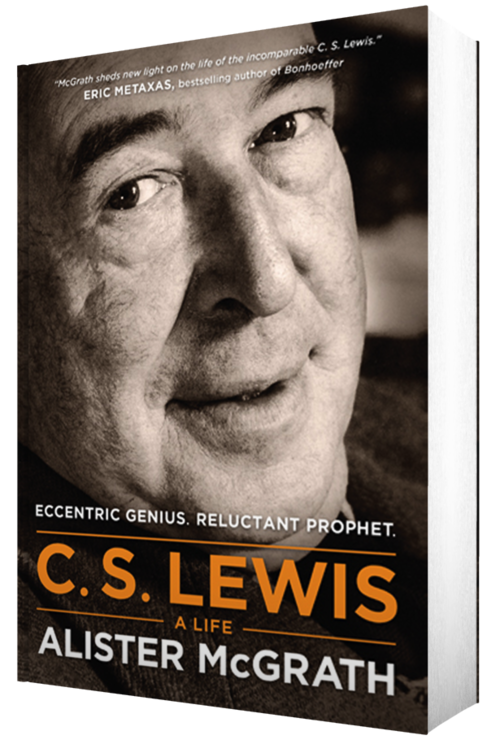
For a great biography of C.S.Lewis, I would recommend C.S. Lewis: A Life, by Alister McGrath.
APPENDIX: Further Notes from C.S. Lewis’ Mere Christianity
On usury, or lending money at interest….
C.S. Lewis rightly argues that Christianity does not specify any one particular political or economic policy or program to correct the social ills of the world. But he could explored this a bit more. Societies across the world, and across history, have accepted the Golden Rule. “Do unto others as you would have them do unto you” is not unique to the Bible. Lewis explains:
“The second thing to get clear is that Christianity has not, and does not profess to have, a detailed political programme for applying “do as you would be done by” to a particular society at a particular moment. It could not have. It is meant for all men at all times and the particular programme which suited one place or time would not suit another. and, anyhow, that is not how Christianity works. When it tells you to feed the hungry it does not give you lessons in cookery. When it tells you to read the Scriptures it does not give you lessons in Hebrew and Greek, or even in English grammar. iI was never intended to replace or supersede the ordinary human arts and sciences: it is rather a director which will set them all to the right jobs, and a source of energy which will give them all new life, if only they will put themselves at its disposal” (p. 47).
Lewis then gives as an example the historical tradition that Christians have been forbidden to practice usury; that is, the lending of money at interest:
“There is one bit of advice given to us by the ancient heathen Greeks, and by the Jews in the Old testament, and by the great Christian teachers of the middle ages, which the modern economic system has completely disobeyed. All these people told us not to lend money at interest: and lending money at interest — what we call investment — is the basis of our whole system” (p. 48-49).
Lewis argues that he is not qualified to give an answer as to how to address this, advising that this should be left for Christian economists to work out. The traditional Christian teaching does condemn usury, which would include all forms of lending money at interest. However, since the time of John Calvin this teaching has been softened, as Calvin forbade the charging of excessive interest, and not the charging of interest in principle. For John Calvin, the idea of “usury” should be strictly defined in terms of this charging at excessive interest rates. Modern economic practices, such as bankruptcy laws, have mitigated against the harsher effects of an unrestrained capitalism. However, Lewis could have cited the Bible to show that this traditional teaching regarding usury is actually quite problematic. For Jesus himself appears to implicitly accept the principle of earning interest with the Parable of the Talents (Matthew 25:14-30). Jesus did urge his followers to loan freely to others without expecting anything in return (Luke 6:35), but this command did not apparently result in any contradiction in the mind of Jesus when it came to the Parable of the Talents.
In other words, the New Testament allows for a more nuanced understanding of usury. Taking out a loan for a home mortgage need not trouble the conscience of a Christian.
On just war theory, and pacifism….
Lewis’ chapter on forgiveness contains one of most puzzling statements in support of a type of just war theory for Christians. Lewis fought for the British in World War 1, and was injured there:
“I have often thought to myself how it would have been if, when I served in the first world war, I and some young German had killed each other simulta- neously and found ourselves together a moment after death. I cannot imagine that either of us would have felt any resentment or even any embarrassment. I think we might have laughed over it (p.66).”
Yet despite how odd this might strike the reader, his reasoning prior to this explains why Lewis was not a pacifist:
‘It is, therefore, in my opinion, perfectly right for a Christian judge to sentence a man to death or a Christian soldier to kill an enemy. I have always thought so, ever since I became a Christian, and long before the war, and I still think so now that we are at peace. it is no good quoting “Thou shalt not kill.” There are two Greek words: the ordinary word to kill and the word to murder. and when Christ quotes that commandment He uses the murder one in all three accounts, Matthew, Mark, and Luke. And I am told there is the same distinction in Hebrew. All killing is not murder any more than all sexual intercourse is adultery. When soldiers came to St. John the Baptist asking what to do, he never remotely suggested that they ought to leave the army: nor did Christ when He met a Roman sergeant-major — what they called a centurion. The idea of the knight — the Christian in arms for the defence of a good cause — is one of the great Christian ideas. War is a dreadful thing, and I can respect an honest pacifist, though I think he is entirely mistaken. What I cannot understand is this sort of semipacifism you get nowadays which gives people the idea that though you have to fight, you ought to do it with a long face and as if you were ashamed of it. it is that feeling that robs lots of magnificent young Christians in the Services of something they have a right to, something which is the natural accompaniment of courage — a kind of gaity and wholeheartedness (p.66)’
The moral argument for belief in God….
Lewis’ moral argument for the existence of God is probably still the best reason for substantiating Christian belief, and it is found in the early chapters of Mere Christianity. It can be summarized like this:
1. There is a universal Moral Law.
2. If there is a universal Moral Law, there is a Moral Law-giver.
3. If there is a Moral Law-giver, it must be something beyond the universe.
4. Therefore, there is something beyond the universe.
The moral argument for God is perhaps the best use of philosophy to defend the Christian faith. But it requires careful thought to adequately make such an argument.
Several quotes from Lewis stand out for me, as being relevant. This one is about “progress,” or being truly “progressive”:
“You may have felt you were ready to listen to me as long as you thought i had anything new to say; but if it turns out to be only religion, well, the world has tried that and you cannot put the clock back……. as to putting the clock back[:] Would you think i was joking if I said that you can put a clock back, and that if the clock is wrong it is often a very sensible thing to do? But I would rather get away from that whole idea of clocks. We all want progress. But progress means getting nearer to the place where you want to be. And if you have taken a wrong turning, then to go forward does not get you any nearer. If you are on the wrong road, progress means doing an about turn and walking back to the right road; and in that case the man who turns back soonest is the most progressive man. We have all seen this when doing arithmetic. When I have started a sum the wrong way, the sooner I admit this and go back and start over again, the faster I shall get on. There is nothing progressive about being pigheaded and refusing to admit a mistake. and I think if you look at the present state of the world, it is pretty plain that humanity has been making some big mistake. We are on the wrong road. and if that is so, we must go back. Going back is the quickest way on” (p.26).
The heading of that chapter is “We have cause to be uneasy.” How true that is. The problem with atheism is not so much an outright attack upon God as it is the kind of effort required to make God seem irrelevant to our lives, whereby we convince ourselves that there is no one else to whom we can be held accountable.
I know of atheistic friends of mine, who are quite moral people, and yet they have developed highly sophisticated means of showing that you can be good with God. As a former atheist himself, Lewis shows that such rationalizations ultimately fail to convince:
“The moral Law does not give us any grounds for thinking that God is “good” in the sense of being indulgent, or soft, or sympathetic. There is nothing indulgent about the moral Law. It is as hard as nails. It tells you to do the straight thing and it does not seem to care how painful, or dangerous, or difficult it is to do. If God is like the moral Law, then He is not soft. It is no use, at this stage, saying that what you mean by a “good” God is a God who can forgive. You are going too quickly. Only a Person can forgive. and we have not yet got as far as a personal God — only as far as a power, behind the moral Law, and more like a mind than it is like anything else. But it may still be very unlike a Person. If it is pure impersonal mind, there may be no sense in asking it to make allowances for you or let you off, just as there is no sense in asking the multiplication table to let you off when you do your sums wrong. You are bound to get the wrong answer. and it is no use either saying that if there is a God of that sort — an impersonal absolute goodness — then you do not like Him and are not going to bother about Him. For the trouble is that one part of you is on His side and really agrees with His disapproval of human greed and trickery and exploitation. You may want Him to make an exception in your own case, to let you off this one time; but you know at bottom that unless the power behind the world really and unalterably detests that sort of behaviour, then He cannot be good. On the other hand, we know that if there does exist an absolute goodness it must hate most of what we do. That is the terrible fix we are in. If the universe is not governed by an absolute goodness, then all our efforts are in the long run hopeless. But if it is, then we are making ourselves enemies to that goodness every day, and are not in the least likely to do any better tomorrow, and so our case is hope- less again. We cannot do without it. and we cannot do with it. God is the only comfort, He is also the supreme terror: the thing we most need and the thing we most want to hide from. He is our only possible — ally, and we have made ourselves His enemies” (p.21-22).
Sobering thoughts. The challenge of being a Christian in the secular West is that we have conflicting standards of what constitutes the moral law. The most vocal critics of Christianity are those who are convinced that the Christian faith actually undermines true morality. Yet it is extremely difficult to build a case for the specifics of moral law simply on the basis of rational arguments alone. For example, while many atheists are “pro-choice” with respect to abortion, and reject the notion of personhood being attached to a fetus, there are actually other atheists who are “pro-life,” making the case that science tells us know when life begins, and it is not at the birth of the child, or even in the “quickening” of the child, as when the mother first feels the baby kicking in her abdomen.
This is where the question of divine revelation comes in, as this appears to me to be the only way to adjudicate conflicting moral standards. Christians will debate over various aspects of biblical interpretation, but those who hold to a high view of Scriptural authority will at least acknowledge the Bible as the ultimate source for knowing God’s perspective on moral issues. In meeting this challenge, it is the task of the Christian apologist to take up this task to convey a theologically coherent, Scripturally faithful vision for the moral life, that captures the imagination of an unbelieving world. In my estimation, this is the great value of C. S. Lewis’ Mere Christianity, in that it helps both the believer and non-believer to think through what a Christian view of the world really looks like.
On virtue, and recognizing the presence of evil in every human being….
Lewis offers a number of excellent insights into the Christian moral life that can assist both believer and non-believer alike. Lewis offers a brilliant way of connecting Christian morality with the Christian future hope of resurrection. Here is Lewis on why it is important to grow in Christian virtue in this life:
“Now it is quite true that there will probably be no occasion for just or courageous acts in the next world, but there will be every occasion for being the sort of people that we can become only as the result of doing such acts here. The point is not that God will refuse you admission to His eternal world if you have not got certain qualities of character: the point is that if people have not got at least the beginnings of those qualities inside them, then no possible external conditions could make a “Heaven” for them — that is, could make them happy with the deep, strong, unshakable kind of happiness God intends for us” (p. 46).
And:
“Virtue — even attempted virtue — brings light; indulgence brings fog” (p. 58).
On recognizing evil within ourselves:
“When a man is getting better he understands more and more clearly the evil that is still left in him. When a man is getting worse, he understands his own badness less and less. a moderately bad man knows he is not very good: a thoroughly bad man thinks he is all right. This is common sense, really. You understand sleep when you are awake, not while you are sleeping. You can see mistakes in arithmetic when your mind is working properly: while you are making them you cannot see them. You can understand the nature of drunkenness when you are sober, not when you are drunk. Good people know about both good and evil: bad people do not know about either” (p53).
On Christian marriage, which is increasingly seen as being controversial today, or even “bigoted”….
“The Christian idea of marriage is based on Christ’s words that a man and wife are to be regarded as a single organism — for that is what the words “one flesh” would be in modern English. and the Christians believe that when He said this He was not expressing a sentiment but stating a fact — just as one is stating a fact when one says that a lock and its key are one mechanism, or that a violin and a bow are one musical instrument. The inventor of the human machine was telling us that its two halves, the male and the female, were made to be combined together in pairs, not simply on the sexual level, but totally combined. The monstrosity of sexual intercourse outside marriage is that those who indulge in it are trying to isolate one kind of union (the sexual) from all the other kinds of union which were intended to go along with it and make up the total union” (p.58).
On charity towards others, in that in our very actions our minds and hearts can be changed, for good or for worse…
“Do not waste time bothering whether you “love” your neighbour; act as if you did. As soon as we do this we find one of the great secrets. When you are behaving as if you loved someone, you will presently come to love him. if you injure someone you dislike, you will find yourself disliking him more. if you do him a good turn, you will find yourself disliking him less. There is, indeed, one exception. If you do him a good turn, not to please God and obey the law of charity, but to show him what a fine forgiving chap you are, and to put him in your debt, and then sit down to wait for his “gratitude,” you will probably be disappointed. (People are not fools: they have a very quick eye for anything like showing off, or patronage.) But whenever we do good to another self, just because it is a self, made (like us) by God, and desiring its own happiness as we desire ours, we shall have learned to love it a little more or, at least, to dislike it less……..”
“…….The worldly man treats certain people kindly because he “likes” them: the Christian, trying to treat every one kindly, finds himself liking more and more people as he goes on — including people he could not even have imagined himself liking at the beginning.”
“This same spiritual law works terribly in the opposite direction. The Germans, perhaps, at first ill-treated the Jews because they hated them: afterwards they hated them much more because they had ill-treated them. The more cruel you are, the more you will hate; and the more you hate, the more cruel you will become — and so on in a vicious circle for ever.”
“Good and evil both increase at compound interest. That is why the lit- tle decisions you and I make every day are of such infinite importance. The smallest good act today is the capture of a strategic point from which, a few months later, you may be able to go on to victories you never dreamed of. An apparently trivial indulgence in lust or anger today is the loss of a ridge or railway line or bridgehead from which the enemy may launch an attack otherwise impossible” (p.72-73).
On why “hope” is a theological virtue, and why Christianity becomes less effective when we take our eyes off of heaven as the future goal…
“…..a continual looking forward to the eternal world is not (as some modern people think) a form of escapism or wishful thinking, but one of the things a Christian is meant to do. it does not mean that we are to leave the present world as it is. If you read history you will find that the Christians who did most for the present world were just those who thought most of the next. The apostles themselves, who set on foot the conversion of the Roman Empire, the great men who built up the middle ages, the English Evangelicals who abolished the Slave trade, all left their mark on Earth, precisely because their minds were occupied with Heaven. It is since Christians have largely ceased to think of the other world that they have become so ineffective in this. Aim at Heaven and you will get earth “thrown in”: aim at earth and you will get neither. It seems a strange rule, but something like it can be seen at work in other matters. Health is a great blessing, but the moment you make health one of your main, direct objects you start becoming a crank and imagining there is something wrong with you. You are only likely to get health provided you want other things more — food, games, work, fun, open air. In the same way, we shall never save civilisation as long as civilisation is our main object. We must learn to want something else even more” (p.73-74).
“If I find in myself a desire which no experience in this world can satisfy, the most probable explanation is that I was made for another world. If none of my earthly pleasures satisfy it, that does not prove that the universe is a fraud. Probably earthly pleasures were never meant to satisfy it, but only to arouse it, to suggest the real thing. If that is so, I must take care, on the one hand, never to despise, or be unthankful for, these earthly blessings, and on the other, never to mistake them for the something else of which they are only a kind of copy, or echo, or mirage. I must keep alive in myself the desire for my true country, which I shall not find till after death; I must never let it get snowed under or turned aside; I must make it the main object of life to press on to that other country and to help others to do the same” (p. 75).
On why the adherence to Christian doctrinal teaching is such an essential part of Christian faith….
Lewis had to change his thinking on the importance of doctrinal teaching when he became a Christian. A Christian epistemology takes into account not just reason, but human intuition as well. This reminds me of the rider and the elephant analogy given by moral psychologist Jonathan Haidt in his book, The Righteous Mind (See this Veracity book review):
“I was assuming that if the human mind once accepts a thing as true it will automatically go on regarding it as true, until some real reason for reconsidering it turns up. In fact, I was assuming that the human mind is completely ruled by reason. But that is not so. For example, my reason is perfectly convinced by good evidence that anaesthetics do not smother me and that properly trained surgeons do not start operating until I am unconscious. But that does not alter the fact that when they have me down on the table and clap their horrible mask over my face, a mere childish panic begins inside me. I start thinking I am going to choke, and I am afraid they will start cutting me up before I am properly under. In other words, I lose my faith in anaesthetics. It is not reason that is taking away my faith: on the contrary, my faith is based on reason. It is my imagination and emotions. The battle is between faith and reason on one side and emotion and imagination on the other….
……Now just the same thing happens about Christianity. I am not asking anyone to accept Christianity if his best reasoning tells him that the weight of the evidence is against it. That is not the point at which Faith comes in. But supposing a man’s reason once decides that the weight of the evidence is for it. I can tell that man what is going to happen to him in the next few weeks. There will come a moment when there is bad news, or he is in trouble, or is living among a lot of other people who do not believe it, and all at once his emotions will rise up and carry out a sort of blitz on his belief. Or else there will come a moment when he wants a woman, or wants to tell a lie, or feels very pleased with himself, or sees a chance of making a little money in some way that is not perfectly fair: some moment, in fact, at which it would be very convenient if Christianity were not true. and once again his wishes and desires will carry out a blitz. I am not talking of moments at which any real new reasons against Christianity turn up. Those have to be faced and that is a different matter. I am talking about moments where a mere mood rises up against it.
Now Faith, in the sense in which I am here using the word, is the art of holding on to things your reason has once accepted, in spite of your changing moods” (p.76-77).
Faith is also about realizing that our efforts do not save ourselves. Only when we realize our complete dependence on God, and his remarkable grace, do we truly “get” what Christian faith is all about:
“The first step towards humility [is] to realise that one is proud. I want to add now that the next step is to make some serious attempt to practise the Christian virtues. a week is not enough. Things often go swimmingly for the first week. Try six weeks. By that time, having, as far as one can see, fallen back completely or even fallen lower than the point one began from, one will have discovered some truths about oneself. No man knows how bad he is till he has tried very hard to be good. …. Only those who try to resist temptation know how strong it is. After all, you find out the strength of the German army by fighting against it, not by giving in. You find out the strength of a wind by trying to walk against it, not by lying down. a man who gives in to temptation after five minutes simply does not know what it would have been like an hour later. That is why bad people, in one sense, know very little about badness. They have lived a sheltered life by always giving in. We never find out the strength of the evil impulse inside us until we try to fight it: and Christ, because He was the only man who never yielded to temptation, is also the only man who knows to the full what temptation means — the only complete realist. Very well, then. The main thing we learn from a serious attempt to practise the Christian virtues is that we fail. If there was any idea that God had set us a sort of exam, and that we might get good marks by deserving them, that has to be wiped out” (p.77-78).
Theology is like a map…
Lewis makes a fantastic argument as to why the learning of Christian doctrine, even that of the Triune nature of God, is so essential to living the Christian life. Lewis draws on the analogy of a map of the Atlantic, which is not useful to anyone who is merely content to take walks along the shoreline of an Atlantic beach in England, as opposed to someone who wants to cross the Atlantic:
“Theology is like [that] map…. Doctrines are not God: they are only a kind of map. But that map is based on the experience of hundreds of people who really were in touch with God-experiences compared with which any thrills or pious feelings you and I are likely to get on our own are very elementary and very confused. And secondly, if you want to get any further, you must use the map….
…..Like watching the waves from the beach, [you] will not get to Newfoundland by studying the Atlantic that way, and you will not get eternal life by simply feeling the presence of God in flowers or music. Neither will you get anywhere by looking at maps without going to sea. nor will you be very safe if you go to sea without a map…..
…..Consequently, if you do not listen to Theology, that will not mean that you have no ideas about God. It will mean that you have a lot of wrong ones — bad, muddled, out-of-date ideas. For a great many of the ideas about God which are trotted out as novelties today, are simply the ones which real Theologians tried centuries ago and rejected. To believe in the popular religion of modern England is retrogression — like believing the earth is flat.” (p.84-85).
On prayer and the Trinity….
Lewis has a wonderfully helpful way of explaining how God can hear the prayers of “several hundred million human beings who are all addressing Him at the same moment” (p. 91), in a way I had not thought of very deeply before. Though not associated with any Scriptural proof text, it has to deal with the idea that God exists outside of time:
“All the days are “now” for [God]. He does not remember you doing things yesterday; He simply sees you doing them, because, though you have lost yesterday. He has not. He does not “foresee” you doing things tomorrow; He simply sees you doing them: because, though tomorrow is not yet there for you, it is for Him” (p. 93).
Lewis offers some very practical help on understanding the significance of the doctrine of the Trinity for the Christian life, too much to try to summarize here. But his insight as to how we know of our sinfulness is both sobering and illuminating that I will quote Lewis yet again:
“When I come to my evening prayers and try to reckon up the sins of the day, nine times out of ten the most obvious one is some sin against charity; I have sulked or snapped or sneered or snubbed or stormed. and the excuse that immediately springs to my mind is that the provocation was so sudden and unexpected: I was caught off my guard, I had not time to collect myself. Now that may be an extenuating circumstance as regards those particular acts: they would obviously be worse if they had been deliberate and premeditated. On the other hand, surely what a man does when he is taken off his guard is the best evidence for what sort of a man he is? Surely what pops out before the man has time to put on a disguise is the truth? if there are rats in a cellar you are most likely to see them if you go in very suddenly. But the suddenness does not create the rats: it only prevents them from hiding. In the same way the suddenness of the provocation does not make me an ill-tempered man: it only shows me what an ill-tempered man I am. The rats are always there in the cellar, but if you go in shouting and noisily they will have taken cover before you switch on the light. Apparently the rats of resentment and vindictiveness are always there in the cellar of my soul” (p.103).
Can you say, “Ouch?”
Christianity is not about making “nice people,” but rather new human beings…
“The world does not consist of 100 per cent Christians and 100 per cent non-Christians. There are people (a great many of them) who are slowly ceasing to be Christians but who still call themselves by that name: some of them are clergymen. There are other people who are slowly becoming Christians though they do not yet call themselves so. There are people who do not accept the full Christian doctrine about Christ but who are so strongly attracted by Him that they are His in a much deeper sense than they themselves understand” (p. 111).
I could go on quoting Lewis. But suffice to say, Mere Christianity is truly a gem and great Christian classic, that can be read by anyone, believer or non-believer alike. Having a paper or digital copy of Mere Christianity can help to recall Lewis’ wonderful quotes, as I sought to do after a while. But most of what I enjoyed about Mere Christianity came from listening to it via an audiobook read by Ralph Cosham. Cosham’s cadence perfectly matched Lewis’ writing style, so I would recommend this method of getting into Lewis’ thought.
Lewis’ book is surely not perfect. He was not married at the time, so some of his ideas about marriage have been ridiculed over the years. But he did get married later in life, and his love for his wife Joy Davidman has continued to inspire movies. It might take some people a bit to get used to, but Lewis as a writer is simply fantastic. I am just so sorry I waited so long to read this classic!




 Veracity