Personal Discipleship

The Life Line

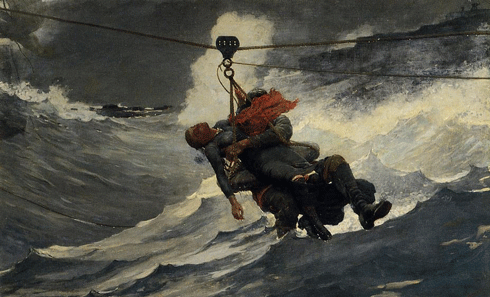
The Life Line by Winslow Homer, 1884

Personal discipleship has been a lifeline for me between what had become a comfortable and complacent Christian experience, and one that became vibrant, exciting, and very real.

If you search for “personal discipleship” on the Internet, you’ll find a variety of  not-very-standardized definitions.  So up front, here’s my homegrown definition: personal discipleship is the process in which a believer or seeker takes personal responsibility for investigating the claims and content of the Bible.

While we all appreciate hearing a well-turned sermon in a moving worship service, sitting in a pew is a passive experience.  None of us would get very far academically if all we ever did was attend lectures.  We have to read, study, work some problems through, write, engage others in discussion, apply ourselves, and prepare to be tested.  And so it is with our faith.

Kierkegaard argued that Christians should take the initiative to work out our own relationship to God.[1]  But this wasn’t Kierkegaard’s original idea, it came from the Apostle Paul.

“Therefore, my beloved, as you have always obeyed, so now, not only as in my presence but much more in my absence, work out your own salvation with fear and trembling, for it is God who works in you, both to will and to work for his good pleasure. Do all things without grumbling or questioning,”
Philippians 2:12-14 (ESV)

Here the more literal ESV translation of the text leads to great doctrine.  This is not the Talmud instructing students to “Find thyself a teacher.”  It’s the author of half the New Testament telling disciples to work out our own salvation with fear and trembling.  Not to make up our ideas of God, but to reverently and humbly work on our relationship with him.  Not to have anyone do the work for us, but to do it ourselves. Continue reading

Nativity Redux

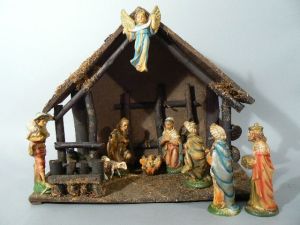
A typical nativity creche that you can get through your Christian bookstore.... replete with Joseph, Mary, the baby Jesus, a shepherd and the "Three Kings of Orient are,"  much like the one I grew up with.  Historically accurate?  Maybe not.

A typical nativity creche available through your local Christian bookstore…. replete with Joseph, Mary, the baby Jesus, a shepherd and the “Three Kings of Orient are,” much like the one I grew up with. Historically accurate? Maybe not.

When I was a kid, I liked setting up our wooden nativity creche during Advent season. The creche had Joseph and Mary in the stable, with barnyard animals all around. There were the shepherds, and of course, the three wise men. I lost the little infant baby Jesus under the couch one year, but found him a few weeks later. I loved this nativity scene. And I was really excited about it…. until I started to actually read the Bible.
Continue reading


The Scandal: Pluralism #3

Pssst! Have you heard about the “scandal”? All curious ears, listen in.

The Scandal of Particularity: Is there really only one way?

Yes, it is the greatest “scandal” of all. Theologians have called it the “scandal of particularity”. In a particular time. In a particular place. In a particular person. God spoke. God acted. Who is the scandal about? Simply put. Jesus Christ. There is just no other way around Jesus. This is indeed a scandal to a post-modern culture that resists particular truth claims. It sounds so exclusive. So intolerant. And that doesn’t sound so good. Right?
Continue reading


Cherry Picking Kierkegaard

The Coffee Gathering Pombo

“La tertulia del café de Pombo” by José Gutiérrez Solana, 1920

Generally I’m more apt to hang out with grill-in-the-driveway, figure-it-out-yourself, change-your-own-oil, workaday kind of guys than intellectuals. When I was younger and thought I knew what was important, I developed an anti-intellectual prejudice that continues to the present day. But as Tim Keller says, “You cannot be a Christian without using your brain to its uttermost,” so game on.

Many of us have a tendency to read Bible passages simplistically, without empathizing or thinking beyond the sacred page. Teachers like Michael Card encourage reading “at the level of our imaginations,” but that takes time and work.

Take the story of the testing of Abraham in Genesis 22 for example.  Danish philosopher, theologian, and Lutheran ethicist Søren Kierkegaard thought about the anguish that Abraham felt while walking for three days to Mount Moriah to sacrifice Isaac.  To Kierkegaard this is not a simple story to be read dryly or mechanically from one punctuation mark to the next.  Kierkegaard thought about the huge weight being placed upon Abraham’s conscience, and posited ideas about the teleological suspension of the ethical.  This isn’t (actually) a post about Kierkegaard, but just to help set the background, here are a few of his quotes: Continue reading


Conflict Avoidance: Pluralism #2

OK. I admit it. I hate conflict. John Paine does not like it either, so I am glad I am not alone.

Cowboys or the Redskins? Duke or North Carolina? Red Sox or the Yankees? Me? I’ll just watch the ball game, thank you. Some love a feisty contest. But it is one thing to engage in competitive sports talk. Conversing about “God” in a pluralistic culture is a much more serious ball game.

Nothing like some good ole’ competition!

There is much at stake when it comes to conflicting truth claims regarding religious belief … or “non-religious” belief … let us not forget atheism. The consequences are great. Eternal matters hang in the balance. Heaven and hell. Life and death.

Imagine you are at a water cooler somewhere in corporate America, and the topic of religion comes up. A disagreement emerges. You feel the tension in the hallway as the conversation heats up. Someone tries to resolve the tension in the conversation and says, “You know, I believe that all religions basically teach the same thing.”

The “conflict avoidance” part of me wonders….”What a powerful and attractive idea”…..
Continue reading