
The Masada Myth: Martyrs or Maniacs?

Aerial view of Masada, Herod's fortress near the Dead Sea, where Jewish rebels resisted the Roman army, just a few years after the Destruction of Jerusalem within a generation after Jesus' Resurrection (Wikipedia image, Godot13 photographer)

Aerial view of Herod’s Masada, where Jewish rebels resisted the Roman army, just a few years after the Destruction of Jerusalem, within a generation after Jesus walked the earth.  Note the Dead Sea faintly in the upper left to the east, and the location on the right where the Romans built their siege ramp on the western approach. (Wikipedia image, Godot13 photographer, click on the image to see it close up…. pretty impressive)

Around the years 72-73 A.D., a band of Jewish rebels and their families sought refuge in one of Herod the Great’s fortresses, Masada. The Roman army had recently destroyed the city of Jerusalem, slaughtering thousands of fellow Jews in the process. These 960 men, women and children belonging to a radical group of Zealots, the Sicarii, sought to hold out at Masada in a last ditch effort to resist the Roman occupation.

Herod the Great, known to students of the Bible for the “massacre of the innocents”, had originally built Masada on a desolate mountaintop just west of the Dead Sea. What happened at the siege of Masada some one hundred years later has continued to fascinate historians and believers down through the years. The Jewish Zealots had enough food and water to last them for many, many months, but it was only a matter of time before their defeat in the hands of the Roman army would become inevitable. Roman troops eventually surrounded the near impenetrable fortress, and over the following months they were able to build a siege ramp that enabled the Romans to break through the Jewish Zealot defenses.

What the Romans found there next on top of Masada has inspired many a freedom fighter while horrifying others by the ghastly moral choices that were made. What really happened at Masada, and how is a Christian to respond to it?
Continue reading

Examples and Warnings

  • These things happened to them as examples and were written down as warnings for us, on whom the fulfillment of the ages has come.
    1 Corinthians 10:11 (NIV84)
Kisses

Essential Tools

Melinda Penner has a poignant observation on the Stand to Reason blog this morning, about a recent post by Rachael Slick—the daughter of apologist Matt Slick, the founder of CARM.

CARM is one of the sites I use frequently in my devotional research. I value their work, and respect their opinions. Sometimes they make me uneasy, but that’s Veracity—we don’t have to accept everything someone thinks, or their style, to benefit from their example or teaching. We’re about sharing resources, not telling people what to think.

Rachael Slick’s post, describing her upbringing and journey into atheism, is undoubtedly heartbreaking for her parents. As Melinda Penner notes, the post is one-sided. That it garnered over 2,300 comments in two days on the atheist channel of Patheos.com demonstrates the voracity of atheist sentiments in our culture. (If we accept the Great Commission and are laboring only in fields full of Christians, here’s a wake-up call.)

Melinda’s observation is that there is no Gospel in Rachael Slick’s story. How anyone can learn 800 Bible verses and all the apologetic doctrine she describes without getting the Gospel is…(I don’t have an adequate adjective).

Dick Woodward has a lot to say about examples and warnings in the Bible. A few months ago, Dick and I were talking about Matthew 23 and the Law of God. Dick made the point that, “The Law of God must always be run through the Love of God.”

I couldn’t help thinking about those words as I read Rachael Slick’s story. I’m not judging Matt Slick and the way he raised his family. I will take this example and apply it to the relationships in my life, particularly where I have a tendency to make a point or press an agenda without stopping to love the other person first. One more time for my own edification—I will try to do better at loving the other person first.

The Apostle John quoted Jesus, “By this all men will know that you are my disciples, if you love one another” (John 13:35, NIV84). The Apostle Paul put it even more strongly, “The only thing that counts is faith expressing itself though love” (Galatians 5:6b, NIV84).

Thank you Rachael Slick for the example and warning—not about how you or your dad might have messed up, but about how less important an agenda is compared to a heart.


Teenagers with Disabilities: Amplifying Our Witness

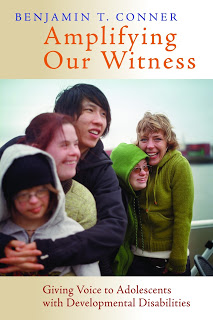
Ben Conner's latest book, Amplifying Our Witness, is a wonderful primer in doing ministry to an often neglected community:  adolescents with developmental disabilities.

Ben Conner’s latest book, Amplifying Our Witness, is a wonderful primer in doing ministry to an often neglected community: adolescents with developmental disabilities.

How many young people today do you know that wrestle with Asperger’s syndrome, cerebral palsy, or Down’s syndrome? How many parents do you know are utterly consumed by the developmental challenges faced by their teenage sons and daughters that keep them from fitting in with their age group?

Benjamin T. Conner has been a long time friend of mine in Young Life in Williamsburg, Virginia. Over the past few years, Ben has been leading the Capernaum ministry, a branch of Young Life dedicated to reaching out to adolescents who struggle with developmental disabilities. In his latest book, Amplifying our Witness, Ben cites an alarming statistic: nearly 20% of all adolescents today are diagnosed with some type of developmental disability. One in five teenagers today deal with issues that make them noticeably different from the rest of their peers. How can the Christian community effectively minister to these young people in need, as well as the families that seek to support them?
Continue reading


How Do We Know the Old Testament is Valid?

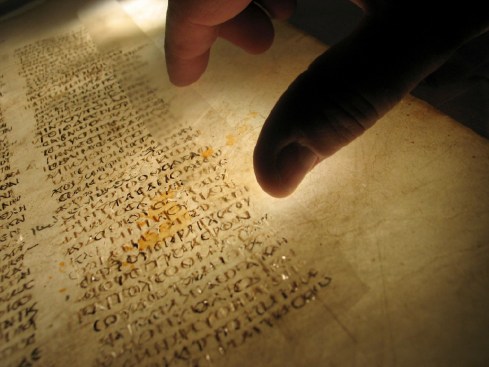
Codex Sinaiticus

Photo Credit: CodexSinaiticus.org


I’ve been reading the Old Testament straight through, struggling at times with the accounts reported in the ancient texts.  Admittedly, if someone at a party started telling these stories we’d all think they were loony.

There are essentially three possible pronouncements for the passages in the OT that are represented as factual, either:

  1. They are fictional and/or fraudulent, or
  2. They are (wholly or partly) allegorical and not meant to be taken literally, or
  3. The miraculous is in play and the historical accounts are correct.

There is no half-off sale in Christianity—we can’t have the New Testament without the Old.  Some poor souls work themselves into torturous and indefensible theological positions by cherry picking which parts of Scripture they accept and which ones they discount as allegorical.  Some of them even show up on documentaries wearing clerical collars, affiliated with organizations that have ‘Jesus’ or books of the Bible in their name.  Hmmm…. It’s best to think it through yourself.

Is our faith based merely on the hope that the OT is valid, or is there some intelligent basis of assurance? Continue reading


The Septuagint and the Original Old Testament?

The first part of the Book of Genesis, from the Septuagint, the early Old Testament Greek translation used by the early Christian church.

The first part of the Book of Genesis, from the Septuagint, an early  Greek translation of the Old Testament, which served as the “Bible” of the early Christian church before the completion of the New Testament.  Is this translation the closest thing we have to the “original” Old Testament?

I noticed sometimes the quotes of the Old Testament passages in [the Book of] Hebrews do not exactly match the wording when I go back and look up the verses in the Old Testament. I am just wondering what is going on.” This was a question sent to our pastors for our summer Bible study series on the Book of Hebrews. I do not know who asked the question in our congregation, but I want that person in my small group. What an awesome question!

The problem is that when you read a number of Old Testament citations in the New Testament, the New Testament writers are actually quoting from the ancient Greek translation of the Old Testament, the Septuagint. Most of the Old Testament was written originally in Hebrew, so it comes as a shock to people to learn that this ancient Greek version of the Old Testament is referenced quite a bit in the New. Critics of Biblical faith will ask if the New Testament writers are at best sloppy when quoting from the original Old Testament, or are they downright fraudulent and terribly mistranslate the Old Testament by relying so much on the Septuagint instead of the original Hebrew?

Get your thinking caps on. This is really a good question.
Continue reading