Why History Matters: That Tucker Carlson – Putin Interview

Here is a quick blog post about the recent Tucker Carlson exclusive interview with Vladimir Putin. I finally made my way through the entire 2-hour video, and I had one big takeaway part.

The posts that I write for the Veracity blog are mainly about Christian apologetics (how to defend your faith in an age when many hold Christian convictions to be rather suspect), but I also write about church history. It is not simply because I am a fanatic about history as a subject (a description I willfully accept), but because I fervently believe that historical amnesia is destructive to the church. The Tucker Carlson – Vladimir Putin interview is Exhibit A in making my case.

In the interview, President Putin took up about the first half an hour of the interview giving an historical justification for why Russia began attacking Ukraine two years ago.  Putin’s historical argument goes back over 1,000 years, to make the case that Ukraine is really part of Russia. But the argument is not just about ethnic identity. There is a deeply seated theological interpretation of history at work here.

Church history now bubbles up to the top of the 24-hour news cycle.


President Putin is convinced that Russian Orthodox Christianity also binds Russia and Ukraine together into an inseparable bond. The current war in Ukraine is a kind of “civil war” between different factions within the same Russian ethnic and religious family.

Nothing Putin said in the interview is really anything new.  But as historian Tom Holland comments in his reaction to the Carlson – Putin interview, the church history argument being advanced by President Putin is akin to the idea of the British government somehow coming up with a scheme to justify a complete takeover of the whole of Ireland because Saint Patrick came from Britain centuries and centuries ago to establish Christianity in Ireland.

Others have offered additional analysis of Putin’s assertion of certain “facts,” but Tom Holland’s utterly perceptive comments raises a crucial point. When an ideology becomes so strong that it keeps someone from entertaining the possibility that they might be wrong in their understanding of certain historical “facts,” then the consequences can be devastating.

Well over half a million casualties can be associated with the war in Ukraine over the past two years, with hundreds more being killed or wounded every day.

We see the same thing in the Israeli/Gaza conflict, as the body count increases daily, spawned by competing historical and theological narratives that extend back hundreds if not thousands of years.

We see this in disputes in church history, as different flash points continue to divide Christians today, due to theological differences which all look for historical justifications for such divisions.

Why does history matter, and even church history, in particular? Because without a proper grasp of history, the consequences can be devastating.


Christmas in Europe: A Tour of Cambridge, England

My wife and I were able to tack on a few extra days, after our Christmas stay in Belgium, to go and visit friends staying in Cambridge, England.

Jon Thompson, the director of the Cambridge House at the College of William and Mary, had taken his family back to Cambridge, where he had previously studied philosophy, before eventually coming to Williamsburg, Virginia. A wide-ranging group of believers in Williamsburg had prayed for several years for the founding of a Christian Study Center at William and Mary, so it has been wonderful to see how God brought Jon Thompson and his family to Williamsburg less than two years ago, to oversee the work at the Cambridge House.

Our Christmas in Europe made it possible to meet up with Jon and his family in his old “stomping grounds” in Cambridge, England. Sickness made traveling quite difficult for us, but Jon was able to take me on a tour of the university town of Cambridge one afternoon.

Jon Thompson, director of the Cambridge House, at the College of William and Mary, took me on tour of the namesake for the Cambridge House, the university town of Cambridge, England, in January, 2024. We are standing in front of the residence the Thompsons’ had while in Cambridge for a few weeks.


Part of Jon’s interest in coming to Williamsburg to serve as the director of the Cambridge House at the College of William and Mary stems from his experience as an intern at the Round Church, a medieval church building in the very center of Cambridge, which now serves as a Christian Study Center for the academic community of Cambridge. This was also where we began our tour of the town of Cambridge, England.

William and Mary Cambridge House director, Jon Thompson, in front of the Round Church, now a Christian Study Center, in Cambridge, England.


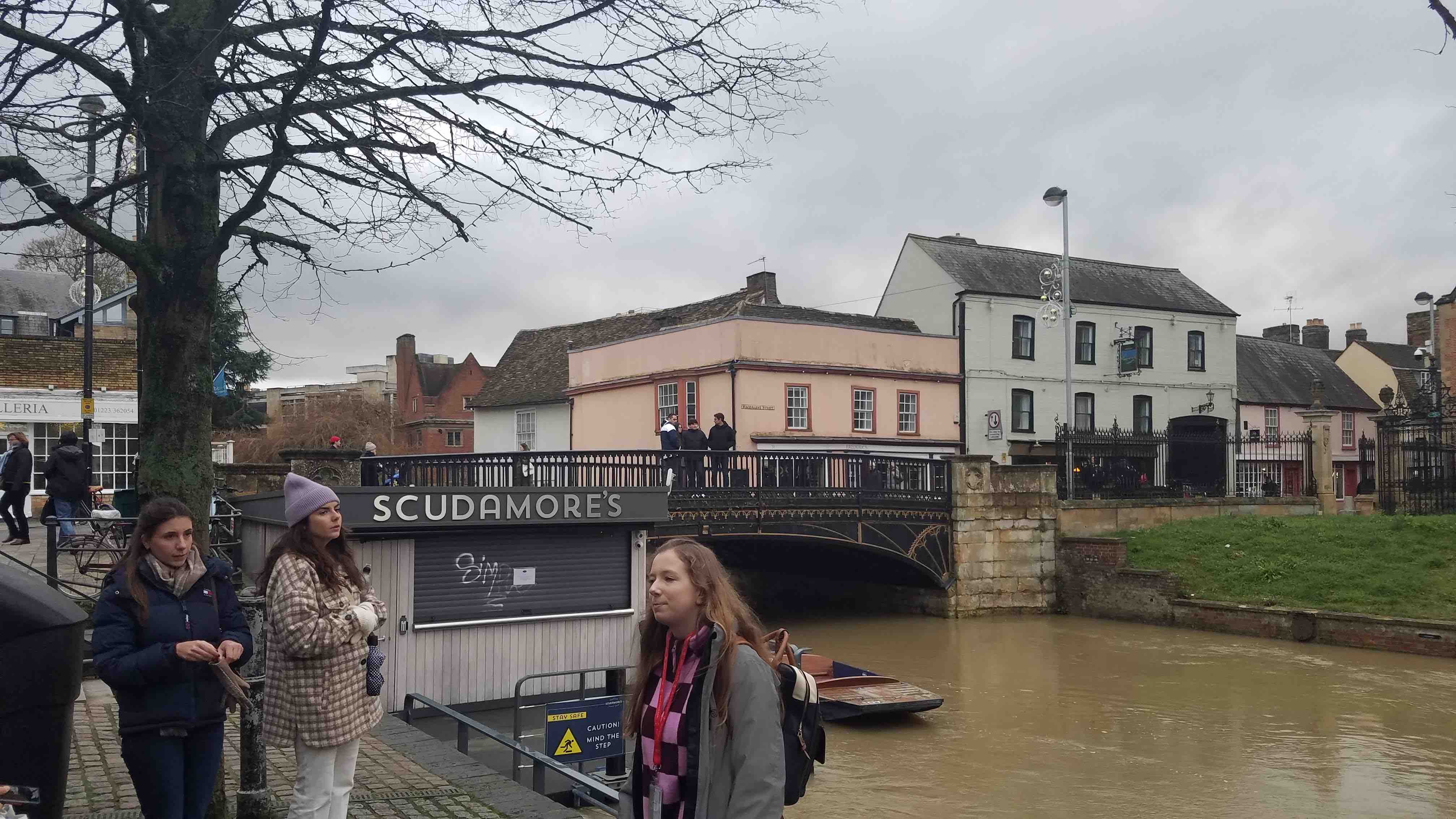
Cambridge, England is an interesting college town, as it is actually a network of loosely affiliated colleges, all part of the Cambridge academic community. The famous Christian apologist and Oxford scholar, C.S. Lewis, spent the last nine years of his life as the Chair of Medieval and Renaissance English for Magdalene College, one of the many colleges that are part of Cambridge. Our official tour guide for a “Christian Heritage” tour of Cambridge, was a wonderful young lady who told us about Lewis’ teaching career at Magdalene, as we gazed across the river Cam, looking at the Bridge that crosses the river, hence the name of the city: “Cam-Bridge.”


Visitors to Cambridge often will go “punting” along the River Cam to view colleges that dot its shoreline. However, the river was running quite high while we were in Cambridge, and the cold weather discouraged us from any “punting” experience.


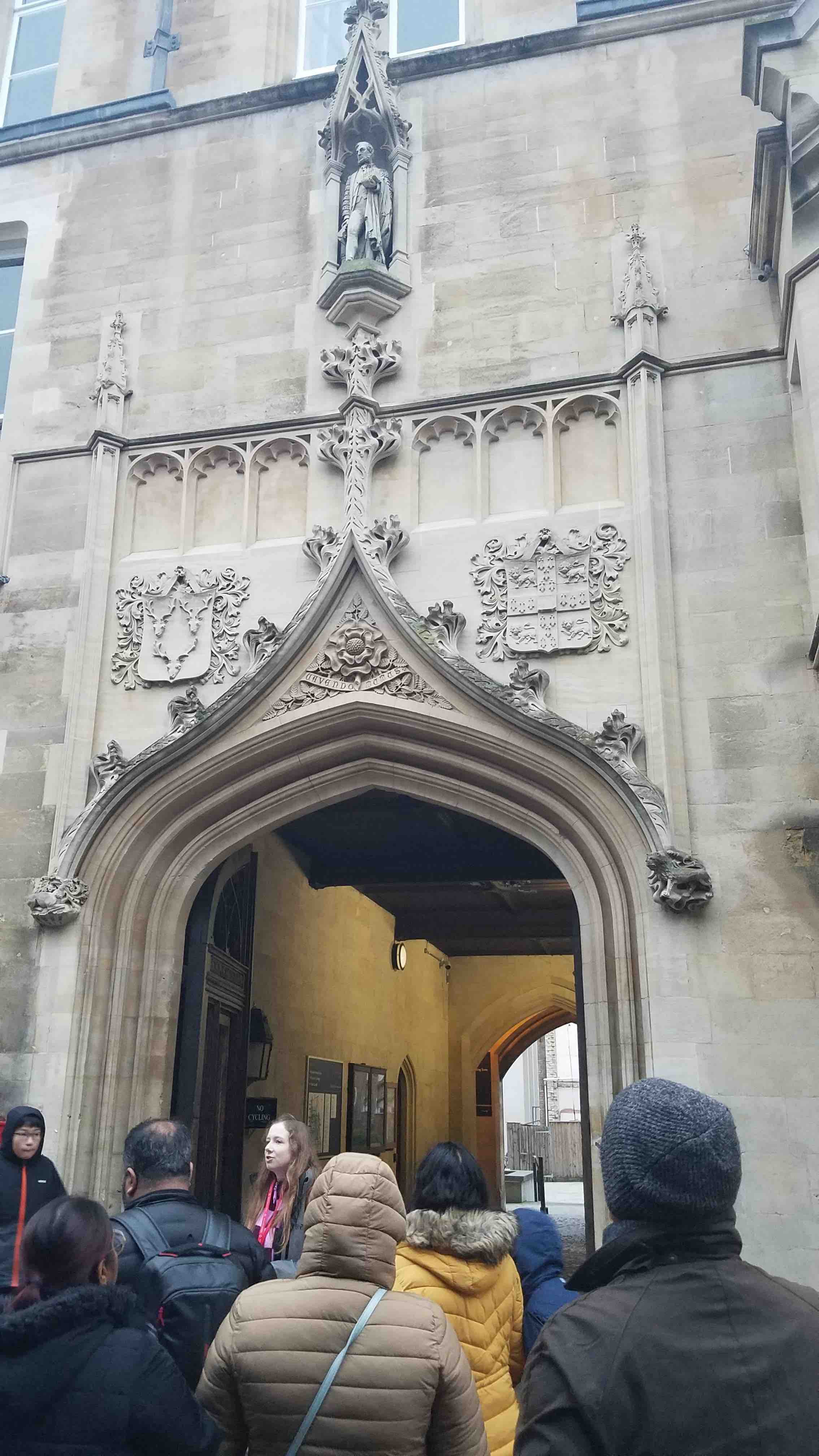
The neat thing about this “Christian Heritage” tour is that we got the opportunity to visit inside some of the various colleges, where several of the colleges typically charge separate fees to visit. Some of greatest names in church history are tied to the Cambridge community, not just C.S. Lewis. For example, William Wilberforce, the 19th century evangelical Christian leader and outspoken advocate for getting rid of the British slave trade, attended St. John’s College. We were able to walk the grounds of St. John’s College and even take a few minutes to visit inside of the beautiful Chapel at St. John’s:

The courtyard of St. John’s College in Cambridge, England. Several Christian leaders in the early 19th century attended college at St. John’s, including William Wilberforce.


St. John’s Chapel at St. John’s College, in Cambridge, England.


We even had the opportunity poke our heads in and glance at the Cavendish Laboratory, led in its early years by James Clerk Maxwell, a leading Scottish scientist of the late 19th century and devout evangelical Christian, whose meditation on the doctrine of the Trinity helped to inspired him to develop his field theory of electricity and magnetism.  His work on “Maxwell’s equations” directly influenced Albert Einstein to develop his theories of relativity. Einstein described Maxwell’s work as the “most profound and the most fruitful that physics has experienced since the time of Newton.” It was at Cavendish Laboratory that the existence of the electron was first discovered:

Entrance to the Cavendish Laboratory, historically one of premier physics labs in the world.


What a treat it was walk along the same streets that some of the greatest names in intellectual history have walked: from Isaac Newton to William Wilberforce to James Clerk Maxwell to Clives Staples Lewis.

I will have more photos from our Christmas in Europe trip in future Veracity blog posts.

Emmanuel College, in Cambridge, England. The school was founded by Puritans, with one of its pupils being Thomas Harvard, who would later travel to New England and establish the first English-speaking college in the Americas, which still bears his name.


Christmas in Europe: Bruges and Ghent, Belgium

My wife and I were able to spend the Christmas season in Europe in late 2023 and early 2024. The details only came together at the last minute, but we ended up staying with friends near Brussels, Belgium for Christmas for almost two weeks. Then just after New Years, we took the Eurostar train underneath the English Channel to eventually meet up with other friends in Cambridge, England for a few days.

Throughout 2024, I plan on posting a few photos and stories of our trip to Belgium and England for Christmas 2023. We did not cover as much territory as we did with our 2022 trip along the Danube, but we did get to experience what Christmas was like in Europe.

It was quite a crazy trip getting to Belgium: missed flights, lost luggage, you name it, all on Christmas Eve. The stress made us susceptible to getting sick while we were in Belgium, which made it difficult to enjoy everything, but we tried to make the best of it. We even flew through Iceland in between volcanic eruptions, only about 12 miles from the airport, which eventually damaged part of the fishing village, Grindavik. We also had to find a way to dodge the threat of a labor strike on the London Tube, which would have interfered with our return trip out of Gatwick Airport back to the United States. The whole trip seriously made me have second thoughts about ever traveling by air again!

Christmas markets in the central city square of Bruges, Belgium, around dusk. Belfort bell tower in the background.


Bruges, Belgium

The city of Bruges, Belgium is enjoyable to walk through as everything is mostly compact. We visited a few days after Christmas, and the streets were really crowded, which was not our type of thing. But it did give us a chance to see what it was like with Europe’s fabled Christmas markets, where vendors were out selling Christmas foods, and in Belgium, particularly waffles, fries, and especially chocolate!

As my contribution to the Veracity blog is mostly about church history and Christian apologetics, I can not resist saying something about those subjects here. A country like Belgium has become increasingly secularized during the modern period, but its church history is largely well preserved, so its Christian heritage is unavoidable. There are several beautiful churches to visit in Bruges, one of them being Saint Salvator’s Cathedral, which dates back to the 13th century.

Interior of Saint Salvator Cathedral in Bruges, Belgium. The church was greatly expanded after a roof collapse in the 19th century. Yet aside from that, Saint Salvator’s Cathedral largely escaped centuries of strife, particularly the destruction inflicted by the devastating wars of the 20th century in Belgium.

More so than in many other cities throughout Europe, Bruges has sustained its medieval character, and a walk through Saint Salvator’s Cathedral serves as a great reminder of the historical influence of Christianity that pervades Europe, with so many works of art displaying stories from the Bible and instances of conversion of various Christian persons during Europe’s long history.

On a trip like this, I like take along with me an audiobook that gives insights into the history. Tim Blanning’s massive and learned The Pursuit of Glory: The Five Revolutions That Made Modern Europe: 1648-1815, part of the Penguin History of Europe series was the perfect guide. It was during this period between the Thirty Years War and the end of the Napoleonic wars when Europe made the transition from being the locus of Western Christendom to the emergence of nationalism as the guiding ideology. Belgium was right in the center of this story, with Napoleon’s famous defeat at Waterloo chronicled at the ending chapter of Blanning’s book, and the site of the battle less than a hour’s drive from where we stayed with friends.

The emergence of a post-Christian Europe has had a long history behind it, as nations like Belgium and the United Kingdom continue to wrestle with this significant spiritual shift. Consider the British monarchy, where the late Queen Elizabeth was perhaps the last of the firmly evangelical, historically orthodox Christians to lead a European country. Her son, King Charles III, has a more progressive take on Christianity, who considers himself a “defender of faith” as opposed to being a “defender of the faith,” as his mother was. Now Charles’ son, William, the heir apparent, wants very little to do with the Church of England. A recent news story suggests that William would like to sever ties with the Church of England, but that is not quite as easy as it sounds. Pray for spiritual revival in Europe!!

Ghent, Belgium, and Its Famous Altarpiece

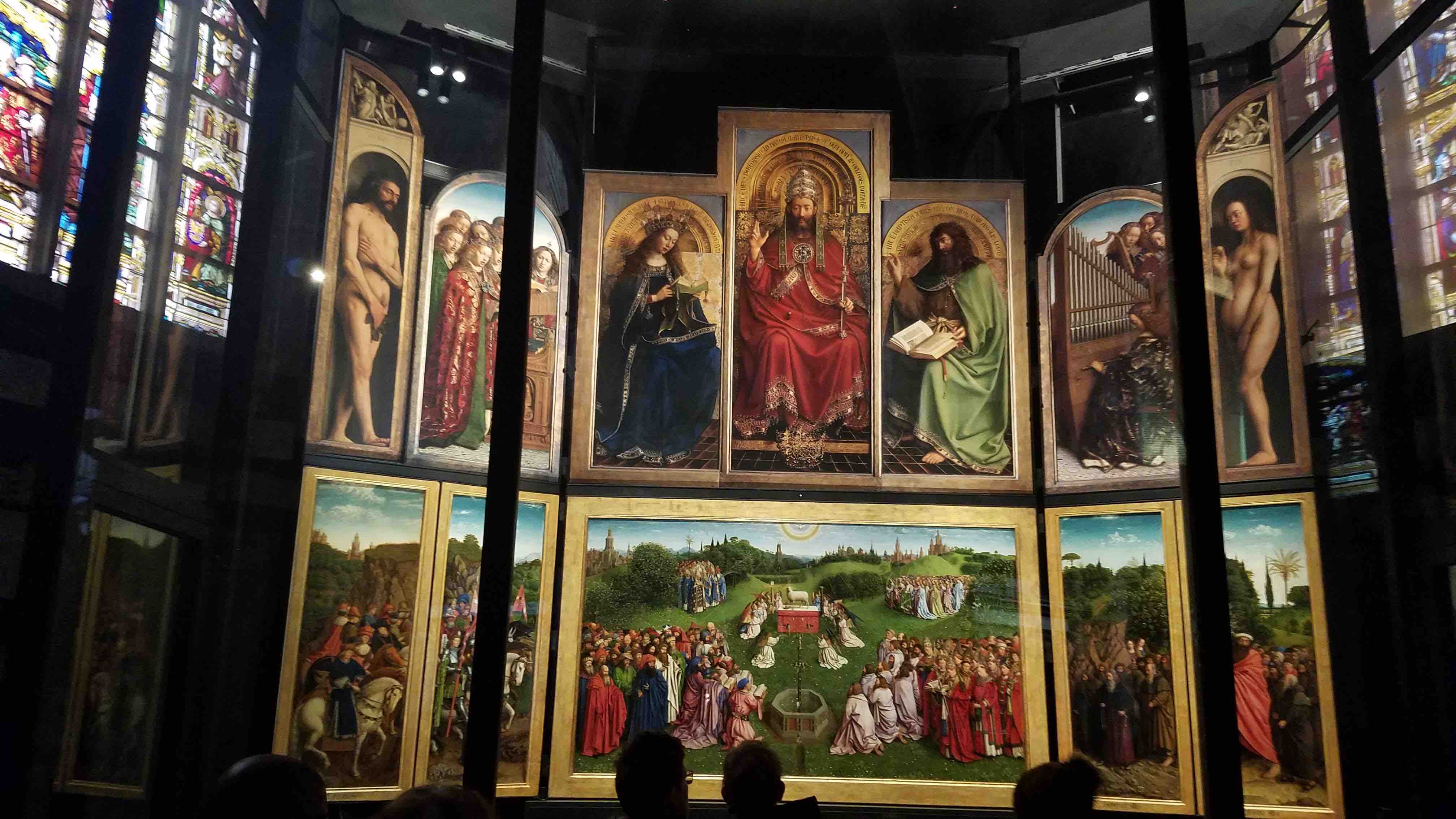
The same day we traveled by train to visit Bruges, we also stopped over in Ghent, a much bigger city than Bruges, where riding a bicycle is really the most efficient way of getting around. The highlight of Ghent was seeing the Mystic Adoration of the Lamb, at Saint Bavo’s Cathedral.

This altarpiece has been popularized the most in recent times by George Clooney’s 2014 movie, The Monuments Men. The Nazis during the World War II occupation of Belgium had stolen the Mystic Adoration of the Lamb, with the intent of installing this great work of art in one of Hitler’s planned museums after the war. But with the impending defeat of Germany, there was concern that great works of art might be destroyed by Hitler, so the Allies formed a special military unit that sought to safely recover the art works stolen by the Nazis. The Mystic Adoration of the Lamb was one of those pieces restored to its rightful place.

The Mystic Adoration of the Lamb dates back to the 15th century, a product of the Dutch painters, brothers Hubert and Jan van Eyck. Each panel stunningly displays a story or person from the Bible. If you ever go visit this yourself, I would recommend booking a time slot in advance, as this will help to avoid long lines of the many visitors who come to gaze at the altarpiece. My photo in no way captures its brilliance (but clicking on the photo to expand it might help). My only regret was in not seeing the altarpiece opening and closing, but there are some good videos out there that suffice.

Speaking of Waterloo and Napoleon above, the Ghent Altarpiece was captured by French Revolutionary troops in 1794, but the painting was returned to Saint Bavo’s Cathedral after Napoleon’s defeat at Waterloo in 1815. The thefts by Hitler and Napoleon only account for two of the thirteen times the Mystic Adoration of the Lamb has been stolen across the centuries.

The Mystic Adoration of the Lamb, in Saint Bavo’s Cathedral, in Ghent, Belgium. Stolen by the Nazis and recovered by “the Monuments Men.”

Look for more highlights of our Christmas in Europe trip in the coming weeks and months on the Veracity blog.

Forgery and Counterforgery: Allonymity as Benign Pseudepigraphy

Is it possible for a letter to be written under the name of a famous person, sometime after the death of that famous person, and yet it NOT be considered a forgery? In this fourth post in our Veracity blog series reviewing Bart Ehrman’s Forgery and Counterforgery, we explore the concept of “allonymity” as a benign alternative to “forgery” to describe certain pseudonymous writings within the New Testament. If you think this is a mouthful of “intellectual-speak,” I will try to unpack all of this here.

In previous posts in this series, we have explored the controversy over “forgeries” in the New Testament in an introductory manner. Secondly, we have examined more closely the kind of arguments Bart Ehrman uses to identify the existence of “forgeries” within the New Testament. Thirdly, we looked at the special case of the pastoral letters; 1 Timothy, 2 Timothy, and Titus, which are Pauline letters in the New Testament that are often deemed as inauthentic by scholars like Ehrman. In this post, we consider one particular alternative to the pejorative use of the term “forgery” to describe a pseudonymous New Testament document.

One of my New Testament professors at Fuller Theological Seminary, Donald Hagner, now emeritus, has made a positive case for a category of pseudonymous writing, one that lacks the negative stigma associated with the more pejorative term of “forgery.” In his The New Testament: A Historical and Theological Introduction, Donald Hagner accepts a number of arguments presented by those like Bart Ehrman, who suggest that certain New Testament writings were not actually written by the ascribed author. However, in contrast to Ehrman, Hagner suggests that such examples of pseudonymity in the New Testament are not deceptive in character. Therefore, we should treat such New Testament writings more fairly and not consider them to be forgeries.1

Bart Ehrman’s Forgery and Counterforgery: The Use of Literary Deceit in Early Christian Polemics argues that up to 70% of the New Testament writers are actually forged documents. How well do the claims of Bart Ehrman stand up to scrutiny?

Continue reading


2023 in Review (…. and Book of the Year, Andrew Wilson’s Remaking the World )

We hit near the end of 2023….so, they canceled Christmas in Bethlehem this year….

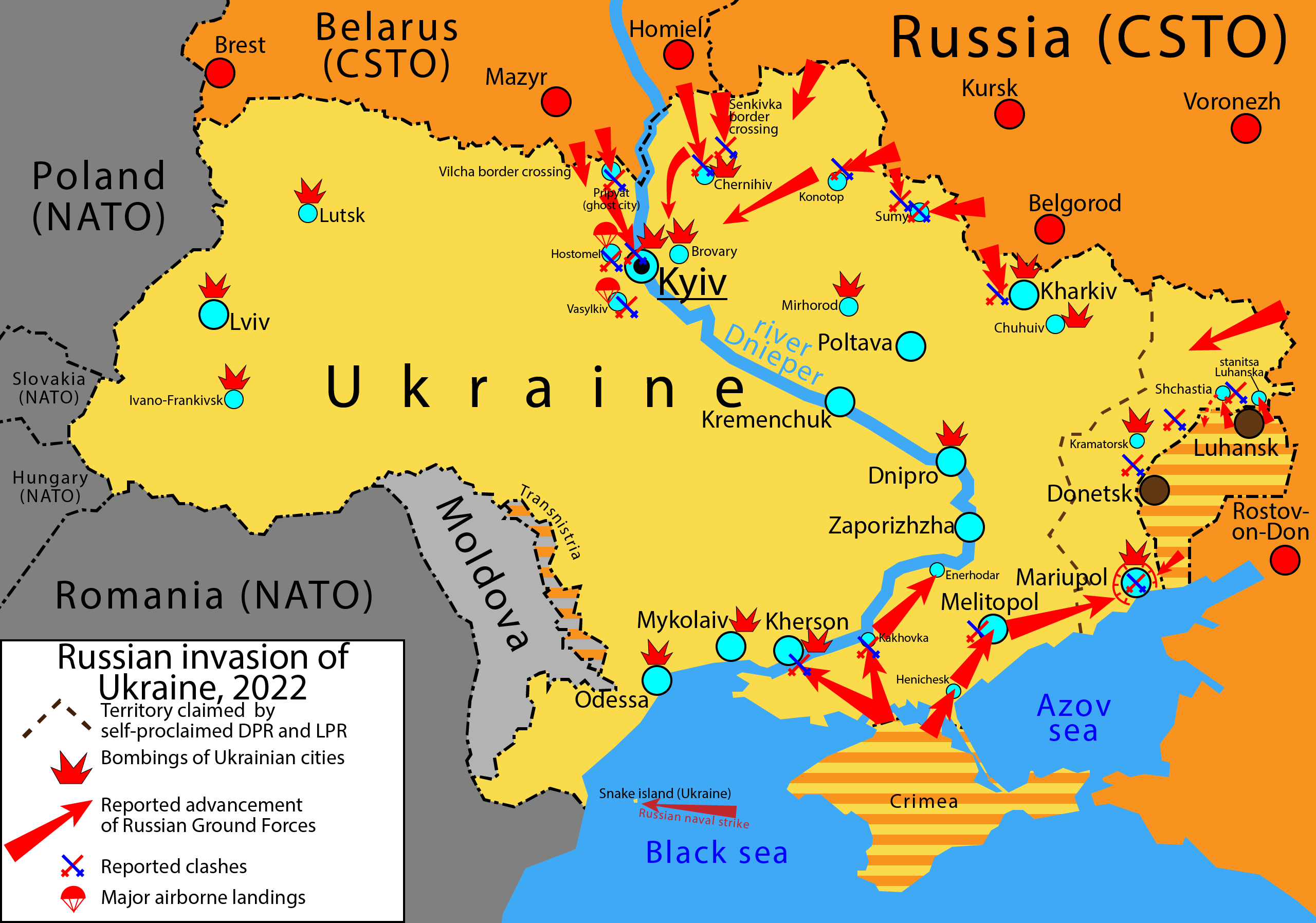
Just when you thought that the world was trying to get past the COVID pandemic, all sorts of other craziness breaks loose and gets worse. The Ukraine/Russia conflict drags on into its second year, and in recent months, the Israel/Palestinian crisis just explodes.

The horribly inhumane October 7 attacks by Hamas upon Israeli civilians shock us, while Israel’s efforts to eradicate Hamas from Gaza has led to thousands of deaths of Palestinian non-combatants. Has Israel really done enough to avoid civilian casualties? Has there not been some better way to protect children and hospitals? How should we respond to the reports of abuse of Palestinian prisoners in Israeli jails? What about attacks from Israelis against Palestinians who continue to build illegal settlements?  Even the minority of Christians in Gaza have been targeted, caught in the crossfire,  or at least confused with being Hamas. When we learn that 19 of the remaining 1,000 Christians in Gaza have been killed since the beginning of the war, it can not be good.

On the other hand, what do we make of the pro-Palestinian protests chanting “From the river to the sea, Palestine will be free?” Do people really understand what that even means? Are there really that many people who seriously want the complete destruction of Israel? Has anti-semitism all of a sudden shot off the scale?

Maybe so. A December article in the Economist shows the upsetting results of a recent poll: one in five young Americans (between the ages of 18 and 29) believe that the Jewish holocaust in World War II was a myth. Almost no one in my age group or older dismisses the Holocaust as a non-event, but apparently nearly a quarter of American young people today believe that “the Holocaust has been exaggerated.” Seriously ??! Simply mind-blowingly sad how we are raising a generation of youth today who have no adequate comprehension about basic historical facts. Look at the Economist survey for yourself.

We apparently live in very crazy times.

In the background behind these political debates stands the complex history of the land in the Ukraine, and in the Middle East, and how people read the Bible. I spent approximately two years (2014-2016) blogging about the Israel/Palestine situation, and I walked away from that with some changes to my thinking (BONUS LINK: Read about the history of how the name “Palestine” got attached to this Middle Eastern land area).

However, I have no real “silver bullet” solution to something like the current Gaza crisis. But this should not be used as a excuse to stick one’s head into the sand. It is frankly impossible to understand anything about the Israeli/Gaza crisis without digging deep into the Bible. Part of my passion in writing on the Veracity blog is to prod myself to better learn about history and think more deeply about the Bible, in hopes that others might do so as well.

2023 Book of the Year: Andrew Wilson’s Remaking the World: How 1776 Created the Post-Christian West.

Continue reading