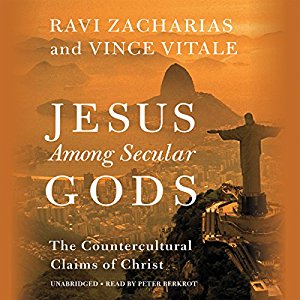
Jesus Among Secular Gods, by Ravi Zacharias and Vince Vitale. Addresses issues that were missed in Zacharias’ earlier work, and geared towards today’s college student.
(December 8, 2017): PLEASE READ THE VARIOUS UPDATES ON the ENTIRE POST BELOW. Thank you….
When I first read Ravi Zacharias’ book, Jesus Among Other Gods, published in 2000, others and I were encouraged by what we considered to be a very readable exploration into why Jesus Christ is so fundamentally different, in a society that is constantly exposed to conflicting and competing truth-claims. So impressive was the book, that our church made a united effort to bring Ravi Zacharias to our church, and the campus of the College of William and Mary, for a weekend of messages, followed by dynamic public question and answer sessions.
Though I still highly recommend Jesus Among Other Gods, I personally felt that the book lacked something important. Zacharias was great at showing the contradictions between various religious worldviews, but he did not adequately address the question of how one is to live in a world, where such conflicting truth-claims exist in the first place. It is one thing to consider the particular truth-claims of different religions. But why even chose any particular worldview at all? Why not just accept them all?
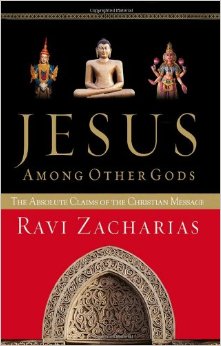
Jesus Among Other Gods, by Ravi Zacharias, 2000.
For example, so many Christians enter into a relationship with someone who is a professing Muslim, Buddhist, or Hindu, with the idea that the other person is “Evil Incarnate.” However, these Christians are often confused when they soon realize that their new Muslim, Buddhist or Hindu friend, is often really a nice person. Are then all religions somehow “true?” An informed response is needed to this question.
Oxford Dictionaries named the term “post-truth” as the 2016 word of the year. So, it is absolutely crucial that Christians begin to more clearly think through the relationship between “truth” and the Gospel, and start having better conversations with our neighbors about these issues.
That is why I am really excited by a new book co-authored by Ravi Zacharias, and fellow associate apologist, Vince Vitale, Jesus Among Secular Gods. With chapter titles such as “Atheism,” “Scientism,” “Pluralism,” “Humanism,” “Relativism,” “Hedonism,” and “Love the Truth,” Jesus Among Secular Gods has great potential to be a great discussion starter among our neighbors.
Ravi Zacharias and Vince Vitale travel the world, speaking before audiences, sharing their faith and answering objections to the Gospel of Christ, through Ravi Zacharias International Ministries. Zacharias is featured on a weekly syndicated radio program, Let My People Think. Below is a 12-minute discussion about the new book. I have not read the book yet, but if you have, please share your review in the comments section below!
UPDATE: December 7, 2017. I am sorry to say that I did not adequately review the video below, before posting. For if I did, I would have caught the fact that Vince Vitale introduces his fellow co-auther as “Dr. Ravi Zacharias.” This is most unfortunate, as I knew that Ravi Zacharias, though clearly a gifted speaker and writer, and a most intelligent, Christ-loving man, has never earned the doctoral equivalent of a PhD, in any field. Ravi has received Honorary Doctorates, but this does not qualify anyone to be called a “Doctor,” especially when one’s ministry field is to students and professors in higher education. I would hope that this was simply an oversight, an honest mistake, on both Dr. Vince Vitale’s (who truly is a “Doctor”) and Mr. Ravi Zacharias’ part. I still have not read the book, but given what I have read before from Ravi, I still think it would be most helpful. Nevertheless, I regret the error on my part. For more information, please read this more recent blog article about this issue.
UPDATE: December 8, 2017. For those who have been following this, as someone who values the work of RZIM, I have had trouble sleeping, and I thought it best to try to reach out to someone at RZIM (this is the biblical way to do it). So, I contacted Vince Vitale directly and expressed my concerns, as this whole episode has been terribly frustrating to me. Thankfully and graciously, Dr. Vince Vitale took the time out of his day, and called me from Oxford (how many times does that happen?). We had a great conversation and I was thoroughly impressed by his integrity.
Vince deeply loves Ravi, and greatly respects him, so it was only natural to address him, in a manner, that would befit showing such respect, to a fine Christian leader. However, Vince also told me that RZIM recognizes that using “Doctor” in this way is contentious in some circles, especially in academia, and that they desire to aim for complete clarity. From our conversation, it appears that he, and RZIM as a whole, are taking steps, in good-faith, to hear the concerns of me and others and to make sure that the way they speak about credentials is both accurate and unambiguous.
Admittedly, people outside of academia might not care one bit about stuff like this, but when you are trying to minister to faculty and students, like we have in our local community, in a college town, it is important for ministers of the Gospel, to stand above reproach. So, I am very, very glad Vince Vitale personally is taking the right steps forward, and that he has been so generous with me. That is a mark of great character. Thank you, Vince!!!
UPDATE: May 20, 2020. Ravi Zacharias died yesterday, from a short battle with bone cancer. Since this blog post was updated on December 8, 2017, RZIM finally took down the controversial video from YouTube, promoting the Jesus Among Secular Gods book. Kudos to RZIM for eventually setting the record straight….. Speaking of McGrath (above), Alister McGrath has a very fine remembrance essay posted at The Gospel Coalition.
UPDATE: December 23rd, 2020. Review of the sexual impropriety charges at a spa, partly owned by Ravi Zacharias, conducted by a law firm hired by RZIM, releases a preliminary report indicating that Ravi did act inappropriately.