Category Archives: Topics

I Can’t Get No Satisfaction… In Christ Alone?

When you are in church singing a hymn or contemporary worship song, how often do you think about what the words mean? Music is a powerful vehicle for expressing praise to God, no matter what the style or genre is. But it is the lyrics in the song that have the greatest importance.

Perhaps one of most illuminating controversies in 2013 was over one particular contemporary hymn, In Christ Alone, written by Stuart Townend and Keith Getty. Several years ago, a Baptist group put out a hymnal, Celebrating Grace, including the song by Townend and Getty. The Baptist hymnal read verse 2 like this:

In Christ alone who took on flesh
Fulness of God in helpless babe
This gift of love and righteous-ness
Scorned by the ones He came to save
Till on the cross as Jesus died
The love of God was magnified
For every sin on Him was laid
Here in the death of Christ I live

In early 2013, the hymnal revision committee of the Presbyterian Church U.S.A (PCUSA), the largest mainline Presbyterian denomination in America, liked this version and asked the original songwriters if they could put the song in their new hymnal. Unfortunately, there was a “small” problem.  It appears that the Baptist group had altered verse two (note the line in bold above), and they had failed to tell Townend and Getty about the modification. The original version was actually this:

Till on the cross as Jesus died
The wrath of God was satisfied

The songwriters would grant permission to the Presbyterians to use the song so long as they would keep the original wording. The Presbyterian hymnal committee refused the songwriters’ conditions and therefore dropped the song from the new hymnal.

You will not be singing In Christ Alone from any PCUSA hymnal anytime soon.

Can you hear Mick Jagger crooning about that? (Hampton Coliseum, 1981)

But for you Presbyterian “rebels” out there who “can’t get no satisfaction”, you can clandestinely sing along with it here (I promise not to tell your pastor)  😉

(SIDE NOTE: Kristyn Getty, married to Keith Getty, the songwriter, is a niece to Irish/British apologist John Lennox who teaches at Oxford).

So what’s the big deal? Brewing in our churches today is a theological controversy regarding the nature of the atonement: When Jesus died on the cross for our sins, what was that all about? What did Jesus accomplish?
Continue reading
Lo! How A Rose E’er Blooming

This Advent season, we sang the English version of the great German carol, Es ist ein Ros entsprungen, more commonly known to English speakers as Lo! How A Rose E’er Blooming.

No one knows who originally wrote it, though it appeared in a German hymnal in Cologne in 1599. The familiar tune was written by Michael Praetorius in 1609. Many hands have been involved in the development of this carol over the years. Having up to 23 stanzas at one point, an American, Theodore Baker, originally translated the first two stanzas into English in 1894. Several other verses in English were added by others later to give us this:

Lo, how a Rose e’er blooming from tender stem hath sprung!
Of Jesse’s lineage coming, as men of old have sung.
It came, a floweret bright, amid the cold of winter,
When half spent was the night.

Isaiah ’twas foretold it, the Rose I have in mind;
With Mary we behold it, the virgin mother kind.
To show God’s love aright, she bore to men a Savior,
When half spent was the night.

The shepherds heard the story proclaimed by angels bright,
How Christ, the Lord of glory was born on earth this night.
To Bethlehem they sped and in the manger found Him,
As angel heralds said.

This Flower, whose fragrance tender with sweetness fills the air,
Dispels with glorious splendor the darkness everywhere;
True Man, yet very God, from sin and death He saves us,
And lightens every load.

O Savior, Child of Mary, who felt our human woe,
O Savior, King of glory, who dost our weakness know;
Bring us at length we pray, to the bright courts of Heaven,
And to the endless day!

And who is this “Rose”, you might ask? You could rightly say “Jesus”, but in the original German version, the “Rose” was understood to be “Mary”. Some medieval interpreters of the Bible understood the “Rose of Sharon” in Song of Solomon 2:1 to be an allegorical representation of Mary. But presumably through the influence of Michael Praetorius, a moderate Lutheran who had an interest in improving relations between Protestants and Catholics, and others like him, the carol gradually shifted its focus to center on Christ. As is made explicit in verse 2 above, the prophet Isaiah in chapter 11 speaks to Jesus as being the fruit derived from the stump of Jesse. Mary’s role is clear as the Christ-Bearer.

As with many carols, they often take on different expressions. I have included three below: The first version is our church band’s  rather avante-garde bluegrass interpretation, loosely based on the second brilliant version by Sufjan Stevens. Our band here includes my friends: Doug Deberry on acoustic guitar, Peter Budnikas on banjo and singing, and our fearless leader, Glenn Lavender, on portable upright bass and singing. Glenn is the worship leader for our church, formerly the bass player with the internationally popular band, Downhere. The mandolin player is some guy they found in between writing blog posts on something called “Veracity” 😉 . If you are looking for a more traditional rendering, have a listen at the majestic, classical version at the bottom by opera legend Ren´ee Fleming singing with the Mormon Tabernacle Choir.

[vimeo 81331569 w=500&h=281]

HT: Steven Wedgeworth’s blog on the carol. Steven has some great reflections on some other carols, too.


Christmas Calculus

Christmas Calculus


I am thankful for the mechanism
that lifts anger off the rails of contention
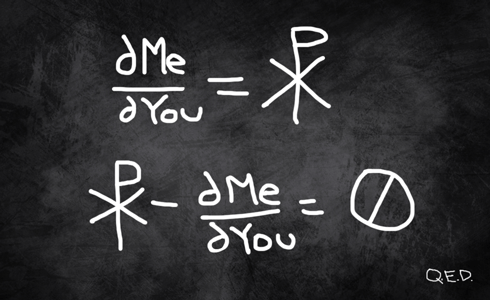
and offers instead a calculus of peace.

Because it occurs to me
that the change in me
with respect to you
was modeled by Jesus Christ.

His equation for anger can be found
in the handbook for our self-obsessing culture—
a testable model for peace.

Because if we genuinely put our anger
next to Jesus Christ
it leads to forgiveness,
and no anger remains.

Absent anger, love can change the intractable,
and save the cost of cleaning up emotional fallout—
leaving energy for peace.

Because there is no peace in anger,
you and I desperately need
a Chi Rho to make it work—
and that’s why Christmas is so necessarily beautiful.


Christmas Wars: Then and Now

The "War on Christmas"? Are we missing something here? Perhaps a look at church history might help.

The “War on Christmas”? Are we missing something here? Perhaps a look at church history might help.

It is that time of year again, December, when Christians in America face an annual existential crisis: Do you wish people a “Merry Christmas”… or not?

I must confess that I am not crazy about fighting amongst the shopping hordes at the mall, and the year after year pressure of finding the right gift can be really stressful. Sure, shopping online helps a teeny bit, but what I am talking about here is a more fundamental cultural anxiety. Increasingly over the past few years, I have heard Christians grumble throughout the month of December over how “they have taken Christ out of Christmas!” I have read angry letters in the local newspaper complaining how store operators are greeting customers more and more with the shallow and inadequate “Happy Holidays”. Where have the traditional nativity scenes at the community fire station gone? Have a “Joyous Winter Solstice”? What is that all about?

Folks. Let’s face it. We are moving more towards to a post-Christian society with every passing year.

Deal with it.

We could continue to get mired in frustration and disgust, or we can see this as a providential opportunity to reflect on what God is calling us to do as witnesses for the Gospel. What does this look like? Might I suggest some lessons from church history?
Continue reading


Bible Secrets Revealed via the History Channel?

God took Enoch (Genesis 5:24). From Figures de la Bible, Gerald Hoet and others, 1728.

God took Enoch (Genesis 5:24). From Figures de la Bible, Gerald Hoet and others, 1728.

As I do not have cable TV, I never really get to watch the History Channel. But when some friends suggested that I check out the new History Channel series on the Bible Secrets Revealed, I thought I should investigate a little.

As it turns out, the History Channel does allow you to watch some of the previous episodes online fairly easily, at least for a limited time. I missed the window to see the first episode, “Lost in Translation“. However, I was able to view the next two episodes, “The Promised Land” and “The Forbidden Scriptures“. I will not attempt to give a full review but just offer some brief general observations and pointers to some resources for further study.

I like Bible documentaries because I always learn something from them, such as in this History Channel series, and it encourages me to dig deeper in the data even more for myself, even if I do not agree with everything presented. But what bothers me about some Bible documentaries is in the style of presentation and the overall narrative that the producers of the film are trying to convey. Genuine efforts to present views even handedly get unwittingly sidetracked by unexamined biases held by these documentary makers. Unfortunately, the History Channel’s latest film on this topic is no exception.
Continue reading
