Category Archives: Topics

Your Desire Shall Be For Your Husband

Katharine Bushnell (1855-1946). Missionary to China and activist for women's equality, spent a lot time studying the original Hebrew meaning of Genesis 3:16 (photo credit: Boston University)

Katharine Bushnell (1855-1946). Missionary to China and activist for women’s equality. Bushnell spent a lot time studying the original Hebrew meaning of Genesis 3:16 (photo credit: Boston University)

To the woman he [God] said,

“I will surely multiply your pain in childbearing;
    in pain you shall bring forth children.
Your desire shall be for your husband,
    and he shall rule over you.” (Genesis 3:16 ESV)

The beauty and simplicity of the early chapters of Genesis ironically leads to a pitfall when reading these chapters. The story of Adam and Eve is very terse and yet captivating. The details are sparse, but the narrative is engaging, as well as being foundational to Christian theology and practice. The story invites the reader to explore the imagination, going deeper in trying to figure out what it all means. But sometimes, the imagination can take you far away from the text itself, and thereby importing an alien sense of meaning that does not belong there.

For years, I have wrestled with the meaning of the curse given to Eve in Genesis 3:16, subsequent to the Fall. In contemporary Western culture, where concerns about women’s rights flourish, many readers bristle over the idea that Eve might somehow be the one to blame for the Fall of Humanity. After all, she interacted with the serpent and then offered the forbidden fruit to Adam. Does Genesis teach that Eve was truly at fault?

More specifically, by asserting herself so forwardly in her dialogue with the serpent, was she subverting her role as a supportive helpmate to Adam? If one reads the Apostle Paul in one of his letters to Timothy,  you might get the idea that Paul really believes that it was all Eve’s fault (1 Timothy 2:13-15).

But even when reading Paul, such a neat conclusion is not so simple. In fact, such a conclusion would be wrong. In his most profound work of theology in his letter to the Romans, Paul squarely places the responsibility for the Fall on Adam’s shoulders (Romans 5:12-17). Eve is not even mentioned.

So, perhaps the wisest conclusion to make is that both Adam and Eve share in the downfall of humanity, though in different ways. You can not pin it all on Eve.

But then there is the whole matter of the curse placed on Eve, specifically, that “your desire shall be for your husband, and he shall rule over you.” What is that all about?

This past summer, our church held a Summer Bible Study on Genesis 1-11, and this very question came up. Here is a TableTalk session where Tommy Vereb, our worship leader, poses the question to our lead pastor, Travis Simone:

Continue reading


Rearranging Prejudices

Rearranging Predjudices in Quebec City

Blending in in Quebec City, August, 2015


“A great many people think they are thinking when they are merely rearranging their prejudices.”
William James

“Offer hospitality to one another without grumbling. Each of you should use whatever gift you have received to serve others, as faithful stewards of God’s grace in its various forms.”
1 Peter 4:9-10 NIV

I have always had an empathetic connection to the civil rights movement. In the early 60’s my family encountered ethnic pressures in a “Quiet Revolution” that caused us to pack up and move from Quebec to Virginia. We switched racial status—from being among the minority of native English Quebecers to being among the majority of southern whites. How times change. Virginia has lost a lot of its ‘southern’ culture, but in 1963 it was strong. I remember being in the back seat of our family’s car while we drove past a cross burning beside a highway interchange. I was too young at the time to know what was going on but knew it was about hatred and fear. We didn’t have any dogs in that fight. We were in Virginia because my father wanted to work and raise a family on a level playing field. That’s all.

My brother and I became completely assimilated into the mid-Atlantic way of life. Dad would express frustration from time to time with Quebec separatists, and we (more or less) passively inherited some of his prejudices. They didn’t seem like ‘prejudices’ at the time, but looking back that’s probably a fair assessment. Ethnic, nationalist and political strife have torn at Canada for decades over the issue of sovereignty for Quebec. In 1995, the year my father died, a national referendum that would have turned Quebec into an independent country was defeated by an extremely narrow margin.

I haven’t really kept up with Canadian politics, much less the temperature of the separatist movement. So when my wife announced this summer that she wanted to visit Quebec City, I really didn’t know what to expect. I had heard that French Canadians were unfriendly to Americans, particularly if the Americans could not converse in French. I struggled through college French 35 years ago, so I was less than optimistic about how we would be treated.

Quebec City StairsQuebec City is one of the most charming, clean and beautiful places in North America. It is a city planner’s dream—beautiful public squares, monuments and statues, lavish stonework, French provincial architecture, lofty vertical buildings that tower over cobblestone streets, flowers and gardens everywhere, sidewalk cafes, talented street performers, horse-drawn carriages, avant-garde restaurants, and people sitting on benches enjoying all the beauty that surrounds them. We didn’t see trash anywhere, not even gum on the sidewalks. The City has a profound Catholic foundation—the major streets and city gates (it’s the only walled city north of Mexico) are named after apostles and saints. There are churches and cathedrals everywhere.

How were we treated? For a couple of language-challenged foreigners, everyone we encountered was extremely friendly and helpful. As soon as they discovered we couldn’t speak the language, they immediately switched to English. Everyone we met was cheerful and hospitable, even complete strangers standing in line to order poutine at Fromagerie Lemaire. Their warmth was striking. Not at all what I had expected.

19th-century pragmatic American philosopher William James wrote, “A great many people think they are thinking when they are merely rearranging their prejudices.” (Dick Woodward used that quote frequently.) The apostle Peter wrote, “Offer hospitality to one another without grumbling. Each of you should use whatever gift you have received to serve others, as faithful stewards of God’s grace in its various forms.” After being in Quebec this week, I can’t help but wonder if Peter’s instruction might have had some pragmatic value in motivating others to change their opinions. The New Testament is full of instructions to be cheerful and to respond to prejudicial behavior with kindness and charity—to treat adversaries with respect and gentleness.

“But I tell you, love your enemies and pray for those who persecute you,” (Matthew 5:44 NIV)

“You must put away every kind of bitterness, anger, wrath, quarreling, and evil, slanderous talk. Instead, be kind to one another, compassionate, forgiving one another, just as God in Christ also forgave you.” (Ephesians 4:31-32 NET)

“Let everyone see your gentleness. The Lord is near!” (Philippians 4:5 NET)

“Who is wise and understanding among you? By his good conduct he should show his works done in the gentleness that wisdom brings.” (James 3:13 NET)

“But reject foolish and ignorant controversies, because you know they breed infighting. And the Lord’s slave must not engage in heated disputes but be kind toward all, an apt teacher, patient, correcting opponents with gentleness” (2 Timothy 2:23-25a NET)

“But set Christ apart as Lord in your hearts and always be ready to give an answer to anyone who asks about the hope you possess. Yet do it with courtesy and respect, keeping a good conscience, so that those who slander your good conduct in Christ may be put to shame when they accuse you.” (1 Peter 3:15-16 NET)

“Do everything without grumbling or arguing,” (Philippians 2:14 NET)

Sometimes being a Christian is like fighting with your hands tied behind your back. We get kicked and slapped and even worse, then we have to fight back with kindness, compassion, empathy, and respect. It can take incredible patience. What we experienced in Quebec was a powerful reminder of the best way to deal with people who don’t like us. Has Quebec turned the corner on ethnic strife? Who am I to say? But their kindness and hospitality makes me want to rearrange my prejudices.

Le Château Frontenac

Le Château Frontenac, Quebec City

HT: Marion Paine


Biblical Literacy Quiz

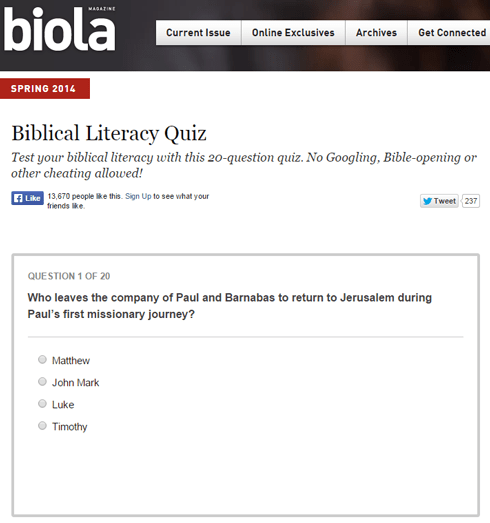
Up for a challenge? Here’s a fast-paced, 20-question online quiz you can take to test your biblical literacy. Click on the image below, then just fill in the dots to get your score at the end. The links at the Biola Magazine site are pretty revealing about biblical illiteracy—spend some time browsing. There is much work to be done. (We’re certain that Veracity readers will be way above average, but give it a shot anyway.)

Biblical Literacy Quiz


Tim Keller on Interpreting Genesis

New York City pastor, Tim Keller, offers a different approach than the one I put forward on how Genesis 1 relates to Genesis 2. Keller argues that Genesis 2 is actually historical narrative and that Genesis 1 fits more into a poetic genre, as opposed to a straight-forward historical narrative.

Keller may be right. The point I want to make is that different believers can look at some of the non-essential interpretation matters in Genesis differently, and they can still agree on the big picture, namely the essential doctrines concerning the knowledge of the God of Abraham, Isaac, and Jacob as the Creator, as well as who is humanity in relation to that Creator.

I call these the great “who” questions of faith: Who is God? Who is the Creator? Who is Man? These “who” questions are in contrast with the “how” questions: How did God create? How long did it take God to create? How does Genesis 1 relate to Genesis 2? The “how” questions are still important, but they pale in comparison to the great “who” questions that the Bible seeks to address.

The following short video by Keller demonstrates some of the challenges in determining the appropriate context and genre of this very ancient passage of the Bible in early Genesis. Keller and I both affirm that no one takes all of the Bible completely literally, and he gives his brief analysis as to what type of interpretive “grid” should be used when reading the Bible. We can still debate the smaller questions, but let us keep in the front of our minds the big picture.

I would highly recommend Tim Keller’s book Reason for God as a great book to give to a non-believer or believer who is struggling with these issues. Here is a quote from the book, around pages 93-94, that explains more in detail Keller’s approach to interpreting Genesis, and interpreting the Bible in general:

“Christians who accept the Bible’s authority agree that the primary goal of Biblical interpretation is to discover the Biblical author’s original meaning as he sought to be understood by his audience. It has always meant interpreting a text according to its literary genre. For example, when Christians read the Psalms they read it as poetry. When they read Luke, which claimes to be an an eyewitness account (see Luke 1;1-4), they take it as history. Any reader can see that the historical narrative should be read as history and the the poetic imagery is to be read as metaphorical.

The difficulty comes in the few places in the Bible where the genre is not easily identifiable, and we aren’t completely sure how the author expects to be read. Genesis 1 is a passage whose interpretation is up for debate among Christians, even those with a “high” view of inspired Scripture. I personally take the view that Genesis 1 and 2 relate to each other the way Judges 4 and 5 and Exodus 14 and 15 do. In each couplet one chapter describes a historical event and the other is a song or poem about the theological meaning of the event. When reading Judges 4 it is obvious that it is a sober recounting of what happened in the battle, but when we read Judges 5,  Deborah’s Song about the battle, the language is poetic and metaphorical. … I think Genesis 1 has the earmarks of poetry and is therefore a “song” about the wonder and meaning of God’s creation. Genesis 2 is an account of how it happened including Genesis 1. But it is false logic to argue that if one part of Scripture can’t be taken literally then none of it can be. That isn’t true of any human communication.

What can we conclude? Since Christian believers occupy different positions on both the meaning of Genesis 1 and on the nature of evolution, those who are considering Christianity as a whole should not allow themselves to be distracted by this intramural debate. The skeptical inquirer does not need to accept any one these positions in order to embrace the Christian faith. Rather, he or she should concentrate on and weigh the central claims of Christianity. Only after drawing conclusions about the person of Christ, the resurrection, and the central tenets of the Christian message should one think through the various options with regard to creation and evolution.

That last part shows some real wisdom that followers of Jesus should keep in mind at all times. Contrary to some well-intended yet misguided approaches, I do not need to debate the age of the earth or even the scientific theory of evolution with a non-believer. Instead, I should focus first on the central claims of the Gospel: Jesus Christ and Him crucified and risen from the dead.


Spiritual Diagnosis

Sphygmograph

Transmission Sphygmograph, c. 1900

Do you ever think about your spiritual health? Spiritually speaking, how are you doing? How about those around you? How about your church? Are you making a difference? Are you trying hard enough? How good is good enough?

I do. I think about spiritual effort a lot.

Dick Woodward used to call this kind of thinking “a checkup from the neck up.” (Dick had a way with words.) Spiritual diagnosis was a prerequisite for the Sermon on the Mount—it’s all about attitudes. And Jesus Christ had a lot to say about attitudes and spiritual effort.

“I know your deeds, that you are neither cold nor hot. I wish you were either one or the other! So, because you are lukewarm—neither hot nor cold—I am about to spit you out of my mouth.”
Revelation 3:15-16, NIV84

That sounds frightfully harsh…but wait a minute. No need to worry, we have Sola Gratia. What about Ephesians 2:4-5 and Romans 3:23? It’s all about grace, right? We don’t have to be good enough. Gimme a break, we all fall short. I’ve got a job that wears me out, responsibilities…I don’t have the time or energy to do more. Besides, salvation doesn’t depend on our works.

The problem with that kind of attitude about spiritual effort is that it constitutes what Dietrich Bonhoeffer called “cheap grace.”

“Cheap grace is the grace we bestow on ourselves. Cheap grace is the preaching of forgiveness without requiring repentance, baptism without church discipline. Communion without confession. Cheap grace is grace without discipleship, grace without the cross, grace without Jesus Christ, living and incarnate.”
Dietrich Bonhoeffer, The Cost of Discipleship

Grace without Discipleship? How can we diagnose grace without discipleship? Well, it could look like serving your church or ministry in a leadership position and feeling a little too complacent. How is your personal discipleship coming along? Is there urgency in your service? Are you working effectively to promote discipleship—or are you part of an organization that’s largely going through the motions? Isn’t it best if everyone just gets along and serves in harmony? It’s best not to rock the boat. Maybe. But if we heed Christ’s words to His churches in Revelation, this is indeed serious business. So how hard should we row? There’s that checkup from the neck up again.

An Ethic for Ministry
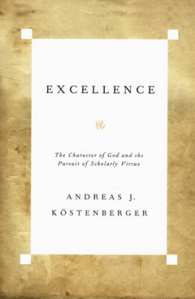
Excellence: The Character of God and the Pursuit of Scholarly VirtueMarion and I recently had dinner with Drs. Andreas and Marny Köstenberger. Not surprisingly, we got around to talking about personal discipleship and the Veracity blog. When I mentioned the spiritual basis for the blog in Philippians 2:12, Andreas told us about a book he had written that expands upon these ideas.

Excellence: The Character of God and the Pursuit of Scholarly Virtue is an exhortation written to scholars, but with broad application to anyone involved in ministry. The burden of the book is to “urge all of us who sense God’s call to scholarly labor to pursue earnestly, and with God’s help, the scholarly virtues discussed in this book.”

We don’t really talk about virtues anymore. It’s as if the word went out with parasols and medicine shows. But the pursuit of biblical virtues constitutes an appropriate cornerstone for personal discipleship.

The biblical basis for Excellence is the apostle Peter’s exhortation for believers to “grow in the rich knowledge of God and of Jesus our Lord” (2 Peter 1:2).

“For this very reason, make every effort to add to your faith excellence, to excellence, knowledge; to knowledge, self-control; to self-control, perseverance; to perseverance, godliness; to godliness, brotherly affection; to brotherly affection, unselfish love. For if these things are really yours and are continually increasing, they will keep you from becoming ineffective and unproductive in your pursuit of knowing our Lord Jesus Christ more intimately. … Therefore, brothers and sisters, make every effort to be sure of your calling and election.”
2 Peter 1:5-8,10a (NET Bible)

Just as Paul instructed believers to work out our own salvation with fear and trembling (Philippians 2:12), Peter directs us to work on our faith. And he sets the bar very high—the first virtue is the pursuit of excellence in increasing measure. With this scripture in focus, we have the answer to “how hard should we row?” and we have an ethic for ministry. Complacency has no place in the church, so go ahead, rock the boat if need be, but appreciate that Christianity is serious business.

One of the things I appreciate most about Excellence is the passionate humility with which Dr. Köstenberger paints the text. A book exhorting readers to steadfastly pursue excellence and Christian virtues could easily have swayed between dogmatic cheerleading and impersonal instructions for self-help. But it doesn’t. Without pulling any punches, he makes the point that mediocrity is not pleasing to God but does so with a gentle and genuinely humble voice. The book is extremely well written and thought out.

Dr. Köstenberger also offers practical suggestions for keeping the work of the ministry from becoming stale and getting off track. I particularly appreciated what he had to say about the importance of balancing purposeful rest with hard work. In fact, the book is full of well-formed balancing points. For lots of reasons, I read the text at just the right time.

The following quotes from Excellence: The Character of God and the Pursuit of Scholarly Virtue should give some indication of how helpful this text can be in thinking about spiritual diagnosis and spiritual effort.

Being set apart unto God as a scholar also entails a rejection of the false modernist dichotomy between faith and scholarship, a wholehearted pursuit of truth, complete dependence on the guidance and empowerment of the Holy Spirit, a balanced life that does not turn our scholarship into an idol, an awareness that the primary orientation of our work is to be missional, and an engagement in spiritual warfare through faithful witness to the truth.

Without the Spirit’s empowerment, our pursuit of holiness and excellence through growth in godly virtues will devolve into mere human self-effort that invariably results in pride and failure.

The primary spiritual disciplines advocated by Scripture are prayer and the obedient study of God’s Word.

We need to cultivate the discipline of rest, of regular time set aside for reflection, planning, and relaxation. In the long run, this will ensure that we will be at our most productive. I often find that after a week or two away from the office, I return invigorated, sharper, and more focused and alert.

The principle, then, is this: rest in God’s grace, look to him for guidance, and then do the work (in that order!). Don’t put self-effort and striving ahead of listening to God. And balance hard work with regular rest and relaxation (which means don’t forget to take a vacation once in a while, or take a day off on your son’s or daughter’s birthday or on your anniversary).

Mediocrity, sloppy workmanship, and a half-hearted effort do not bring glory to God or advance his kingdom.

The message here is not simply to try harder, to put in more effort, and to make things happen through sheer force of will. Salvation is entirely by God’s grace (Eph. 2:8–9), and sanctification is by grace as well (Eph. 2:10). This means that the pursuit of scholarly excellence must be undergirded by a keen sense of God’s continual grace in the personal and professional spheres of our lives and that we should pursue scholarly excellence in an environment of grace, not in a spirit of self-effort or unhealthy competition.

As evangelicals, we have too often, in Franky Schaeffer’s words, been “addicted to mediocrity,” and this mediocrity has in many cases become a curse—a curse that has kept us from reaching our personal, creative, and academic potential given to us by God, and has prevented us from impacting other believers as well as unbelievers for the glory of God and for his kingdom.

To your wisdom, add grace. Everything a Christian does should be characterized by grace. Grace should permeate our thoughts, words, and actions, and make a noticeable impression on those with whom we come in contact, both believers and unbelievers.

What are you and I going to do? Will our scholarship be characterized by a mean-spirited, confrontational, and harsh attitude? The writings of some evangelicals show little love for their scholarly opponents; in fact, one might almost conclude that they despise them. Unfortunately, these brothers in Christ do not seem to realize that the scholars on the other side of a given issue are, ultimately speaking, not the enemy. Satan is our common enemy.

Graciousness in response to criticism requires that we take ourselves out of scholarship to some degree and leave the results in God’s hands.

This balance, of course, is hard to achieve. It is much easier to spend long hours in one’s study and to ratchet up an impressive record of scholarly publications while neglecting one’s family. Conversely, someone may be a great father and husband but only a mediocre scholar (though, if a choice has to be made, the latter is, of course, to be preferred over the former).

While dangers are doubtless lurking ahead, commit yourself to excellence. The God you serve is himself characterized by excellence, and that same God has called you to the pursuit of excellence for his glory and for the good of others. If you pursue excellence and progress in it, you and others will be blessed, and God will be glorified.

HT: Dr. Andreas Köstenberger, Museum of Historical Medical Artifacts (transmission sphygmograph photo)