Category Archives: Topics

The Problem with Words

You all will probably think I am weird.

But for some upcoming blog posts, I plan on blogging some thoughts every now and then about the problem with words.

Over the past year or so, it occurred to me that many Christians get hung up on how we use certain words, in theological discussion. A lot of strife between believers is due to not having a basic agreement on terminology, when we engage in important discussions about the Bible.

This is not uniquely a Christian problem. It is a problem with the whole human race. Somewhere, I am sure that our sinfulness figures into the equation. But Christians are especially susceptible to the problem because we look to a text, namely “the Bible,” as our authority. So, when you deal with a text, you are dealing with words, and often, words gets lost in translation, and in our communication with other believers.

I confess, that I am not always good at it myself.

When confusion results, because of our failure to grasp a common vocabulary, this is not good for people who believe that God has revealed Himself through the pages of Scripture. So, I decided to read some of the writings of “The Inklings,” that 20th century British braintrust, that met together weekly in a pub, to discuss the really big things in life, to give me some help.

In particular, I checked out C.S. Lewis’ Studies in Words, and Owen Barfield’s History in English Words. Both Lewis and Barfield were experts in philology, or the study of language. Barfield’s theology is a bit strange, compared to Lewis’ “mere Christianity,” but both writers give us tremendous insight into some of the challenges in how language evolves over time, and how we end up using words, in our communication.

For a quick example, Owen Barfield (p.66) writes about a certain Sir John Cheke, a 16th English Reformer, who worked on an English translation of the Book of Matthew. For about a thousand years prior to Cheke, the only readily available translation of the Bible in England was St. Jerome’s Latin Vulgate. But like more well-known Reformers, such as William Tyndale, Cheke believed that the Bible should be accessible in the mother tongue of his native England, in a language that everyone could read, as the average person understood very little of Latin.

But Cheke was very creative in his English translation of Matthew, looking for uniquely English words, or closely English-like words, to translate certain terms, instead of trying to borrow from Latin.  The King James Version (KJV) of the Bible translates Matthew 4:24 like this:

And his fame went throughout all Syria: and they brought unto him all sick people that were taken with divers diseases and torments, and those which were possessed with devils, and those which were lunatick, and those that had the palsy; and he healed them.

Notice how the KJV translators used the word “lunatick” to describe someone who was probably mentally ill. Cheke thought “lunatick,” or our more modern, “lunatic,” to be too Latinized. So, he came up with his own word, derived from the traditional English word, for that brightest object in the nighttime sky, “moond.”

Have you ever thought of a crazy person as being “moond?”  No, I did not think so. Neither did I.

The etymology for the word, luna, the root for lunatic, is derived from an old Latin name for the “goddess of the moon.” Perhaps Cheke believed that the pagan or occultic ideas associated with the word lunatic were inappropriate for use in the Bible, whereas the traditional English moon, could be slightly altered to signify the same idea, with less pagan connotations. I do not know, but it is fascinating to think about.

As an aside, this helps me to better understand why some Christians refuse to use the word “Easter” to speak of Christ’s Resurrection, claiming that the concept of Easter is rooted in pagan mythology.

As a further aside, Barfield notes (p. 65,) that John Wycliffe, the 14th century translator of the Bible into English, used the English-sounding word againrising to translate the Latin word resurrectio, as well as the English-sounding undeadliness to translate the Latin word immortalitas.

I often wonder what the English-speaking world would be like if Wycliffe’s translation of these words would have won out over the traditional Latin transliterations into English.

Anyway, back to Sir John Cheke….

Here are a few more examples of Cheke’s attempt to de-Latinize the Bible:

  • Instead of the Latin word centurion, as in a “Roman centurion,” Cheke opted for the word hundreder.
  • Instead of the Latin word apostle, Cheke chose the word frosent.  This strange word frosent, was derived from a short phrase “from-sent,” since an apostle basically means someone who is sent out by someone else; as in when Jesus sends out the twelve apostles, in Matthew 10.
  • Instead of the Latin word crucified, Cheke translated that as crossed.
  • Instead of the Latin word proselyte, Cheke translated that as freshman.

That all sounds really quirky to us today, for the simple reason that Cheke’s translation of the Book of Matthew never really caught on with 16th century English readers.

Which is why most people have never heard of Sir John Cheke.

Which is why we find more Latinized words, even in some of our more modern translations still today, like centurion, apostle, crucified, proselyte, …. and lunatic.

Words are funny things, are they not?

.     .     .

Other posts in this series:

How Modernity Influenced the Evolution of English Words

How Christians Change Words

Verbicide

Conservative and Liberal as Christian Labels

Concluding Thoughts on Owen Barfield’s History in English Words

Pagans: A Review

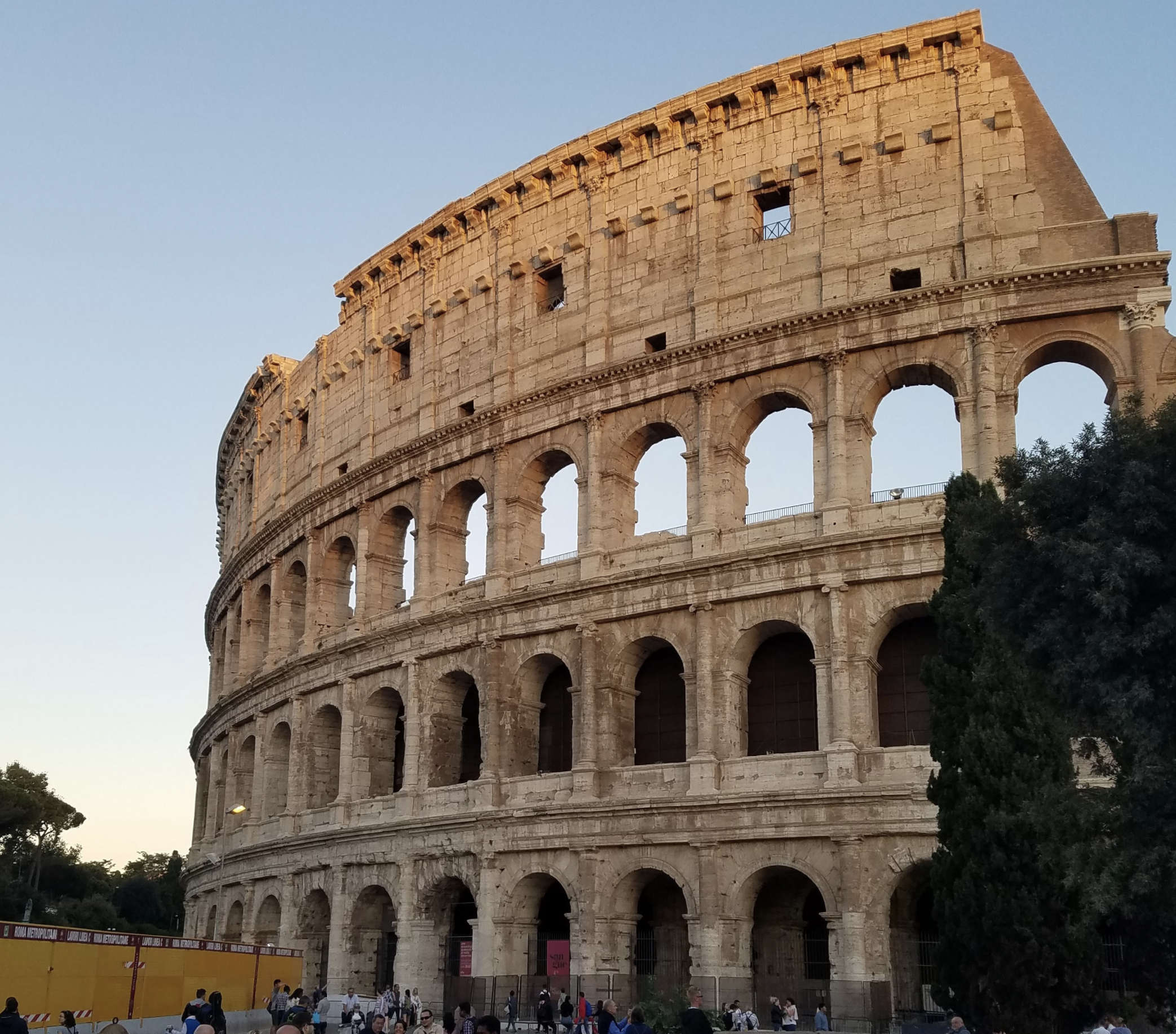
Rome’s famous Colosseum, right before dusk (October 2018)

If you have a “bucket list,” of things do in this life, consider putting a trip to Rome on there. My wife and I spent two weeks last October, walking through Rome’s ancient side streets, following tour guides underground in the Catacombs, and savoring some delicious food above ground, all while uncovering layers and layers of buried history. I could have spent a whole month in Rome, and still hungered for more.

What stood out to me the most was how this once great center of pagan, classical culture, was overtaken by the story of Christianity. How did this marbled, sculptured story of the Greco-Roman world get superseded by the painted images of the Crucified and Risen Christ, found throughout so many of Rome’s churches?

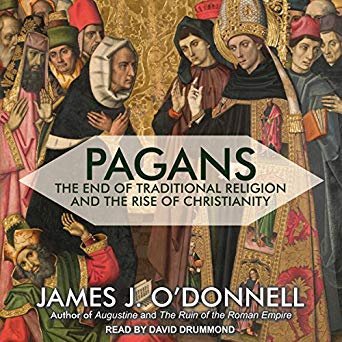
Pagans: The End of Traditional Religion and the Rise of Christianity, by James J. O’Donnell, tells the fascinating story of how “pagan” Rome became Christian Rome.

My wife and I took another trip recently, a bit closer to home, down to Florida and back, which afforded me a lot of time driving and riding in a car … for many hours. It was the perfect opportunity to listen to some Audible audiobooks, so I downloaded James J. O’Donnell’s Pagans: The End of Traditional Religion and the Rise of Christianity , and I enjoyed it immensely. I felt like I was right back there in Rome, ascending the Palantine Hill overlooking the Roman Forum.

Pagans is one of the recommended books that you will find, while viewing Tim O’Neill’s excellent website, History for Atheists. Followers of Veracity will know that Tim O’Neill has done a great service by properly educating atheists regarding the accurate history of Christianity, and Christians can learn from him as well.  As an atheist himself, to accuse O’Neill of having a cognitive bias favoring Christianity simply falls flat.

Likewise, O’Donnell, a classical scholar at Arizona State University, and biographer of Saint Augustine of Hippo, manages to correct a lot of popular errors of pagan and early Christian historiography, despite having a somewhat contrarian bent of his own.

In O’Donnell’s retelling, “paganism” as a religious system, did not exist, prior to the rise of Christianity, in the latter days of ancient Rome. The religious traditions of the Greco-Roman world were an amalgamation of various local practices, shrines, and deities, all jumbled together, to be ultimately synthesized by Greek philosophy and Rome’s politics. Christianity essentially invented “paganism” as a concept, as a convenient way of describing what the Christian faith was not. Christianity was unique, as was Judaism, from which it came, in that it claimed that the God is Israel, who raised Jesus from the dead, was the one and only true divine being. The victory of Christianity therefore made the ad hoc assemblage of pagan gods and goddesses irrelevant.

In describing the transition of the pagan world to a Christian Rome, O’Donnell skewers many common misperceptions, that all too often get tossed together along with other “fake news” of our day, propagated by social media. Take the word, “pagan” itself. Historically, to be “pagan” had no religious connotation. The root word, pagani, simply meant “country folk.” This makes great sense considering that the early Christian movement took root in cities like Corinth, Ephesus, and Rome, and not the countryside.

More “fake news” gets annihilated with O’Donnell’s prose. No, the emperor Constantine did not impose his imperial thumb on the Christian church, in order to “make” Jesus into a God, at the Council of Nicea. If anything, O’Donnell correctly shows that Constantine went along with the bishops’ decisions at Nicea, affirming the divinity of Jesus, largely as a matter of political expediency. But he  was actually more sympathetic to the Arian heresy, that situated Jesus as being something greater than merely human, but nevertheless, still not wholly divine. You can think of Constantine as a politicized promoter of Jehovah’s Witnesses-style theology, as opposed to someone who supposedly “made” Jesus into becoming God.

It was not until emperor Theodosius, several regimes later, that orthodox Christianity, as we know it today, got the full rubber stamp from the seat of political power in Rome, as affirmed by the church at the Council of Constantinople in 381.

This did not mean that Theodosius’ orthodox theology necessarily made him a nice guy. Theodosius was excommunicated from the church, by the influential bishop Ambrose, following a massacre that Theodosius ordered in Thessalonica. Only after months of penance was the emperor readmitted back into the church. Though Theodosius did crack down on pagan temples, much of the old ways of the Greco-Roman gods were already fading away.

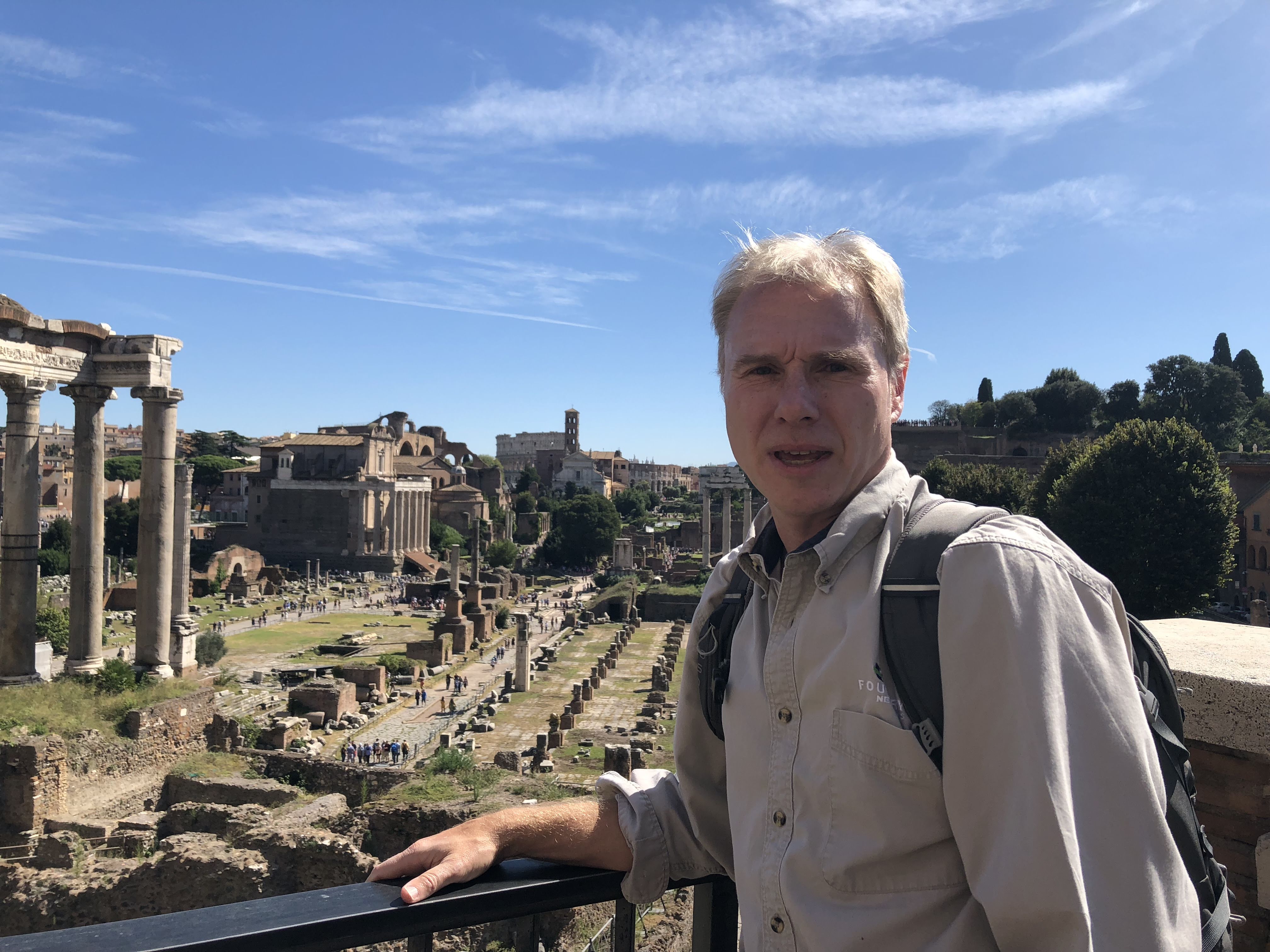
Veracity blogger, on-site, overlooking the Roman Forum, in 2018, where the “pagan” culture of Rome reigned supreme, until the story of the Crucified and Resurrected One superseded it.

Furthermore, the greatest Christian thinkers of the 4th and 5th centuries, like Ambrose and Augustine, made use of the classical tradition, when it served the purposes of promoting the Gospel. They were not afraid of any inherently polluting influence of paganism, though such thinkers often disagreed with one another, as to what aspects of pagan culture could be redeemed, and what aspects of pagan culture should be rejected, when advancing the cause of the faith.

I appreciated O’Donnell’s frank retelling of this fascinating period, avoiding the over-romanticization of Christianity’s history, on the one side, while also correcting a lot of the misinformation, regularly propagated by atheists on the Internet, on the other. It was a relief to hear from a genuine scholar. Alas, O’Donnell’s contrarian tendency disturbed me at a few points, which I thought took away from his overall presentation.

For example, O’Donnell matter of factly describing Saint Augustine of Hippo to be entirely ambitious in using his rhetorical skills, to promote himself, as a defender of the faith. I can see this in Augustine as the young Christian, but I would certainly hope that as Augustine matured, so would his growth in sanctification. Plus, O’Donnell’s insistence that Augustine never actually “converted” to the Christian faith, came across as forced and unconvincing. Yes, Augustine had a Christian mother, and so he surely did have some basic Christian instruction as a child. But that did not mean that Augustine automatically embraced his mother’s faith. Augustine’s Confessions still tells that story of his conversion, as a young man, into the loving arms of Jesus, rather well.

But aside from a few prickly moments like these, I found O’Donnell to be generally an excellent, accurate tour guide of ancient Rome. O’Donnell does not reveal where his sympathies regarding the Christian faith really stand (based on his few, cynical digs, here and there, he probably is not), but for a work of history like this, he need not to. If you want to understand how the ancient world transitioned from “paganism” to Christianity, O’Donnell’s Pagans would be a good place to start.


See Don Webb’s excellent review of Pagans here, and Michael Bird’s brief review.

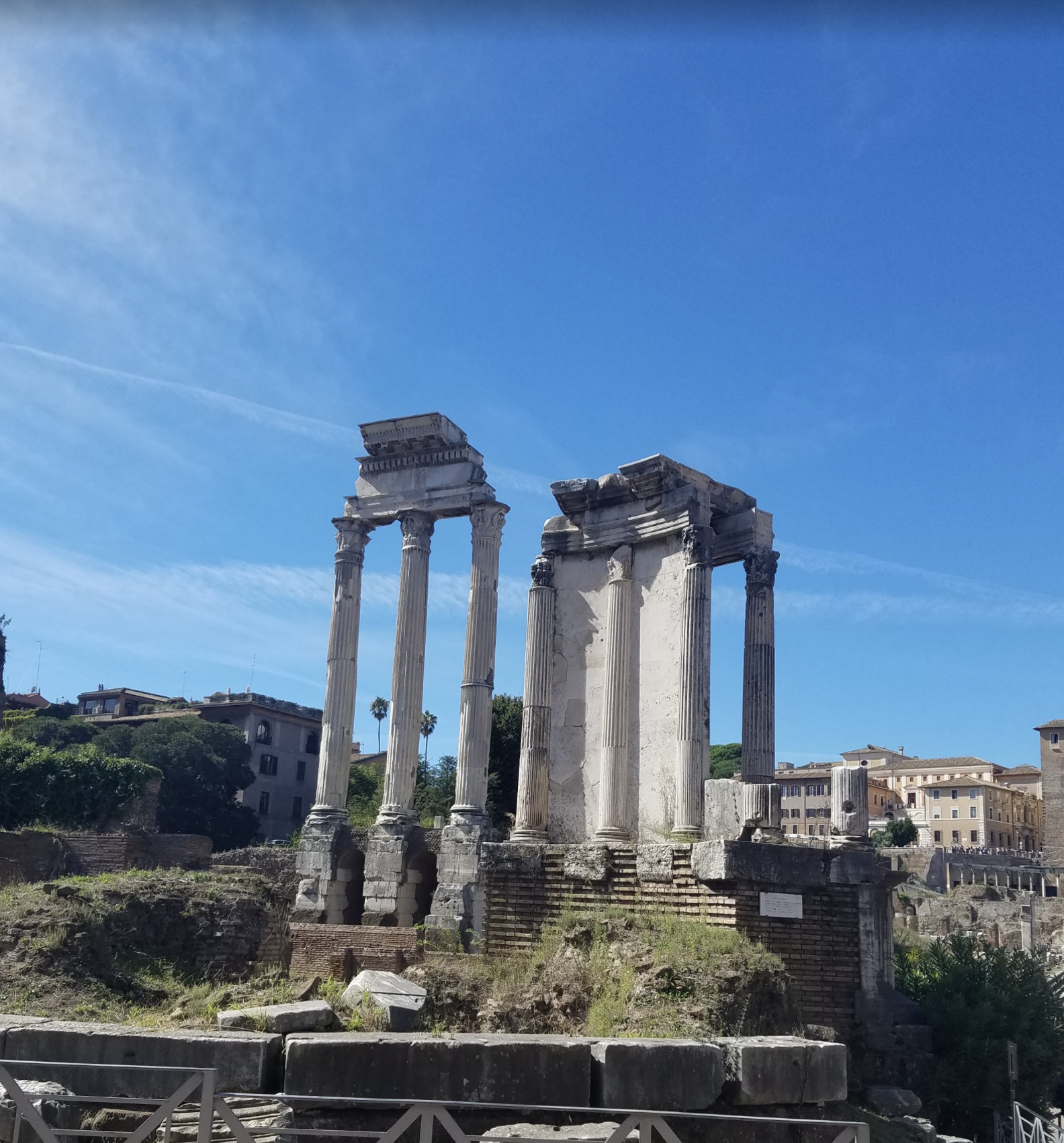
The Temple of Vesta, in the Roman Forum, was a site for “pagan” cultic activity, back to the 7th century before Christ. The temple was eventually closed during the late 4th century C.E., when Christianity became the official religion of Rome.


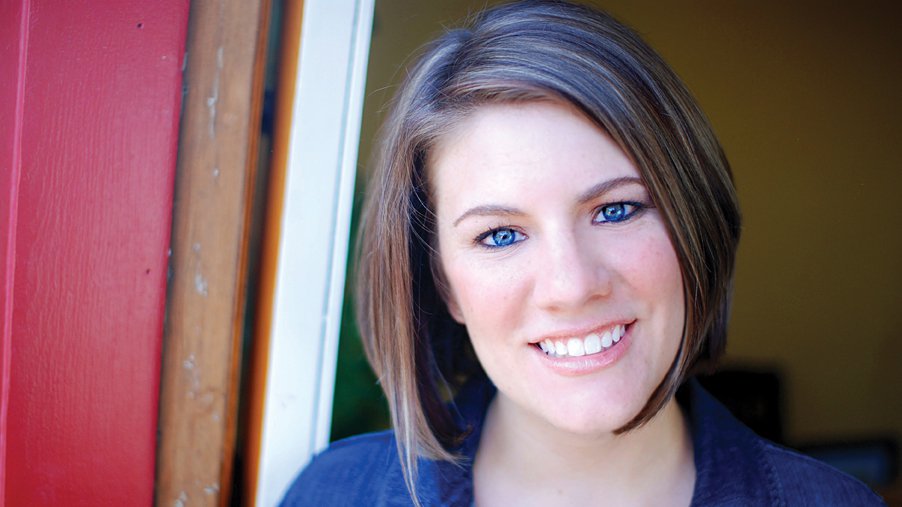
Rachel Held Evans Has Died

I am out of town right now, but pretty stunned in reading this. Rachel Held Evans, the popular millennial, progressive Christian blogger and author, who announced in 2014 that she was leaving evangelicalism behind, exhausted by “wearing out [her] voice in calling for an end to evangelicalism’s culture wars,” did not recover from a medically induced coma. She died today, at age 37, leaving behind her husband, Dan, and two young children.


About Vaccine Hesitancy: Having a Conversation


Several months ago, I blogged on Veracity about vaccines, encouraging Christians to consider that one of the best ways that we can express the love of Christ to our non-believing neighbor is by encouraging the use of vaccines, particularly with children. Though I received no comments directly to that post, I have since received some pushback offline. So, I feel obligated to address it, particularly in view of the current measles outbreak that is ravaging certain Orthodox Jewish communities, that have been particularly hesistant to vaccination.

Within the past twenty years, there has been an increase of concern about the safety and effectiveness of vaccines, despite the fact that we had nearly wiped out measles in the United States, in the early part of the first decade of the 21st century. Many doctors say that the recent measles outbreaks in America can be directly correlated to the decreased practice of vaccination across the country, and many Christians are involved in this movement.  Yes, there is misinformation in the vaccination debate, but there is also a lot of unnecessary vitriol, from both sides. Here are some points for discussion, that I hope everyone (maybe?? maybe?? maybe??) can adopt:

  • Parents who are hesitant about vaccination love and care for their kids. Take a trip scanning through social media, and you will quickly find rude and insulting comments lodged at parents who do not support vaccination. We need to find ways of encouraging conversation, instead of just shutting down conversation with un-Christlike comments. Parents need compassion, not condemnation.
  • Not everyone can take vaccines. Some people are unable to take vaccines, due to known medical risks. Folks should consult their doctor about those risks, before going ahead with vaccines. There is nothing wrong with asking questions. The good news is that across the broader population, those who are unable to take vaccines without adverse side-effects can be protected by herd immunity. Unfortunately, as the rates of vaccination continues to decline, the effectiveness of herd immunity continues to decline as well, leaving those who are unable to take vaccines at risk of exposure to deadly diseases.
  • Some vaccines have been developed from cell lines that were derived from aborted fetuses. As Young Earth Creationist scientist, Jay Wile, observes, most Christians are rightly horrified by abortion, and so might reject vaccination on moral grounds. Yet some, like popular Christian talk show host of Wallbuilders, David Barton, draw from this the conclusion that parts of dead babies are hiding in the vaccines, that your doctor wants you to take. This is misleading information. Cell lines derived from aborted fetuses are not the same as dead baby body parts, or “debris,” themselves. Nevertheless, how is a Christian who cares about the unborn to respond, regarding this connection between some vaccines and abortion? Following the lead set by the Roman Catholic Church here, is a wise move to make. Christians should lobby for the medical and pharmaceutical professions to find other ways of obtaining cell lines, without crossing ethical boundaries that violates Pro-Life concerns. Nevertheless, until those vaccines become available, across the board, the Roman Catholic Church teaches that the benefits of using such suspect vaccines outweighs such ethical concerns.
  • Time is limited, and not everyone can be an expert. That is why we have doctors. As is the case with you, my time is limited. I can not be an expert on everything. That is why it is important to find a doctor, whom you can trust, to help guide you through navigating cost/benefit analysis for taking vaccines.
  • In some very limited cases, vaccines can produce negative outcomes. I have known friends who have experienced such negative reactions, particularly to flu vaccines. Nothing in life is risk free. This may sound insensitive to someone who has a child who was injured by vaccines, but it need not be. We should encourage those in the medical profession to better help those who have concerns, or those in this small category who might have experienced some injury in using vaccines. In at least a few cases, some are probably receiving vaccines, when they should not, because they are not being properly screened. Every child, every person is important to God. Nevertheless, this point needs to be balanced by the next point.
  • The overwhelming scientific consensus in medicine today indicates that the benefit of taking vaccines, to protect against deadly diseases, far exceeds the risks involved in actually taking the vaccine.

I know that some Veracity readers might be confused, or challenge me on some of these points (particularly the last one). But it is important to consider that when you search for information on the Internet, whether it be using Google, YouTube, or Facebook, these databases are designed to narrow your search field to include results, that by default, will skew what you are looking for. For example, if you do an Internet-based search for “vaccine injury,” the results of your search will be skewed to point you towards websites that favor anti-vaccine movement information, as opposed to pro-vaccine information, in line with the current scientific consensus. Likewise, if you search for “vaccine injury” on YouTube, you will be directed to anti-vaccine videos more than pro-vaccine videos, even though Google may force a CDC-sponsored video to pop up at the top of your search, in an effort to counter-balance the anti-vaccine info that otherwise pops up. And the more you watch anti-vaccine videos on YouTube, the more it will skew your searching for vaccine information in the future, to be biased towards giving you other anti-vaccine videos to watch, instead of pro-vaccine videos.

That is just how Internet-based social media works, folks. We live in an era of “fake news,” largely due to the proliferation of disinformation spread by social media. As someone working in the field of information technology for 34 years, I know how this works. It should be no surprise that the current rise of the interest in  the anti-vaccine movement coincides with the rise in popularity of social media websites, like Facebook, etc.

My grandfather served as a medical doctor missionary in South Africa, in the 1920s, vaccinating hundreds of Africans against the spread of tuberculosis. My grandfather’s actions to get vaccines out to people saved countless lives. But in letters I have from my grandmother from those years, while her  husband doctor was running off into the African hinterlands, with his bag of medicines, my grandfather’s greatest challenge was in trying to calm the fears of those, who would benefit the most from those living-saving vaccines.

Apparently, some things never change.

Vaccines were not 100% safe back then, with positively zero side effects, just as they are not absolutely, without any margin of error, 100% safe today. But their benefits surely outweigh the risks, by a significant order in magnitude. In fact, the order of magnitude is so great that the risks associated with taking vaccines is almost negligible, compared to the benefits. Serious negative reactions to vaccines are barely a fraction of a percentage point. You and your children are at a higher risk of contracting a deadly disease, that a vaccine can prevent, than having a negative, life-threatening result from taking a vaccine. I know of older family members, who have since died in recent years, who would tell me tales of barely surviving measles, mumps, and polio infections, some 70 to 80 years ago. These type of diseases are thankfully rare today, but the rise of anti-vaccine concerns threatens to reverse those gains that doctors like my grandfather fought so hard for.

Nevertheless, my own personal view is that vaccines should be received voluntarily, and not by mandatory government force (but stay home please, if there is an outbreak locally). People should do the right thing, because… well…. it is the right thing to do. I am also concerned when information content providers unduly restrict information about the anti-vaccine movement. Government sponsored dictates and censorship of ideas only serve to reinforce the perception of conspiracy. Instead, we need more information, specifically correct information, not less.

I am not a doctor, and I have never played one on television. I am not omniscient. So, if folks really want to challenge on the data, just make sure it is backed up by truly peer-reviewed science, and not some questionable source that passes itself off as “peer review.” Extraordinary claims require extraordinary evidential backing in order to overturn a current scientific consensus.

It surely is possible that vaccines are not as completely safe as they have been made out to be. I could be quite wrong about my support for vaccines. But surely, peer reviewed science will sort that out. That is how science works.

So I simply ask that the challenger to the current consensus be willing to consider the other side of the argument, about the effectiveness of vaccines, and how God has given us a wonderful tool to do much good in the world, to limit some of the deadly effects of natural evil, exacerbated by the Fall. Consider giving vaccines a chance, if not to protect yourself, but also to help to protect others, and express the love of Jesus in a concrete manner. Can we have a conversation, please?

I am personally encouraged that Christian young people, like high school senior, Ethan Lindenberger, who grew up in a Christian family that opposed vaccines, was willing to do the research himself, to figure out if vaccines were good or bad, and weigh the evidence himself, and conclude that he should get vaccinated. This young man plans on pursuing a career in either Christian ministry or politics. The first video below is Ethan’s testimony before Congress.

The video with Ethan is followed after that with an interview by anti-vaccine leader Del Bigtree, with Ethan’s mother and older brother. What disturbed me the most about this video are several peculiar expectations Ethan’s mother originally had about vaccines:

  • (1) Ethan’s mother was told, as she put it, that she would need to get the chicken pox vaccine initially, and repeated again once every ten years after that. Current CDC recommendations are that vaccine recipients should get the vaccine only twice, “the first dose at 12 through 15 months old and a second dose at 4 through 6 years old.” For adults, the vaccine should be given twice, “4 to 8 weeks apart.” Perhaps the recommendations several years ago were different, but I highly doubt it. Did she not clearly understand her doctor, or was her doctor not properly informed, or worse, incompetent?
  • (2) Ethan’s mother expected that the vaccine need be only applied once, and that once a vaccine is given, it will be a “forever thing.”  But numerous vaccines require an additional treatment, for the fullest effectiveness. Yearly vaccines, like for the flu, should be taken every year, because of the changing nature of the flu. Again, did she not clearly understand her doctor, or was her doctor not properly informed, or worse, incompetent?
  • (3) Ethan’s mother expected that vaccines were always 100% safe, with no potential side effects ever. But as noted above, nothing in life is 100% risk free. Driving a car is risky. Stepping outside during a thunderstorm puts you at risk of getting hit by lightning. But does this keep people from driving cars, or being fearful of springtime and summertime, when thunderstorms are more prevalent? Where did Ethan’s mother get this expectation from?

But to reiterate, it is apparent that Ethan’s mother really loves her son, and only wants the best for him. If this story moves you, you might want to consider praying for this family.

After that is another video, which shows several pro-vaccine people in dialogue with several anti-vaccine people. After that is the last video, by the well-known “Dr. Mike,” critiquing the pro/anti-vaccine discussion video. Is this a good way of having the conversation?


Pray for Rachel Held Evans

Rachel Held Evans is a progressive Christian blogger, and popular author. Though I do not share the theological trajectory she has pursued, I was grieved to hear that this relatively young mother of two, has been in a medically induced coma, for the past week, due to complications from the flu, an infection, and allergic reactions to antibiotics. Difficult times. Whether you know of her or not, please pray for her and her family.