
We need discernment now more than ever. But it appears to be a disappearing commodity. Especially in 2020.
When I was growing up in the 1970s, Walter Cronkite was the most trusted man in America. There were only three sources of evening news television: CBS, ABC and NBC, but my parents liked Cronkite on CBS the best.
That started to change in the mid-1970s, when the Watergate affair blew the lid off of America’s innocence. While Nixon and his White House staff were under scrutiny practically every night, the MacNeil/Lehrer Report premiered on PBS, to eventually become the PBS Newshour. Having a new choice in where to get news was refreshing. Getting the news was still pretty simple back then, but it was about to get more complicated.
Way more complicated.
Cable TV in the 1980s brought a plethora of new television channels, along with other news networks. By 1992, Bruce Springsteen wrote the song “57 Channels (And Nothin’ On).” And that was before the Internet exploded.
Fast forward to the beginning of the third decade of the 21st century. Except for my mother-in-law, I do not know anyone who watches the 6:30 Evening News anymore. We all have our cultivated social media feeds, podcasts, and streaming radio news sources, designed to fit our preferences. Not since the dawn of movable type, that catapulted an obscure German monk, Martin Luther, to become the best known person in Europe, have we seen anything like it, in world history. For medieval Europe, the voice of Rome was the voice of newsworthy authority, until Luther came along, as the catalyst for the Protestant Reformation.
Luther almost single-handedly cracked the traditional authority of the medieval church, through the power of his printed words, as they rolled off the printing press. Then when Luther came into conflict with other Reformers, over the nature of the Lord’s Supper, even the Protestant Reformation movement began to splinter. The Christian church obviously survived the crisis, and even thrived as Christianity continued to spread across the world. However, the church was fractured in ways that we are still deeply struggling with, 500 years later. The voice of Rome became but one voice, alongside a plethora of Protestant voices. But this is nothing like what we have with the Internet and social media landscape, of the first quarter of the 21st century.
Historian Brad S. Gregory makes the case in his The Unintended Reformation: How a Religious Revolution Secularized Society (another book on my to-be read list), that the unintended consequences of the Protestant Reformation have led to “hyperpluralism of beliefs, intellectual disagreements that splinter into fractals of specialized discourse, the absence of a substantive common good, and the triumph of capitalism’s driver, consumerism.” These days I tend to think that he might be right.
You can even go to a website now that displays “The Media Bias Chart,” showing how an amazing spread of news organizations, including Christian ones, fall on a scale, with “Neutral” in the middle, and “Most Extreme Left” to “Most Extreme Right,” on either side. There are so many “news sources” out there now, I can not even count them all. All you need is an iPhone and an Internet connection, and you can become your own news source.
The Internet has revolutionized global society, and taken the Christian church with it. Today, we have Protestantism on-steroids. Everyone has their “own interpretation” about everything, it seems. And, as a professional Information Technology specialist, who builds computer networks for a living, I helped to make it all happen.
YIKES!
Even scarier: I have been in the business of computer science and Internet technology for 35 years… and not once has a church pastor or youth group leader asked me (or someone else, with my technical background … I freely admit that I am not the best speaker) to speak to parents about how Internet technology really works. Now, perhaps such church leaders have other resources to help address this problem. I pray that this is, in fact, the case. But my honest observation, from my vantage point, is that most church leaders take a “head in the sand” approach to social media.
A recent documentary, The Social Dilemma, features interviews with Internet technologists at Google, Facebook, and other monster social media companies, explaining how the simple practice of searching for something in a Google search box, or thumbing through new entries in your Pinterest feed, has been carefully tailored to manipulate you, and get you hooked on using the technology. Technology pioneers, like Microsoft founder Bill Gates, and the late inventor of the Apple iPhone, Steve Jobs, both limited their children’s use of smartphone technology. Bill Gates refused to get a smartphone for his children until they reached the age of 14.
Sadly, I see Christian parents all of the time handing out smartphones to their 12-year old kids in middle school, if not even earlier! It is as though many Christian parents are either being pushed by peer pressure or they are amazingly unaware that by giving such powerful technology to young children, that they are potentially exposing them to forms of addictive behavior, which is already having a negative impact on a whole generation of teenagers. All of this is leading to confusion as to how we can help a growing generation of young people develop the art of discernment, ranging from how a person can wisely consume news and information, to even the most addictive form of all, unfettered and almost endless pornography.
Wow. We are in deep trouble.
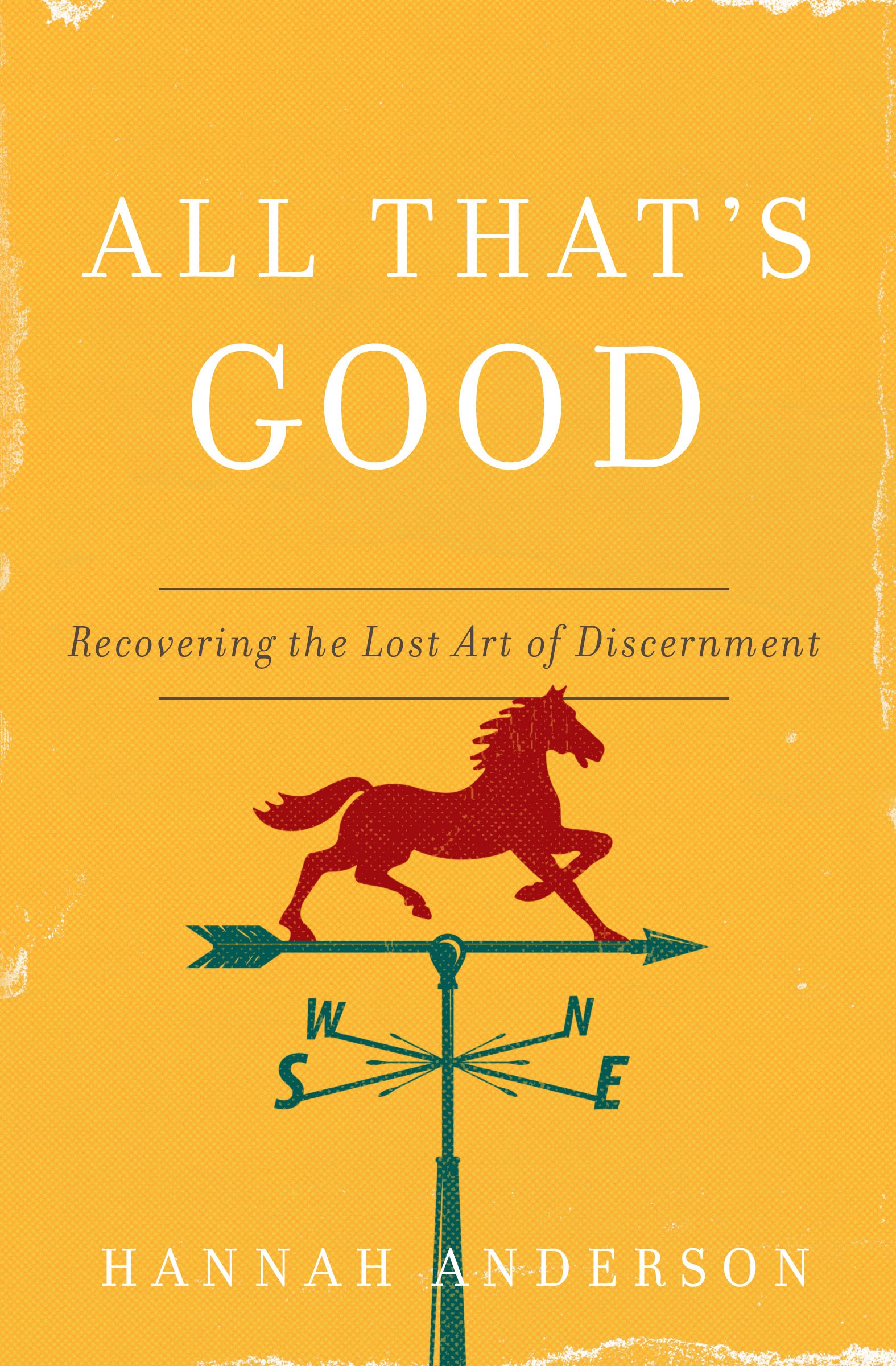
It is with this backdrop of information overload, addiction, and disinformation that I read this selection from Hannah Anderson’s 2018 book, All That’s Good: Recovering the Lost Art of Discernment. Hannah was writing about what draws her to enjoy murder mystery novels, and these few paragraphs hit me like a bolt of lightning (page 84):
You don’t have to be a student of world history or a fan of murder mysteries to understand why truth is so important to discerning goodness–just look at your social media feed. Unlike the compact boundaries of a village, the digital world sprawls, leaving us with a type of informational vertigo. But it’s not simply that we have too much information; it’s that we have too little shared reality. Like the characters in a mystery, we don’t know what is true and what isn’t. We can’t agree on who is an expert and who isn’t. So more often than not, we simply craft our own reality and can’t be bothered with whether we share it with anyone else or not.
The result is a confusing muddle experience of the world. When my “facts” collide with your “facts,” it results in anger, conflict, mistrust, and isolation. Family members blocking and unfriending family members. Perfect strangers yelling and belittling each other. Communities coming apart at the seams– not simply because we can’t agree on what is good and valuable, but because we can’t agree on what is true anymore. And slowly but surely, our separately constructed realities cut us off from each other and lead us to solitude. Surrounded by a mass of people, we feel unloved and misunderstood, for the simple fact that we’ve created millions of worlds with a population of one.
Because shared reality is necessary to a good, flourishing life, Paul begins Philippians 4:8 by calling us to first seek “whatever is true.” The importance of shared reality to a good, flourishing life also explains why the serpent attacked truth from the start and why Jesus links falsehood with murder. “You are of your father the devil,” He says in John 8:44. “He was the murderer from he beginning and does not stand in the truth, because there is no truth in him. … He is a liar and the father of lies.” When the serpent lied to the woman about the consequences of disobedience, he, in effect, murdered her, bringing death and isolation upon the human race.
And when we lie to and about each other, we destroy the bonds of community that sustain life, effectively destroying the people in them.
That pretty much sums up what I see in American culture these days, and in the evangelical church, in particular. As a side note, a few years ago, I discovered Hannah Anderson, the wife of a pastor in the Blue Ridge Mountains of Virginia, and a blogger at SomeTimesALight.com. She came on my radar after being forced to think through the theological issues, regarding the complementarian/egalitarian controversy, that continues to divide evangelical churches today, and Hannah came across to me as someone who thinks deeply theologically about what it means to be male and female, created in the image of God. However, she apparently thinks deeply about other matters, too, in a way that stretches and renews me spiritually.
As I have been reading her All That’s Good, it has helped to remind me just how important is for Christians to be pursuers of truth. Discernment seems to be something lacking in a number of the Christian circles I come across, so All That’s Good has been a great source for thinking through, what it means to know truth, and meditate on how we come to know that truth. Hannah has another great section that explores epistemology, a “ten-dollar word for the study of knowledge and opinions. It answers questions like: How do we know what we know?” (page 86). She explains why discernment of what the Holy Spirit is saying to us must be grounded in factual reality:
While it’s true that God guides us to truth through His Spirit, it won’t happen apart from the physical reality that He has ordained for us. After all, we don’t have a sensory experience of the world by accident– God made us both spiritual and physical, and we dare not reject either. Because of this truth must be rooted in factual reality. Facts are not the sum total of all that is true, but truth is not a set of privately held beliefs that cannot be tested by other people. The information that we use to come to our decisions and opinions to come under scrutiny. We must not be offended when people ask us to prove them. We must not expect people to accept anyone else’s opinions simple because they claim that they are true.
This is especially true in how much of American evangelicalism portrays the Christian faith today, particularly as I look back on 2020. We sadly also have far too many Christian celebrities, who make a name for themselves, through their charisma and winsome personalities, instead of investing in the type of true spiritual discernment that Hannah Anderson is arguing for.
Too many have made claims that the Holy Spirit has given them private revelations, that others are unable to confirm, and that lack a convincing grasp of Scriptural knowledge ( I appreciate legitimate concerns about voter fraud, but I have to ask some questions: What was that whole crazy “Jericho March” really supposed to be about?….. Eric Metaxas is a very funny and sweet Christian man, but is he claiming to be a prophet, or is he just pulling our leg?…. We are about to find out in less than a month).
Others have unintentionally or even intentionally redefined traditional theological categories to unwittingly make room for anti-Christian ideologies to permeate the church (is critical theory, or “wokeness,” really just a tool to help in recasting Martin Luther King Jr’s biblical vision of a colorblind society, or is it an ideological agenda bent on undercutting classic Christianity with Neo-Marxism propaganda?).
Others have gained the acclaim of their followers, while living lives that lack sufficient accountability (who was asking the tough questions in apologist Ravi Zacharias’ life, particularly when doubts about Ravi began to surface five years ago, if not sooner?). Others have been elevated as leaders, despite lacking the theological foundations and spiritual maturity that should help them to weather the storms of life. The cause of truth suffers as a result.
That can all sound quite depressing. So, it would be best to end on a brighter, and still truthful, note.
Thankfully, there are millions of Christ followers who humbly and quietly follow Jesus, loving God and loving their neighbors, sharing their faith and living out Christ-likeness in very concrete ways, whose stories never show up in our Facebook and Twitter feeds. Godly Christian parents are training up their children to be confident in their faith, with no Pinterest fanfare. Across the world, thousands are coming to know Christ, despite persecution of the faith. For example, in Iran alone, a great spiritual revival is happening there, where Christianity is growing faster there than anywhere else in the world, despite the pandemic. Even in America, the growth of small groups of believers meeting either in person or on Zoom potentially signals a revitalization of American Christianity, during the time of COVID. A mission my wife and I support, International Cooperating Ministries, is on the verge of building their 10,000th church! The accessibility of high-quality, peer-reviewed biblical scholarship to the average Christian is at an all-time high, due to the ease of the Internet. A new crop of young, knowledgeable Christian apologists are having a huge impact in defending the faith on YouTube , for the up and coming generation. Just one example: Aside from Queen Elizabeth’s Christmas message, YouTube apologist Michael Jones’ (a.k.a. Inspiring Philosophy) “The Lost Message of the Bible” was in my mind this years best YouTube Christmas video, encouraging me to dig more into the Bible, and share the Good News of Jesus with others! …. So, there are still plenty of good reasons to rejoice, even in an era when spiritual discernment more generally seems to be in short supply.
Hannah Anderson goes on in other chapters, exploring more themes derived from Philippians 4:8, “Whatever is honorable, whatever is just, whatever is pure, whatever is lovely, whatever is commendable.” This is not really a super-heady book, but it still helped me to think more deeply about where I am with God, and where the church of Jesus Christ is today. Sprinkled with her own family anecdotes, and wise thinking, this is the best devotional type of writing I read all year.
Just get the book and read it, if you want to see what I mean. It will be like balm to your soul.
Onward to 2021!




 Veracity