Category Archives: Topics

Dover Design Debate Debacle

Dover, Pennsylvania.  Symbol of the defeat of Intelligence Design as scientific theory..... or a tragic setback for the advancement of scientific discourse?

Dover, Pennsylvania. Symbol of the defeat of Intelligent Design as scientific theory….. or a tragic setback for the advancement of scientific discourse? (photo credit: msnbc)

Should Intelligent Design be taught as science in the classroom?

It has been almost ten years since the Kitzmiller v. Dover Area School District case in Dover, Pennsylvania. There a group of elected school board officials, spearheaded by some Christians favoring Young Earth Creationism, sought to have a particular biology textbook removed from the classroom. The biology textbook was co-authored by Kenneth Miller, a biologist at Brown University, a practicing Catholic, and an outspoken advocate of what some call “theistic evolution.” Instead, a different textbook developed by the Discovery Institute, Of Pandas and People, would be used. The Discovery Institute is a think-tank that advocates Intelligent Design as opposed to Darwinian Evolution, among other important cultural and intellectual interests. A lawsuit ensued, and while it was not as big and spectacular as the famous 20th century Scopes Monkey Trial, the Dover case still became a media sensation. In the end, the court ruled that teaching Intelligent Design in a public school science class is a violation of the Establishment Clause of the First Amendment of the U.S. Constitution. The court reasoned that Intelligent Design (ID) is not science and therefore cannot be uncoupled from its Creationist, and therefore religious, antecedents.

It was a devastating blow to the movers and shakers behind Intelligent Design. I pretty much thought that the ID movement was dead in the water after that. However, the issues behind the controversy are still with us.
Continue reading



Christians in Assad’s Syria

Maaloula, St. Takla Convent, Syria.   Refugees from the Syrian civil war are hiding here as of early, September, 2013.  Residents of this village still speak a dialect derived from the ancient Aramaic, the language that Jesus spoke.

Maaloula, St. Takla Convent, Syria. Refugees from the Syrian civil war are hiding here as of early, September, 2013. Residents of this village still speak a dialect derived from the ancient Aramaic, the language that Jesus spoke.

As of early September, 2013, the world has been shocked by reports of chemical weapons being used in the civil war in Syria.   Numerous reports in the media argue that President Bashar al-Assad was behind these attacks. This horrible tragedy surely deserves at least some response.   But what kind of response?

Philip Jenkins is a renowned evangelical historian at Baylor University.   He has studied extensively the history of Christianity in the Middle East and the rest of the Mediterranean region.    Jenkins recently wrote an editorial piece giving his view that the lessons of church history should give American leaders caution in their response to the situation in Syria.  In particular, will a military intervention in Syria help or hurt the existing Christian community in Syria?

Jenkins’ position is that military intervention in Syria will not only hurt the Christians, it could ultimately lead to the annihilation of the Christian community in that country.  Pretty strong words.

Sadly, many American Christians are largely ignorant about the history of Christianity in this part of the world.  As I have tried to show with the recent situation in Egypt, the issues are exceedingly complex.   Frankly, I am not sure what the clear answer is on what to do.   But what I do know is that most Christians in the Middle East and particularly in Syria itself oppose outside intervention into Syria’s internal problems.   Assad is not the nicest guy in the world.  That much is over-abundantly clear.  But Christians in the region have looked to Assad and his family for many years for at least some protection from Islamic extremists.   What will happen to an already persecuted church if the country is further destabilized?

Perhaps you might have a completely different view.   Perhaps Jenkins is mistaken. There is much that I do not know.  Nevertheless, as a Christian in America what I do know that it is my duty and responsibility to listen to my brothers and sisters in Christ in Syria and make a better effort to fully understand their history and appreciate their situation today in view of the present crisis.


Egypt: Coptic Christianity

Members of an historic Christian community in Egypt find themselves persecuted in the midst of political and economic turmoil.   How should Christians at large throughout the world pray for them?

The international media highlights the conflict between the secular elite and Islamic fundamentalists in Egypt.  But what about Egypt’s historic Christian community, the Copts?  How should believers around the world pray for them?

Since the Arab Spring of 2011, Egypt has been a focal point of political renewal … and unrest. Much of the conflict in Egypt is between a secular minded ruling class and a resurgence of fundamentalist Islam. What will take shape in Egypt? A Westernized secular democracy? A return to a traditional Islamic state?

What many do not realize is that there is another group of people in Egypt often caught in the middle: the Coptic Christians.  It is a situation where many other Christians, like me, here in America, find it difficult to comprehend.
Continue reading


Jesus the “Zealot”?

Reza Aslan's, Zealot, has profited greatly from a television interview gone viral.   But does Aslan's creative thesis really deliver?

Reza Aslan’s, Zealot, has profited greatly from an embarrassing television interview gone viral. But does Aslan’s creative thesis really deliver?

Was Jesus a “Zealot”, a Jewish political revolutionary? According to a new popular book by Reza Aslan, Zealot: The Life and Times of Jesus of Nazareth, the answer would be “yes”.

Aslan’s conclusion is in marked contrast with what I wrote on Veracity just last week and before. There I briefly made the case that Jesus offered an alternative between those Jews, like the tax collector, Matthew, who colluded with Rome, and others like Simon the Zealot, who sought to violently eject the Romans from the land. Matthew and Simon joined the group of Jesus’ twelve disciples and were drawn by Jesus’ extra-political claim as being the One who transcends and personally fulfills the messianic hopes and national aspirations of first century Judaism. A less convinced author, Reza Aslan, pretty much casts aside Jesus’ relationship with those like Matthew and places him squarely in the Zealot camp, prior to the formation of a distinct “Zealot party” that dominated Jewish politics during the era of Josephus.

But the Zealot issue is not what has captured the public’s attention about Aslan’s book. Rather, the spark was a recent, combative interview on the FOX television network. The controversy originated over whether or not a Muslim had a right to write a book about Jesus. The case that Aslan was making got lost in a series of ad hominem attacks. Yikes!! Granted, Aslan makes an embarrassingly big deal about how many academic degrees he has (“look how smart I am!”), but might I suggest that the way FOX conducted the interview was not terribly helpful, to put it mildly?
Continue reading


Dr. Bell’s Submarine Chaser

“For what can be known about God is plain to them, because God has shown it to them. For his invisible attributes, namely, his eternal power and divine nature, have been clearly perceived, ever since the creation of the world, in the things that have been made. So they are without excuse. For although they knew God, they did not honor him as God or give thanks to him, but they became futile in their thinking, and their foolish hearts were darkened.”
Romans 1:19-21 (ESV)

Bell Hydrofoil

Alexander Graham Bell’s HD-4 “Submarine Chaser” Hydrofoil. Constructed in 1919, it set a marine speed record that remained unbroken for two decades.


I read a very touching letter this week—from one of the Twentieth century’s most inspiring women to one of mankind’s most brilliant pioneers. By any measure, Helen Keller and Alexander Graham Bell were truly remarkable people.

“Dear Dr. Bell, it would be such a happiness to have you beside me in my picture-travels! As in real journeys you have often made the hours short and free from ennui, so in the drama of my life, your eloquent hand in mine, you make the way bright and full of interest, give to misfortune an undertone of hope and courage that will assist many others beside myself to the very end.”
Helen Keller letter to Alexander Graham Bell, July 5th, 1918

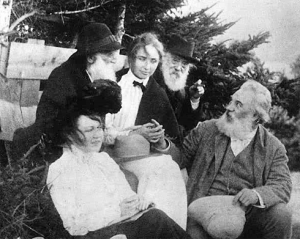
Alexander Graham Bell and Hellen Keller

Helen Keller and Bell “finger spelling,” August 29th, 1901.

For someone saddled with blindness and deafness, who was disappointed by her own speech, Helen Keller had a profoundly beautiful and powerful voice.  Her letter to Bell is affectionate, expressing deep love and gratitude.  But when she writes “your eloquent hand in mine,” she is alluding to something that surpassed a simple display of affection—she and Bell conversed through “finger spelling.” Continue reading