Category Archives: The Gospels

Bart Ehrman’s Challenge to the Divinity of Jesus

How God Became Jesus, by multiple authors, is a rebuttal to Bart Ehrman's book, How Jesus Became God.

How God Became Jesus, by multiple evangelical scholars, is a popular-style, accessible rebuttal to Bart Ehrman’s book, How Jesus Became God.

From the preface of How God Became Jesus, by editor and Australian scholar Michael Bird:

[Bart] Ehrman is something of a celebrity skeptic. The media attraction is easy to understand. Ehrman has a famous deconversion story from being a fundamentalist Christian to becoming a “happy agnostic.” He’s a New York Times bestselling author, having written several books about the Bible, Jesus, and God with a view to debunking widely held religious beliefs based on a mixture of bad history, deception, and myth. He’s a publicist dream since in talk shows and in live debates he knows how to stir a crowd through hefty criticism, dry wit, on the spot recall of historical facts, and rhetorical hyberbole. He also has a global audience…

For conservative Christians, Ehrman is a bit of a bogeyman… Conservatives buy his books if only for the purpose of keeping their disgust with him fresh and find out what America’s favorite skeptic is up to now… For secularists,… Erhman is a godsend. He provides succor and solace that one need not take Jesus too seriously, confirming that religion is the opiate of the masses and that the whole God thing might be just a big mistake.

Why is Bart Ehrman, a professor of religion teaching at the University of North Carolina at Chapel Hill, on a lot of people’s radar?


Continue reading


The Trials of Jesus

John Paine's avatarLessons in Lent

The Gospel accounts of the trials of Jesus before Annas, Caiaphas, Pilate and Herod have considerable agreement, and some interestingly unique statements. While all four accounts agree on the essential details of what happened early in the morning of Good Friday, only Luke records that Jesus was interrogated by Herod Antipas (see Luke’s Sources). Only John—writing long after the three synoptic Gospel writers—adds the detail of the name of the location in Jerusalem where the trial took place (Gabbatha). And in writing that one word John left a great clue for modern archaeologists to find the location of the trial before Pilate.

There is so much to be gleaned about the veracity of the Gospel accounts from reading about the trials of Jesus. The accounts are not identical—but they are not inconsistent. An argument could be made that if this material was contrived, all four accounts would be…

View original post 169 more words


How To Live

John Paine's avatarLessons in Lent

Plumb Line In Matthew 25:14-30 Jesus gives us a clear parable about God’s expectations for His people. The basic point of the story is that God has given every one of us gifts, and that He will turn away those who fail to use their gifts wisely. Some parables are difficult to understand, but not this one. It’s a tough object lesson.

N.T. Wright comments on these verses that, “Each of us is called to exercise the primary, underlying gifts of living as a wise, loving human being, celebrating God’s love, forgiving, praying, seeking justice, acting prudently and courageously, waiting patiently for God’s will to be done.”

Okay…how?

To tell you the truth, I’ve never been big on taking a spiritual gift inventory or getting wound up about discerning God’s will for my life. That’s just me. I trust that God has a plan for my life. But the parable does beg…

View original post 836 more words


William Tyndale’s Gospel

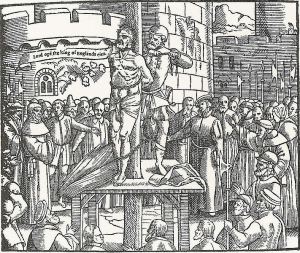
William Tyndale is one of the most important people in English history that few rarely ever know. Through his passion to get the Bible, God’s Word, into the hands of ordinary people, he gave us the linguistic structure of what we consider modern English, perhaps just as influential, if not more so, than William Shakespeare. The following blog post from our church’s Lenten series demonstrates the Tyndale legacy…

Some dismiss William Tyndale and his followers as being hopelessly anti-Catholic, but such an assessment obscures his otherwise remarkable contribution to the history of the church.

As an aid to better appreciate William Tyndale, I found the following documentary by BBC journalist Melyvn Bragg, one of Britain’s foremost public intellectuals, linked here below on Veracity. Bragg is not evangelical in his theology, as he embraces a high-minded form of Christianity as a type of “tribal” faith celebrating the history and grandeur of English culture over against an empty atheism. Nevertheless, his appreciation for Tyndale is something that I hope evangelically-minded Christians will find contagious.

lathamta's avatarLessons in Lent

Woodcut from John Foxe's  The Book of Martyrs. William Tyndale (1494-1536) cries out, "Lord, open the King of England's eyes." Woodcut from John Foxe’s The Book of Martyrs. William Tyndale (1494-1536) cries out, “Lord, open the King of England’s eyes.”

Are you willing to “go the extra mile” for someone?

If you know what I am talking about, you might know that this phrase,
go the extra mile“, comes from the Bible (Matthew 5:41). But
did you know how this phrase became part of the English language?

William Tyndale (1494-1536) was an energetic scholar, a real brainy
guy, kind of like his fellow yet modern Englishman, Tom Wright, who
wrote our study book for Lent on the Gospel of Matthew.

Tyndale was bothered that his typical neighbor was not able to read
the Bible in their native English language in the 16th century. So he
went about learning ancient Greek and Hebrew and began translating the
Bible into English. Unfortunately, the political and religious
establishment of his day…

View original post 379 more words


Painting Jesus

John Paine's avatarLessons in Lent

Christ Driving the Merchants from the Temple Christ Driving the Merchants from the Temple by Jacob Jordaens, c. 1650

Left to your imagination, what would Jesus look like?

In Matthew 21:1-22 we see Jesus’ triumphal entry into Jerusalem on Palm Sunday, with an adoring crowd shouting praises and laying palm branches on the road. They shout “Hosanna!” which is a Hebrew expression for “Save!” and an exclamation of praise.

If  you would like to get a sense for the setting of the Palm Sunday processional, here’s a brief video on the Golden Gate in Jerusalem that documents an extraordinary archaeological find.

One theme throughout the Gospels is that Jesus is on a mission, and that mission includes the fulfillment of prophesies made centuries before He appeared on earth. In this case, the parade was foretold by the prophet Zechariah—who prescribed a donkey for the processional. Not some big chariot, not with a military escort as a show of power, not…

View original post 474 more words