Category Archives: Apostle Paul

Martyn Lloyd-Jones on the Human Condition

Let us be honest. None of us really likes to talk about sin.

But when we talk about the great and glorious news of the Gospel, that in Jesus Christ we have been forgiven of our sin, it would behoove us to fully understand what the sin problem really is. If we fail to do that, it would be like a doctor trying to give a prescription to a patient for their healing without fully grasping the proper diagnosis of the condition.

Dr. Martyn Lloyd-Jones was perhaps the greatest evangelical preacher in 20th century Britain, only rivaled by perhaps one of my favorite expository British teachers, John R. W. Stott (who teaches on the subject of human sin as found in Ephesians 2:1-3 in a commentary found here). Formerly a doctor, Martyn Lloyd-Jones went onto preach as a minister for 30 years. Jones was a great admirer of the Puritans, thoroughly immersed in the Reformed tradition.

I have been spending several weeks reading Romans 5:12-21 in preparing some discussions for our small group Bible study. Of everything I have read in Romans, this passage of Scripture is probably the most compact, dense, liberating, and enriching text in the entire letter. It is nevertheless controversial within the church as to how it has been interpreted. Just ask any Roman Catholic, Protestant or Eastern Orthodox Christian familiar with the discussion. For starters, consider verse 12:

Therefore, just as sin came into the world through one man, and death through sin, and so death spread to all men because all sinned——

The Apostle Paul simply breaks off his thought within mid-sentence.  It is as though Paul had to pause there, anticipating the objections that would be raised to the concept of human as sinners that would chafe against the rational mind for the next 21 centuries. What does Paul mean by this phrase all sinned?   I have been reading this over and over again, looking at commentaries like this one, only to be further drawn into the Apostle Paul’s famous pause at the point. What was Paul getting at?

It is as breath-taking as it is challenging.

In the following video, Martyn Lloyd-Jones gets to the heart of why so many people have such difficulties with Paul’s message in Romans 5.

Also, if you want to hear some of the best Reformed, expository Bible preaching ever recorded, you will be pleased to know that over 1,600 of Martyn-Lloyd Jones sermons are now available for free on the Internet (though you can donate to make sure that those sermons remain freely available).

In the meantime, you can get the flavor of his approach to the Bible and why it is so important to understand the proper diagnosis of the human condition. This interview was conducted by journalist Joan Bakewell in December, 1970:


Manual Philosophy

“Make it your ambition to lead a quiet life, to mind your own business and to work with your hands, just as we told you, so that your daily life may win the respect of outsiders and so that you will not be dependent on anybody.”
1 Thessalonians 4:11-12 (NIV84)

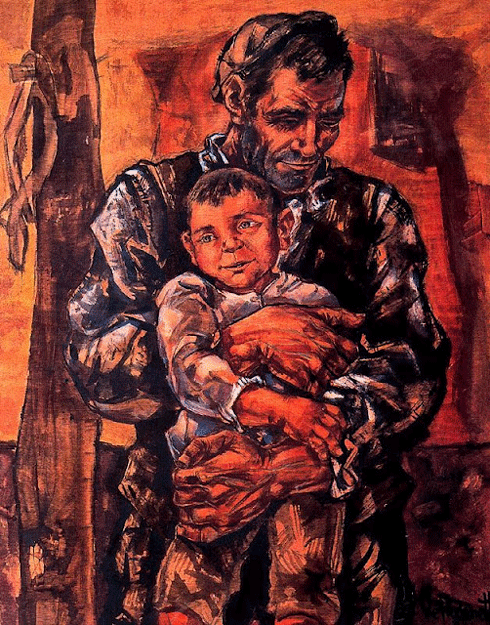
Untitled by Vela Zanetti, 1975

Untitled by Vela Zanetti, 1975

Last week I took a day off work and went with my son David to the Washington Nationals home opener.  It was a truly special day, capped by dinner with my niece, nephew and son’s girlfriend.

My niece is a student at George Mason University, currently enrolled in a philosophy class.  We started talking a little bit about Socrates and Aristotle (both of whom she is required to read), the Audible app I’ve been enjoying lately to ‘read’ philosophy, and how critical context can be to appreciating ancient writing. Continue reading


Keeping the Faith

The Race, 2004

Therefore, since we are surrounded by such a great cloud of witnesses, let us throw off everything that hinders and the sin that so easily entangles, and let us run with perseverance the race marked out for us.
Hebrews 12:1 (NIV)

Hebrews 12:1 reveals so much about the character of God.  This short, pivotal verse tells us about the heavenly realm; the ability of those in that realm to ‘see’ what we are doing; that God has a plan for our lives; that he knows it is not easy; and that he values our striving.  The race we are directed to run gives us a purpose and a mission.  In context it’s about keeping the faithHebrews Chapter 11, often called the Great Faith Chapter, precedes the ‘therefore’.  If you pay attention to the ending of Hebrews Chapter 11, you’ll notice that all the saints mentioned “were commended for their faith, yet none of them received what had been promised. God had planned something better for us so that only together with us would they be made perfect.”

God works by processes.  He wants us to run a race that he knows will be difficult.  Some believe this to be unfair—why doesn’t God just poof everything to be easy for everybody?  But God plays by his own rules.  That’s what the sacrifice of Jesus Christ is all about.  And we have a role in that sacrifice—we’re supposed to keep the faith.

Who wrote the Book of HebrewsOpinions vary considerably, but my personal hunch is Barnabas.  It’s hard to say, but one thing is certain—the apostle Paul knew and appreciated this theology. Continue reading


The Life of the Mind

February by Michael Sowa

“February” by Michael Sowa

Do you have light-bulb moments when you realize that a word or phrase has escaped your lexicon? They’re often accompanied by a revelation that you missed something interesting. It can be that way with ideas as well.

While writing a post on personal discipleship, I came across a podcast by William Lane Craig in which he mentioned “the life of the mind.” I didn’t bird-dog the phrase at the time, but it registered. Then, while reading Kenneth Samples‘ work I tripped over that phrase on his blog. Finally, I heard Clarke Morledge use the phrase in conversation.

As stated previously, I have an anti-intellectual prejudice—big thoughts are best communicated with small words. On the other hand, I might just be turning into a closet intellectual. Or maybe not. Continue reading


Peace

The Veracity blog is all about sharing, so for Christmas I’d like to share a gift that we all need so desperately—peace.

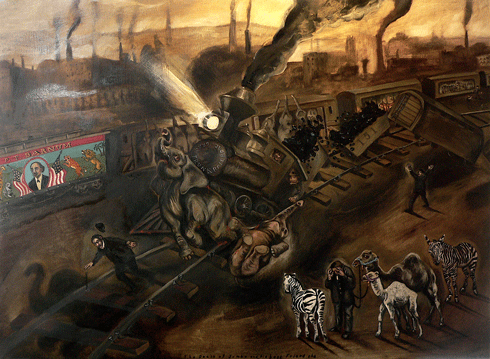
The Death of Jumbo by Sue Coe, 2007

The Death of Jumbo by Sue Coe, 2007

This year there’s no shortage of personal train wrecks and tragedies among my family and friends.  Through death, sickness, the collapse of relationships, or just the passage of time, many of them are dealing with insidious loneliness. And everyone has troubles. Yogi Berra was right, “The future ain’t what it used to be.” They’re all carrying on, but they all need peace. Just like you and me.

Peace isn’t linked to our circumstances—although a lot of misery certainly can be.  Some of the most peace-filled people I know have pretty difficult worldly circumstances.  But peace runs deeper than our circumstances.  Much deeper. Continue reading