Category Archives: Apostle Paul

A Jewish Paul, Matthew Thiessen’s Case for Paul’s Pneumatic Gene Therapy

Let us make Paul weird again. In Matthew Thiessen’s A Jewish Paul, which is actually a rather short book, the author packs quite a punch with a core idea in the thought of the Apostle Paul which is often overlooked: Paul’s “Pneumatic Gene Therapy.”

The first blog post of this book review offers an overview and special insights into A Jewish Paul: The Messiah’s Herald to the Gentiles. However, in this second blog post of a two part book review, we focus on Thiessen’s description of  “Pneumatic Gene Therapy.”

The story of the Bible focuses on Israel as God’ chosen people. How much more anti-democractic or anti-egalitarian can you get to have a “chosen people” separated out from the other, gentile peoples of the world? But the Christian message according to Paul is a lot about breaking down that barrier between Jew and Gentile, without fundamentally losing the distinctiveness of what it means to be Jewish.

So, we have a problem. Gentiles are outside of the God’s covenant with Israel, but Israel is simultaneously set apart to be a blessing to all of the nations. How then is the gentile problem solved by Jesus, according to Paul, as read by Matthew Thiessen? This is where Thiessen’s most provocative insight comes into play, and it highlights even more the weirdness of Paul.
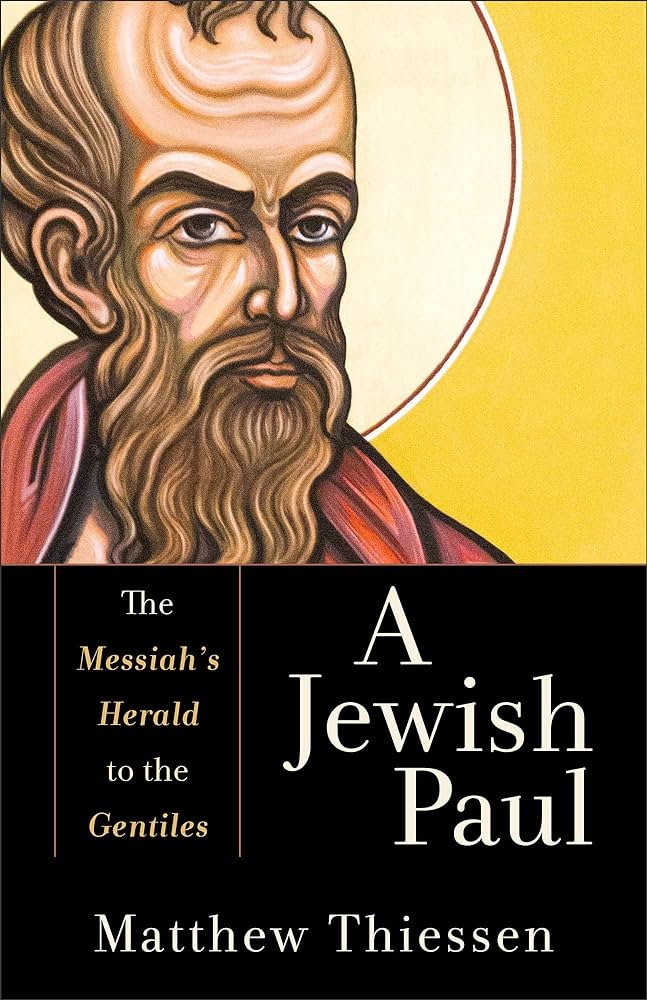
A Jewish Paul: The Messiah’s Herald to the Gentiles. Matthew Thiessen makes Paul weird again.


Pneumatic Gene Therapy

For Paul, gentile believers need to be connected to Abraham, but how? “Abraham is the father of all who believe, and those who trust in the Messiah are Abraham’s seed (Rom. 4:11, 13; Gal. 3:6, 29)” (Thiessen, p. 102). But if circumcision itself fails to properly unite gentile believers in Jesus to Abraham, what does?

Thiessen maintains that Paul knows the solution, as described primarily in Romans 4 and Galatians 3, but it is a solution that is often misunderstood. Thiessen offers his translation of Galatians 3:29: “If you are [part] of the Messiah [ei hymeis Christou], then you are the seed [sperma] of Abraham” (Thiessen, p. 103). Some translations begin this verse with: “And if you are Christ’s” (ESV) or “if you belong to Christ” (NIV). But it takes some unpacking to figure out what it means to “belong to Christ,” for example. Thiessen explains:

“One does this by being immersed into and being clothed in the Messiah. Paul uses the language of containment—entering into (eis) and becoming wrapped by or clothed in (enduō) the Messiah (Gal. 3:27). Such statements encourage us to think in very spatial categories. The Messiah is a location or a container or a sphere into which gentiles must enter in order to be related to Abraham” (Thiessen, p. 103).

But how does one enter that container or sphere? Through the “spirit,” or what Thiessen transliterates from the Greek, “pneuma,” which gives us English words like “pneumatic” and “pneumonia.” In Galatians 4:6, God has sent the pneuma of his Son into the hearts of believers. But what is this pneuma all about?

This is where Matthew Thiessen suggests that Paul’s actual thinking about the pneuma is counter-intuitive to modern readers of Paul. Today, we often think of “spirit” as something which is immaterial. Not so, according to Thiessen. For when the pneuma enters the heart of a believer, the actual stuff of the Messiah enters the body of that believer, permeating, clothing, and indwelling that person (Thiessen, p. 105). This material aspect of “spirit/pneuma” reflects the ancient science of Paul’s day.

Thiessen explains:

“Understandably, this strikes us as odd. The best analogy that I can come up with is a sponge that one immerses in a pail of water. If held underwater long enough, the porous body of the sponge is filled with water while also being surrounded by it. The water simultaneously enters into the sponge and “enclothes” the sponge. This is close to, if not quite the same thing as, what Paul envisages” (Thiessen, p. 105).

Paul’s view of pneuma is related to the ancient Stoic understanding of krasis, whereby two substances can mix with one another, so that the first substance surrounds the second substance, and the second substance surrounds the first substance. Not everyone bought into the Stoic view of krasis. Plutarch thought it was laughable.

But apparently Paul accepted this ancient scientific concept as genuinely real. The spirit/pneuma is made up of the best material available, extremely fine in nature, which then combines with the “flesh and blood” of the believer, made up of coarse material, subject to corruption and decay. Here is how Thiessen translates Romans 8:9-11, where Paul dives deep into his teaching on the spirit/pneuma:

“But you are not in the flesh; you are in the pneuma, since the pneuma of God dwells in you. Anyone who does not have the pneuma of the Messiah is not part of him. But if the Messiah is in you, though the body is dead because of sin, the pneuma is life because of righteousness. If the pneuma of him who raised Jesus from the dead dwells in you, he who raised the Messiah from the dead will give life to your mortal bodies also through his pneuma that dwells in you” (Thiessen, p. 106)

For comparison purposes, consider how the ESV translation renders this passage:

“You, however, are not in the flesh but in the Spirit, if in fact the Spirit of God dwells in you. Anyone who does not have the Spirit of Christ does not belong to him. But if Christ is in you, although the body is dead because of sin, the Spirit is life because of righteousness. If the Spirit of him who raised Jesus from the dead dwells in you, he who raised Christ Jesus[a] from the dead will also give life to your mortal bodies through his Spirit who dwells in you.”

The classic Greek understanding of matter suggested that there are four elements that make up matter: fire, air, earth, and water. But all four of these elements are subject to corruption and decay. So, Aristotle suggested yet a fifth element, aether, which is completely different in that it was eternal, unchanging, and divine (Thiessen, p. 106). So while Paul does not reach for Aristotle’s aether, a similar idea is in his mind. For that which is of the “flesh” (Greek, sarx) is subject to corruption and decay, whereas the spirit/pneuma is not.

The spirit/pneuma then is what connects the gentile believer in Jesus with Abraham, and Abraham’s seed. To summarize the argument made by Paul:

Gentiles need to become Abraham’s sons and seed to inherit God’s promises. The Messiah is Abraham’s son and seed. Gentiles, through faith, receive the Messiah’s essence, his pneuma. Through faith and pneuma they have been placed into the Messiah. The pneuma of the Messiah also infuses their bodies. They have the Messiah’s essence in them, and they exist in the essence of the Messiah. Gentiles have become Abrahamic sons and seed (Thiessen, p. 110-111).

This very material understanding of spirit/pneuma radically goes against the common immaterial view of spirit/pneuma readers today typically have of Paul’s thought. This makes Paul weird.

It also helps to explain one of the most difficult parts of Paul’s great chapter on the resurrection, 1 Corinthians 15:

(42) So is it with the resurrection of the dead. What is sown is perishable; what is raised is imperishable. (43) It is sown in dishonor; it is raised in glory. It is sown in weakness; it is raised in power. (44) It is sown a natural body; it is raised a spiritual body. If there is a natural body, there is also a spiritual body. (45) Thus it is written, “The first man Adam became a living being”; the last Adam became a life-giving spirit. (46) But it is not the spiritual that is first but the natural, and then the spiritual (1 Corinthians 15:42-46 ESV).

What is this passage really talking about?

A Material Spirit?

Matthew Thiessen’s reading of Paul’s notion of “spirit/pneuma” as material resolves several problems. For it identifies a “spiritual body” as being fully material. Just as Christ experienced a fully bodily resurrection, so will believers experience the same type of resurrection, but with a new, incorruptible body in its place of the decaying, corruptible body. The finer material of the spirit/pneuma will overcome the limitations of the coarse material of the flesh.

We may not be able to fully resolve existing questions about what the future resurrected life would look like: for example, will someone born as an amputee have a new bodily limb that they never had in their earthly life? Yet it does establish that a material spirit/pneuma guarantees that the resurrection will be a material existence, and that this new bodily existence will be without corruption.

Thiessen notes that as early as the second century, some Christians no longer accepted Paul’s understanding of a material spirit/pneuma. A pseudepigraphic text that sought to imitate Paul, known to historians as Third Corinthians, tried to argue for a “resurrection of the flesh,” against what the historical Paul was arguing (Thiessen, p. 117).  Third Corinthians was probably written by an overly enthusiastic defender of Paul, some time after the apostle’s death, who was bothered that certain people were not believing Jesus to have been genuinely human, susceptible to frailty and death; that is, having human flesh. But in trying to defend the humanity of Jesus, the pseudo-Pauline author of Third Corinthians never bothered to consider the misleading ramifications of promoting a “resurrection of the flesh.”

This “resurrection of the flesh” in Third Corinthians suggests that bodily resurrection is no more than a kind of resuscitation, whereby our old bodies are simply given life back into them, without any substantial change. But a “resurrection of the flesh” means that the body is still susceptible to death and decay. Thankfully, the early church fathers who helped to affirm the New Testament canon we have today were astute enough to recognize the deceptive origins of Third Corinthians, thus excluding it from our New Testament.

The historical Paul may be weird, but the explanatory power is substantial. This ancient understanding of material spirit/pneuma may give greater insight into Paul’s use of the phrase “in Christ” in his letters. This is commonly associated with the “mysticism” of the apostle Paul, whereby a believer somehow “participates” in Christ. But perhaps being “in Christ” is more closely connected to this understanding of material spirit/pneuma as opposed to an ambiguous “mysticism” of what it meant to participate in Christ, which can be quite difficult to grasp.

Furthermore, a material interpretation of “spirit/pneuma” helps to better explain why Paul insists that the church, the gathered believers in Christ, make up what he calls “the body of Christ.” This “body” language is not simply presented as a metaphor in the New Testament. Rather, it suggests that “the Messiah followers are his flesh-and-blood body on earth” (Thiessen, p.119), a theme that Paul elaborates on in 1 Corinthians 12 and Romans 12:4-8.

Paul even combines the corporate body of the Messiah; that is, his church, with the individual bodies of believers, showing that the gathered believers, the body of the Messiah, and the sacred space where God dwells, just as God dwelt in the tabernacle and the temple in the Old Testament, and therefore, Christians should act accordingly with their individual bodies. Thiessen shows that Paul pulls the individual and corporate sense of “body” together in his translation of 1 Corinthians 6:19-20:

“Or do you all not know that your [plural] body [singular!] is a temple of the holy pneuma within you all, which you all have from God, and that you all are not your own? For you all were bought with a price; therefore glorify God in your [plural] body [singular]” (Thiessen, p. 121).

Modern English translations rarely demonstrate this intentional connection of the plural “your” with the singular “body,” as English lacks a particular second person plural pronoun as differentiated from second person singular (the primary exception is the old trusty King James Version, which still had a second person plural pronoun, from the Elizabethan era). Certain translations, like the NIV, obscures Paul’s point altogether by wrongly translating “body” as “bodies.”

On numerous occasions, Paul refers to those who are “in Christ‘ as “holy ones” (Here is a short list of such references: Rom. 1:7; 8:27; 12:13; 15:25, 26, 31; 16:2, 15; 1 Cor. 1:2; 6:1, 2; 7:14; 14:33; 16:1, 15; 2 Cor. 1:1; 8:4; 9:1, 12; 13:12; Phil. 1:1; 4:22). Unfortunately, most English translations miss the significance of this terminology by translating this phrase as “saints.” The language of “holy ones” harkens back to this same language found in the Old Testament, such as Zechariah 14:5.

So, who are these “holy ones?” In the Old Testament, as well as Second Temple literature like the Wisdom of Solomon and in the Dead Sea Scrolls, the “holy ones” are identified as being members of Yahweh’s divine council (Thiessen, p. 124ff). This suggests that those who are “in the Messiah,” including both Jew and Gentile are to be somehow connected to God’s divine council. This demonstrates that the Eastern Orthodox view of sanctification as “theosis,” whereby believers in Christ are being made, in some sense, to be “divine,” is not just some late theological development unique to Eastern Orthodoxy, but that goes back to very language of the New Testament (see 1 Thessalonians 3:13. The NIV translation is one of the few English translations that gets this verse right!).

It should not be a surprise then that in 1 Corinthians 6:2-3, Paul is teaching that believers in Christ will one day judge angelic, divine beings. This is not to be confused with a Mormon understanding that certain human beings will become “gods” themselves, suggesting that such humans will become just as the God of the Bible is now. Rather, the God of the Bible is supreme overall.

“This does not threaten Paul’s belief in one supreme God; it rather confirms it. The supreme God is God by nature (physis) and has the power to deify others. All other gods are gods only by God’s gift or grace, a gift that is newly available to humanity in and through the Messiah and the Messiah’s pneuma” (Thiessen, p. 128).

Correcting False Views About the Resurrection

Here is my biggest takeaway from A Jewish Paul. Matthew Thiessen’s thesis about a material concept of “spirit” (pneuma), as opposed to a non-material concept, clears away confusion about the doctrine of the resurrection.  Look at how the pseudepigraphic author of Third Corinthians (noted above) gets Paul wrong in comparison to what Thiessen says about 1 Corinthians 15, the greatest chapter in the New Testament about the resurrection in the world to come:

If we allow our own astrophysics to creep into our readings of 1 Corinthians 15, then we are bound to run into problems. Since most (perhaps all) of us make a sharp distinction between the material and spiritual realms, we might think that when Paul says “spiritual,” he must mean nonphysical. Consider the NRSVue translation of 1 Corinthians 15:44, which distinguishes between the first body, which is sown, and the second body, which comes out of the sown seed: “It is sown a physical body; it is raised a spiritual body. If there is a physical body, there is also a spiritual body.” There are at least two problems with this translation. First, the Greek word the translators render as “physical” is psychikos, a word that does not mean physical. Instead, it is related to the Greek word for soul—psychē. So while Paul is referring to a material body, that is not the point of the distinction he is making between the two bodies. Rather, he alludes to Genesis 2:7, which speaks of God making the earthling into a living soul (eis psychēn zōsan). In contrast to this original psychikos (soulish) body, the resurrection body will be a pneumatic body. Second, I prefer to use the term pneumatic rather than spiritual because it helps modern readers distance themselves from the assumption that what is spiritual is the opposite of material or physical. (Think, for example, of how often you hear that you must be grateful for your spiritual blessings rather than your material blessings.) (Thiessen, p. 142).

It is remarkable how so many popular English Bible translations get 1 Corinthians 15:44 wrong. The Common English Bible (CEB), the Contemporary English Version (CEV), the older Revised Standard Version (RSV), and even The Message all get this wrong,  just as the NRSVue has done. By translating psychikos as “physical,” this implies that the resurrection body is in contrast with the physical, suggesting that the “spiritual body” is not material.  Thankfully, there are translations like the NIV, NASB, and ESV that get it right:

It is sown a natural body; it is raised a spiritual body. If there is a natural body, there is also a spiritual body (1 Corinthians 15:44 ESV).

Being sown a “natural body” is the much better translation, and not a “physical body.” (A recent interview with New Testament scholar Michael Licona underscores this point). Sadly, such mistranslations of the Bible have given many Christians the wrong impression that our resurrection bodies will have no material element.

This wrong interpretation suggests that at the resurrection we will simply have some ethereal existence floating on the clouds, kind of like the Hollywood picture of wearing white robes, with halos, and even sprouting wings, with lots of harp playing going on.  In other words, “going to heaven when we die” in this wrong view of resurrection is about escaping the human body, with all of its frailties, instead of a transformation of the human body to become perfected. In contrast, a more biblical and accurate perspective has our resurrected bodies in a material form existing within the realm of the “new heaven and new earth” (Revelation 21:1).

If there is but one critical lesson to learn about “pneumatic gene therapy” in the writings of Paul, it would be this one!


Pushback Against the “Pneumatic Gene Therapy”

Perhaps the strongest pushback against Thiessen’s “Pneumatic Gene Therapy” proposal is what is to be done with Paul’s doctrine of the Holy Spirit? In many of the passages where Thiessen cites the “pneuma” as this material conception of “spirit” some translations instead capitalize the word as “Spirit,” thereby suggesting that Paul has in view the third person of the Trinity, the Holy Spirit.

It is important to note that the original Greek of the New Testament does not use capitalization for “spirit/pneuma,” or for anything else. The King James Version translation set a type of precedent of capitalizing “Spirit,” an interpretive decision which has been a difficult habit to shake for subsequent English translations. The KJV often distinguishes between some other “spirit” and the “Holy Spirit” by simply capitalizing the single word, “Spirit,” as in Romans 8:15:

For ye have not received the spirit of bondage again to fear; but ye have received the Spirit of adoption, whereby we cry, Abba, Father.

This might indeed be the right way to interpret this verse, but capitalization of the latter is not found in the original Greek. Context is key when trying to figure out the correct interpretation for any passage of Scripture, and it is not entirely self-evident as to why the KJV translators capitalized “Spirit” sometimes but not other times. Perhaps the “spirit of adoption” is meant by Paul to mean the finest material available, associated with being a new creature in Christ, versus the inferior “spirit of bondage,” which suggests the coarser, corruptible material of the fallen world. It may not necessarily suggest that the “spirit of adoption” here is the third person of the Trinity, in Paul’s mind.

Clinging to a more non-material “spirit of adoption” might well explain the rise of the idea that believers “go to the heaven” when they die, and stay there, living up on some puffy clouds, bearing ethereal wings, or something else which owes itself more towards the Gnostic idea of getting rid of our bodily existence in the afterlife. This Gnosticism is very much at odds with historic orthodox Christianity, which insists that believers will dwell bodily, exploring all that the “new heaven and new earth” has to offer. Perhaps we should be much slower to think “Holy Spirit” when we read of the “pneuma/spirit,” at least in certain passages of our New Testament.

Yet a purely material conceptualization of the “Holy Spirit” does seem at odds with historic Christian orthodoxy. I am not saying Thiessen’s “Pneumatic Gene Therapy” idea is misleading or incorrect. I am just wondering how this all fits in with Paul’s understanding of the Holy Spirit.

But there could be an answer to this objection. It is quite possible that not all Pauline references to the “pneuma” have the ancient material sense of “spirit” in mind. There are potentially other Pauline uses of “pneuma” that have the Holy Spirit in view, as opposed to a material infusion of “spirit/pneuma,” congruent with Stoic philosophy.

For example, Romans 5:5 specifically mentions the “Holy Spirit,” as in “God’s love has been poured into our hearts through the Holy Spirit who has been given to us” (ESV). The ESV here suggests a personal and less material sense of “spirit/pneuma.” But in the same letter, particularly in chapter 8, Paul speaks of the “spirit/pneuma” in more of the material sense numerous times, as in: “For to set the mind on the flesh is death, but to set the mind on the [spirit] is life and peace” (Romans 8:6 ESV, without capitalizing). Compare this with the KJV which intentionally does not capitalize the “spirit,” translating the phrasing differently: “For to be carnally minded is death; but to be [spiritually] minded is life and peace.”

Yet then Paul might be shifting back and forth between the “Holy Spirit” or “Spirit of God“, and the “spirit/pneuma” in the material sense, later in Romans 8:13-14: “For if you live according to the flesh you will die, but if by the [Spirit/spirit] you put to death the deeds of the body, you will live. For all who are led by the [Spirit/spirit] of God are sons of God” (ESV). Is the first reference to pneuma in the material sense, and the second reference in the sense of the Holy Spirit? The ESV translation by default capitalizes “S/spirit,” which suggests that both references are to the “Holy Spirit,” but perhaps this is not the best way to understand Paul. Unfortunately, Matthew Thiessen does not address this particular issue as to how the Holy Spirit and “spirit/pneuma” in the material sense relate to one another.

What I would like to see is other critics taking a good look at Thiessen’s thesis, and suggest if a convincing explanation could be found to figure out why this Pauline concept of a material “spirit/pneuma” was relatively so quickly lost during the era of the early church, at least among some Christians. Is it possible for a robust Pauline theology of the Holy Spirit to be synthesized with Matthew Thiessen’s thesis? To my knowledge, there was no early church effort among the historically orthodox to strongly deny such a “pneumatic gene therapy,” though I could be proven wrong here. As I understand Thiessen’s thesis, it could simply have been that a material concept of “spirit/pneuma” was simply forgotten over time, at least in popular thought, as opposed to being actively rejected by certain groups of Christians, whereby debates concerning the “Spirit” in Paul’s writings eventually got taken over by other theological concerns.

A second pushback could be made by those who bristle at the thought that Paul might have embraced an ancient, obsolete scientific view of matter to explain one of the central themes in Pauline theology taught within his New Testament letters. Would God really accommodate to the apostle’s fallible, yet broadly accepted view of “spirit/pneuma” in Paul’s day in order to reveal divine, infallible truth?

For those who say that such a suggestion of divine accommodation violates their sense of the inspiration of Scripture, pneumatic gene therapy will find a difficult path towards acceptance. But those who struggle with such a prospect, they already have enough on their hands trying to explain why the human heart, which according to modern science, is but a sophisticated pump, is nevertheless described in the Bible as the seat of human emotions (1 Samuel 13:14, Psalm 73:21). They also struggle with the notion of the kidneys being a similar source for human emotions (Proverbs 23:16), when modern science tells us that the kidneys have a different function, that of being a filter to rid the body of substances that threaten it. Do we need to say anything more about the supposed “teaching” of Genesis 1 that we will live on a flat earth? I have written before on Veracity that it would be unfair to judge the Bible negatively simply because the scientific views held during ancient times had not yet caught up with contemporary understandings of biology and cosmology.

These possible pushbacks aside, Thiessen’s material interpretation of “pneuma” makes for the most thought-provoking contribution to our understanding of Paul to be found in A Jewish Paul. The explanatory power of Thiessen’s thesis is indeed very compelling. While there are still some lingering questions in my mind, I am pretty much on-board with Thiessen’s thesis.

A Recommendation for Reading A Jewish Paul

Far too often in some conservative evangelical circles, various reassessments of Pauline theology have resulted in a false dichotomy whereby a “new perspective” is thought to cancel out an “old perspective” regarding Paul (Read here for an introduction to the so-called “New Perspective on Paul”). I have friends of mine who are immediately suspicious of anything “new” regarding a “New Perspective Paul,” as this suggests that something “new” must be something “liberal,” and therefore not based on the Bible. But “new” in this context should be better understood as recovering something that has been lost and forgotten due to layers and layers of tradition.

However, such suspicion is not totally unwarranted, as some proponents of such “new perspectives” have too excitedly tried to show that everything you once thought about Paul has now been “proven” to be wrong. Why? Because some scholar with a PhD said so.

Thankfully, Matthew Thiessen does not do that in this book. Thiessen is sympathetic to such concerns. A renewed focus on Paul’s Second Temple Jewish context need not cancel out a robust and classical doctrine of justification by faith. If anything, a fresh look at Paul can help to better sharpen our theological understanding of Paul, rather than blunt it.

Perhaps the best example to be considered is the status of Luther’s view of the righteousness of Christ being imputed to the Christian believer, a doctrine that a number of proponents of the New Perspective on Paul deny. Those who oppose the New Perspective on Paul often do so because they believe that such advances in our understanding of Paul today have obscured this doctrine, to the detriment of the Gospel. But Matthew Thiessen’s proposal helps to give us a different way of thinking through this controversy. For if it is a kind of pneumatic gene therapy that makes one belong to the people of God, and find salvation, then this surely is not something which originates from one’s self. This pretty much rules out any kind of “works-righteousness” approach to salvation, which is consistent with Martin Luther’s 16th century concern, while reframing our thought to be more consistent with Paul’s original 1st century perspective.

According to the old Greek way of looking at matter, based on the four primary elements of earth, sky, fire, and water, human existence by default dwells within this state of coarse matter. To move towards a state of the finest matter, that of the “spirit/pneuma,” Paul in no way would suggest that can be accomplished by human effort alone. Rather, in order to attain this finest matter, it must be given to us, a reality that rules out any idea of a “works-based” righteousness. In this sense, to say that Christ’s righteousness is “imputed” to us, as Protestant Reformers like Martin Luther insisted, is not that far off from saying that the Messiah gives us spirit/pneuma to transform us. It would be of great interest if Thiessen would explore this theme in some follow-up book.

Paul’s theology is indeed rich, teaching that salvation by good works is not achievable by human effort, while simultaneously affirming the Jewishness of Paul.  Matthew Thiessen backs up his argument not by any appeal to some new idea, but by recovering the ancient sources to make his case. Whether or not Thiessen has solidly interpreted those ancient sources is up for the reader to assess. No matter where the reader lands, Matthew Thiessen gives the reader a lot to think about.

If I could recommend a single book that acts like a one-stop shop that gives an overview of where Pauline studies is today, without a lot of academic jargon, it would be Matthew Thiessen’s A Jewish Paul. Paula Fredriksens’ impressively engaging Paul: The Pagans’ Apostle covers a lot of the same ground as Thiessen’s A Jewish Paul, and comes to broadly overlapping conclusions, as I have reviewed here before two years ago on Veracity. Paula Fredriksen is a more senior, experienced scholar than Matthew Thiessen. But Fredriksen’s still extraordinary book is more difficult to penetrate for the general reader, whereas Thiessen’s book is easier to grasp and brief in comparison. For the best book review of Matthew Thiessen’s A Jewish Paul, read what Brad East had to say, which gave me plenty of food for thought in this review.

And a Cautionary Note For Reading A Jewish Paul

I could continue with the accolades for A Jewish Paul. Matthew Thiessen is a fine scholar and enjoyable to read. Nevertheless, there are still some problematic issues with Matthew Thiessen’s work that might give at least some readers pause. I could be very wrong on this, but I am doubtful that Thiessen would consider himself an “evangelical” Christian scholar, as he rejects (or to be more generous, at least downplays) a number of historically orthodox views of the Christian faith. He embraces a number of ideas popular today among many critical scholars that might bother some in his audience. This is disappointing, but not altogether unexpected.

Three examples stand out. First, Thiessen follows the common critical view that Paul did not write all thirteen letters in the New Testament, associated with his name. He is largely convinced that Paul did not write the pastoral letters (1 Timothy, 2 Timothy, Titus), and he is unsure about 2 Thessalonians, Ephesians, and Colossians. Nevertheless, he (cautiously) uses evidence found in all thirteen letters associated with Paul to make his case (Thiessen, p. 51), which suggests that he might be open to being wrong about the disputed status of certain letters from Paul.

Good for him. I will just say that I am persuaded that all thirteen letters in our New Testament all derive from Paul’s authority, though he probably enlisted significant help from competent secretaries he trusted, particularly in the case of 1 Timothy, 2 Timothy and Titus, the most disputed of the Pauline writings.

Furthermore, Thiessen remarks and asks, “Paul was not a trinitarian, but do his writings perhaps inevitably point in trinitarian directions?” (Thiessen, p. 113). I wonder if Thiessen could have reframed this a little differently. Some readers will be annoyed to think that Paul was not trinitarian from the start, at least implicitly, but Thiessen is nevertheless open to thinking that Paul’s ideas do lend themselves towards a fully trinitarian theology articulated at the councils of Nicea and Constantinople in the 4th century. Still, Thiessen’s stark remark about Paul not being a trinitarian is a curious posture to take.

Here is how I would put it: While Paul was not explicitly trinitarian, Paul was implicitly trinitarian, as those early church fathers eventually understood the doctrine of the trinity by the end of the 4th century.

On top of that, it was not clear to me as to what Matthew Thiessen thinks about the exclusive claims of Christ. On the one hand, Thiessen emphasizes that Paul unequivocally taught that one must believe in Jesus as the Messiah. There is no denying Paul’s exclusivity about Jesus. Then Thiessen gives the analogy of being on the Titanic when it starts to sink. The exclusive truth claim of historic orthodox Christianity is akin to the cry that one must board one of the lifeboats, or else one may die. The lifeboat on the Titanic represents Jesus as the only way to salvation. “Many Christians believe that they have a moral obligation to tell people throughout the world that they are doomed and that they need the lifeboat” (Thiessen, p. 43). This has been the historically orthodox position, despite various attempts to posit a doctrine like universalism. Thiessen on the other hand refrains from telling the reader his own position.

One particular critique of the “Paul Within Judaism” school of thought is that it might be making the exclusive truth-claims of Christianity not-so exclusive. Thiessen is hesitant about applying the “Paul Within Judaism” label to himself, but it left me as a reader scratching my head. This theological issue is probably best understood as one of those mysteries of the faith: where we must simultaneously uphold the uniqueness and supremacy of Christ, while trusting in the goodness and wisdom of God in dealing with those like the Jewish people, and others, who do not outwardly make a profession of Christian faith. Unfortunately, Thiessen left me hanging on this one. Again, this is disappointing.

Salvation is salvation in Christ, and Christ alone. But from our finite human perspective we can nevertheless trust in God’s sovereign purposes and the wideness of God’s mercy to save in ways that we can not fully understand.

A Jewish Paul: A Final Assessment

However, while none of these comments above from A Jewish Paul are ringing endorsements of classic, historically orthodox Christian claims, this should not discourage potential readers from taking in what Matthew Thiessen has to say. A Jewish Paul wants to engage with all Christian believers across the theological spectrum to help us to gain a more accurate and nuanced appreciation for Paul and his message.

A Jewish Paul also serves as a catalyst for trying to purge centuries of antisemitic tropes Christians have at times unwittingly wielded against Jews. While I still consider the great Reformer, Martin Luther, one of my favorite Protestant heroes, Luther went off the rails towards the end of life writing some of the worst, anti-Jewish writings imaginable. Luther’s failure to see the real Jewish-ness of Paul is a fault that we as Protestant evangelicals need to get past and overcome. I am grateful that Matthew Thiessen is helping to try to set the record straight.

As a conservative evangelical myself, I think Matthew Thiessen’s A Jewish Paul is a wonderful book, which has taught me a lot, even though I find myself wondering about or disagreeing with the author on certain fundamental convictions. I can still learn from someone who does not share the exact same evangelical commitments that I have. As a book of less than 200 pages, A Jewish Paul is a perfect introduction into the state of contemporary scholarship regarding the apostle Paul, written at an accessible level. I plan on referring to A Jewish Paul often when I read Paul. A Jewish Paul is an invaluable contribution to the discussion, deserving the widest readership possible, for both scholars and laypersons alike.


A Jewish Paul, Matthew Thiessen Makes Paul Weird Again

Can we please make Paul weird again?

Many of us know the standard story of Paul. At one time, Paul (then Saul) was the most feared opponent of the fledgling Christian movement, bent on destroying such a pernicious heresy. The followers of Jesus had foolishly embraced the idea of a crucified now-risen Messiah, and Paul was dedicated to stamp the movement out.

God soon stopped Paul on the road to Damascus. Confronted by the Risen Jesus himself, Paul realized that he had been championing the very wrong side. Shortly thereafter, Paul reversed his course entirely, proclaiming the Resurrection of Jesus. It took some time for the other Christian leaders to fully trust him, but Paul was eventually to become the great apostle to the Gentiles. Paul had rejected the Jewish commitment to the Law of Moses, with all of its “works-righteousness.” Instead, Paul embraced and proclaimed a message of faith, that of having trust in the Risen Messiah. In contrast with those unbelieving Jews obsessed with trying to earn their own salvation, Paul’s new gospel was a message of grace towards those who believe, receiving a salvation that could never be earned by human effort alone.

While much of this story has staying power, it has a serious weakness when it comes to analyzing the following question: When Paul became a Christian, did he really cease to be a Jew?

Such is the question at the very heart of Matthew Thiessen’s A Jewish Paul: The Messiah’s Herald to the Gentiles.

A Jewish Paul: The Messiah’s Herald to the Gentiles. Matthew Thiessen makes Paul weird again.


What Was At the Heart of Paul’s Message?

Matthew Thiessen acknowledges many of the virtues associated with the standard story of Paul, but he contends that this standard story begins to break down when trying to consider Paul’s real relationship to Judaism as a professing Christian. In essence, Thiessen maintains that Paul never ceased being a Jew when he became a follower of Jesus. Instead, he became a very particular kind of Jew. While this may sound weird to Bible readers today, this is the very point Thiessen is trying to make: We need to make Paul weird again.

Matthew Thiessen is a New Testament professor at McMaster University, in Canada. Coming from a Mennonite background, he is part of an intellectual movement to try to rethink and recover who the real Paul the Apostle was. Sadly, layers of anti-Jewish sentiment following the break between Judaism and Christianity in the early church period have distorted the historical picture we have of Paul. While Jesus is surely the founder of the Christian faith, Paul is indeed his greatest and most influential interpreter. Agree or disagree with Matthew Thiessen on particular matters, one thing Thiessen says sticks out for sure is this: Paul is indeed weird. We would do well to remember this.

What? Paul remained a Jew, while still becoming a Christian? I have to admit, this did sound pretty weird when I first heard this. But Thiessen makes a compelling case for Paul’s weirdness. Some of Paul’s weirdness goes against the norm of Western, Educated, Industrialized, Rich and Democratic people today (WEIRD!), as Jonathan Haidt popularized in his absolutely brilliant The Righteous Mind: Why Good People are Divided by Politics and Religion. But perhaps that is a point as to why thinking about Paul’s weirdness is so important. It shows us just how “weird” we are today, and perhaps why our weirdness gets in the way of situating Paul in his original first century context as a Jewish follower of the Risen Messiah.

In A Jewish Paul: The Messiah’s Herald to the Gentiles, Thiessen offers a succinct overview of the history of Pauline studies over the past few hundred years. First, the traditional reading reflected in the standard story above stems from Martin Luther and other leading Protestant Reformers. In this traditional reading, the main problem faced by Paul was legalism, the attempt to earn one’s salvation through good works. Paul linked this legalism with Judaism itself, and rejected it for the message of grace found by having faith in Christ, superseding Judaism as a whole.

What many Christians do not realize is that a reexamination of this standard story has occupied the attention of New Testament scholars for at least a good forty years now, among both non-evangelical and evangelical scholars. In the world of academic scholarship, it seems like a new study with new insights into the Apostle Paul gets published about once a month.

The thrust of this new line of scholarly research is known as the “New Perspective on Paul” founded by the late E.P Sanders, but popularized the most by writers like N.T. Wright and James D.G. Dunn. Unlike the traditional view, the “New Perspective on Paul” says Paul was not concerned about legalism and correcting it with the “imputed righteousness” of Christ championed by Martin Luther (which is N.T. Wright’s way of saying it). Instead, with the “New Perspective on Paul,” the problem faced by Paul was ethnocentrism. To borrow from N.T. Wright at times, the message of Paul was about “grace, not race.” The Judaizers of Paul’s day wanted gentiles to become Jews by embracing circumcision and the rest of Torah law. But Paul insisted that the death and resurrection of Christ is what makes people right before God and joined together as God’s people, not the ethnically cultural customs  which have been part of keeping the Torah.

Thieseen observes yet a third way of looking at Paul, having its origins in the “apocalyptic” theology of the early 20th century German scholar-turned-missionary doctor, Albert Schweitzer. In this apocalyptic view, the coming of Jesus ushers in a radical break with the Jewish past. Schweitzer had written about the “mysticism” of the Apostle Paul, with all of Paul’s statements about being “in Christ,” and Schweitzer’s followers like the 20th century German theologian Ernst Käsemann, have suggested that the death and resurrection of Jesus relativizes the Torah completely. All of the old structures of order: Jew and Gentile, male and female, and slave and free, have been dissolved (Galatians 3:28).

Thiessen acknowledges that each of these three views have certain strengths to them, but they also fall short in other ways. For example, Paul is clearly teaching that one can not earn one’s salvation by works, so Luther was absolutely right here. But the New Perspective on Paul offers an important corrective by showing that at least some, if not most forms of ancient Judaism were not promoting a works-based righteousness. For example, the Old Testament announces that “there is no one who does not sin” (2 Chronicles 6:36 ESV), and “Surely there is not a righteous man on earth who does good and never sins” (Ecclesiastes 7:20 ESV). This hardly coheres with the standard, old Protestant view that all Old Testament Jews believed that you could simply earn your own salvation on the basis of performing good works. Even Abraham, the father of the Jewish people, received God’s favor due to an act of God’s graciousness, and not by superior Law-keeping.

This Old Testament theme of grace is echoed in the Paul of the New Testament: “Yet we know that a person is not justified by works of the law but through faith in Jesus Christ, so we also have believed in Christ Jesus, in order to be justified by faith in Christ and not by works of the law, because by works of the law no one will be justified” (Galatians 2:16 ESV). Everyone from the Old Testament Jew to the New Testament Gentile stands in need of God’s grace.

But according to Thiessen, the New Perspective on Paul has faulted by insisting that Paul’s problem with the Jewish resistance to the Christ message was ethnocentrism. For Paul himself could also be accused of ethnocentrism, just as anyone else could: Paul’s message was “first to the Jew, then to the Gentile(Romans 1:16 NIV). Why put the Jew first? Was Paul placing the Jew as being more important or superior to the gentile?

Thiessen’s critique continues with another target: While the “apocalyptic” view rightly announces a radical proclamation of something new, that view tends to suggest a break with Judaism that Paul never really had. Paul believed that the Mosaic Law had its goal and purpose fulfilled in the coming of Christ: “For Christ is the end of the law for righteousness to everyone who believes” (Romans 10:4 ESV).

Instead, what Matthew Thiessen proposes is yet a fourth view that might be called “Paul within Judaism,” though Thiessen is not wholly satisfied with that description. Nevertheless, it is a label that a scholar such as Paula Fredriksen agreeably aligns with, in her Paul: The Pagan’s Apostle. First and foremost, this “Paul within Judaism” view acknowledges that the Judaism of the Second Temple period, to which the Apostle Paul lived in, was not some monolithic belief system. Someone who was Jewish in Paul’s (and Jesus’) day could have held beliefs that sharply differed from another Jew. For example, even Acts 23:8 tells us that the Sadducees and the Pharisees held contradictory views about a future resurrection, the Sadducess being dismissive of such an idea whereas the Pharisees embraced it. It is better to think in terms of multiple “Judaisms” of Paul’s day as opposed to a single “Judaism.”

“Paul was one ancient Jew living and thinking and acting within a diverse Jewish world that sought to be faithful to Israel’s God and Israel’s law“(Thiessen, p. 8).

Yet what makes Paul so important is that Paul is the most prolific and deepest thinker we encounter when reading the pages of the New Testament. But to miss the essential Jewishness of the Apostle Paul is to completely miss the message from him we read about in the New Testament.

Paul’s Unique Contribution to New Testament Christianity

Along the way in reading A Jewish Paul, we learn that:

…It is simply wrong to believe that all or even most Second Temple Jews thought that gentiles needed to become Jews. Such a commonly held view is the result of Christian interpreters who have reconfigured Judaism into the image, albeit inevitably an inferior image, of Christianity” (Thiessen, p. 18).

Yet Thiessen’s contention is contrasted with the very mission of Paul to be Christ’s apostle to the Gentiles, compelling Paul to travel across the Roman empire to share the Good News with all he encountered. While most Jews did not “evangelize” their faith, Paul in his own understanding of Judaism was exactly opposite, a feature of Paul’s ministry which Thiessen acknowledges.

Paul did not in any way think that Judaism was somehow deficient as a whole. Rather he specifically came to believe that Jesus Christ was the once dead but now Risen Messiah, and that gentiles can be brought into the community of God’s people by having faith in Jesus.

Some might argue against Thiessen that Paul spoke of his “previous way of life in Judaism” (Galatians 1:13-14 ESV), suggesting that Paul had given up his Jewish way of life. However, later in Galatians 2:15 Paul tells his readers that he is very much still a Jew, and in Romans 11:1 and Philippians 3:5, he embraces his Benjamite identity. Therefore, it is better to think of Galatians 1:13-14 as saying that Paul gave up one form of Judaism for yet another form of Judaism (Thiessen, p. 41 and pp. 54ff).

It might be fair to say then that Paul’s “conversion” to Christianity was not a “conversion” away from Judaism. Rather, Paul was converted from one form of Judaism to a different, particular Jewish vision of acknowledging Jesus as God’s promised Messiah.

Paul is not against circumcision per se, for he does not believe the Jewish Christians need to have the marks of circumcision removed. But he is emphatic on insisting that gentile Christians not be required to undergo circumcision in order to become followers of the Messiah.

To demonstrate Paul’s very point, it is crucial to understand how the Book of Acts functions in its placement within the New Testament.  Sandwiched between the Gospels and Paul’s letters, Acts shows the reader that Paul was very much still a Torah-observant Jew (Acts 21:23–24; 25:8; 28:17), getting along well with other apostles, like Peter. But even in Acts, Paul preaches that complete Torah observance was not required for the Gentile follower of Jesus (Acts 13:38-39). It was this insistence that circumcision be not required of the believing gentile which stirred up Paul’s opponents within the Jesus movement in Jerusalem. For there is nothing in the story of Jesus from his earthly ministry prior to his Resurrection, as we find in the Gospels, which would indicate that Jesus had removed the circumcision requirement from the gentiles. We only get that from the post-Resurrection story of the apostle Paul.

So, it would be too strong to say that Paul was the founder of Christianity. Jesus himself took that role. But it was through Paul’s unique calling, as the apostle to the gentiles, that Christianity became a universalizing faith, intended for everyone, and not just one particular group of people.

Christians who contend that they “love Jesus” while “having problems with the Apostle Paul,” need to seriously rethink such an attitude. For while Paul does believe that he got his message straight from the Risen Jesus, nevertheless, if it were not for Paul, Christianity probably would never have made the in-roads which it did into the gentile world.

If all we had was the teaching of Jesus in the Gospels, we would never have had a Christian message with the universal impact it had. While Paul does not go as far some would like in stimulating social change, we might never have had the eradication of racial-based slavery without Paul, nor the reconfiguring of roles for women in leadership without Paul, in the Western world. Why Jesus waited to impart through the Holy Spirit the full Gospel message until after the Ascension, perhaps somewhere on that road to Damascus, so that Paul could unpack it all out for us, is a question I hope to to get answered some day. Without Paul, Christianity might have remained a peculiar Jewish sect, where the only Jesus followers would be those who accepted circumcision, and other distinctives of the Law of Moses.

Rethinking Paul’s Message in Light of His Jewishness

Much of contemporary New Testament scholarship has tried to show that the narrative of Paul’s life, as told through his letters, conflicts with the narrative of Paul given to us in the Book of Acts. This has led many scholars to dismiss the historical reliability of Acts. But Thiessen argues that much of this conflict comes from misunderstanding Paul from his own letters (Thiessen, pp. 27ff).

Thiessen suggests that part of our misunderstanding about Paul comes from misleading ways of reading the book of Romans. For example, many Bible translations of Romans 1:18-32 employ subtitles like the ESV’s “God’s Wrath on Unrighteousness” or the NIV’s “God’s Wrath Against Sinful Humanity.”   Only a few translations, like the CSB, with “The Guilt of the Gentile World,” more accurately convey the intent of  Paul’s message.  The primary thrust of Romans 1:18-32 is to critique the sin of idolatry and its consequences in the gentile world, problems that do not normally appear in the Jewish world.

Much of Paul’s writing is focused on how his message of inclusion regarding the gentile believers meshes together with honoring circumcision among believing Jewish followers of Jesus. In contrast, Thiessen refutes someone like N.T. Wright, who redefines circumcision as taught in 1 Corinthians 7:19 as something “spiritual,” and therefore physical circumcision is no longer important to Paul, for the Jewish Christian. Thiessen suggests that this spiritualizing of circumcision would be akin to a Christian today rejecting baptism or communion as unnecessary, and that we should only listen to God’s words instead (Thiessen, p. 31).

While Paul has the gentile in mind in Romans 1:18-32, Paul has the Jewish Christian in mind in Romans 2.  Nevertheless, some Bible translations tend to miss this focus, as did the older NRSV in Romans 2:28-29:

“For a person is not a Jew who is one outwardly, nor is true circumcision something external and physical. Rather, a person is a Jew who is one inwardly, and real circumcision is a matter of the heart—it is spiritual and not literal. Such a person receives praise not from others but from God.”

(The new NRSVue translation fixes this). Thiessen notes that this older translation is misleading as there is no mention of “true” or “real” in the original Greek. Instead, Thiessen offers this alternative translation:

For it is not the visible Jew, nor is it the visible in-flesh circumcision, but the hidden Jew, and the circumcision of the heart by the pneuma [spirit], not the letter, whose praise is from God, not from a human.

Paul still acknowledges the importance of physical circumcision for the Jewish Christian. Paul’s inward “circumcision of the heart” in no way invalidates the outward circumcision of the Jew. God’s desire was for the Jew to be both outwardly circumcised and inwardly circumcised in the heart (Thiessen, p. 91).

Rethinking the “Allegory” of Galatians 4:21-31

Paul’s use of the “allegory” of Abraham’s son Ishmael versus his son Isaac, in Galatians 4:21-31 can be puzzling. For years, I have thought that in this passage Paul is treating the story about Ishmael and Isaac as an allegory that actually flips the roles around filled by Ishmael and Isaac.  Ishmael represents the Jews who rejected Jesus, whereas Isaac represents Christian believers.  In other words, the descendants of Abraham through Isaac, the Old Testament Jews, have now become the Ishmaelites, separated from the promise of God.  In turn the Ishmaelites, those who embrace Jesus, including the gentiles, have now become the inheritors of the promise given through Abraham’s son, Isaac.

But there are several problems with this interpretation according to Thiessen. First, Matthew Thiessen notes that Paul is not simply treating or interpreting the Genesis narrative regarding Ishmael and Isaac as an allegory. Rather, the Genesis story IS an allegory, according to Paul.  Some translations, such as the ESV, take the wrong approach at translating Galatians 4:24:

Now this may be interpreted allegorically: these women are two covenants. One is from Mount Sinai, bearing children for slavery; she is Hagar.

In contrast, the NASB 2020 is more direct:

This is speaking allegorically….

Or better the NRSVue:

Now this is an allegory: these women are two covenants. One woman, in fact, is Hagar, from Mount Sinai, bearing children for slavery

The implications of this claim by Thiessen go beyond what he comments on in A Jewish Paul. But the lesson for how Paul reads the Old Testament is evident: “The trick, then, was to learn to recognize which texts were originally allegorical and then to figure out how to read them accurately” (Thiessen, p. 95).

However, the clarifying insight in A Jewish Paul suggests that my old way of reading Galatians completely misses the original context of the letter, which is about Paul’s efforts to encourage his gentile followers of Jesus to not fall into the trap a listening to the Judaizers who want these gentile Christians to undergo circumcision to become fully Jewish. In the allegory, we learn that both Ishmael and Isaac undergo circumcision.  However, only Isaac is the one who receives the promise. The covenant will be fulfilled through the line of Isaac, and not Ishmael. Isaac is circumcised correctly, whereas Ishmael was not, an idea that Theissen draws from the apocryphal Book of Jubilees, a popular Jewish text from the Second Temple period (Theissen, p. 97). Therefore, in and of itself, circumcision itself does not guarantee membership within the covenant people. The very fact that in the Genesis narrative that Hagar and her son Ishmael are eventually expelled from Abraham’s household demonstrates the failure of circumcision done for the wrong reasons.

Paul does not want the gentile Christians in Galatia to follow along the Ishmaelite path, for to do so would be accepting a false gospel, and lead to spiritual peril. Much of this explains why Paul encouraged Timothy to get circumcised, though having a gentile father, was also born of a Jewish mother (Acts 16:3), while explicitly rejecting the idea that Titus, a pure gentile, should get circumcised (Galatians 2:3-5).

The correct interpretation of Galatians 4:21-31 then is as follows:

“You gentile men want to keep the law, but you haven’t read it carefully enough. You want to be Abraham’s sons through circumcision. But Abraham had two circumcised sons: Ishmael (a slave) and Isaac (an heir). By undergoing adult circumcision, you imitate Ishmael, not Isaac. Consequently, you will share in Ishmael’s fate. You, like Ishmael, will not inherit. Instead, you will be cast out of Abraham’s house altogether. Only those who are like Isaac, born according to the pneuma [spirit] and promise, will inherit” (Thiessen, p. 98).

While this does not solve the gentile problem of how gentiles can become inheritors of the promise, it does show that “gentile circumcision is nothing more than a cosmetic effort to look like Abraham, but it is one that results only in a superficial, fleshly connection, something too tenuous to be of eschatological, and therefore lasting, value” (Thiessen, p.99).

For me, this insight alone is worth the price of A Jewish Paul.

Stay Tuned for Part Two of This Book Review:  Pneumatic Gene Therapy?

However, the best and most provocative part of A Jewish Paul comes towards the second half of the book. This is where Matthew Thiessen dives into a core idea in Paul’s thinking, which Thiessen cleverly calls “pneumatic gene therapy.” The concept is so intriguing that it is best to cover this in a separate blog post, where I will also give some critique, pushback, and summary conclusions to A Jewish Paul.  Stay tuned!

Link to next blog post.


Is the Apostle Paul Being Anti-Semitic in 1 Thessalonians?

A common critique against Christianity that I run into is that the New Testament promotes a certain degree of antisemitism; that is, a kind of hatred towards the Jews. This may sound strange and offensive to some Christians today, but history has shown us that anti-Jewish statements by supposed followers of Christ, and actual acts of persecution, have indeed tarnished the image of the Christian church. If you have Jewish friends who know about Jewish history, they can probably tell you all about it.

For example, the late Jewish intellectual Richard Rubenstein grew up in New York City. In the mid-20th century, groups of Roman Catholic young people streamed through Jewish neighborhoods after Good Friday Masses yelling “Christ-Killers!” That is pretty intense!

A few other points of evidence stick out in people’s minds:

  1. The Jewish holocaust perpetrated by Nazis during World War II. Germany had a reputation for being a stronghold of Christianity for centuries, yet Adolph Hitler was able to find fertile ground for his poisonous ideas in the early-to-mid 20th century, that led to the murder of 6 million Jewish people. How could that have happened?
  2. The great Protestant Reformer, Martin Luther, who articulated so beautifully the doctrines of salvation by grace, and grace alone, wrote several antisemitic tracts towards the end of his life. For those who have visited the United States Holocaust Museum in Washington, D.C., you will learn that these antisemitic tracts were circulated and read by many across Europe for several centuries. What warped Luther’s otherwise Gospel-saturated mind during the twilight of his life?
  3. Even into the 21st century, some who say that they are followers of Jesus have stirred up controversy over their antisemitic statements. Anti-Jewish prejudice did not simply die off during the Nazi era. It is sadly alive and well today.  I mean, what will Adidas do with $1.3 billion worth of unsold Yeezy shoes??

However, the charges become more poignant when we find certain passages in the New Testament that have what appears to be an anti-Jewish edge to them. Here is one of the most controversial, from the Apostle Paul:

(13) And we also thank God constantly for this, that when you received the word of God, which you heard from us, you accepted it not as the word of men but as what it really is, the word of God, which is at work in you believers. (14) For you, brothers, became imitators of the churches of God in Christ Jesus that are in Judea. For you suffered the same things from your own countrymen as they did from the Jews, (15) who killed both the Lord Jesus and the prophets, and drove us out, and displease God and oppose all mankind (16) by hindering us from speaking to the Gentiles that they might be saved—so as always to fill up the measure of their sins. But wrath has come upon them at last! (1 Thessalonians 2:13-16 ESV)

The language Paul uses is quite strong. So, is the Apostle Paul being antisemitic here?

Paul in prison, by Rembrandt (credit: Wikipedia)


Should We Conclude that the Apostle Paul is Antisemitic? …. Not So Fast

The issue came to mind a number of weeks ago when I was listening to an episode of Mere Fidelity, one of Timothy Keller’s favorite recommended theological podcasts. I am a big enthusiast for Tim Keller, and this particular episode grabbed my attention, because frankly, I have read 1 Thessalonians several times before, but the issue had never crossed my mind.  However, my CSB Apologetics Study Bible had a note about the controversy in it, so it caught my attention. This passage provides a good opportunity to look at out how some very good resources, several of which are freely available on the Internet, can help us study the Scriptures more fruitfully.

In case the gravitas of the difficulty does not hit you, consider the following quote from a 19th century German Bible scholar, Ferdinand Christian Baur:

This passage has a thoroughly un-Pauline stamp. It agrees certainly with the Acts, where it is stated that the Jews in Thessalonica stirred up the heathen against the apostle’s converts, and against himself; yet the comparison is certainly far-fetched between those troubles raised by the Jews and Gentiles conjointly and the persecution of the Christians in Judaea.1

Baur, known to most Bible scholars simply as “F.C. Baur,” was an early champion of the so-called “higher criticism” of the Bible, falling under the broader category of the “historical criticism” of the Bible. One of my first religion classes in college required me to read quite a bit of F.C. Baur’s writings.

Like many other advocates of the tradition of “higher criticism,” Baur was tired of all of the often conflicting and contradictory interpretations foisted upon the Bible, by various denominational traditions, and so he sought to use the principles of scientific investigation, that in the 19th century was beginning to unlock many of the mysteries of the physical sciences, in fields like chemistry and physics, and apply those same kind of principles to the study of the Bible, in hopes of trying to arrive at a scientific interpretation of the Bible. 200 years later, people are still trying to follow F.C. Baur’s example, but with decidedly mixed results.

Despite a number of drawbacks about Baur’s approach, Baur did make some good observations here that are worth noting, namely that Acts 17:13 shows that the believers in nearby Berea had been persecuted by other Jews from Thessalonica:

But when the Jews from Thessalonica learned that the word of God was proclaimed by Paul at Berea also, they came there too, agitating and stirring up the crowds.

The comment about the passage having a “thoroughly un-Pauline stamp ” stems from the evidence that Paul was not antisemitic for several reasons.  First, Paul was Jewish. Christians often forget this simple fact, that has become the topic of considerable debate, as to what the ramifications of this fact suggests. But the main point is that Paul did not throw his entire Jewish tradition away, once he became a Christian.

Secondly, Paul had a tremendous heart for his fellow Jews, that they might come to know Jesus as their Messiah:

I have great sorrow and unceasing anguish in my heart. For I could wish that I myself were accursed and cut off from Christ for the sake of my brothers, my kinsmen according to the flesh. (Romans 9:2-3 ESV)

Far from being antisemitic, Paul grieved that many of his fellow Jews had not yet embraced Jesus as the Christ. If anything, Paul still held to the notion of a type of preeminence that the Jews had with respect to the Gentiles. True, the Gospel was for both Jew and Gentile equally. Nevertheless, the Jew was still first when it came to the Gentile, regarding the order of God’s saving purposes. This did not mean that Jews were somehow better than Gentiles, or that Gentiles were somehow inferior to Jews.

For I am not ashamed of the gospel, for it is the power of God for salvation to everyone who believes, to the Jew first and also to the Greek. For in it the righteousness of God is revealed from faith for faith, as it is written, “The righteous shall live by faith.” (Romans 1:16-17 ESV)

This suggests, for some, the exact opposite of antisemitism, that might be wrongly confused with Paul having actually a lower view of the Gentiles, in comparison to the Jews: Paul evidently believed that God focused on presenting the story of the Gospel through the Jewish people, but why? What makes them so special? Paul speaks of the relationship between the Jews and the Gentiles (non-Jews) in the economy of salvation, in terms of an order, but he frankly admits that this is a “mystery.”

Lest you be wise in your own sight, I do not want you to be unaware of this mystery, brothers: a partial hardening has come upon Israel, until the fullness of the Gentiles has come in (Romans 11:25 ESV)

It is curious that Paul uses the word “mystery” here to describe the order of God’s salvation plan. When I come to things like this, I like to consult the StepBible to dig a little deeper.  For this passage, you can go right to the chapter, Romans 11, and then go down to verse 25 and hover your mouse over the word “mystery,” and it will give you some word analysis of this Greek word, “musterion,” which is “a matter to the knowledge of which initiation is necessary; a secret“. Interestingly, in Saint Jerome’s translation of the Bible, the famous Vulgate, he translated that word into Latin as “sacramentum,” from which we get the English word, “sacrament.”

This word “mystery” is used elsewhere in the New Testament to describe other “mysteries,” such as the picture of Christ’s relationship to the church, which serves as an analogy to help us understand the meaning of marriage (Ephesians 5:32) and God’s overall plan of salvation (Ephesians 3:9). With respect to Paul’s understanding of the relationship between Jew and Gentile, it opens up a deeper way of appreciating Paul’s thought:

There is neither Jew nor Greek, there is neither slave nor free, there is no male and female, for you are all one in Christ Jesus. (Galatians 3:28 ESV).

Is Paul turning his back on his own people, the Jews, in 1 Thessalonians? Veracity investigates the claim, and suggests a better answer.


What To Do with This Passage in 1 Thessalonians? Does it Really Belong Here?

Going back to F.C. Baur, conservative evangelical scholars have taken issue with Baur’s insistence that the comparison is “certainly far-fetched” in associating the persecution of Thessalonian Christians with the persecution of believers in Judea. First, it is important to rightly observe the types of persecution in 1 Thessalonians 2:14 suffered by (a) the Thessalonian believers from their “own countrymen;” that is, Jews in Thessalonica who were not convinced by Paul’s message, and (b) that suffered by the Judean believers from “the Jews.

Note that this reference to “the Jews” at the end of verse 14 is not about all Jews everywhere and at all times. Rather, Paul’s focus is on the Jews back in Judea, living in and around Jerusalem, who opposed the Christian message about Jesus being the Risen Messiah. This is not an ethnic slur against “all Jews.”

Still, the real sticking point for F.C. Baur comes in the last verse of this perplexing passage.

(14) For you, brothers, became imitators of the churches of God in Christ Jesus that are in Judea. For you suffered the same things from your own countrymen as they did from the Jews, (15) who killed both the Lord Jesus and the prophets, and drove us out, and displease God and oppose all mankind (16) by hindering us from speaking to the Gentiles that they might be saved—so as always to fill up the measure of their sins. But wrath has come upon them at last!

That phrasing of “so as always to fill up the measure of their sins” is harsh enough, but it is puzzling to consider what is meant by the last phrase, “But the wrath has come upon them at last.”

In Baur’s view, Paul’s statement seems over-the-top. Baur argued that this passage was actually an interpolation, a fancy word used by scholars to suggest that someone else added this passage into Paul’s letter, long after Paul had written the letter, so that over the years copyists of the New Testament simply just included the passage into the main body of the text, assuming that this actually came from the pen of Paul.2

Whoops!!! How did that sneak in there??

A fundamental problem with Baur’s hypothesis as that we have no existing manuscripts that indicate these verses were ever left out of the New Testament. It is quite tempting to be drawn to an interpolation hypothesis when you run into verses in the Bible that come across as objectionable. If everyone were to call out verses of the Bible as being “invalid” insertions, simply because they were objectionable, we might end up with a Bible a lot thinner than the one we already have!! Nevertheless, it is worth considering Baur’s further reasoning here.

As evidence for this late addition into the text, Baur argued that this interpolation hypothesis makes sense since relationships between the Jewish and Christian communities were still fairly positive in the early days of the church, at the time Paul had written this letter, roughly about the year 49 C.E.  Despite notable conflict between Christian and traditional Jews, Jews were still coming into the Christian community. However, by the time of the destruction of the Jerusalem temple in 70 C.E., the relationship between Jews and Christians began to strain severely. Decades later, in the time of the Bar Kokhba Revolt in 132 C.E., the flow of Jews into the Christian church practically slowed down to a mere trickle, if not completely stopped.

Many Christians had concluded that the destruction of the Temple was a sign of God’s judgment against the Jews, more broadly speaking. More than any other event in the 1st century C.E., the destruction of the Temple in Jerusalem was the equivalent of America’s 9/11, in the early 21st century, with the destruction of the Twin Towers of the World Trade Center, in New York. The psychological blow to America in many ways echoes the type of negative psychological impact that the Jews felt with respect to the destruction of their central religious site in Jerusalem. Therefore, Baur proposed that the statement of wrath against the Jews, here in 1 Thessalonians, reflected a view held by Christians decades after Paul wrote this letter.

In other words, someone stuck this passage into a copy of 1 Thessalonians in order to give Paul a certain anti-Jewish edge, according to F.C. Baur, and others sympathetic to Baur’s reasoning.

As it turns out, Baur’s interpolation proposal begins to weaken further once you understand other possible factors involved, based on other evidence. That same year that Paul wrote this letter, which many scholars suggest is indeed Paul’s earliest letter, Emperor Claudius had expelled the Jews from the city of Rome. Also that same year, a riot in Jerusalem during Passover led to the death of thousands of Jews. There was also a great famine in Judea in the previous years. Paul probably had one if not more of these events in mind.3

Nevertheless, there are still those who believe that these incidents in 49 C.E. do not necessarily rise to the level of citing God’s wrath in the severe way that Paul does so in this passage. However, a better solution might be to suggest that Paul is making use of typological interpretation to emphasize the point that opposition to the Gospel in Paul’s current day actually points toward a more fulfilling future event.4

In the typological interpretation of Scriptural prophecy, a particular event (or person) in history serves as a “type” of that which is to come, “the real thing,” sometime in the future. The classic use of typological interpretation by Paul can be found in Romans 5:12-14, where Paul speaks of Adam as a “type of the one who was to come,” that is, Christ. Adam is the first Adam, and Jesus is the second Adam. Jesus was able to fulfill the task that Adam failed at doing. The use of typology was a common interpretive method used, not only by the writers of the New Testament, but by other Jewish writers in the period of Second Temple Judaism.

The language of God’s wrath in this passage might indicate that Paul saw that events like the expulsion of Jews from Rome and/or the death of many Jews at Passover in Jerusalem served as a type of judgment against the Jews that anticipated a yet future event of even greater significance, a catastrophe that would have lasting impact on the Jewish community. In this case, the destruction of Jerusalem and its Temple, some 20 years after this letter was written would fit the bill.

This interpretation is reinforced by other translations that suggests that Paul had this typological thinking in mind. BibleGateway.com allows you to see footnotes in various English translations. For the Christian Standard Bible, you can find a note under 1 Thessalonians 2:16 that reads that “and wrath has overtaken them at last” could be better translated as “and wrath has overtaken them to the end,” which more clearly demonstrates Paul’s prophetic insight, linking the current events of his day with God’s coming future judgment.

I can reference a few other resources for those who wish to dive deep into this perplexing passage:

On the weekend when so many Christians in the West ponder the meaning of the death of Jesus on the cross, Christians should always consider that for centuries the ancestors of our Jewish friends have felt the sting of being called “Christ-killers.” Instead of giving into an antisemitic impulse, we as believers today, whether from a Jewish or Gentile background, probably would have championed for the death of Jesus, if we had been among those Jewish leaders who condemned Jesus 2000 years ago.

In summary, the argument that this passage in 1 Thessalonians 2:13-16 is antisemitic, while at first might seem plausible, in its full analysis does not have the full force of the evidence in its favor. Paul is not antisemitic, nor is it warranted to say that this passage was somehow slipped into the letter by later Christians who wanted to make Paul sound anti-Jewish. Instead, it is quite probable that this passage offers a prophetic glimpse into the type of persecution that believers in Jesus will experience, and that such persecutors will eventually have to face accountability for their actions against those who seek to be faithful to the Truth they received as revealed in Jesus. Paul was no more singling out a particular group of Jews than he was pagan opponents who also sought to persecute the early Christian movement. As verse 13 states, Paul is thankful to God “constantly for this, that when you received the word of God, which you heard from us, you accepted it not as the word of men but as what it really is, the word of God, which is at work in you believers.” May that be true of all believers who experience opposition to their faith in Christ.


Notes:

1. Quoted from Peter C. Hodgson, The Formation of Historical Theology (New York, 1966). See The Harvard Theological Review, 1971, Volume 64, No.1, pp.79-94, “1 Thessalonians 2:13-16: A Deutero-Pauline Interpolation” by Birger A. Pearson.  

2. Another example of possible interpolation into Paul’s letters can be found in 1 Corinthians 14:34-35.  See earlier Veracity posting about that passage.

3. See discussion in Charles A. Wanamaker, The Epistles to the Romans,. p. 30. Josephus reports in Antiquities 20.112 and Jewish Wars 2.225 that twenty to thirty thousand people were killed in that riot. Many scholars believe that Josephus’ numbers are inflated, but this is still a major event.  

4. An exploration of how the New Testament writers used the typological method of interpreting prophecy can be found in an earlier Veracity blog post. It is also important to note that the verb in verse 16, “the wrath has come upon them at last,” is in the Greek aorist tense, a past tense, describing an action without indicating whether it is completed, continued, or repeated. This suggests that the events in 49, though in the past, might point yet forward to a future event.   


What About Paul’s Epistle to the Laodiceans???

In Colossians 4:16, the apostle Paul talks about a letter he wrote concerning the Laodiceans. What is the story behind this mysterious letter?

The ESV puts the verse as follows:

“And when this letter has been read among you, have it also read in the church of the Laodiceans; and see that you also read the letter from Laodicea.”

First, note that the word “from” is highlighted. There is a good deal of controversy regarding how this should be translated, as the phrasing is ambiguous. Most translations, like the ESV, say that that letter came from Laodicea, which might imply that it was the Laodiceans who wrote the letter. For if the letter actually came from Laodicea, it might imply that Paul wrote it while in Laodicea. The difficulty here is that there is no evidence to indicate that Paul was ever in Laodicea.

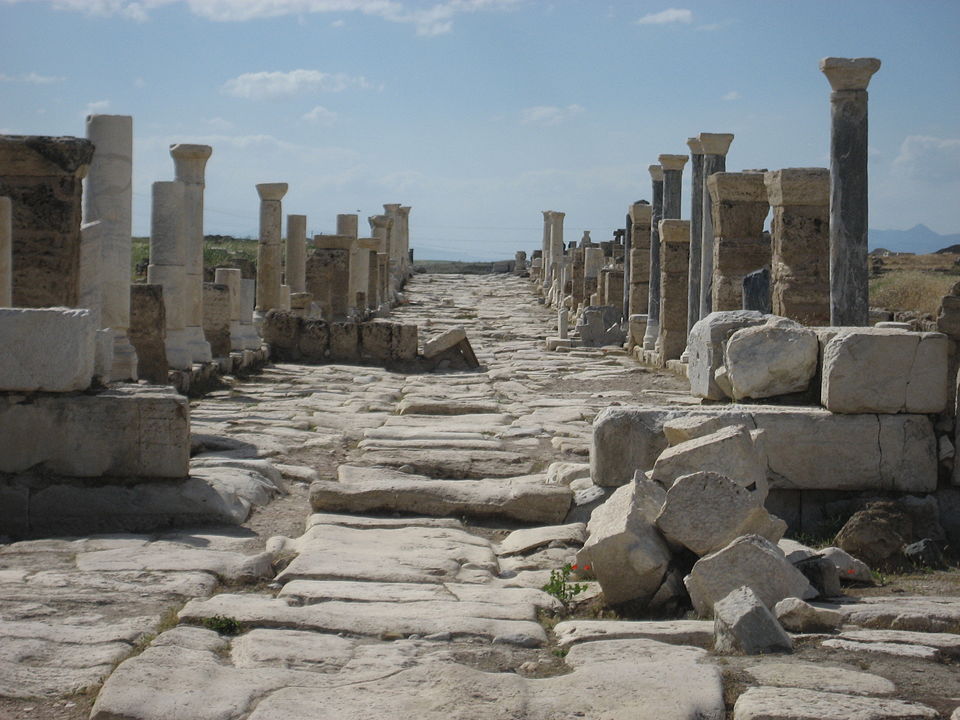
The ancient city of Laodicea, an early church city site, mentioned in the Book of Revelation. The Apostle Paul also mentions a mysterious letter, with respect to the church in Laodicea, in his letter to the Colossians.
(Credit: Rjdeadly – Own work, CC BY-SA 3.0, https://commons.wikimedia.org/w/index.php?curid=19781425)

It is possible to say that the letter “from Laodicea” was actually another letter written by Paul, that was being circulated around the area, which had most recently been in the hands of the Laodiceans. The strongest candidate for this letter would be Ephesians, as most scholars contend that Ephesians was not written for any particular church community location, but rather was intended to be circulated among a number of churches nearby Ephesus, which could also include Laodicea.

Either way, most scholars today contend that it was actually Paul who wrote the letter, and not the church in Laodicea. The New Living Translation (NLT) is one of the few translations that explicitly puts this out there (the NASB is similar):

“After you have read this letter, pass it on to the church at Laodicea so they can read it, too. And you should read the letter I wrote to them.”

This then raises the question as to what this letter is: If it is not the Book of Ephesians, then what is it?

Interestingly, some copies of the Latin Vulgate, dating back to at least the 6th century (if not earlier), possess a copy of the “Epistle to the Laodiceans.” What makes this very remarkable is that a separate “Epistle to the Laodiceans” has never been confirmed as being in our possession today, as being written by Paul. Such skepticism can be found with Jerome, the original translator of the first version of the Vulgate, back in the 4th century, who completely rejected the “Epistle to the Laodiceans” as a forgery.

Nevertheless, this “Epistle to the Laodiceans” survived in popularity, well into the late medieval period. John Wycliffe, the early English proto-Reformer, included the “Epistle to the Laodiceans” in his English translation of the Bible. Despite there being no surviving Greek text for this document, we still have some Christians, like the Quakers in the 16th century, still claiming it was a valid letter from Paul.

If you actually read the “Epistle to the Laodiceans,” it does not really say much of anything of theological substance. But it does make you wonder why the popularity of this book survived for so long, as being something authentically from Paul, when there is really very little, if any evidence, to support this assertion.

Pastor/teacher John Piper, in this video answers the question, as to what we should do if an authentically Pauline “Epistle to the Laodiceans” were to ever show up:

Piper correctly notes that it would be extraordinarily difficult to determine if a newly discovered document was this so-called lost “Epistle to the Laodiceans.” The evidential support for such a claim would have to be quite extraordinary.

The Proverbial “Who Cares?”

Why even bother with this question? Because in recent centuries, a number of the letters of Paul have been disputed as being actually written by Paul. Of the thirteen letters attributed by Paul, in our New Testament, six of them fall into the category of being “disputed.” The seven undisputed letters written by Paul are:

  • Romans
  • 1 Corinthians
  • 2 Corinthians
  • Galatians
  • Philippians
  • 1 Thessalonians
  • Philemon

To varying degrees, the disputed letters include:

  • Ephesians
  • Colossians
  • 2 Thessalonians
  • 1 Timothy
  • 2 Timothy
  • Titus

In general, the first three in the list have a higher degree of confidence, as being written by Paul, as compared to the last three (1 Timothy, 2 Timothy & Titus). These disputed letters are notable as they contain important teaching material that is not repeated as clearly as in other parts of the Bible. For example, Ephesians is known for having some important material regarding predestination. 1 Timothy and Titus are the only letters of Paul that discuss the concept of “elders.”

New Testament scholar Thomas Schreiner, at Southern Baptist Seminary, takes 6-minutes to lay out the issues:

The problem with having a “disputed” letter in the canon of Scripture is that all of these thirteen letters explicitly say that they were written by Paul. Aside from a particularly unique proposal called “allonymity,” the idea of having letters in our New Testament that were not written by Paul, even though the actual text of these letters all claimed to have been written by Paul, is a particularly devastating claim made against an orthodox perspective of the Bible.

But as we see with the case of the “Epistle to the Laodiceans,” great care has been taken over the centuries to dismiss certain documents as being forgeries, and rejecting them from the canon of Scripture, even when such documents at times still linger on as being popular, in some circles (In the Tom Schreiner video above, Dr. Schreiner lays out a similar case against the second century work, The Acts of Paul and Thecla). Part of the reason why it took so long for the canon of Scripture to mature is that Christians, particularly in the early church, wanted to make sure that the texts that were claimed to be inspired actually measured up to such claims.

The truth of the matter is that while the text of the original New and Old Testament is inspired, the table of contents section is not. Nevertheless, we have good reasons to believe that our current canon of Scripture, that has survived the test of time, is still sufficient for us to maintain our confidence in what is listed in the table of contents of our Bibles.


Was Paul’s “Philosophical” Speech at Mars Hill in Athens a Failure?

In Acts 17:16-34, we read about Paul’s appearance before the Athenian philosophers at the Areopagus. In verses 22-31, Paul makes a speech before the crowd, before being mocked and cut off in mid-argument (verse 32). Some Christians believe Paul later came to regret this speech, as too “philosophical,” a rhetorical style ill-suited for Gospel presentation. In other words, what Paul argued before the Athenians was a mistake, an example for us today of what not to do when contending for the faith among non-believers.

I intend to challenge that interpretation of this text as misguided. Instead, I argue that Paul’s “philosophical” speech at the Areopagus, otherwise known as “Mars Hill,” was simply yet another tool in the toolbox of the evangelist, given to us today by God as an example of how we can seek to persuade our non-believing friends of the truth of the Gospel, when the situation calls for it. Paul’s performance at Athens, far from being a failure, was a resounding success, and worthy of emulation by a follower of Christ today.

St. Paul Preaching at Athens, by Raphael (1515-6).

A bit more background is in order. The Apostle Paul was disturbed that the city was “full of idols” (verse 16), but there was more to it. Ancient Athens was the seat of philosophical sophistry in the Greco-Roman world. The early church father, Tertullian, famously asked, “What has Athens to do with Jerusalem?,” suggesting that the story of the Risen Jesus, the narrative that came from Jerusalem, was quite different from the wisdom of man, that symbolized the philosophical sophistication of Athens.

This is undoubtedly true. Paul himself noted that knowledge puffs up, even for Christians (1 Corinthians 8:1). Often, intellectual pride is a stumbling block for Christians, as well as being a stumbling block for the non-believer, in coming to faith in Christ.

But is it ever permissible to use philosophy as part of one’s defense for the Gospel? Apparently, there are Christians who say no, believing that Paul’s speech before the Athenians was a failure. Such Christians believe that any evangelist should stick with the Bible, and avoid any style of argumentation that sounds “philosophical,” that trusts in mans’ wisdom as opposed to the wisdom of God.

However, trusting in “man’s wisdom” and employing philosophical argumentation for the advancement of the Gospel are not the same thing. When Christians confuse the two together, and reject Paul’s example in Athens, as something to avoid, they rob the intellectually-inclined skeptic of the opportunity to hear the Gospel presented to them, in a language which they can understand.

In Paul’s speech, he sought to persuade his listeners by contending that they were very “religious” (verse 23). He praised the Athenians for their inscription “to the unknown god,” though it surely raised more than a bit of curiosity, by his claim that the Risen Christ was that “unknown god” (verse 23).  Paul appeals to the Creator, as “Lord of heaven and earth” (verse 24), a theme consistent with Scripture (Isaiah 42:5), that also echoed the philosophical thought of Plato. God “does not live in temples made by man” (verse 24) recalls Mark 14:58, but it was also a sentiment found in the thought of both his Stoic and Epicurean listeners. Paul quotes, with admiration, two of the most well known pagan poets, Epimenides of Crete and Aratus, regarding God, “In him we live and move and have our being,” and “For we are indeed his offspring,” respectively (verse 28). Paul cites these pagan thinkers to argue that we are not to worship idols, a teaching consistent with the Old Testament (Deuteronomy 5:8).

He does all of this within the context of suggesting that his listeners “should seek God, and perhaps feel their way toward him and find him” (v. 27), as a pretext for his final claim that Jesus is risen from the dead, the revelation of the one true God (v.31). In short, Paul is appealing to pagan wisdom, the best of pagan philosophy, that which was consistent with the message of Scripture, as part of his Gospel presentation.1

Sadly, in much of the church today, Christians have largely given up on the art of persuasion, that appeals to the intellect, of those who are philosophically inclined, like the Athenians, as a preparation to hear the Gospel. But let us examine the Scriptural evidence: On what basis do those who believe that Paul failed in Athens, make their case that Paul later came to regret the rhetorical substance of his speech before the Athenians?

After Paul leaves Athens, he then moves to Corinth (Acts 18:1). In his first letter to the Corinthians, he recalls his posture in originally approaching the Corinthians:

And I, when I came to you, brothers, did not come proclaiming to you the testimony of God with lofty speech or wisdom. For I decided to know nothing among you except Jesus Christ and him crucified. And I was with you in weakness and in fear and much trembling, and my speech and my message were not in plausible words of wisdom, but in demonstration of the Spirit and of power, so that your faith might not rest in the wisdom of men but in the power of God. (1 Corinthians 2:1-5 ESV).

Did Paul write these words, with his experience in Athens on the forefront of his mind?

Some believe so. They contend that Paul was disturbed by what happened at Athens, citing that he came to Corinth “in weakness and in fear and much trembling,” indicating anxiety on his part, regarding his previous preaching experience. Paul had tried the “intellectual approach” in Athens and it had failed. Paul then resolves not to use such philosophically tainted rhetoric among the Corinthians, “so that your faith might not rest in the wisdom of men but in the power of God.” In other words, Paul came to regret his appeal to philosophy at Athens, vowing to only preach the “simple Gospel” moving forward.2

Granted, Paul’s speech at Athens is the most “philosophically” oriented discourse we have recorded in the Book of Acts, but there are a number of problems with the viewpoint of Paul having “regret” over the Athenian episode.

Some have cited the relatively poor response to the Gospel in Athens (Acts 17:32-34). True, there is no evidence in Scripture that a church was established in Athens, as a direct result of Paul’s ministry. But do not “all the angels in heaven rejoice, when even one is saved,” as the common saying goes? There were “some” who did join Paul and believed. Would not have Paul rejoiced in the fact that God did indeed move within the hearts of at least some of his Athenian listeners? The thought of new followers to the faith, though few in number, would hardly have been a good reason for Paul being anxious or discouraged, upon entering Corinth.

Furthermore, Dionysius the Areopagite (v.34), one of Paul’s successes in Athens, is reported later by the church historian Eusebius to have been eventually a leader in the church at Athens, and became a martyr for the faith. So, the rumor that there was no church to come out of Paul’s preaching in Athens, should be safely dismissed.

Was there any further activity by Paul in Athens? Acts simply does not say. All we know is that sometime after his appearance on Mars Hills, he left for Corinth. There is nothing here in Acts that tells us that Paul was in any way discouraged by the events in Athens. We are left with trying to figure out what Paul was trying to communicate to the Corinthians, in his first letter to them.

However, even if Paul was discouraged in Athens, there were plenty of other reasons why he might have entered Corinth in a discouraged, anxious state. Paul had been treated poorly earlier in Thessalonica by many of the Jews (Acts 17:1-9), and his Jewish opponents followed him to Berea, where Paul was harassed there as well (Act 17:10-15), thus leading to his visit in Athens. While the Athenians did not threaten Paul with violence, he was treated with amusement in Athens, and not taken seriously by all. Opposition of any sort to Paul’s ministry might have caused the great Apostle some distress. But to tie this to Paul’s words to the Corinthians, in 1 Corinthians 2, is purely speculative. Paul had previously made a shorter, philosophical discourse among the pagans at Lystra, and there is no indication that he felt any sense of regret at his performance among Lystra’s pagan listeners (Acts 14:8-18) .3

A strong case can be made that Paul understood Corinth to be quite a different city than Athens. While Athens was a center of scholarly learning and disputation, Corinth was a port city, focused on commerce and industry. The heady, philosophical approach employed at Athens would not make much sense to the dock workers at Corinth. Instead, Paul sought to meet his listeners, whether in Athens or in Corinth, where they were at.

Furthermore, it was characteristic of Paul’s ministry in general, not to appeal to the power of his own rhetoric or academic learning. Rather, as Paul reminded his readers in Philippi, the believer should “work out your own salvation with fear and trembling” (Philippians 2:12). There is no reason to think that his “fear and much trembling” in Corinth should substantially differ from the message he gives to the Philippians. Bible scholar Kenneth Bailey suggests that:

For Paul, “fear and trembling” meant that he went in humility, trusting in the grace of God, not in earthly power or in his abilities or good works….”Fear and trembling” was not a special psychological condition experienced by Paul uniquely on the road from Athens to Corinth; but it was for him the appropriate spiritual attitude for all Christians as they fulfilled their callings.4

Some scholars contend that Paul’s admission of “weakness” before the Corinthians, in 1 Corinthians 2:3, might have actually been a physical condition, as some sort of illness.5 Either way, the common, popular view that Paul’s “weakness” among the Corinthians, referring to some sort of psychological condition resulting from a sense of failure at Athens, is without foundation or evidential support.

A closer examination of 1 Corinthians itself reveals that Paul was not adverse to continue quoting pagan poets and philosophers to make his points: “We see in a mirror dimly.” (1 Cor. 13:12, from Plato, “Phaedo”), and later, he quotes “Bad company ruins good morals.” (1 Cor. 15:33, from Menander’s Comedy, “Thais”). Why would Paul rightly reject “the wisdom of men,” only to contradict himself by favorably quoting pagan philosophers in the very same letter?

Instead, it might be best to conclude that Paul’s apologetic efforts at Athens were not a failure, but rather a resounding success. While Paul was among the intellectual elite in Athens, he used the philosophical tools available to him, for the advancement of the Gospel. By appealing to the thoughts and sentiments of the Athenians, Paul was able to gain a more effective hearing.

While among the laborers in the dockyards of Corinth, Paul used the appropriate style of rhetoric for his listeners there. Wherever Paul preached the Gospel, he did so by appealing to the backgrounds of his listening audience, tailoring the style of his message that would best suit the presentation of the Gospel. The variety of approaches to preaching and evangelizing that Paul used throughout his ministry, gives testimony that the message can be adapted in style to the particular audience, without compromising the substance of that message.

To further prove the argument, in that very same letter to the Corinthians, that rightly speaks against the “wisdom of men,” Paul nevertheless contends that,  “I have become all things to all people, that by all means I might save some” (I Corinthians 9:19-23).

Others have followed in Paul’s footsteps over the years, in speaking before the great intellectual minds of the day: Saint Augustine wrote his City of God to challenge the mockery of the pagan intellectuals, in the waning days of the Western Roman empire, and his book has become a classic. Thomas Aquinas wrote Summa contra Gentiles to refute the great scholars of 13th century Islam. C.S. Lewis’ radio addresses on the BBC Radio, during the bleak period of World War II, that became substance of Mere Christianity, shook up the spiritual agnosticism of the British intellectual elite. Genetic scientist Frances Collins held back the assault of the New Atheists when he published The Language of God, 2006. Leading Christian thinkers today, ranging from Tim Keller to William Lane Craig, continue to “take every thought captive to obey Christ” (2 Corinthians 10:5), just as Paul did before the Athenian philosophers.

…. And to think that the Apostle Paul did this all for the glory of God…. That we might learn from all of the examples of Paul that Scripture lays before us, to encourage us to be faithful witnesses for Christ!!

Notes:

1. See I. Howard Marshall’s exegesis of Paul’s speech in Acts 17, in the Tyndale New Testament Commentary: Acts, p. 281-292. Marshall identifies where Paul’s appeal to pagan philosophical sources mirrors the teaching of Scripture, while acknowledging, that at times, Paul is also contrasting pagan thought with the truth of God’s Word. In agreement with my case, Marshall argues that 1 Corinthians 2:3 should NOT be understood as reflecting on Paul’s experience in Athens (see footnote, page 292). 

2. Over the years, I have heard various sermons where preachers make this argument. Most recently, I find it in the teaching of Steve Gregg, of the Narrow Path ministries (accessed January 12, 2019) , whom I greatly respect and admire for his fairness and thoroughness. But I believe that Gregg’s opinion is incorrect on this point. The lynchpin in the “Athens-as-failure” argument comes down to how one should interpret 1 Corinthians 2:1-5.

3. F.F. Bruce in Paul: Apostle of the Heart Set Free, p. 248. Unfortunately, Bruce inadvertently errs on page 246, by observing that Paul did not preach the message of the cross at Athens, as a fault of his own. This has led some to conclude that this was a tactical error on Paul’s part, that he repented of when arriving in Corinth. The text in Acts 17 clearly indicates that Paul was cut off from completing his message, by the amusing jeers of the crowd, and not because of a tactical error by Paul. 

4. Kenneth E. Bailey, Paul Through Mediterranean Eyes: Cultural Studies in 1 Corinthians, p. 104-107. Bailey contends that for Paul to have received an audience in Athens was a victory in and of itself. Children of the elite in Greco-Roman culture were sent to Athens for an education. That Paul was given an invitation to speak before the Areopagus was a spectacular achievement, and his positive reception in Athens set in motion several hundred years of Christian apologetics among the Greeks that won over that region of the Roman empire. Furthermore, Paul’s appeal to the Corinthians was not based on fancy rhetoric, but rather on the signs and wonders that God performed (1 Corinthians 2:1-5). There is therefore no evidence that a sense of failure in Athens was on Paul’s mind while in Corinth. Bailey goes even farther by suggesting the I Corinthians itself has an awareness of the debate with the pagan philosopher Pericles, in making a defense of his evangelistic preaching. Paul never completely abandons the use of pagan philosophy for the purposes of his evangelistic presentation. Bailey’s case, supported by Marshall (above), yet contra Gregg and Bruce (see above), is far more compelling.

5. Gordon Fee, in the New International Commentary on the New Testament: The First Epistle to the Corinthians, p. 93. Fee continues to say that precisely what Paul’s weakness was in Corinth is beyond our ability to reasonably ascertain.