Timeline showing where the En-Gedi scroll fits in, relative to the Dead Sea Scrolls and much later discoveries of the preserved Hebrew Bible.
In the early 1970s, a team of Israeli archaeologists uncovered the charred remains of a scroll at an ancient synagogue in Ein Gedi, in Israel. Unfortunately, the rolled up scroll was so heavily damaged, that it was impossible to unroll and decipher it without destroying the artifact…. until now.
A computer scientist at the University of Kentucky, Brent Seales, has developed a technique that essentially performs a series of CT scans, that could recover the ink markings from inside the scroll, without having to physically unwrap the delicate object. Inside the scroll, that dates to about the 3rd century A.D., researchers were finally able to read the first eight verses of the Book of Leviticus.
These verses correspond exactly to the ancient Hebrew text, the Masoretic text, preserved by the Jewish community since the medieval period. This would make the En-Gedi scroll the most significant find of Old Testament Hebrew writings, second only to the Dead Scrolls… Read about the geeky side of the story here.
Atlanta Megachurch pastor Andy Stanley. Promoter of Biblical truth… or compromiser?
I do not follow popular, megachurch pastors that much. But when a fellow Veracity reader tipped me off regarding a recent controversy with Atlanta-based Andy Stanley, I was puzzled.
Andy Stanley, the pastor of NorthPoint Community Church, and son of another popular Atlanta preacher, Charles Stanley, has been preaching a sermon series on “Who Needs God.” The basic concern Andy Stanley has is that there is a startling trend of people who grow up in conservative, evangelical, Bible-believing churches, who later end up “deconverting” to some form of agnosticism by the time they become adults.
In the third message of the series, entitled “The Bible Told Me So,” Stanley talks about people who grow up believing Christianity is true because “the Bible told me so.” But when they go off to college, or watch a PBS Nova special, or simply surf the Internet, they are surprised to learn that there is little to no concrete, archaeological evidence that supports the idea that an army of some 600,000+ Israelites conquered the town of Jericho, near the start of the Canaanite conquest, as recorded in the Book of Joshua. As a result of hearing things like this, the fragile “Bible-told-me-so” faith of such a person collapses, kind of like a car tire that just got a flat, with the air hissing out.
As Stanley puts it, “If the Bible is the foundation of our faith, here is the problem, it is all or nothing. . . Christianity becomes a fragile house of cards that comes tumbling down when we discover that perhaps the walls of Jericho didn’t.” As a result, Christians need to learn that we are to base our faith, first and foremost, on Jesus and the Resurrection, and stop relying on an “all or nothing” approach to the Bible.
Well, that is not quite, right. It would be more accurate to say that the early church did indeed possess “the Bible.” But they did not possess that “Bible” in the same form as we have it today. The early church surely embraced the Old Testament, though it did take a few hundred years to sort out the details regarding the particularity of the New Testament canon. These critiques aside, professor Kruger still felt that pastor Stanley’s motives were good, even if the proposed solution advanced by Stanley was slightly off-kilter.
But what astounded me was reading the comments left on professor Kruger’s blog. Quite a number of readers did not believe that Kruger’s criticisms went far enough. Various readers described Andy Stanley as “repeatedly [denying] the authority of Scripture”, “deceitful,” “decidedly non-biblical,” and “a false teacher.”
Andy Stanley is far from perfect, but I think British pastor and blogger, Andrew Wilson, has written an excellent defense of Andy Stanley. In a nutshell, Wilson argues that, “I don’t trust in Jesus because I trust the Bible; I trust the Bible because I trust in Jesus.” I would be curious to know what some of our Veracity readers think of all of this.
My take pretty much follows from what something my late pastor emeritus, Dick Woodward, taught a number of years ago: The Bible is true, not simply because the Bible says it is true. Rather, the Bible is true, because it is true.
Something to think about.
For some answers as to how one might think about archaeology and Jericho, you might want to start here and here. For a 13-minute interview that Southern Baptist leader, Russell Moore, has with Andy Stanley, give this a listen:
My friend, Hunter Ruch, invited me to participate in a “Summer Reading Challenge” interview, for our church, this past Sunday. We had read 2 Timothy during the prior week, and I talked about an experience in college when I was told that “Paul never wrote 2 Timothy… it was a forgery.”
Unfortunately, we ran out of time for me give an adequate response to the forgery claim. So, after you view this 9-minute video, stick around and read my response below…. But most importantly, consider with me why it is important for Christians in our culture to care to know about these things.
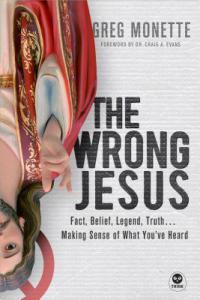
The Internet. YouTube. Your NewAge neighbor. The History Channel. Morgan Freeman’s The Story of God. Youth pastors. Skeptical friends. Parents. College professors…. Our world is simply bombarded with an untold number of conflicting voices, all telling us who Jesus really was. How do you figure out who the right Jesus is from the wrong Jesus?
If you know of a Christian young person graduating high school or college, you should know that they will be facing challenges to their Christian faith in college, the secular workplace, or just with their iPhone, scrolling through the Internet. Would not the best gift to such a person be something that will help to prepare them to better understand and defend their faith?
In past years, I have recommendedTruth Matters: Confident Faith in a Confusing World, by Andreas Köstenberger, Darrell Bock, Josh Chatraw. This is another excellent book along the same line (Hey, if Veracity co-blogger, John Paine, had dinner with co-author Andreas Köstenberger, it has to be good, right?). In Truth Matters, the authors focus on the popular writings of former evangelical scholar turned skeptic, Bart Ehrman. However, Monette’s book is broader in focus, looking also at archaeological issues, the miracles of Jesus, and how Jesus treated women.
Monette brilliantly defends the faith, but he is also refreshingly candid. The Bible is historically reliable, but the truth of Christianity is not dependent on our ability to figure out every detailed Bible discrepancy and fitting it in with some simplistic view of inerrancy.1 What ultimately matters is that if Jesus really is resurrected from the dead, then this changes everything.
Why are Christians so hesitant about talking about hell? Is it because we are not really sure what hell even is? A new edition of a Zondervan Counterpoints book, Four Views on Hell, provides some help, looking at the Bible for answers.
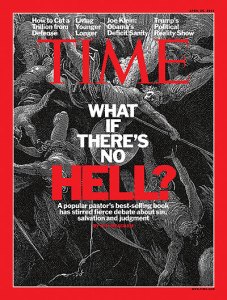
It is rare when a Christian mega-church pastor winds up somehow on the cover of TIME magazine. But when a story about (now former) pastor Rob Bell was plastered on the front of TIME five years ago in 2011, people took notice.
As the mind behind the popular Nooma series of videos, Rob Bell had written a controversial book, Love Wins: A Book About Heaven, Hell, and the Fate of Every Person Who Ever Lived. In the book, Bell raises a lot of provocative questions about the classic Christian doctrine of hell, but he does not provide very firm answers. In his engaging and winsome way, Bell believes that when people experience rough times in this earthly life, such experiences can be truly hell. Who can argue with that? But as to whether or not hell exists in the next life, Bell is not so sure.






 Veracity