The New Testament did not give us the Resurrection; the Resurrection gave us the New Testament. Some Christians strangely think this is controversial. But this is spot on. Thanks, Frank Turek. It all comes down to the Risen Jesus.
This past week, I went to see Timothy Mahoney’s new film, Patterns of Evidence: The Moses Controversy. Following the relative success of Mahoney’s first film on the Exodus, Mahoney has been able to raise enough funds to put out this second movie, that seeks to defend the idea that Moses wrote the first five books of the Bible.
On the good side, Mahoney demonstrates that there is a certain critical bias among mainstream scholars, that tends to pooh-pooh the idea, that a man named Moses really had that much do with the the transmission of Genesis, Exodus, Numbers, Leviticus, and Deuteronomy, down through history. A lot of Christians are surprisingly ignorant of the fact that doubting the Mosaic authorship of the Pentateuch, has been pretty much the standard teaching in nearly all institutions of higher learning in the United States, for decades. So, Mahoney gets brownie points for urging Christians to engage more with critical scholarship. If you send your kid off to college, allow them to watch TV, or allow them to surf the Internet, it behooves the Christian to become aware of the challenges that confront a young person’s faith.
But the down side of the movie is that Mahoney leans heavily on the contrarian, and highly disputed theories, of Egyptologist David Rohl, to make Mahoney’s case that God essentially inspired the human alphabet system, that allowed Moses to write the Torah. The movie was basically a 2-hour slog, through a rather complicated apologetic argument, to try to defend Moses’ involvement in writing the first part of the Bible. Even Gary Bates and Lita Cosner, Young Earth Creationist apologists for Creation.com, found Mahoney’s alphabetic writing system proposal as “both unnecessary and unsupported by Scripture itself.”
Why Mahoney leans so heavily on David Rohl, the latter who admits that he is an agnostic, is beyond me. In contrast, Egyptologist Kenneth Kitchen, an outspoken evangelical Christian, and highly respected by many of his agnostic and atheistic peers, dismisses David Rohl’s speculation as pretty much total nonsense. Kitchen, author of the exhaustively learned On the Reliability of the Old Testament, champions the so-called “late date theory” of the Exodus, that the film maker Mahoney casually dismisses twice in the movie, as having “no evidence” to support it. Rohl makes some legitimate criticisms of “late date theory” proponents, but his alternative solution fails to convince most scholars, believer and non-believer alike. I will spare you the details and simply refer the Veracity reader to Dewayne Bryant‘s fair and balanced review of The Moses Controversy.
I do not mean to pile onto Tim Mahoney, as he seems like a really likable, sincere guy, and I do commend him for addressing the topic. I think that his experience with doubt, and his journey in trying to resolve such doubt, should be treated with respect and sensitivity. Mahoney plans to put out another movie, addressing the apologetics of the Red Sea crossing. Let us hope that this next movie will be an improvement over The Moses Controversy.
Despite its shortcomings, I am very glad and thankful Tim Mahoney has put out a thought-provoking film, that will hopefully spur thoughtful Christians to actively engage the issues behind The Moses Controversy. Nevertheless, I am concerned that an uncritical examination of Mahoney’s claims will only confuse Christians, when they actually encounter peer-reviewed scholarship on this topic, making it harder to defend the faith before an unbelieving world.
Did you know that astrophysicists have found the “missing baryons?” Why would a Christian care about such a discovery?
As Hugh Ross, an astrophysicist and president of Reasons to Believe, put it, this discovery helps to solve the mystery of “dark matter,” supporting the modern Big Bang theory, which points to a beginning of the universe. When the Big Bang theory was first developed in the mid-20th century, a problem immediately became apparent, as the theory predicted that there should be a great mass of matter (or energy) existing between galaxies, making up to about 70% or so of the universe. The problem was that researchers could never see it; hence, roughly speaking, the term, “dark matter.”
But for those who believe that the evidence supporting the modern scientific consensus for the Big Bang is, at least, in some sense, consistent with what the Bible teaches, namely, that the universe had a beginning (“In the beginning”…. see Genesis 1:1), dark matter is not a problem at all. For if the universe had a beginning, it stands to reason that you will also have a Beginner!
Now, with a God who works miracles, a Young Earth Creation is still possible. Many of my dear Christian friends are Young Earth Creationists, and they have several thoughtful reasons for holding to their position. But the story of dark matter raises a good question: As a Christian, what is easier to defend when talking with a non-believer? The idea that science coheres with the Bible, or that science is in conflict with the Bible?
Some Christians are not fans of radiometric dating. They believe that radiometric dating has been used to attack the Bible. These Christians seek to honor God’s Word, so the motives behind the argument against some scientific practices, such as Carbon-14 dating, are well-intentioned. Nevertheless, this approach can be confusing, if not wrongheaded, for the simple reason that Carbon-14 dating actually presents strong evidence for the Christian faith (and not against it).
Carbon-14 dating is but one of several radiometric dating methods, whereby scientists can determine the ages of things, by examining how quickly certain substances have decayed over time in a sample. Substances, like Carbon-14, will slowly break down, at a rate determined by the radioisotope’s half-life.
Radiometric dating methods, like with Carbon-14, get a bad rap among some Christians, in that the science of radiometric dating is used to suggest that the earth is really, really old… as in millions of years old… which runs contrary to a common view, that the earth is only 6,000 years old. However, it should be clarified that Carbon-14 dating, specifically, can only measure things in terms of thousands of years old, and not millions. But the calibration principle behind Carbon-14 dating, when applied to other substances with a much longer half-life, like potassium, allows scientists to measure dates in the range of millions of years. Therefore, the concern about radiometric dating in principle remains.
But how many Christians know that Carbon-14 dating actually has been used to confirm the Bible? Let me describe a few examples. Continue reading
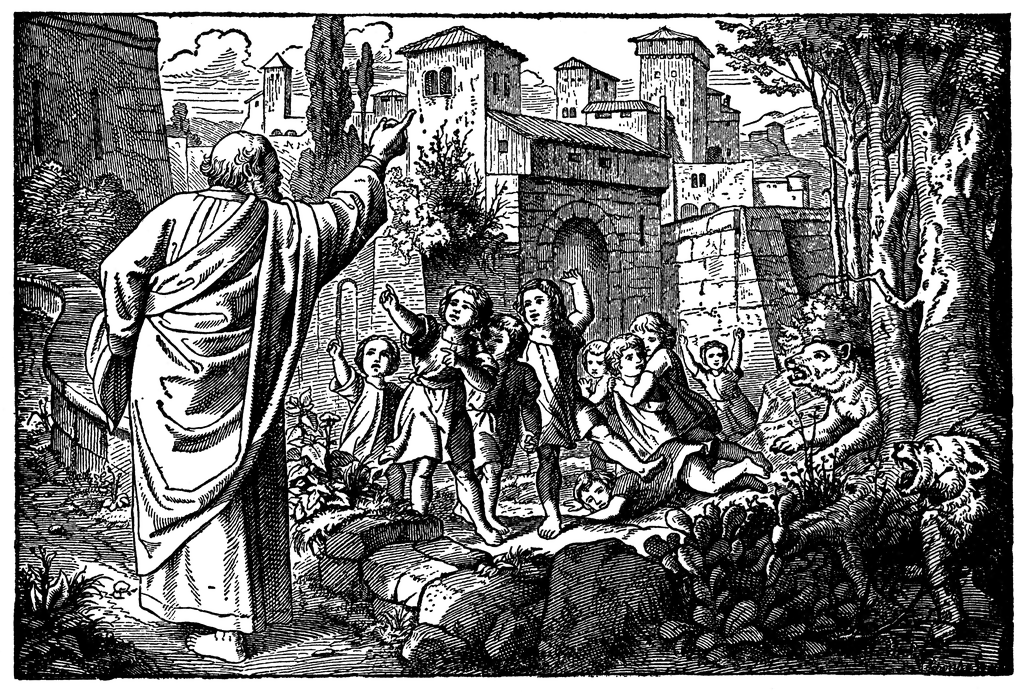
This is up there near the top of “Weird Stories of the Bible,” when the prophet Elisha curses a group of young boys, who taunt him. But does this image really correspond to the message that the Scriptural writer is intending to convey?
I was totally dumbstruck, a moment I will never forget. I was doing youth ministry, when a high school student asked me about the weird incident of Elisha and the She-Bears, found in 2 Kings 2:23-25. What is that all about?
I had never seen the passage before, and it left me speechless:
“23 He [Elisha] went up from there to Bethel, and while he was going up on the way, some small boys came out of the city and jeered at him, saying, “Go up, you baldhead! Go up, you baldhead!”24 And he turned around, and when he saw them, he cursed them in the name of the Lord. And two she-bears came out of the woods and tore forty-two of the boys.25 From there he went on to Mount Carmel, and from there he returned to Samaria.“
What is going on in this passage? I will be honest: Having never read that before, I had no clue how to respond. Over seven years in Bible-teaching churches had never prepared me for that question (Why do most churches skip over these difficult passages????).
But this high school student who quizzed me about this passage was not at all trying to ridicule the Bible. It was a honest question. This teenager was sincerely confused… and I was stumped.
In this interpretation, the “small boys” in this passage, really are not children at all. Instead, they are a band of idolatrous priests that threaten Elisha, and the true worship of God the prophet represents. The author uses the language of “small boys,” not to historically chronicle their age, but rather to criticize the immaturity of these rebellious priests.
The critique of Elisha’s “baldness?” Well, this is not really about a loss of hair, but rather the loss of losing his mentor Elijah, as a spiritual covering.
This explanation may not completely remove for you the scandal that this passage raises. Understood, but the shock value maybe the point. Passages in the Bible that sound just plain weird, might be clues that more is going on than what can be picked up by a surface reading. As I wrote about in my review of Andy Stanley’s book, Irresistible, perhaps the problem with the Old Testament, is not with the Old Testament itself, but in how we interpret it.






 Veracity