In our new COVID-19 world, there is a lot of confusion, misinformation, and even disinformation. The plethora of Internet-based news outlets and social media does not help matters. What are reliable sources of information? Who can you really trust?
Such a climate is fertile ground for generating conspiracy theories. Granted, it is very easy to pooh-pooh skepticism about conspiracy theories. After all, some conspiracy theories actually do happen. Here is just a partial list of some of the more well-known conspiracy theories, that turned out to be true:
Watergate. The 1970s break-in attempt at the Democratic National Committee headquarters triggered a cover-up that brought down an American President.
The Arrest & Crucifixion of Jesus: Jewish leaders, Roman rulers, and one of the insiders of the Jesus movement, who defected (Judas), conspired together, leading to Jesus’ Crucifixion.
The Arrest of the Apostle Paul: As former persecutor of Christians, turned follower of Christ, Paul threatened the religious establishment of his day, in Jerusalem, which led to his arrest and final appeal to Caesar in Rome to resolve the matter.
There are a lot of good questions that sit underneath some of these more overt questions. There is still a lot about COVID-19 that we do not know. But sometimes the lure of conspiracy thinking can easily take us down the wrong path. As a Christian, I get bothered when critics of evangelical faith create their own conspiracy theories about Christianity. But when Christians themselves foster conspiracy thinking, that lacks evidential support, we risk damaging our witness to an unbelieving world.
It is far better to follow the evidence we already do have, instead of speculating on the possibility of evidence we do not currently possess.
Look. The uncertainty generated by the COVID-19 crisis is extremely stressful. We are already seeing a great deal of civil unrest, partly related to the COVID-19 crisis. I know people who are currently out of work, due to the crisis. I long for the day when businesses can fully reopen, and our churches can begin meeting again, without having to worry about social distancing. Thankfully, as I am writing this (June 1, 2020), there are positive signs that things are slowly coming back to normal. But let us not needlessly complicate matters by giving into unwarranted conspiratorial thinking.
Some Christians will be offended by my post here. But I would encourage keeping an open-mind on these things. Consider this: How is your conspiracy theory helping to enhance the service of the proclamation of the Gospel? Are you building bridges of trust, or are you creating an unnecessary barrier, keeping others from hearing about Jesus?
It is important to say that the conspiratorial theorizing about COVID-19 should not be linked even to Young Earth Creationism. Todd C. Wood, a prominent Young Earth Creationist, with a PhD in biology, has written twoblog posts encouraging fellow Young Earth Creationist Christians not to give into the conspiratorial rhetoric. Wood even likens the rise of conspiracy thinking among Christians to a revival of the ancient heresy of gnosticism. A couple of quotes from Wood stand out for me:
“Everything about [COVID-19] is a classic, natural viral outbreak. I’ve seen absolutely nothing out of the ordinary. The concern that prompted the drastic social distancing was the rapid rate at which this virus spread, combined with early estimates of a fatality rate about ten times higher than the flu. Have we learned more and revised those estimates? Of course we have, that’s what science does. We learn new things and revise our models. It’s not the sign of a scam…..
…..Is COVID-19 really no worse than a bad outbreak of the flu? It’s far worse, or at least it has the potential to be. The flu has been around for years, and there’s a lot of resistance already in the population. Plus, the flu does not spread nearly as fast as COVID-19, and there are preventatives (flu shot) and effective treatments available for the flu.”
Also, a new edition of the Reasons to Believe podcast, RTBLive, tackles some of the questions surrounding conspiracy theories regarding COVID-19. Virologist A.J. Roberts, who has studied coronaviruses extensively, and Mark Clark, a political scientist and expert in national security, fielded a number of questions from listeners, offering a sound Christian perspective, grounded in good science and evidence-based reasoning. The program is about an hour and a half, but if you are looking for reliable information, that goes into some detail to answer questions many people are asking, it would be worth your time to listen. Some of the questions could not be answered in the RTB Livestream, but they can be found in the RTB Live Extra podcast, linked here:
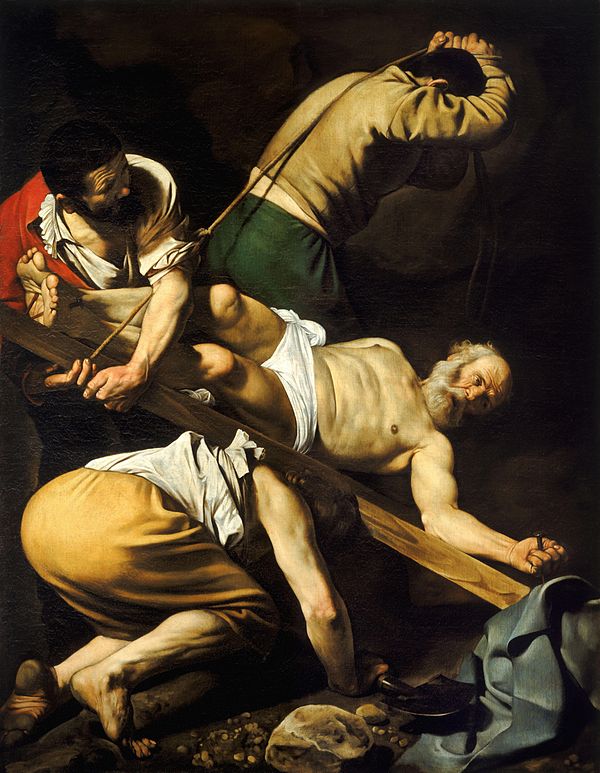
The Crucifixion of Saint Peter, by Michelangelo Merisi da Caravaggio, in 1601. But was Peter really crucified upside down? Well, according to Sean McDowell (in this linked YouTube video), Peter was most probably killed as a martyr, for his faith. But the historical record of him being crucified upside-down is difficult to substantiate (It might be true, but it may not).
I can not tell you how many times I have used this argument, in conversations with non-believers, over the years: With the exception of John, the “Beloved Disciple,” all of the remaining 11 original disciples of Jesus (after Judas Iscariot) were martyred for their faith. This is a proof of Christ’s resurrection. For why would all of those in Jesus’ inner circle “die for a lie?”
Sound familiar?
If you are like me, you probably read it in books like Josh McDowell’s More Evidence That Demands a Verdict, or more clearly, in his More Than a Carpenter, apologetic books for the Christian faith that have been around for decades. Here is how Josh McDowell put it in More Than a Carpenter, perhaps as late as a printing in 2009(?), or a few years earlier (from an online excerpt, in the chapter on “Who Would Die for a Lie?“):
“I can trust the apostles’ testimonies because, of those men, eleven died martyrs’ deaths on the basis of two things: the resurrection of Christ, and their belief in him as the Son of God. They were tortured and flogged, and they finally faced death by some of the crudest methods then known:
1 Peter — crucified
2 Andrew — crucified
3 Matthew — the sword
4 John — natural
5 James, son of Alphaeus — crucified
6 Philip — crucified
7 Simon — crucified
8 Thaddaeus — killed by arrows
9 James, brother of Jesus — stoned
10 Thomas — spear thrust
11 Bartholomew — crucified
12 James, son of Zebedee — the sword”
.
That is a pretty powerful argument.
But here is the problem: This argument is an overstatement of the actual evidence.
Now, when someone first told me this, that Josh McDowell’s claim was an “overstatement,” I got angry. After all, I trusted Josh McDowell. He was defending the Christian faith in his books. So, if someone was attacking these books, with the charge of “overstatement of the actual evidence,” then clearly such a charge was an attack from Satan, and I should resist it with all of my “righteous indignation.”
That’s right. I was angry. And I justified myself as being in the right. I mean, I was defending Jesus, was I not?
But then when I began to hear the same charge from fellow Christians, it really caused me to stop and think: What is really going on here?
As it turns out, a few years ago, Sean McDowell, Josh McDowell’s son, began to wonder about the same thing. Josh encouraged his son, Sean, to go figure it out. So, Sean McDowell did his own PhD dissertation on the topic of which of the early apostles actually died for their faith.
Sean McDowell’s research concluded that, yes, indeed, his father’s claim in More Than a Carpenter was an overstatement of the actual evidence (though it is hard to pin the blame specifically on Josh McDowell, as he got his information from others before him). Nevertheless, there is still good reason to believe that at least a few of the original apostles did die deaths as martyrs, and that even if the others did not die as persecuted martyrs, they never recanted from their belief in the Resurrection of Jesus, and they were at least willing to die for their faith. This does not necessarily prove the truth of the Resurrection, but it is still an important data point, as part of a larger argument to support the claim of the Risen Jesus.
Sean’s work is summarized in this linked article for the Christian Research Institute. Sean shows that much of what Christians often believe about martyrdom in the early church goes back to church tradition, and stories that originated several centuries after the events took place. Nevertheless, Sean notes that historically speaking, we can look at the available evidence and conclude, that while most of the original apostles may not have died gruesome deaths as martyrs, a few of them most probably did. Here is Sean in his own words:
…I examine the historical evidence for each apostle and rate the likelihood of his martyrdom on a ten-point probability scale that ranges from not possibly true (0–1) to highest possible probability (9–10). Historical research deals with probability and not certainty. And so my estimates are based on a careful assessment of the quantity and quality of the available evidence for each apostle. The common narrative is that all the apostles except John died as martyrs for their faith. While this may be true, it cannot be demonstrated historically.
In fact, here is what I believe the historical record reveals:
Highest possible probability (9–10): Peter, Paul, James son of Zebedee, James brother of Jesus
More probable than not (7): Thomas
More plausible than not (6): Andrew
As plausible as not (5): Philip, Bartholomew, Matthew, James (son of Alphaeus), Thaddeus, Simon the Zealot, Matthias
Improbable (3): John
So, a more modest approach to the evidence indicates a high degree of confidence that folks like Peter, Paul, and those first two James did die as martyrs for their faith. But when it comes to the rest of the others, the evidence is murkier. The only clear exception is concerning John, whom all agree did die a natural death.
For example, consider the death of Andrew, that Sean McDowell puts at a probability of 6, of being killed for his faith. Our primary source for this is an apocryphal work, The Acts of Andrew. The ancient church historian, Eusebius, dismissed The Acts of Andrew as a spurious work, and even heretical in its teachings. Could there still be good evidence for Andrew’s martyrdom, in The Acts of Andrew? Possibly, yes. But considering the disputable nature of the source, Christians should be cautious when appealing to it as some kind of authoritative statement.
Here is another example: There is a claim that Bartholomew was skinned alive. But the only available source for this claim comes from around 500 A.D., over 4 centuries after the event would have taken place. While this does not rule out martyrdom for Bartholomew completely, it makes the story that I had been sharing with non-believers for decades less than compelling.
Does this new conclusion from Sean McDowell harm the case for the Resurrection? Not really, but it does help us to properly frame the argument. Rather, it is yet one more data point, along with the claim of the empty tomb, and the unlikelihood of mass hallucination among the early witnesses to the Resurrection, that supports the central truth claim of the Christian faith. As Sean puts it, “This may come as a disappointment to some, but for the sake of the resurrection argument, it is not critical that we demonstrate that all of them died as martyrs. What is critical is their willingness to suffer for their belief that Jesus had risen from the grave and the lack of a contrary account that any of them recanted.”
A more fair way of putting it is that sometimes Christians tend to trust too much in what we hear, and do not do the harder work of discerning if what is being said is actually true or not. The path of least resistance is always simply holding onto what we think is true, just because we were always taught that way, or because we have developed a deep conviction about something, despite the existence of evidence to the contrary. We tend to latch onto those things that reinforce our presuppositions and intuitions, and ignore evidence that might overturn such presuppositions and intuitions (this was my big take-away from Jonathan Haidt’s insightfully excellent book, The Righteous Mind).
This principle holds true for believer AND non-believer alike. If we really want our non-believing friends to consider changing their minds about the truth claims of the Christian faith, we need to be willing to re-examine our own presuppositions and intuitions, that blind us from the truth.
The fact that Josh McDowell’s story about the “eleven martyrs deaths” has been in print since 1977, without a serious inquiry, among evangelical scholars, as to its evidential support, until his son, Sean, started to do his own research, within the last decade or so, is indeed embarrassing. But to suggest that this delay in setting the record straight is due to some purposeful, ethical misconduct, is simply an over-reach, in the opposite direction, by critics of the Christian faith.
Wallace was reasonably confident of the first-century Mark claim, due to assurances from other trusted scholars, that the discovery was, in fact, legit. Wallace did caution that he was waiting for a peer-reviewed study to confirm this claim. Josh and Sean McDowell included a statement from Wallace, to this effect, in a recent edition ofEvidence That Demands a Verdict, published in 2017. The McDowells did so despite the fact that some had grown increasingly skeptical of the claim, in the intervening years.
As Elijah Hixson, co-author of Myths and Mistakes in New Testament Textual Criticism(p.161-163), put it, this fragment of Mark is currently the earliest archaeological evidence for the antiquity of the Gospel of Mark. That is nothing to dismiss lightly. The discovery is still a remarkable piece of evidence, that furthers the case for the substantial integrity of the New Testament.
Sadly, the actual news of the discovery of the earliest known fragment of Mark has been overshadowed by the scandal surrounding it…. and this is the type of stuff that demonstrates why it is dangerous to overstate apologetic claims for the Christian faith. Critics will latch onto these missteps, and use it as further leverage, in their argument that Christians are not to be trusted. Doing our homework, to verify certain apologetic claims, is worth the effort. The integrity of the apologetics enterprise is at stake.
One clarification here: I have great respect and admiration for the apologists and scholars mentioned above. Yes, mistakes were made, but I do not believe that any of these Christians intentionally sought to deceive anyone. In fact, I respect their efforts to acknowledge their own shortcomings, and in their work to set the record straight. But in other respects, there have been other players in the mix, who have used fraud and deception, and duping other Christians in the process.
I could highlight several other examples, where Christians have repeated overstated claims, in hopes of defending the Christian Faith. Hopefully, these two examples are sufficient to drive home the point. While voicing such claims, is often driven by good intentions, there is a downside.
We see this all of the time now, when it comes to the decline of civility of political discourse, that marks a crisis in our current culture. Having this spill over into spiritual and theological matters can be devastating. Unfortunately, we live in an era, dominated by the proliferation of Internet-based media, that makes it very difficult to properly distinguish between good, solid, evidence-based reasoning and “fake news.”
Christians, above all people, should be advocates for the truth.
A good name is to be chosen rather than great riches, and favor is better than silver or gold. (Prov. 22:1 ESV)
If you really want to geek out on all of this, here are just a few of videos that address, first, the martyrdom of the apostles issue, with a discussion between Sean McDowell, and an Internet atheist critic, Paulogia, and secondly, a panel discussion covering issues pertaining to textual criticism, led off by a question posed to Daniel Wallace, about the Gospel of Mark fragment. Then, finally, here is a brief video by Ariel Sabar, of The Atlantic, who told the tale of the “first-century Gospel of Mark” scandal, but who in this older video, uncovers the incredibly crazy story about the “Gospel of Jesus’ Wife,” that led to a debunking about it, back in 2016, much to the chagrin of certain skeptics of Christianity:
I do a lot of face-palming these days, during the COVID-19 scare (even though I am not supposed to touch my face!). It seems that some Christians can do and say some downright awful things (particularly when it comes to science), that give the Gospel a bad reputation. But I think that there are some lessons to be learned here.
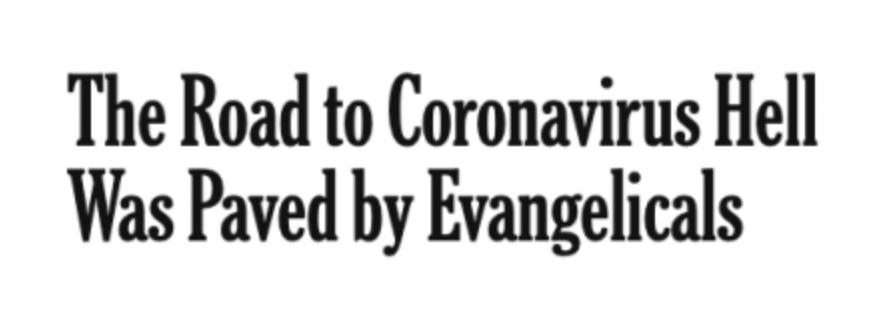
A few weeks ago, I was greeted by the following headline in an op-ed for the New York Times.
The headline was so offensive that even the normally secular-liberal New York Times later toned down the headline to read, “The Religious Right’s Hostility to Science Is Crippling Our Coronavirus Response.” It was still a pretty scathing article, that went over the top at crucial moments. Nevertheless, the article sadly had some cogent and sobering points to make.
When I read stuff like this, I either get really mad at the journalist, or I get upset with the folks being criticized by the writer, depending on the validity of the evidence being presented and on the perception of bias. Sometimes I do both. But I think it is worth taking a deep breath, and think carefully through what is going on here.
First, a lot of folks read articles like the NYT op-ed and they inform their opinion of what Christianity is like. It bears remembering that we should draw people’s attention to Christ, first and foremost. If we draw too much attention to Christians, and not Christ Himself, then the “Christians behaving badly” will tend to lodge in the minds of non-believers. We should focus our attention where our attention is due, in our witness: to Jesus Christ. Therefore, my intent here is not to narrowly criticize particular persons, but rather to take a step back and reflect on how we think about such matters more broadly. “Be wise as serpents and innocent as doves” (Matthew 10:16 ESV). Ignorance in these matters is not bliss.
Secondly, about the author of the op-ed: A lot of Christians will simply dismiss an article like this completely out of hand. Insert the name of whatever “demonic” political party you want, and go from there. We can decry that this is yet another piece of evidence that our nation has “forgotten God,” and that the American Christian church is in serious need of repentance, etc. But here is the thing. I obviously do not know the spiritual status of Ms. Stewart. But more than likely, she is not a Christian. So, it is not simply that she has “forgotten God.” Rather, it is more likely that she has never heard the Gospel winsomely presented to her, in such a manner that she even knows who this “God” of the Bible really is, much less how to “forget” such a God. The bottom line: You simply can not expect a non-Christian to think and act like a Christian… Why? …. Well, at the risk of stating the obvious, because that person is not a Christian. Rather, we need to pray for a person like this, that they may winsomely hear the Gospel! A good verse to memorize that teaches this is Colossians 4:5, “Walk in wisdom toward them that are without.”
Thirdly, most Christians are abiding by the federal social-distancing guidelines. In fact, the overwhelming vast majority of evangelical Christians are taking COVID-19 seriously. We should remind our non-believing friends of that. So, when someone reads something like this NYT op-ed piece, hopefully that person has a relationship with a Christian who can demonstrate for them, in living color, that Ms. Stewart’s description of a typical “evangelical” does not square with the actual evidence.
Fourthly, about the Louisiana pastor, making those international headlines. He has some information-source problems. Like the Louisiana pastor, journalist and editor of The American Conservative, Rod Dreher, and the author of the provocative The Benedict Option, is from Baton Rouge. According to a Rod Dreher essay, which towards the end is quite gut-wrenching, the Louisiana pastor believes that COVID-19 has a “99.3 percent recovery rate.” I do not know where the pastor gets his information from, but this is completely incorrect. According to the WHO, the mortality rate, according to research done in early March, is about 3.4%, not 0.7% as is claimed. Of course, we know a lot more about COVID-19, as of mid-April, than we did back in early March. By collecting more data over time, we will get a better handle on the mortality rate. That rate varies depending on what part of the world you are in, and how much testing has been done. Nevertheless, we should continue to do what we can to minimize that rate. If the eventual rate, over the long term, becomes greatly lower than 3.4%, it would mean that “social distancing,” and other public health measures (more ventilators, better testing, etc.), have proven to reverse the earlier trend. Would that not be awesome?? But the pastor is not alone here in passing on incorrect information. I have Christians friends who contend that COVID-19 is no worse than the flu. The problem is that the mortality rate for the flu is 0.1%. Even allowing for some margin of error, the math used by those who think that COVID-19 is just like the flu, just does not add up. Some even suggest that the current lower-than-expected death rate in the United States is all due to political misinformation. Yet perhaps there is a simpler answer: As of mid-April 2020, most Americans are abiding by the federal social-distancing guidelines, and perhaps those efforts are actually working to reduce the amount of fatalities! I do not like it when non-believers misrepresent the Christian faith, but we do not do anyone any favors when we pass on misinformation, particularly when we call ourselves Christians, for whom the truth should matter more than anything else.
Sixthly, here is a particular objection to how this pastor handles the Bible:The Louisiana pastor’s interpretation of Romans 13 is badly misinformed. He believes that when Romans 13:1 says “Let every person be subject to the governing authorities,” what Paul really meant to say is “Let every person be subject to the governing church authorities…. not political authorities.” I do not know any New Testament scholar who reads the text in the original Greek who would concur with that particular reading…… Furthermore, we must seek to know the whole of Scripture well enough to compare Scripture with Scripture. In this case, it would be important to recall 1 Peter 2:12, “Keep your conduct among the Gentiles honorable, so that when they speak against you as evildoers, they may see your good deeds and glorify God on the day of visitation.”
Seventhly, because this is a Pentecostal church, other Christians should take note. Pentecostal churches, like this one in Louisiana, are highly-integrated, multi-racial churches. This church represents the cultural and ethnic diversity in Baton Rouge in such a way that they put the vast bulk of evangelical churches, across America, to shame. In particular, this church is reaching out to the poor and disenfranchised, with greater effectiveness, than most evangelical churches. These are very difficult days for many people, who are out-of-work, due to the COVID-19 crisis, and this pastor is feeling the effects of this crisis on his people first hand, unlike a lot of wealthy evangelical churches, who can probably ride out this crisis without that much suffering. So, before you completely throw this Pentecostal church under the bus, for how their pastor is handling the COVID-19 crisis, it bears to keep that in mind.
Eighthly, many Christians and non-Christians alike will be tempted to look down upon this controversial Louisiana pastor and conclude that he is “in it for the money.” The desire to draw this conclusion is understandable. After all, he is part of the prosperity gospel movement. But I would caution against this. Arrogant self-promotion is one thing, but greed is a different animal. Many of this pastor’s congregants are on the worst receiving end of the devastating economic consequences millions of Americans are experiencing, due to the COVID-19 crisis. Those most likely to throw stones his way probably are not experiencing the dire consequences experienced by those who could not make their rent payment this past month, because the restaurant or retail store they worked in laid them off indefinitely. I do not agree with the pastor’s decision, but I am willing to give him the benefit of the doubt that he is acting with the greatest amount of sincerity. Some things are worth a lot more than $$$ … but it does not mean that you make well-informed decisions. It is quite evident that this pastor’s recklessness in ignoring public health concerns tells us how his own inflated sense of self-importance is blinding his sense of moral judgment.
Ninthly, I will give the Louisiana pastor some credit when it comes to church attendance. He is obviously concerned that once the COVID-19 crisis is over, that some people might find the habit of not going to church a hard habit to break. It will be interesting to see how many people will stop going to church, once the crisis is eventually over. On the other hand, the current “stay at home” orders provide a good opportunity for others to rethink their relationship with God, or lack thereof. Pray that we see new faces coming to our churches, at the end of this crisis, and that we know how to receive them.
And finally, if you view this YouTube video interview with the controversial pastor, you will get the sense that he is mostly concerned about the freedom of religion. He does a have a point here about the threat of government coercion, and respecting the right of a person to act upon the convictions of their conscience. It is kind of odd to think that a liquor store is considered an “essential business,” when a church meeting is not. Point well taken. But is the real issue here about religious persecution? No, it should be evident that religious persecution is not in view here. Christians are not being singled out for their beliefs. If anything, this pastor’s grandstanding about “religious liberty” only trivializes freedom of conscience, and gives opponents of the Christian faith cause to attack genuine religious liberty. During a public health crisis, Christians should do the right thing, not ultimately because the government tells them to do it, but because it is the right thing to do. We should not allow a persecution complex to become an excuse for not being properly informed, and thus not acting in a way that demonstrates how a Christian might best love their neighbor.
So, why is it that there is this perceived hostility towards science, that encourages people to think that either (a) Christians are “anti-science,” or on the flip side, that (b) the claims of modern science today are simply a part of a deceitful, politically-biased narrative?
I believe that the answer comes down to trust.
Take the example of how a number of ultra-orthodox Jews have been dealing with the COVID-19 crisis in Israel. During the early period where Israeli authorities were trying to warn their citizens about COVID-19, and encouraging them to abide by “social distancing” techniques, many ultra-orthodox Jews eschewed such public health directives. Such conservative Jews do not accept the New Testament as authoritative, yet they do accept the Hebrew Scriptures (the “Old Testament” for Christians) as the Word of God. Their allegiance to the Scriptures far outweighs their respect for government-issued directives.
But in recent days, Israel’s ultra-orthodox community is beginning to take the public health warnings seriously. Israeli authorities are trying not so much to be heavy-handed in their approach, but are focused more in building relationships of trust.
It can be really hard to build relationships of trust, particular among people with whom you have serious disagreements with. I know from personal experience that such efforts at making friends, and breaking down barriers takes a lot of hard work, and a lot of humility. But to see how the Jewish ultra-orthodox community is starting to come around to “do the right thing” is an encouraging sign that such relationship building is really worth the effort.
It may not be so much an issue of there being a supposed conflict between science and the Bible, as the New York Times revised op-ed title put it , the so-called “Religious Right’s Hostility Towards Science.” Rather, it is more likely a sense of distrust of scientists and medical doctors, in conservative religious communities, that drives what appears to be an “anti-science” antagonism. Building a sense of trust between religious conservatives and scientists (including medical doctors) will go a long way in addressing the so-called “warfare thesis” behind science and the Bible.
I missed worshipping in physical proximity with other believers this past Easter Sunday, celebrating the Resurrection of our Lord together. “Virtual” worship was better than nothing, but it is not the same thing. I pray that current public health crisis will end soon, and life can return to normal.
But the blatant distrust of science that some Christians feel compelled to accentuate is harming the witness of the faith. We need to do better in reaching out to our fellow misinformed Christians for the sake of protecting the reputation of the Gospel, as we proclaim the Good News to an unbelieving world.
(For a more in-depth response to the Louisiana pastor defying the “stay at home” order, I have included the video of Rod Dreher making his analysis of the controversy)
What gave us Christianity? The New Testament, or the Resurrection? In 90-seconds, apologist Frank Turek tells us why it is all about the event of the Risen Jesus (a re-post from Easter last year).
Does having a good God … and deadly viruses, like the coronavirus, really mix? That is a question on the minds of many folks these days.
To help me think through this type of question, I am indebted to the good folks at Reasons to Believe. A few years, virologist A. J. Roberts joined the staff at Reasons to Believe, an Old Earth Creationist ministry. She participated in several very good (and short) interviews on this very topic, when she joined Reasons to Believe, and her answers are just as helpful today, as they were a few years ago….
…. in the meantime, pray for the medical workers on the front lines, who are at the highest risk of infection from COVID-19:
If you like the video, you may want to watch the others, in this series below:




 Veracity